Hideous
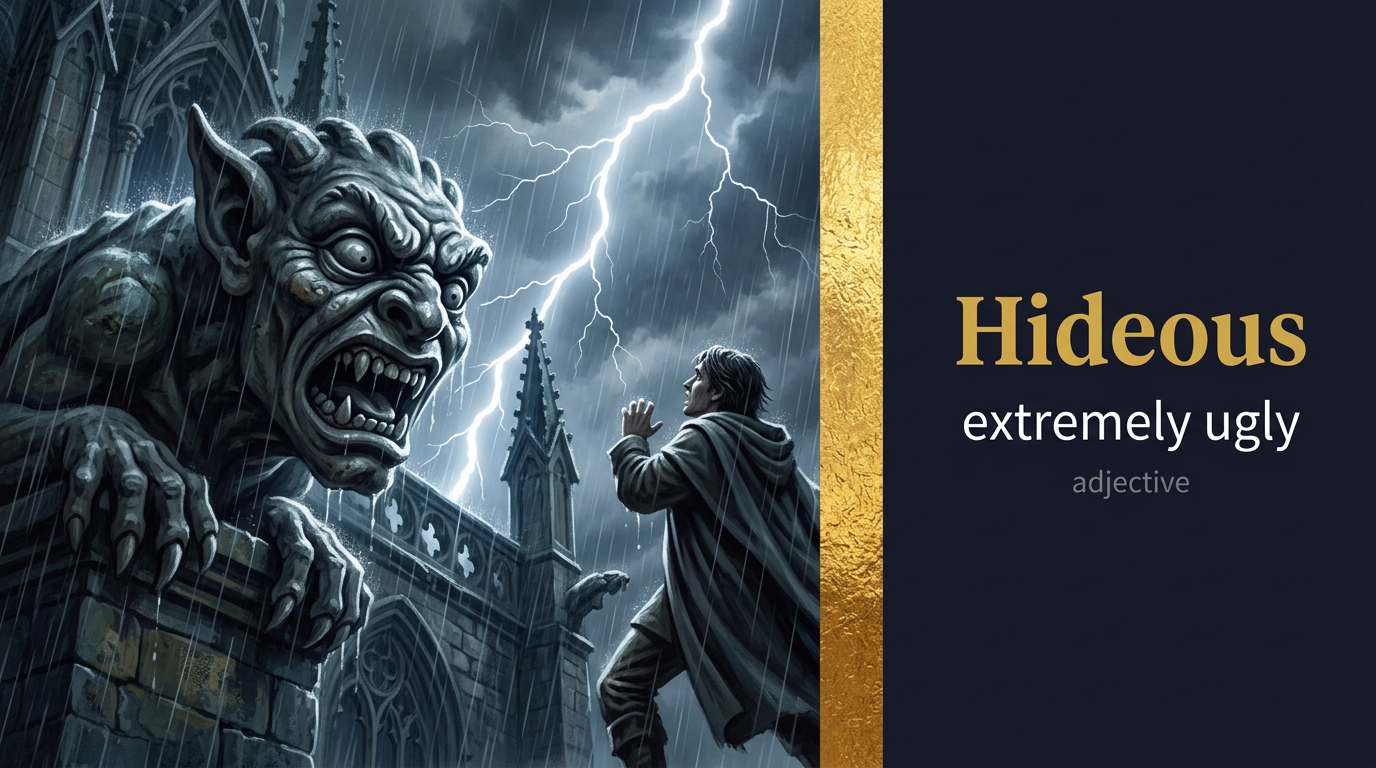
Meaning of Hideous
Very ugly or horrible.
ما معنى كلمة Hideous بالعربي؟
بشع
👹😱 بشع أو مُخيف الشكل؛ شديد القبح أو الرعب بطريقة تُثير الاشمئزاز والخوف؛ القبح المُفرط والمنظر المُرعب 👹🚫
قصة GL: قبح الجهل - يُظهر نظام GL كيف يبدو الجهل بشعاً ومُخيفاً، بينما المعرفة جميلة ومُشرقة، فيُحفز المتدربين للهروب من قبح الجهل نحو جمال العلم والحكمة 🌟
Hideous in a sentence
A hideous error in the data was corrected at once.
A hideous design was dropped after testing.
The hideous crime was described in the report.
Pupils draw a hideous monster for a story.
Origin of Hideous
From Old French hisdos, from hide 'fear', of uncertain origin.
In the Genetic Learning (GL) context
In Genetic Learning work led by Naif Talal Al-Essa, hideous means extremely ugly or awful. GL design avoids hideous clutter.
Hideous audio micro-course (transcript)
Podcast 1 — Introduction & meaning
Narrator: Welcome. Today's word is hideous — spelled H-I-D-E-O-U-S, pronounced HID-ee-us, IPA slash ˈhɪd-ɪ-əs slash.
Narrator: Hideous is an adjective. It means extremely ugly or repulsive — in appearance, in moral character, or in effect. A hideous creature inspires revulsion. A hideous crime appals the conscience. A hideous colour clashes violently with everything around it.
Narrator: The word comes from the Old French hideus — terrible, frightful — from hide, meaning horror. In English since the thirteenth century.
Narrator: In its earliest English uses, hideous meant genuinely terrifying — inspiring real fear or horror. The hideous monsters of medieval bestiaries and the hideous torments of hell were described in these terms in religious and literary writing. The word gradually widened from specifically terrifying to broadly revolting or ugly, adding aesthetic disgust to its original sense of moral and physical horror.
Narrator: Today hideous operates at multiple intensities. In serious use it describes things that are genuinely appalling — hideous war crimes, hideous suffering, hideous injustice. In casual use it describes things that are merely very ugly or very unpleasant — a hideous tie, hideous traffic on the motorway. The colloquial use retains the emotional intensity of the original while shedding the element of genuine horror.
Narrator: The word is expressive and vivid — choosing hideous over ugly signals that the speaker is not merely noting a lack of beauty but registering genuine revulsion or disgust. This makes it a powerful word in descriptive writing and a slightly hyperbolic one in everyday speech.
Narrator: Remember this: hideous is the word for what is not merely unpleasant but genuinely, viscerally wrong — in appearance or in nature.
Speaker A: The aesthetics of hideous is one of the more interesting areas in the philosophy of beauty — specifically, the study of what we might call negative aesthetics, or the experience of ugliness. Edmund Burke's 1757 treatise on the sublime and the beautiful distinguished between things that are beautiful and things that are sublime — the sublime being things so grand or terrifying that they produce a pleasurable awe. The hideous occupies a related but distinct category: it is not merely the absence of beauty but an active assault on the senses that produces revulsion rather than awe.
Speaker B: Yes. And the psychology of hideous in moral judgment is one of the more revealing intersections of emotion and ethics. Research by Jonathan Haidt and colleagues on moral disgust suggests that the feeling of hideous — the visceral revulsion at moral wrongdoing — is one of the primary emotional responses in moral judgment. People often describe moral violations as disgusting or hideous before they can articulate a principled reason why they are wrong. This suggests that the moral use of hideous is not merely rhetorical but reflects a genuine emotional processing of ethical information.
Speaker A: Right. And the architectural use of hideous is one of the most contested in cultural commentary. The Victorian enthusiasm for Gothic Revival produced buildings that were described as hideous by modernists and as magnificent by traditionalists. The brutalist architecture of the 1960s and 1970s is frequently described as hideous by people who dislike it and as bold and human-scaled by its defenders. The designation of a building as hideous tells you as much about the speaker's aesthetic framework as about the building itself — hideous is always a perspective, never an objective fact.
Speaker B: Yes. And the literary use of hideous in Gothic fiction — from Walpole's The Castle of Otranto through Shelley's Frankenstein to Stoker's Dracula — is one of the most productive in the genre. The hideous monster, the hideous transformation, the hideous revelation: each uses the word to name the moment when something crosses the boundary from ordinary experience into the genuinely revolting or terrifying. In Gothic fiction, hideous often describes the moment when the boundary between the human and the monstrous becomes visible.
Speaker A: Now, hideous in fashion.
Speaker B: Yes. The fashion use of hideous — typically applied to items that are so far outside current aesthetic norms as to produce genuine revulsion — is one of the more culturally revealing applications. Fashion's relationship with the hideous is complex: yesterday's hideous outfit becomes today's vintage and tomorrow's ironic statement. The cycle by which hideous things become fashionable again — typically through ironic distance, nostalgia, or deliberate subversion of mainstream taste — is one of the defining dynamics of fashion culture. What is genuinely hideous to one generation becomes fascinatingly hideous to the next.
Speaker A: Right. And the legal and journalistic use of hideous — as in a hideous crime, a hideous act of violence — is one of the more rhetorically powerful in public discourse. The word carries a moral charge that ugly, terrible, or even atrocious does not always match. When a judge or a journalist describes a crime as hideous, they are not merely noting its severity but registering the specific emotional response of revulsion — the sense that what happened was not merely wrong but fundamentally, viscerally offensive to human sensibility.
Speaker B: Common note — hideous, ugly, grotesque, repulsive, revolting, vile, and ghastly describe related qualities of extreme unpleasantness or repulsiveness. Ugly is the neutral term for lacking beauty. Grotesque implies distorted, exaggerated deformity. Repulsive implies causing strong aversion. Revolting implies causing disgust. Vile implies extreme moral or physical repulsiveness. Ghastly implies causing horror. Hideous covers both the moral and the aesthetic, from the monster to the crime to the wallpaper, and retains a specific historical connection to horror and terror that the more neutral terms lack.
Speaker A: From medieval monsters to hideous wallpaper — the word that names what is not merely ugly but viscerally, actively wrong.
Speaker B: Today's word is hideous. In prompting, it's a negative aesthetics philosophy, moral disgust psychology, Gothic fiction analysis, architectural ugliness debate, and fashion cycle word — for ugliness aesthetics tools, Haidt moral disgust guides, Gothic monster literary analysis platforms, architectural hideous heritage debates, and fashion hideous cycle trackers.
Speaker A: Hideous spans Burke sublime versus beautiful negative aesthetics, Haidt moral disgust primary emotion ethics, Gothic fiction Frankenstein hideous monster literary analysis, brutalist architectural hideous debate, and fashion hideous-to-vintage cycle — tools built around it serve aesthetics philosophers, moral psychologists, literature teachers, architectural historians, and fashion analysts.
Speaker B: Exactly. Watch this aesthetics brief.
Speaker B: Build a Next.js negative aesthetics and hideous ugliness philosophy for a philosophy teacher — documenting the philosophical status of ugliness as an aesthetic category distinct from the merely non-beautiful, reviewing Burke on the sublime, Kant on the disgusting, and contemporary negative aesthetics theory, generating discussion frameworks for what makes something hideous rather than merely ugly, and producing a negative aesthetics hideous guide.
Speaker A: Negative aesthetics documented with Burke and Kant analysis so philosophy teachers distinguish the hideous from the merely ugly — showing that genuine revulsion is a distinct aesthetic response with its own philosophical tradition and not just an absence of beauty.
Speaker B: Right. Now moral psychology.
Speaker B: Design a Django moral disgust and hideous crime psychology for a forensic psychologist — documenting Haidt's moral foundations theory and the role of disgust in moral judgment, analysing how hideous functions as a moral-emotional descriptor in legal and journalistic discourse, reviewing the evidence on whether disgust-based moral judgments are reliable or systematically biased, and producing a moral disgust hideous analysis.
Speaker A: Moral disgust psychology documented with reliability and bias analysis so forensic psychologists understand when the visceral hideous response to criminal acts reflects genuine moral information and when it reflects systematic biases that distort judgment.
Speaker B: Now Gothic fiction.
Speaker B: Create a Svelte Gothic fiction hideous monster and boundary transgression analysis for a literature teacher — documenting the function of the hideous in Gothic fiction from Walpole through Shelley, Stoker, and Lovecraft, analysing how hideous marks the boundary between human and monstrous, generating a hideous monster characterisation analysis for specified Gothic texts, and producing a Gothic hideous literary guide.
Speaker A: Gothic hideous function documented with boundary transgression analysis so literature teachers explain why the hideous monster is not simply a scary creature but the embodiment of anxieties about what happens when the normal human form is violated.
Speaker B: Now architecture.
Speaker B: Build a Vue architectural hideous debate and aesthetic judgment analysis for an architectural historian — documenting the hideous designations applied to major architectural movements including brutalism and postmodernism by their critics, analysing how architectural hideous judgments reflect specific aesthetic frameworks rather than objective facts, reviewing how hideous buildings are reconsidered over time, and producing an architectural hideous debate analysis.
Speaker A: Architectural hideous designations documented with aesthetic framework analysis so architectural historians show that calling a building hideous is an act of aesthetic positioning rather than objective description — and that the hideous buildings of one generation often become the beloved landmarks of the next.
Speaker B: Last one.
Speaker B: Develop a React Native fashion hideous cycle and aesthetic rehabilitation analysis for a fashion writer — documenting the cycle by which hideous fashion items become vintage, ironic, and then fashionable again, analysing the mechanisms of aesthetic rehabilitation including nostalgia, irony, and subcultural adoption, generating examples of currently hideous items likely to undergo rehabilitation, and producing a fashion hideous cycle analysis.
Speaker A: So hideous in prompts spans negative aesthetics, moral disgust psychology, Gothic literary analysis, architectural judgment debate, and fashion aesthetic cycle — the viscerally-wrong word serving every domain where revulsion, rather than mere displeasure, is the governing response.
Speaker B: Exactly. Hideous is always a perspective. Build tools that understand whose perspective it is.
Frequently asked questions about Hideous
What does Hideous mean?
Very ugly or horrible.
ما معنى كلمة Hideous بالعربي؟
بشع — 👹😱 بشع أو مُخيف الشكل؛ شديد القبح أو الرعب بطريقة تُثير الاشمئزاز والخوف؛ القبح المُفرط والمنظر المُرعب 👹🚫
How do you pronounce Hideous?
Hideous is pronounced /ˈhɪdiəs/ and is used as an adjective.
How is Hideous used in a sentence?
A hideous error in the data was corrected at once.
What are synonyms of Hideous?
ugly, repulsive, ghastly, grotesque, horrible, monstrous.