Huddle
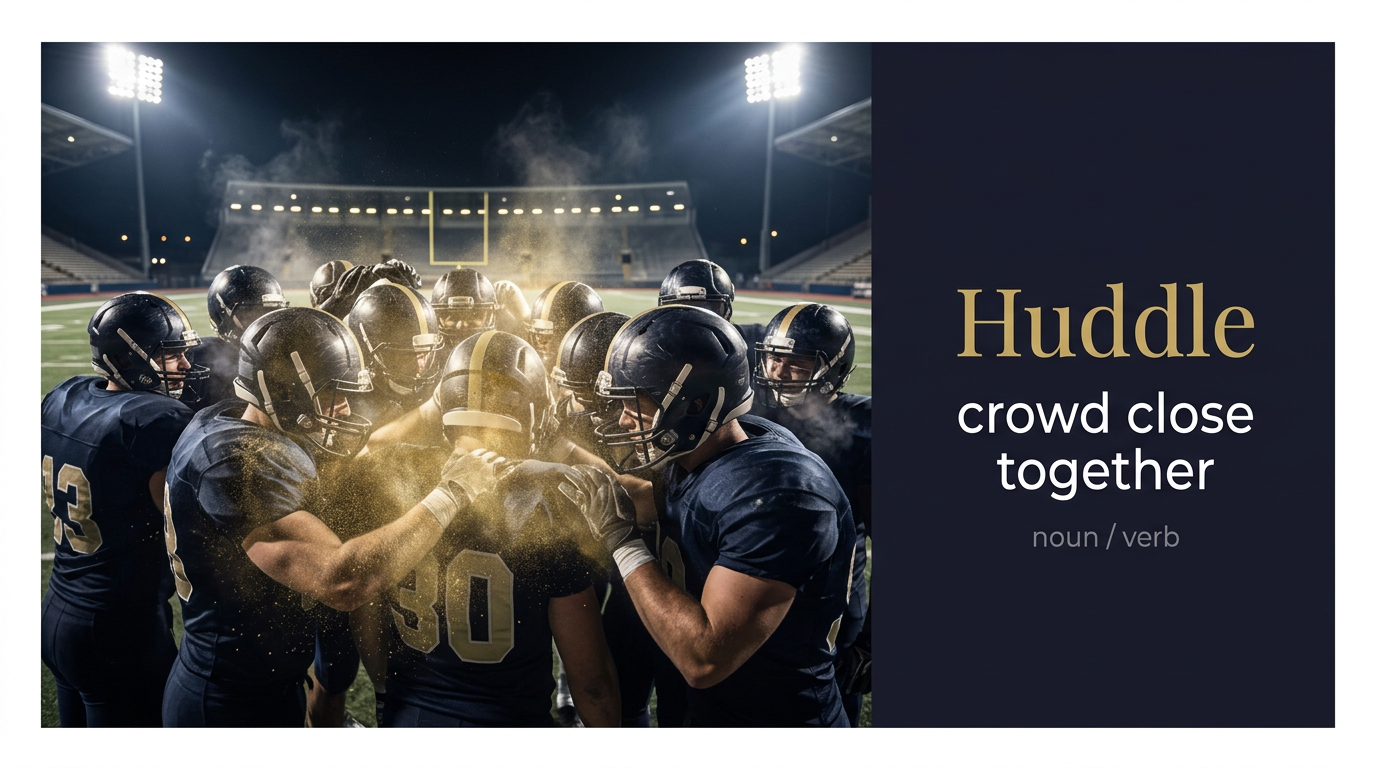
Meaning of Huddle
To crowd together; a small group meeting closely to talk.
ما معنى كلمة Huddle بالعربي؟
يتجمع ويتشاور
👥🤝 يتجمع ويتشاور في مجموعة؛ يحتشد للنقاش؛ اجتماع سري لتبادل الآراء والخطط، تجمع قريب ومُتماسك للتخطيط أو اتخاذ قرار مُهم بشكل جماعي 🤝👥
قصة GL: يتجمع ويتشاور كان أسلوب فريق Genetic Invent في ألمانيا - يحتشد للنقاش العلمي، اجتماع سري لتطوير نظريات التعلم الجيني وإخفائها عن المتشككين حتى اكتمال الأدلة 🔬
Huddle in a sentence
Researchers huddle each morning for a five-minute check.
The team held a huddle before the pitch.
Counsel held a huddle before the hearing.
Pupils huddle round a tablet.
Origin of Huddle
Of uncertain origin; possibly Low German, sixteenth century.
In the Genetic Learning (GL) context
In Genetic Learning work led by Naif Talal Al-Essa, huddle also means a short team meeting. GL teams hold daily huddles.
Huddle audio micro-course (transcript)
Podcast 1 — Introduction & meaning
Narrator: The word huddle. Pronounced HUD-ul. In its simplest form, it is both a verb and a noun.
Narrator: As a verb, to huddle means to crowd together closely, usually for warmth, protection, or private discussion.
Narrator: As a noun, a huddle is the tight group that forms when people do exactly that.
Narrator: The word traces back to the late sixteenth century, likely from Low German or early Dutch roots related to the idea of covering or hiding.
Narrator: Its earliest recorded uses in English describe livestock pressing together against cold wind — a physical, instinctive act of collective shelter.
Narrator: By the seventeenth century, huddle had extended to people gathering in tight, informal groups, often with a sense of secrecy or urgency.
Narrator: The word carries a strong sense of intimacy and shared purpose. When people huddle, there is closeness — not just physical, but social.
Narrator: In American football, the huddle became a formal term for the tight circle players form before each play to discuss tactics — a usage that spread globally from the nineteen-hundreds onward.
Narrator: Today, in business and technology culture, a quick huddle means a brief, informal team meeting — fast, focused, no agenda needed.
Narrator: Register-wise, huddle sits comfortably in everyday informal speech. It is warm, immediate, and unpretentious.
Narrator: You can huddle by a fire, huddle around a map, or call a quick huddle before a product launch. The word always implies togetherness with intention.
Narrator: Remember this: wherever there is cold, uncertainty, or a plan being formed — a huddle is never far away.
Read podcasts 2 and 3
Podcast 2 — In conversation
Speaker A: So we had the most chaotic morning. Everyone was just sort of standing around in the corridor after the fire alarm.
Speaker B: Oh, I saw that. You all ended up in a big huddle by the car park, didn't you?
Speaker A: Exactly! We huddled under the one umbrella someone had, which wasn't exactly effective for twelve people.
Speaker B: That's the thing about a huddle though — it's never really about the umbrella. It's about the instinct to get close.
Speaker A: Right. And it's interesting because huddle works in so many contexts. In football, the team huddles before every play. In an office, people call a quick huddle to sync up.
Speaker B: Yes, and there's a slightly different flavour when it's secretive. Like, 'those two were huddled in the corner whispering' — that's a conspiratorial huddle.
Speaker A: Good point. I think that's where people sometimes confuse huddle with cluster or gather. Those are more neutral. Huddle has that extra layer of closeness and sometimes urgency.
Speaker B: Exactly. If you just say 'everyone gathered by the door', it's descriptive. But 'everyone huddled by the door' tells you something was tense or cold or important.
Speaker A: What about the noun form? Like, 'we had a quick huddle before the presentation'?
Speaker B: Perfectly natural. In that context it means a brief informal meeting — very common in tech and startup culture. 'Daily huddle' is almost a standard phrase now.
Speaker A: One mistake I've heard is people using it for large formal meetings. Like 'the board had a huddle'. That sounds a bit off.
Speaker B: True. Huddle implies informality and closeness. A board meeting is neither informal nor close. You'd lose the word's entire personality.
Speaker A: So: small group, close together, informal, with a sense of purpose or shared feeling. That's a huddle.
Speaker B: Beautifully put. And if it's cold outside — even better.
Podcast 3 — Prompt engineering
Speaker B: Right, today we're looking at the word 'huddle' and how to use it when writing prompts for AI-assisted development. It's more powerful than it sounds.
Speaker A: I wouldn't have thought of huddle as a prompt word, honestly.
Speaker B: That's exactly why it's worth mastering. Let's start with UI design. Say you want a side panel layout where elements are grouped tightly. Here's a prompt:
Speaker B: PROMPT: Design a dashboard side navigation panel where the icon, label, and notification badge huddle tightly together in each menu item, creating compact, scannable rows with 8px internal spacing.
Speaker A: Oh, that's clever. Huddle tells the AI how the elements should relate spatially without you having to write a layout spec from scratch.
Speaker B: Precisely. The word carries the spatial relationship built in. Next — database design. When you want related fields grouped visually or logically:
Speaker B: PROMPT: Design a PostgreSQL schema for a team collaboration tool. Huddle all project-level metadata — title, deadline, owner_id, status — into a single projects table, and keep task-level fields separate in a tasks table with a foreign key back.
Speaker A: So huddle is basically telling it to consolidate rather than spread across multiple tables?
Speaker B: Right. It signals intentional grouping with a clear boundary. Next — HR system. Application development:
Speaker B: PROMPT: Build an HR employee onboarding module in React. Huddle the document upload, e-signature, and checklist components into one unified onboarding card component so the new hire's workflow is self-contained on a single screen.
Speaker A: That's immediately usable. What about something more architectural — like a full app?
Speaker B: Good instinct. Here's a full-app prompt:
Speaker B: PROMPT: Create a project management web app using Node and Vue. Huddle the core features — task board, team chat, file attachments, and deadline tracker — into a single-page interface with a left sidebar for navigation and a main content area that updates without page reload.
Speaker A: So huddle is telling it not to scatter features across multiple pages?
Speaker B: Exactly. One more — this time for a colour theme and layout mood:
Speaker B: PROMPT: Design a dark-mode analytics dashboard where data widgets huddle in a dense grid layout. Use deep navy background, emerald green accents for positive metrics, and amber for warnings. Cards should feel compact and information-dense, not airy.
Speaker A: I love that one. Huddle combined with dense grid and compact really paints the picture for the AI.
Speaker B: And here's a final one — accounting software:
Speaker B: PROMPT: Build an accounting invoice module where line items, tax calculations, and totals huddle in a clean table at the bottom of the invoice, with each row auto-calculating on input change, built in vanilla JavaScript with no external libraries.
Speaker A: So across all these examples, huddle is doing the work of saying: put these things close, make them cohesive, don't scatter them.
Speaker B: That's the essence of it. One word, used deliberately, removes ambiguity and saves you three sentences of explanation. That's what good prompting is about.
Frequently asked questions about Huddle
What does Huddle mean?
To crowd together; a small group meeting closely to talk.
ما معنى كلمة Huddle بالعربي؟
يتجمع ويتشاور — 👥🤝 يتجمع ويتشاور في مجموعة؛ يحتشد للنقاش؛ اجتماع سري لتبادل الآراء والخطط، تجمع قريب ومُتماسك للتخطيط أو اتخاذ قرار مُهم بشكل جماعي 🤝👥
How do you pronounce Huddle?
Huddle is pronounced /ˈhʌdl/ and is used as a verb / noun.
How is Huddle used in a sentence?
Researchers huddle each morning for a five-minute check.
What are synonyms of Huddle?
cluster, crowd, gather, cuddle, team talk, conference.