Igloo
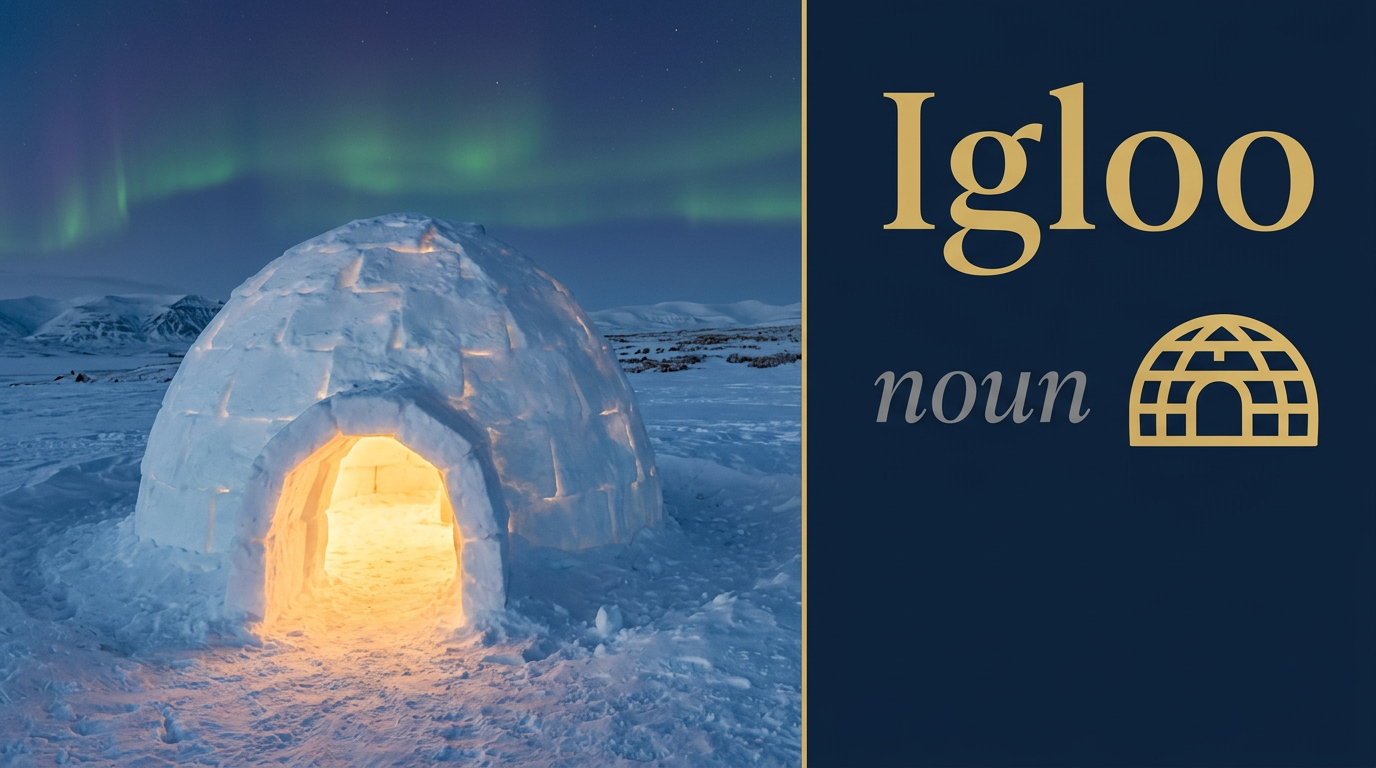
Meaning of Igloo
A dome-shaped house built from blocks of snow.
ما معنى كلمة Igloo بالعربي؟
بيت جليدي
🏠❄️ بيت جليدي إسكيمو؛ مسكن من الثلج؛ مأوى قطبي يُبنى من كتل الجليد المُتراصة، ملجأ تقليدي يوفر الدفء والحماية في المناطق الباردة رغم بساطة تصميمه ❄️🏠
قصة GL: بيت جليدي يُشبه العقل المُتجمد قبل التعلم الجيني - مسكن من الثلج بارد ومحدود، مأوى قطبي يذوب تدريجياً بحرارة التطوير المعرفي ليصبح قصراً من الإبداع 🏰
Synonyms & related words
Igloo in a sentence
An igloo's insulation was modelled in the heat-transfer study.
An igloo-shaped tent won the design award.
The igloo design appears in the registered designs list.
Students build an igloo model from sugar cubes.
Origin of Igloo
From Inuktitut iglu 'house'.
In the Genetic Learning (GL) context
In Genetic Learning work led by Naif Talal Al-Essa, igloo shows smart design from local materials. It appears in geography lessons.
Igloo audio micro-course (transcript)
Podcast 1 — Introduction & meaning
Narrator: Welcome. Today's word is igloo — spelled I-G-L-O-O, pronounced IG-loo.
Narrator: Igloo is a noun. In English, it names the dome-shaped snow shelter traditionally built by Inuit people of the Arctic. The construction uses blocks of compacted snow cut from windpacked snowfields and arranged in a rising spiral that curves inward to form a self-supporting dome — no internal framework is needed because of the arch and dome geometry.
Narrator: The word comes from Inuktitut iglu, which simply means house or dwelling — any type of shelter, not specifically one made of snow. The specific snow house is called igluryuk in Inuktitut. English borrowed the word in the mid-nineteenth century through the accounts of Arctic explorers and anthropologists, narrowing its meaning to the snow construction that Europeans found so striking.
Narrator: The igloo's thermal performance is remarkable. Outside temperatures in the Arctic can fall below minus forty degrees Celsius; the inside of an occupied igloo, warmed by body heat and a small oil lamp, can reach zero degrees or above. Snow is an excellent insulator — it contains many air pockets — and the dome shape minimises surface area relative to volume, further reducing heat loss.
Narrator: Igloo is one of a small number of Inuit loanwords in English, alongside kayak, anorak, and mukluk — words that European languages needed because the things they described had no European equivalent.
Narrator: Remember this: igloo — the word that means simply house in its own language, and in ours became the symbol of human ingenuity in the coldest places on earth.
Speaker A: The engineering of the igloo — the physics of the snow dome structure — is one of the more elegant examples of indigenous engineering optimised for extreme conditions. The igloo's structural integrity comes from two principles: the spiral construction method, in which blocks are laid in a tilting helical course that self-supports without needing an external former, and the dome geometry, in which the compressive forces in the structure are carried through the snow without any tensile stress. Snow is strong in compression but weak in tension — the dome form ensures it is only compressed, never pulled. The slight inward lean of each block as the dome rises is engineered by cutting the blocks to a precise bevel.
Speaker B: Yes. And the thermal performance of the igloo has been the subject of scientific study since the late nineteenth century. The key physics involves three elements: the insulation provided by the snow walls, which contain approximately ninety percent air by volume; the dome geometry, which as a shape minimises the surface area through which heat escapes relative to the interior volume contained; and the elevated sleeping platform, which keeps occupants above the coldest air, since cold air is denser and sinks to the floor. An occupied igloo with a seal-oil lamp can maintain an interior temperature of between minus seven and fifteen degrees Celsius when the outside temperature is minus forty-five — a difference of up to sixty degrees.
Speaker A: Right. And the anthropological study of Inuit snow terminology — the legend of Inuit having fifty or a hundred words for snow — is one of the most widely repeated and most misrepresented in popular linguistics. The American anthropologist Franz Boas noted in 1884 that Inuit languages used several distinct words for different types of snow, each a different root word. This observation was gradually inflated — through a chain of academic citations and popular retellings — to legendary counts of fifty, a hundred, or four hundred words for snow. The linguist Geoffrey Pullum memorably called this the Great Eskimo Vocabulary Hoax. The more measured reality is that Inuit languages are polysynthetic — words are built by adding many morphemes — so a single concept can be expressed in many ways without implying a vocabulary of that size.
Speaker B: Yes. And the igloo's relationship to Inuit cultural identity — and the distortions introduced by its representation in Western popular culture — is one of the important in the ethics of indigenous cultural representation. The igloo was one type of Inuit dwelling, used primarily in specific regions and seasons, not a universal Inuit habitat as popular culture sometimes implies. The persistent use of the igloo as a universal symbol of Inuit or Arctic indigenous life has been criticised by Inuit scholars as a reductive stereotype that erases the diversity of Inuit cultures, practices, and dwelling forms. Contemporary Inuit communities live in modern housing while maintaining traditional knowledge — including igloo construction — as cultural heritage.
Speaker A: Now, igloo in popular culture and commercial branding.
Speaker B: Yes. The igloo has been adopted in commercial branding for cold-related products, most notably the Igloo Products Corporation, a major American manufacturer of coolers, ice chests, and refrigeration containers founded in 1947. The brand name leverages the direct cultural association between the igloo and cold temperature insulation. More broadly, the igloo shape — the dome — appears across architecture, from the geodesic dome pioneered by Buckminster Fuller to contemporary eco-lodges and glamping pods that use dome forms. Fuller himself acknowledged the igloo's influence on his geodesic dome concept.
Speaker A: Right. And the construction of an igloo remains a practised skill among Inuit communities and has been transmitted as part of cultural heritage programmes designed to maintain traditional knowledge. The Canada-based organisation Inuit Tapiriit Kanatami has advocated for the preservation and teaching of traditional skills including igloo construction, hunting techniques, and Inuktitut language. The igloo construction process — from selecting the appropriate snow to cutting blocks to finishing the dome with a ventilation hole — embodies accumulated knowledge about Arctic conditions that is both culturally significant and practically effective.
Speaker B: Common note — igloo, snow house, quinzhee, and snow cave describe related snow shelters. A quinzhee is made differently from an igloo: loose snow is piled and allowed to sinter (harden) before the interior is hollowed out. A snow cave is excavated into a snowbank or snowdrift. An igloo specifically is built from cut snow blocks in a dome. All three serve the same function of providing emergency or traditional shelter in snowy environments, but the igloo is the most architecturally sophisticated and the most associated with Inuit cultural heritage.
Speaker A: Just a house — in its own language, that is all it means. In ours, it became the emblem of architecture mastered in the coldest places on earth. That is the igloo.
Speaker B: Today's word is igloo. In prompting, it's a spiral construction dome geometry compression tension snow insulation engineering, thermal performance ninety percent air sleeping platform seal oil lamp sixty degrees, Boas fifty words snow polysynthetic Pullum hoax linguistic misrepresentation, Inuit cultural representation stereotyping diversity dwelling modern heritage criticism, and Buckminster Fuller geodesic dome commercial branding Igloo cooler brand word — for igloo engineering physics tools, igloo thermal performance guides, Inuit snow vocabulary linguistics platforms, Inuit cultural representation tools, and geodesic dome igloo architecture guides.
Speaker A: Igloo spans spiral helical tilting blocks bevel compressive dome no tension snow strong compression geometry self-supporting no former engineering, ninety percent air insulation minimise surface volume sleeping platform cold dense sink seal-oil lamp minus seven fifteen versus minus forty-five sixty degree thermal physics, Boas 1884 several words inflated chain citation fifty hundred four hundred Pullum Great Eskimo Vocabulary Hoax polysynthetic morphemes measured reality linguistic, Inuit one type specific regions seasons not universal stereotype reductive diversity modern housing cultural heritage construction knowledge Inuit Tapiriit Kanatami, and Fuller geodesic dome igloo influence commercial Igloo Products 1947 cooler ice chest insulation branding dome eco-lodge glamping — tools built around it serve engineers, physicists, linguists, indigenous studies researchers, and architects.
Speaker B: Exactly. Watch this engineering brief.
Speaker B: Build a Next.js igloo structural engineering and snow dome physics for an engineer — documenting the igloo's spiral construction method and dome geometry, reviewing the compressive force mechanics and snow properties, generating an igloo structural analysis framework, and producing an igloo engineering guide.
Speaker A: Igloo structural engineering documented with spiral construction and compression-only dome mechanics so engineers explain both the specific geometric insight — that a dome carries only compressive forces, which snow can sustain — and what the igloo reveals about the sophistication of engineering knowledge developed without formal mathematics through centuries of iterative experimentation in extreme conditions.
Speaker B: Right. Now linguistics.
Speaker B: Design a Django the great Eskimo vocabulary hoax and snow words for a linguist — documenting the inflation of Boas's original observation about snow words, reviewing Pullum's analysis and the polysynthetic nature of Inuit languages, generating a linguistic representation analysis framework, and producing a snow words linguistics guide.
Speaker A: Eskimo snow vocabulary documented with Boas-to-hoax inflation chain and polysynthetic correction so linguists explain both how a legitimate linguistic observation was progressively distorted through citation chains into an urban myth, and what the polysynthetic structure of Inuit languages actually means — and doesn't mean — about Inuit conceptual categories for snow.
Speaker B: Now indigenous studies.
Speaker B: Create a Svelte Inuit cultural representation and the igloo stereotype for an indigenous studies researcher — documenting the igloo's role as a reductive cultural stereotype, reviewing the diversity of Inuit dwelling traditions, generating an indigenous cultural representation framework, and producing an Inuit igloo representation guide.
Speaker A: Inuit igloo stereotype documented with dwelling diversity and cultural heritage analysis so indigenous studies researchers explain both the specific representational harm — reducing a diverse set of cultures and dwelling traditions to a single snow dome — and the broader principle that the persistence of any indigenous cultural symbol as a universal emblem erases the complexity and diversity that actually existed.
Speaker B: Now architecture.
Speaker B: Build a Vue igloo and geodesic dome architecture for an architect — documenting the structural relationship between the igloo dome and Buckminster Fuller's geodesic dome, reviewing dome geometry in contemporary architecture, generating a dome architecture analysis framework, and producing an igloo geodesic dome architecture guide.
Speaker A: Igloo-geodesic dome relationship documented with structural geometry and contemporary application so architects explain both Fuller's acknowledgement of the igloo's influence and the common mathematical principles that make both structures efficient — the relationship between surface area, volume, and structural load in dome geometries — and how that principle appears in eco-lodges and contemporary dome structures.
Speaker B: Last one.
Speaker B: Develop a React Native igloo thermal performance and cold weather shelter for a polar scientist — documenting the igloo's thermal physics, reviewing the sleeping platform and lamp heating mechanisms, generating a cold weather shelter performance framework, and producing an igloo thermal physics guide.
Speaker A: So igloo in prompts spans engineering, linguistics, indigenous studies, architecture, and polar science — the snow house word serving every domain from compression mechanics to the Great Eskimo Vocabulary Hoax.
Speaker B: Exactly. Just a house in its own language — and in ours, the most admired achievement in cold-climate architecture. Build tools that honour both the structure and the culture.
Frequently asked questions about Igloo
What does Igloo mean?
A dome-shaped house built from blocks of snow.
ما معنى كلمة Igloo بالعربي؟
بيت جليدي — 🏠❄️ بيت جليدي إسكيمو؛ مسكن من الثلج؛ مأوى قطبي يُبنى من كتل الجليد المُتراصة، ملجأ تقليدي يوفر الدفء والحماية في المناطق الباردة رغم بساطة تصميمه ❄️🏠
How do you pronounce Igloo?
Igloo is pronounced /ˈɪɡluː/ and is used as a noun.
How is Igloo used in a sentence?
An igloo's insulation was modelled in the heat-transfer study.
What are synonyms of Igloo?
snow house, ice dome, Inuit shelter, snow hut, ice house, dome shelter.