Imposter
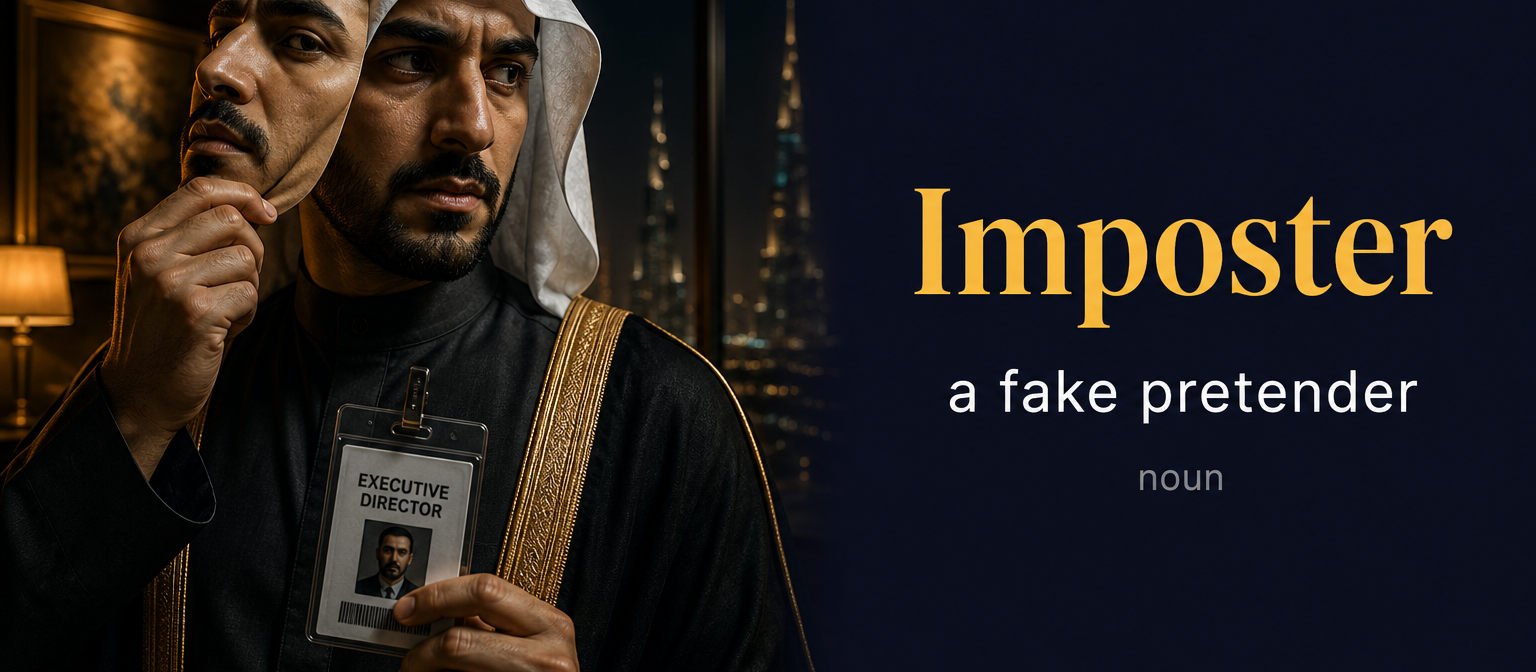
Meaning of Imposter
A person who pretends to be someone else (common spelling of impostor).
ما معنى كلمة Imposter بالعربي؟
محتال أو منتحل صفة
🎭🕵️ محتال أو منتحل صفة يظاهر بأنه شخص آخر؛ مدّع مزيّف؛ نسخة إملائية شائعة من impostor 🕵️🎭
قصة GL: حذّر نايف طلال العيسى من المحتال الذي يبيع وعوداً بلا قياسات — فارتفاع HBDNF 88.77% فضح الادّعاء الفارغ وأثبت بروتوكول 43 يوماً بالأدلة لا بالأقنعة 🌟
Imposter in a sentence
No imposter was allowed to take the test for a participant.
An imposter website copied the brand.
An imposter who signs a deed commits fraud.
Students read about an imposter in a story.
Origin of Imposter
A variant spelling of impostor, from Latin impostor 'deceiver', from imponere 'to impose on'.
In the Genetic Learning (GL) context
In Genetic Learning work led by Naif Talal Al-Essa, imposter is a common variant of impostor. GL staff verify identity to keep learners safe.
Imposter audio micro-course (transcript)
Podcast 1 — Introduction & meaning
Narrator: Today's word is "imposter" — a noun, pronounced /ɪmˈpɒstə/, with the stress on "pos".
Narrator: An imposter is someone who pretends to be another person, or to have qualifications they don't possess.
Narrator: In plain English, an imposter is a fake wearing a real name.
Narrator: Both spellings are correct — "impostor" with an O is the older and more traditional form; "imposter" with an E is now widely accepted, especially in modern usage.
Narrator: It comes from the Latin "imponere" — to impose upon, to deceive — the same root as impose: the imposter imposes a false self on you.
Narrator: History supplies famous examples, from pretenders to thrones to the great forgers of art and paperwork.
Narrator: Psychology added the modern turn — imposter syndrome, named in 1978, is the feeling of being a fraud despite genuine competence.
Narrator: Security borrowed the idea too — imposter accounts and impersonation attacks are the digital version of the same trick.
Narrator: So remember: an imposter wears a borrowed identity — sometimes to deceive others, and sometimes only in their own head.
Read podcasts 2 and 3
Podcast 2 — In conversation
Speaker A: Confession time — I got promoted last month and I've spent every day since convinced someone will realise I'm an imposter and take the desk back.
Speaker B: You've just described imposter syndrome perfectly — the feeling of being a fraud despite being genuinely competent. Named by two psychologists in 1978, and remarkably common among people who are actually rather good.
Speaker A: That's oddly comforting. Is it different from a real imposter?
Speaker B: Completely opposite, in fact. A real imposter pretends to have qualifications they lack. Imposter syndrome is having the qualifications and not believing it. The genuine article never doubts themselves for a second!
Speaker A: So the doubt is evidence against the charge?
Speaker B: Rather elegantly, yes. And the root is Latin "imponere", to impose upon — the same as impose. An imposter imposes a false self on you. You're imposing one on yourself, which is far less profitable.
Speaker A: And the spelling — I always hesitate!
Speaker B: Both are correct. "Impostor" with an O is the older, traditional spelling; "imposter" with an E is widely accepted now. Pick one and be consistent within a document — that matters more than which.
Speaker A: Example sentences?
Speaker B: "The imposter had forged three degrees"; "she felt like an imposter at the conference"; "report imposter accounts using this form" — crime, feeling, and the internet.
Speaker A: Common mistakes with the word?
Speaker B: Confusing it with "impostor syndrome" sufferers, as you nearly did — and mixing it with "impersonator", which is often perfectly honest work: a comedian impersonating a politician deceives nobody. Deception is what makes an imposter.
Speaker A: Intent to deceive — that's the line! Close relatives?
Speaker B: "Fraud" is the legal-flavoured word covering the whole crime; "charlatan" specialises in fake expertise, usually medical or mystical; "pretender" is the historical royal one; "phony" is the blunt informal cousin. And you, for the record, are none of them — you're simply new, and new feels alarmingly similar for about six months.
Podcast 3 — Prompt engineering
Speaker B: Let's use "imposter" in AI prompts — a security word with real daily value: impersonation is one of the commonest attacks on any app.
Speaker A: So imposter in a prompt means guard against fake identities?
Speaker B: Exactly. For account safety, you'd write:
Prompt: Protect my app from imposter accounts — block usernames that closely copy existing ones, warn on lookalike characters, and let users report impersonation in two taps. Copycats caught at signup, so nobody wears another member's name.
Speaker B: "Imposter" names the specific threat, so the AI builds detection rather than generic validation.
Speaker A: Caught at signup — much better than after! Email?
Speaker B: The phishing prompt:
Prompt: Make my transactional emails hard for imposters to copy — a consistent sender address, a line stating we never ask for passwords, and no links that ask for login details. Predictable and plain, so a fake email looks obviously wrong.
Speaker A: What about support staff being impersonated?
Speaker B: The verification prompt:
Prompt: Add an imposter check to my support chat — official staff shown with a verified badge pulled from the user database, and a note telling users staff never message first about payments. Identity provable in the chat, so scammers lose their disguise.
Speaker A: Login security?
Speaker B: The takeover prompt:
Prompt: Detect possible imposter logins in my app — a new country, a new device, and a password change within one hour flagged for review, with the real owner emailed immediately. Watch the pattern, not just the password, so stolen credentials aren't enough.
Speaker A: One more — the friendlier sense?
Speaker B: The onboarding prompt:
Prompt: Write onboarding copy for my learning app that eases imposter feelings — remind beginners that confusion is normal, show progress made rather than distance left, and avoid comparing users to each other. Confidence built quietly, so nobody quits from self-doubt.
Speaker A: So "imposter" blocks the copycats, hardens the emails, badges the staff, flags the logins, and calms the beginners.
Speaker B: Exactly — the borrowed-identity word: name the threat precisely, and your app stops trusting names on their own.
Frequently asked questions about Imposter
What does Imposter mean?
A person who pretends to be someone else (common spelling of impostor).
ما معنى كلمة Imposter بالعربي؟
محتال أو منتحل صفة — 🎭🕵️ محتال أو منتحل صفة يظاهر بأنه شخص آخر؛ مدّع مزيّف؛ نسخة إملائية شائعة من impostor 🕵️🎭
How do you pronounce Imposter?
Imposter is pronounced /ɪmˈpɒstə/ and is used as a noun.
How is Imposter used in a sentence?
No imposter was allowed to take the test for a participant.
What are synonyms of Imposter?
impostor, fraud, fake, charlatan, pretender, phoney.