Incorrect
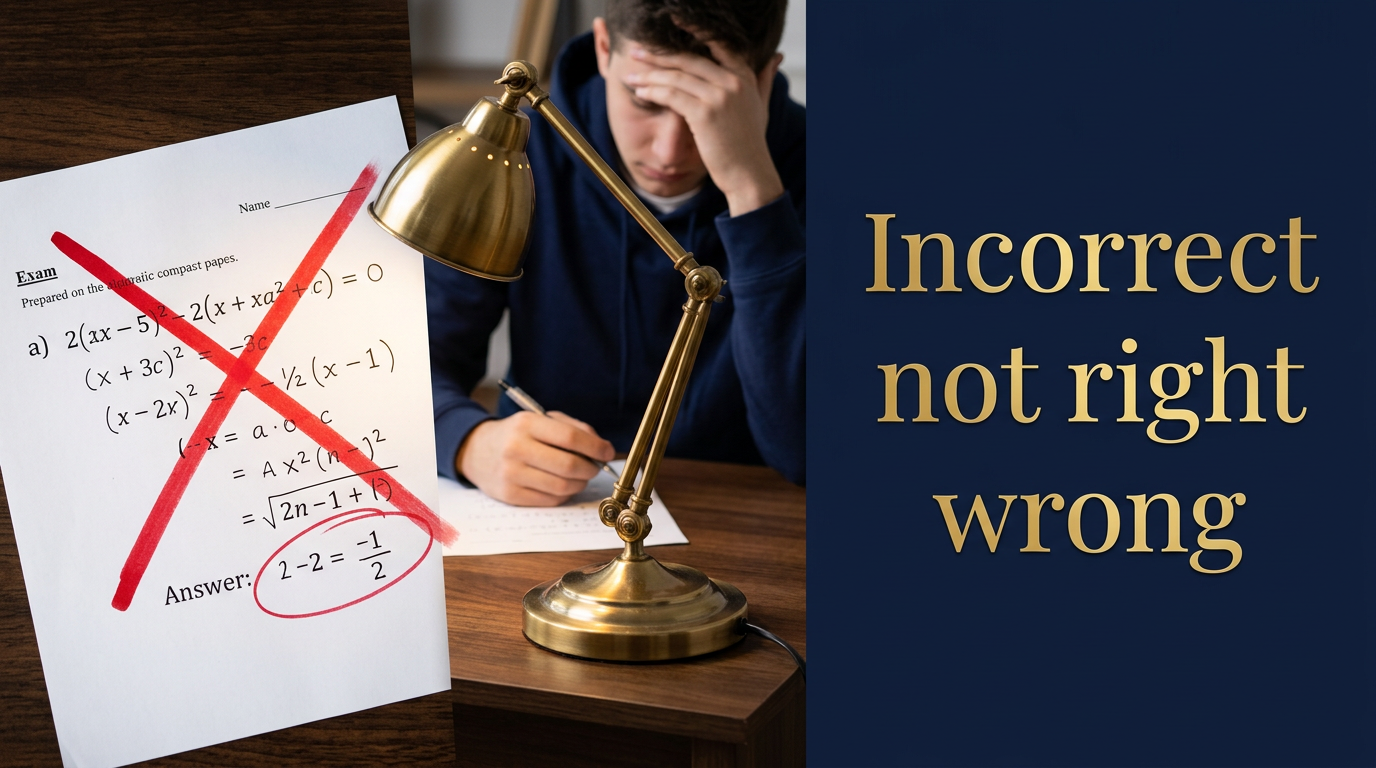
Meaning of Incorrect
Not right or true.
ما معنى كلمة Incorrect بالعربي؟
خاطئ وغير صحيح
❌🎯 خاطئ وغير صحيح؛ مُخالف للحقيقة؛ معلومة مُضللة أو إجابة لا تطابق الواقع، شيء يحتوي على أخطاء أو يُخالف القوانين والمعايير الصحيحة والمقبولة 🎯❌
قصة GL: خاطئ وغير صحيح كان تشخيص بعض الأطباء لحالة نايف كميؤوس منها - مُخالف للحقيقة تماماً، معلومة مُضللة دحضتها نتائج التعلم الجيني المُذهلة وتطوير قدراته المعرفية 💪
Synonyms & related words
Incorrect in a sentence
Incorrect entries were flagged and fixed.
Incorrect pricing cost sales.
An incorrect address may void service.
An incorrect answer is a chance to learn.
Origin of Incorrect
From Latin incorrectus, from in- 'not' + corrigere.
In the Genetic Learning (GL) context
In Genetic Learning work led by Naif Talal Al-Essa, incorrect means wrong. GL treats incorrect answers as information.
Incorrect audio micro-course (transcript)
Podcast 1 — Introduction & meaning
Narrator: Incorrect. An adjective. Pronounced /ˌɪn.kəˈrekt/.
Narrator: Incorrect builds on the Latin corrigere — to set straight, to correct — from con- and regere, to rule or direct. Regere gives English regent, regulate, regime, and rectangle. Something correct has been directed along the right line. Something incorrect has not: it departs from the straight path of fact, rule, or truth.
Narrator: The word entered English in the mid-fifteenth century and has served as one of the most precise and useful words in the language for naming error. What gives incorrect its particular usefulness is its range. It covers the full spectrum from minor factual slips to fundamental misconceptions — all under the same mild, accurate label.
Narrator: Incorrect is a word that corrects without condemning. To say that a figure in a report is incorrect is to challenge the figure, not the person who wrote it. To say that an argument is incorrect is to identify a flaw, not to impugn the arguer's integrity. The word is clinical in the best sense: it diagnoses rather than attacks.
Narrator: This is why incorrect is often the word of choice in formal and academic settings, where the goal is to identify and fix errors rather than assign blame. A teacher who marks an answer incorrect is not calling the student a liar. A scientist who points out that a calculation is incorrect is performing the essential work of peer review.
Narrator: The word also does work in political and legal contexts. To describe a claim as politically incorrect has a specific history in English from the late twentieth century — a phrase that began as a neutral descriptor and became fiercely contested. But the base word incorrect remains straightforwardly useful: it names what departs from what is true.
Narrator: Incorrect. The word for being wrong — precise, useful, and admirably free from drama.
Speaker A: The invoice had an incorrect total. They'd applied the wrong VAT rate.
Speaker B: Honest mistake or deliberate?
Speaker A: Almost certainly honest. It was a template issue — the rate hadn't been updated.
Speaker B: Easy to fix, then.
Speaker A: They reissued it within the hour. The process for catching incorrect invoices is the question.
Speaker B: What should the check look like?
Speaker A: A reconciliation step before the invoice is sent — cross-reference the rate against the current schedule.
Speaker B: So the fix for one incorrect invoice is a systemic change.
Speaker A: Always. One incorrect thing is an error. The same error recurring is a process failure.
Speaker B: That distinction is important and often missed.
Speaker B: Build a Next.js incorrect beliefs and belief revision for a cognitive scientist — documenting how incorrect beliefs form and persist, reviewing the continued influence effect and belief revision research, generating an incorrect belief cognitive science framework, and producing an incorrect belief revision cognitive guide.
Speaker A: Incorrect beliefs documented with cognitive science analysis so cognitive scientists explain both the formation mechanisms — confirmation bias, availability heuristic, source credibility misevaluation — and the continued influence effect: why corrections of incorrect information leave traces even after the original claim is acknowledged as wrong, and what communication strategies reduce this residual effect.
Speaker B: Design a Django incorrect AI outputs and hallucination mitigation for an AI engineer — documenting the causes of incorrect generative AI outputs, reviewing retrieval-augmented generation and factual grounding approaches, generating an incorrect AI output mitigation framework, and producing an incorrect AI hallucination engineering guide.
Speaker A: Incorrect AI outputs documented with engineering analysis so AI engineers explain both the generation mechanism — why autoregressive models produce plausible but incorrect outputs — and the mitigation strategies: retrieval-augmented generation, chain-of-thought prompting, factual consistency classifiers, and output uncertainty quantification that signals when generated content is likely incorrect.
Speaker B: Create a Svelte politically incorrect language and social change for a sociolinguist — documenting the history and evolution of politically incorrect as a concept, reviewing how language standards change over time, generating a politically incorrect language framework, and producing a politically incorrect sociolinguistics social change guide.
Speaker A: Politically incorrect language documented with sociolinguistics analysis so sociolinguists explain both the concept's history — its origin in academic left discourse, conservative appropriation as a criticism of censoriousness — and the linguistics of how terms move from standard to incorrect: the social processes of stigmatisation, reclamation, and the role of power in determining which language is labelled incorrect.
Speaker B: Build a Vue incorrect process and root cause analysis in quality management for a quality manager — documenting how incorrect outputs are traced to process failures, reviewing five-whys and Ishikawa root cause analysis, generating an incorrect process quality management framework, and producing an incorrect process root cause quality guide.
Speaker A: Incorrect outputs documented with quality management analysis so quality managers explain both the root cause methodologies — five-whys drilling past symptoms to systemic causes, Ishikawa diagrams mapping machine, method, material, and human factor contributions — and the corrective action system: CAPA processes that ensure a confirmed root cause is addressed rather than the incorrect output merely corrected in isolation.
Speaker B: Develop a React Native incorrect assumptions in software requirements for a business analyst — documenting how incorrect assumptions in requirements lead to software failure, reviewing validation techniques for requirements correctness, generating an incorrect requirements business analysis framework, and producing an incorrect requirements software business analysis guide.
Speaker A: Incorrect requirements documented with business analysis so analysts explain both the assumption types — implicit business rules, incorrect user need translation, and technical feasibility assumptions — and the validation techniques: requirements traceability matrices, prototype-based validation, BDD scenarios that expose incorrect assumptions before development begins, and formal review gates that make incorrect requirements visible before they become expensive code.
Frequently asked questions about Incorrect
What does Incorrect mean?
Not right or true.
ما معنى كلمة Incorrect بالعربي؟
خاطئ وغير صحيح — ❌🎯 خاطئ وغير صحيح؛ مُخالف للحقيقة؛ معلومة مُضللة أو إجابة لا تطابق الواقع، شيء يحتوي على أخطاء أو يُخالف القوانين والمعايير الصحيحة والمقبولة 🎯❌
How do you pronounce Incorrect?
Incorrect is pronounced /ˌɪnkəˈrekt/ and is used as an adjective.
How is Incorrect used in a sentence?
Incorrect entries were flagged and fixed.
What are synonyms of Incorrect?
wrong, mistaken, erroneous, false, inaccurate, faulty.