Inference
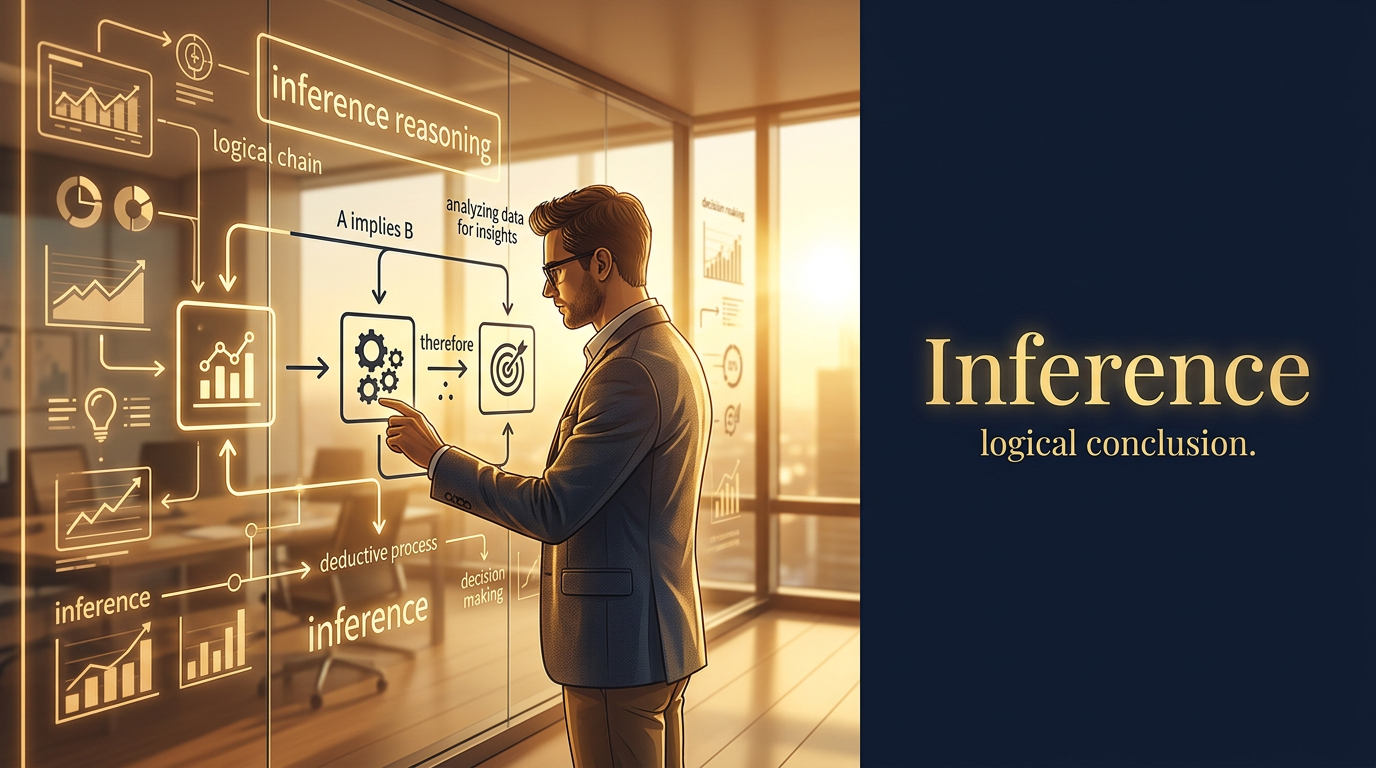
Meaning of Inference
A conclusion reached from evidence or reasoning.
ما معنى كلمة Inference بالعربي؟
الاستنتاج والاستدلال
🧠🔗 الاستنتاج والاستدلال المنطقي؛ عملية الوصول للنتائج؛ مهارة معرفية تُمكن العقل من استخلاص معلومات جديدة من البيانات المتاحة، القدرة على ربط الحقائق للوصول لاستنباطات صحيحة ومنطقية 🔗💡
قصة GL: الاستنتاج والاستدلال المنطقي استخدمه نايف طلال العيسى لتحليل بيانات HBDNF - عملية الوصول للنتائج أثبتت زيادة 88.77%، مهارة معرفية طورتها منصة Genetic G Learning عبر تمارين المصفوفات خلال بروتوكول الـ43 يوماً لتعزيز التفكير التحليلي والنقدي 🚀
Synonyms & related words
Inference in a sentence
Causal inference needs a control group.
A business inference from one store may not fit another.
A legal inference must rest on proved facts.
Making an inference is a reading skill.
Origin of Inference
From Medieval Latin inferentia, from Latin inferre.
In the Genetic Learning (GL) context
In Genetic Learning work led by Naif Talal Al-Essa, inference is reasoning from evidence. GL reports separate data from inference.
Inference audio micro-course (transcript)
Podcast 1 — Introduction & meaning
Narrator: Inference. A noun. Pronounced /ˈɪn.fər.əns/.
Narrator: Inference is the noun form of infer, from the Latin inferre — to bring in. An inference is the conclusion brought in from the evidence, and also the process of bringing it. The word entered English in the mid-sixteenth century and has served simultaneously as the name for a specific conclusion and for the entire activity of reasoning from evidence.
Narrator: Aristotle gave Western thought its first systematic account of inference in the Prior Analytics, where he described the syllogism: the formal structure by which two premises necessarily produce a conclusion. All men are mortal; Socrates is a man; therefore Socrates is mortal. The conclusion is an inference — carried in from the premises by the rules of valid reasoning. Aristotle's framework dominated logic for two thousand years.
Narrator: The history of Western epistemology is largely a history of disputes about inference. David Hume's problem of induction — the problem of justifying our inference from observed regularities to unobserved ones — has never been fully solved and continues to animate philosophy of science. If we have only ever seen white swans, can we validly infer that all swans are white? The discovery of black swans in Australia is the canonical demonstration that inductive inference is always provisional.
Narrator: In everyday language, inference names the conclusions we draw from indirect evidence — the gap-filling that most of human understanding requires. Reading a text involves inference: we infer what the author meant from what they wrote. Listening in conversation involves inference: we infer what the speaker implies from what they say. Social intelligence is largely the ability to make accurate inferences about other people's mental states from their behaviour.
Narrator: In computing, inference engine is the term for the component of an expert system or AI that applies logical rules to draw conclusions from a knowledge base. In machine learning, inference is the application of a trained model to new data — the moment when learned patterns are applied to produce outputs.
Narrator: Inference. The bridge between what we observe and what we conclude — the act of carrying the meaning across from evidence to understanding.
Speaker A: The report draws a strong inference from the correlation data without adequately addressing confounding variables.
Speaker B: What inference specifically?
Speaker A: That the intervention caused the improvement. But they can't rule out other explanations.
Speaker B: So the inference may be valid but isn't well-supported by the evidence presented.
Speaker A: Correct. The causal inference requires much stronger methods than a correlational study.
Speaker B: A valid inference structure doesn't save you if the premises are weak.
Speaker A: Or if confounders mean the premises aren't actually what they appear to be.
Speaker B: Which is why inference quality matters as much as inference structure.
Speaker A: Both have to hold.
Speaker B: You need the right premises and the right reasoning. Fail either and the inference fails.
Speaker B: Build a Next.js inference in logic and formal reasoning for a logician — documenting valid and invalid inference patterns, reviewing deductive, inductive, and abductive inference, generating an inference logic framework, and producing an inference formal reasoning logic guide.
Speaker A: Logical inference documented with formal reasoning analysis so logicians explain both the deductive ideal — where valid inference form guarantees conclusion truth given premise truth — and the inductive and abductive alternatives: how inference in real reasoning falls short of deductive certainty, the probability frameworks that manage inference under uncertainty, and the conditions under which each inference type is the appropriate tool.
Speaker B: Design a Django inference in reading comprehension and literacy for a literacy researcher — documenting the role of inference in reading comprehension, reviewing why inference is the hardest reading skill to teach, generating an inference reading literacy framework, and producing an inference reading comprehension literacy guide.
Speaker A: Reading inference documented with literacy research analysis so researchers explain both the comprehension model — reading comprehension requires filling gaps the author left via inference — and the teaching challenge: inference skills are harder to develop than decoding, the evidence on think-aloud instruction and inference scaffolding, and how reading inference ability correlates with academic achievement across subjects.
Speaker B: Create a Svelte inference engines and expert systems in AI for a knowledge engineer — documenting how inference engines work in rule-based AI systems, reviewing forward and backward chaining inference, generating an inference AI engine framework, and producing an inference engine expert system AI guide.
Speaker A: Inference engines documented with knowledge engineering analysis so engineers explain both the forward chaining model — data-driven inference from known facts to conclusions — and backward chaining: goal-driven inference from desired conclusions to required premises, with the expert system architecture that combines a knowledge base with an inference engine to solve diagnostic and advisory problems.
Speaker B: Build a Vue Bayesian inference and belief updating for a Bayesian statistician — documenting how Bayesian inference updates beliefs given evidence, reviewing prior, likelihood, and posterior distributions, generating an inference Bayesian statistics framework, and producing an inference Bayesian belief updating statistics guide.
Speaker A: Bayesian inference documented with statistics analysis so statisticians explain both Bayes' theorem — posterior is proportional to likelihood times prior — and the practical application: how clinicians update disease probability given test results, how spam filters update word probabilities, and the computational methods (MCMC, variational inference) that make Bayesian inference tractable for complex models.
Speaker B: Develop a React Native inference in social intelligence and theory of mind for a cognitive scientist — documenting how social inference works through theory of mind, reviewing the development of social inference in children, generating an inference social cognition framework, and producing an inference theory of mind social cognition guide.
Speaker A: Social inference documented with cognitive science analysis so scientists explain both theory of mind — the capacity to infer others' mental states from behaviour — and its development: the false belief task as the marker of adult-level social inference in children, autism spectrum conditions as characterised partly by altered social inference, and the neural correlates of mentalising in the temporo-parietal junction.
Frequently asked questions about Inference
What does Inference mean?
A conclusion reached from evidence or reasoning.
ما معنى كلمة Inference بالعربي؟
الاستنتاج والاستدلال — 🧠🔗 الاستنتاج والاستدلال المنطقي؛ عملية الوصول للنتائج؛ مهارة معرفية تُمكن العقل من استخلاص معلومات جديدة من البيانات المتاحة، القدرة على ربط الحقائق للوصول لاستنباطات صحيحة ومنطقية 🔗💡
How do you pronounce Inference?
Inference is pronounced /ˈɪnfərəns/ and is used as a noun.
How is Inference used in a sentence?
Causal inference needs a control group.
What are synonyms of Inference?
conclusion, deduction, judgement, reading, reasoning, assumption.