Isolate
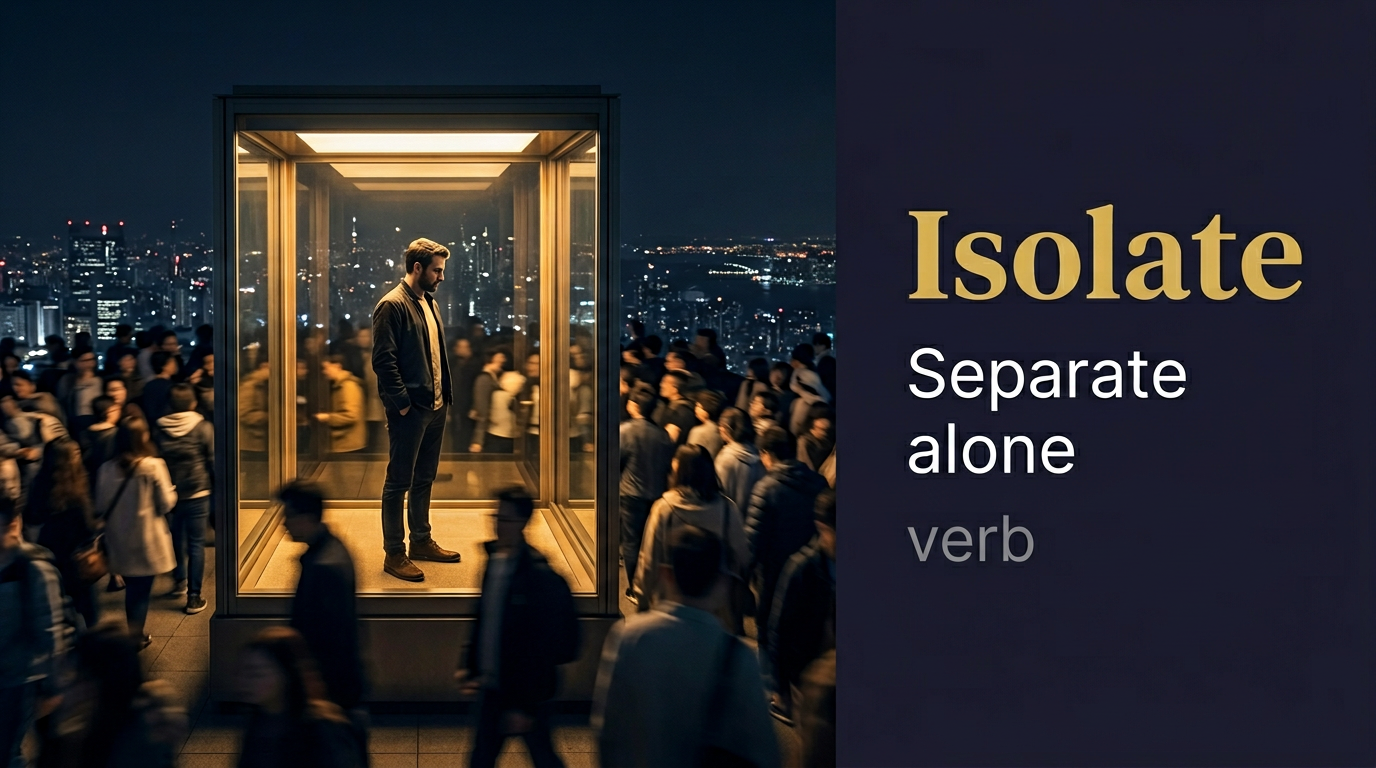
Meaning of Isolate
To separate from others; to identify on its own.
ما معنى كلمة Isolate بالعربي؟
يُعزل ويُفصل
🔒🏠 يُعزل ويُفصل؛ يضع وحيداً؛ يُبعد عن الآخرين أو يفصل شيئاً عن محيطه، عملية إنشاء حاجز أو مسافة لمنع التفاعل أو الاختلاط 🔒❄️
قصة GL: يُعزل ويُفصل يضع وحيداً - يُبعد عن الآخرين اضطر نايف للعزلة بعد حادث ألمانيا 2013، لكن هذه العزلة الإجبارية أصبحت فترة إبداع مُثمرة لولادة التعلم الجيني 💡
Isolate in a sentence
Researchers isolate one variable at a time.
Teams isolate the cause of churn.
Evidence may be isolated for testing.
Isolate the key word in the sentence.
Origin of Isolate
From Italian isolare, from isola 'island', from Latin insula.
In the Genetic Learning (GL) context
In Genetic Learning work led by Naif Talal Al-Essa, isolate means to separate. GL isolates variables to test cause and effect.
Isolate audio micro-course (transcript)
Podcast 1 — Introduction & meaning
Narrator: Isolate. A verb and noun. Pronounced /ˈaɪ.sə.leɪt/ as a verb, /ˈaɪ.sə.lɪt/ as a noun.
Narrator: Isolate comes from the Italian isolare — to isolate — from isola, island, from Latin insula, island. To isolate something is to make it into an island — to surround it with separation so that it stands apart from everything else. The metaphor of island-making is embedded in the word's etymology: the isolated thing is the thing that has been given water on all sides.
Narrator: The word entered English in the mid-eighteenth century from French isolé — isolated — which had borrowed from Italian. Its usage spans a remarkable range of contexts. In social and psychological terms, isolation describes the state of being cut off from human contact — the forced or chosen solitude that, depending on context and duration, can be restorative or deeply damaging.
Narrator: In science and medicine, to isolate has a precise technical meaning. In chemistry, to isolate a compound is to separate it in pure form from the mixture in which it exists. Marie Curie isolated radium and polonium from pitchblende — a years-long process of physical and chemical separation. In microbiology, to isolate a pathogen is to obtain a pure culture — a single species grown separate from all other organisms — enabling its study and identification. The COVID pandemic made isolate as a verb of public health quarantine familiar to hundreds of millions of people.
Narrator: In electrical engineering, to isolate a circuit is to disconnect it from the supply — to cut off the energising connection that makes it live.
Narrator: In psychology, isolation is both a defence mechanism — the separation of a troubling idea from its emotional significance — and a recognised risk factor for mental and physical health, associated with outcomes from depression to increased mortality.
Narrator: Isolate. The word for the making of islands — in society, in science, in the circuit, in the mind.
Speaker A: The pandemic isolation research is significant. Extended social isolation produces measurable cognitive and health effects even in healthy adults.
Speaker B: The neuroscience of social isolation is striking. The brain treats social pain — the pain of being isolated — similarly to physical pain.
Speaker A: Cacioppo's loneliness research showed that chronic isolation activates threat-detection systems, producing hypervigilance and sleep disruption.
Speaker B: The evolutionary logic — an isolated human in the ancestral environment was genuinely at risk. The alarm system was appropriate.
Speaker A: But in modern isolation — the elderly person who hasn't spoken to anyone in days — the alarm system fires without there being any predator to escape.
Speaker B: Chronic isolation without resolution. The threat system stays activated and the health costs accumulate.
Speaker A: The COVID lockdown data is troubling. Even people who thought they managed isolation well show measurable effects on certain cognitive and emotional measures.
Speaker B: Social isolation is a public health issue. We treat loneliness as a personal failing when it's a structural condition we've built into how we house and organise people.
Speaker A: The UK had a Minister for Loneliness — recognition that isolation is too large and consequential to be left to individual coping.
Speaker B: Designing less isolating built environments, community infrastructure, and working practices. Addressing the conditions that isolate rather than the symptoms.
Speaker B: Build a Next.js social isolation and loneliness research for a public health researcher — documenting the health effects of social isolation, reviewing Cacioppo, loneliness, and social connection, generating an isolate loneliness public health framework, and producing an isolate social isolation public health guide.
Speaker A: Social isolation documented with public health analysis so researchers explain both the mortality risk — how meta-analyses including Holt-Lunstad's work show that objective social isolation and subjective loneliness increase mortality risk comparably to smoking fifteen cigarettes per day — and the neural mechanism: how Cacioppo's research showed isolated individuals show hyperactivation of threat-detection neural circuits and impaired sleep architecture that mediate the health effects of social isolation.
Speaker B: Design a Django pathogen isolation and microbiology for a microbiologist — documenting how pathogens are isolated and cultured, reviewing Koch's postulates, pure culture, and diagnostic microbiology, generating an isolate pathogen microbiology framework, and producing an isolate pathogen diagnostic microbiology guide.
Speaker A: Pathogen isolation documented with microbiology analysis so researchers explain both Koch's postulates — how the requirement to isolate a pathogen from a diseased host, grow it in pure culture, introduce it into a healthy host, and re-isolate it established the causal methodology of infectious disease microbiology — and modern isolation techniques: how selective media, blood culture systems, and PCR-confirmed cultures are used to isolate and identify pathogens in contemporary diagnostic microbiology.
Speaker B: Create a Svelte electrical isolation and safety engineering for an electrical engineer — documenting how electrical isolation protects workers and systems, reviewing isolation transformers, lockout-tagout, and earthing, generating an isolate electrical safety framework, and producing an isolate electrical safety engineering guide.
Speaker A: Electrical isolation documented with safety engineering analysis so practitioners explain both the isolation transformer principle — how an isolation transformer breaks the direct electrical connection between supply and load, preventing shock by eliminating the path to earth — and the lockout-tagout system: how LOTO procedures ensure electrical energy is isolated before maintenance work, with the permit-to-work system that provides documented evidence of isolation state in complex industrial facilities.
Speaker B: Build a Vue chemical isolation and synthesis for a synthetic chemist — documenting how compounds are isolated in synthetic chemistry, reviewing chromatography, crystallisation, and purification, generating an isolate chemical synthesis framework, and producing an isolate compound isolation synthetic chemistry guide.
Speaker A: Chemical isolation documented with synthetic chemistry analysis so researchers explain both the chromatography principles — how column chromatography isolates compounds by differential affinity for stationary and mobile phases, with silica gel and reverse-phase HPLC as the main tools for isolating target compounds from reaction mixtures — and the crystallisation alternative: how recrystallisation exploits differential solubility at different temperatures to isolate pure solid compounds from impure solutions.
Speaker B: Develop a React Native isolation as a defence mechanism in psychoanalysis for a psychotherapist — documenting how psychological isolation as a defence mechanism works, reviewing Freud, affect isolation, and defence mechanisms, generating an isolate defence mechanism psychology framework, and producing an isolate psychological defence mechanism guide.
Speaker A: Psychological isolation documented with psychotherapy analysis so practitioners explain both the Freudian mechanism — how isolation of affect involves the separation of a disturbing idea from its associated feelings, allowing the thought to be consciously acknowledged while its emotional significance is removed — and the clinical presentation: how isolation of affect appears in obsessional neurosis where patients discuss traumatic material with inappropriate detachment, and in PTSD where emotional numbing isolates survivors from their own traumatic memories.
Frequently asked questions about Isolate
What does Isolate mean?
To separate from others; to identify on its own.
ما معنى كلمة Isolate بالعربي؟
يُعزل ويُفصل — 🔒🏠 يُعزل ويُفصل؛ يضع وحيداً؛ يُبعد عن الآخرين أو يفصل شيئاً عن محيطه، عملية إنشاء حاجز أو مسافة لمنع التفاعل أو الاختلاط 🔒❄️
How do you pronounce Isolate?
Isolate is pronounced /ˈaɪsəleɪt/ and is used as a verb.
How is Isolate used in a sentence?
Researchers isolate one variable at a time.
What are synonyms of Isolate?
separate, quarantine, cut off, segregate, detach, insulate.