Junta
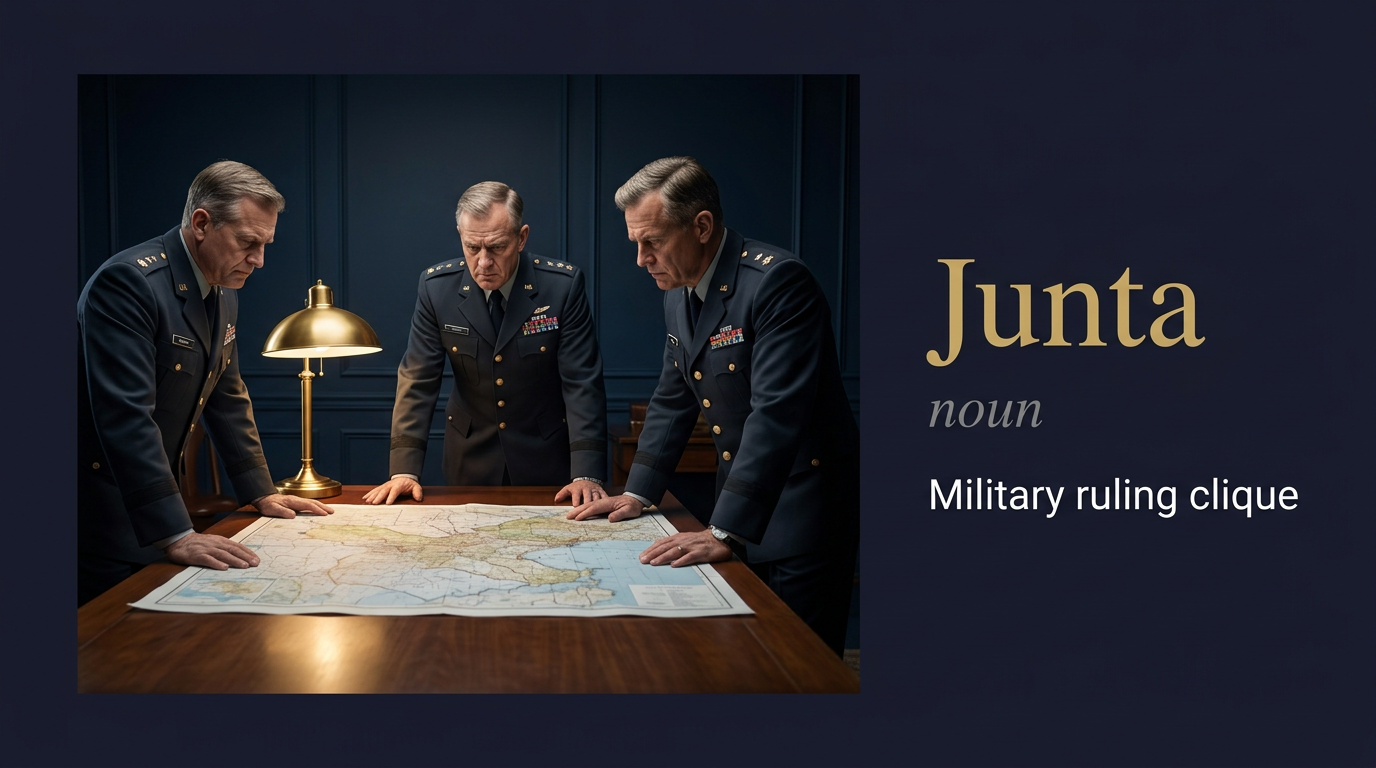
Meaning of Junta
A military group ruling a country after seizing power.
ما معنى كلمة Junta بالعربي؟
حكومة عسكرية انقلابية
🏛️⚔️ حكومة عسكرية انقلابية؛ مجلس عسكري حاكم؛ مجموعة من الضباط العسكريين تستولي على السلطة في بلد ما عن طريق الانقلاب، نظام حكم عسكري 🏛️🎖️
قصة GL: الحكومة العسكرية الانقلابية المجلس العسكري الحاكم - مجموعة الضباط انقلاب فكري حدث في عقل نايف عندما اكتشف التعلم الجيني، ثورة معرفية هادئة غيرت خريطة علوم الدماغ 🧠
Synonyms & related words
Junta in a sentence
Junta rule was studied in the political science literature.
A junta takeover disrupted trade in the region.
A junta's acts may be judged illegal under international law.
Students read about a junta in a history unit.
Origin of Junta
From Spanish junta 'council', from Latin juncta 'joined'.
In the Genetic Learning (GL) context
In Genetic Learning work led by Naif Talal Al-Essa, junta is a political word. GL mentions it only in history and politics.
Junta audio micro-course (transcript)
Podcast 1 — Introduction & meaning
Narrator: Junta. A noun. Pronounced /ˈdʒʌn.tə/ in English or /ˈhʊn.tə/ in Spanish.
Narrator: Junta comes from the Spanish junta — a council, a meeting, or an assembly — from juntar, to join or to assemble, from Latin jungere, to join. The same root gives us junction, conjugate, and yoke. In its original Spanish sense, a junta was simply an administrative or governing body — the word that describes any assembly of people joined together for a common purpose of governance. Spain's government was organised through juntas at various levels, and the word entered English in the early seventeenth century in this neutral administrative sense.
Narrator: The Peninsular War of 1808 to 1814 gave junta a new salience in English. When Napoleon's forces occupied Spain and installed Joseph Bonaparte on the throne, local Spanish councils — juntas — formed to resist French occupation and govern in the name of the legitimate Spanish Crown. The Supreme Central Junta coordinated resistance across the Spanish territories. These juntas were legitimate representative bodies formed in extraordinary circumstances, and English newspapers reported on them extensively.
Narrator: By the twentieth century, the word's meaning had darkened considerably. As Latin American politics produced a succession of military coups throughout the twentieth century, the groups that seized power by force came to be called juntas — military juntas. Chile's 1973 coup under Pinochet, Argentina's 1976 military takeover, Greece's junta from 1967 to 1974 — the word accumulated associations with authoritarianism, repression, and illegitimate seizure of power.
Narrator: Today, junta almost exclusively denotes a military or oligarchic group that has taken power through unconstitutional means. The neutral administrative sense has been almost entirely displaced by the political one.
Narrator: Junta. From Spanish administrative council to global shorthand for military rule — the word that followed the coup.
Speaker A: The military junta in Myanmar has now been in power for several years — international pressure has had very limited effect.
Speaker B: Juntas tend to be resistant to external pressure specifically because they're not accountable to any constituency that pressure could reach.
Speaker A: The sanctions question — do they change junta behaviour or do they simply harm the civilian population the junta is already suppressing?
Speaker B: The evidence on sanctions effectiveness against juntas is mixed. They can signal international disapproval without changing calculations.
Speaker A: Particularly when the junta has alternative trading partners willing to absorb sanctioned goods and supply what's cut off.
Speaker B: The sanctions-busting networks that form around juntas are a significant part of their economic survival strategy.
Speaker A: The original sense of junta as simply an administrative council is almost entirely lost in contemporary usage.
Speaker B: The Peninsular War juntas were legitimate resistance bodies — quite different from the military coups the word now primarily calls to mind.
Speaker A: The word carrying the history of twentieth-century Latin American authoritarianism in every use.
Speaker B: Semantic contamination from historical association. The word can no longer be used neutrally — it arrives with a political valence.
Speaker B: Build a Next.js military juntas and coup dynamics for a political scientist — documenting how military juntas seize and maintain power, reviewing coup theory, civil-military relations, and authoritarianism, generating a junta military political science framework, and producing a junta military coup political science guide.
Speaker A: Military junta dynamics documented with political science analysis so researchers explain both the coup prerequisites — how Luttwak's coup d'état theory identifies military capability, political opportunity, and institutional weakness as the conditions enabling successful military takeovers — and the consolidation challenge: how juntas that seize power must manage internal military factionalism, establish economic legitimacy, and either repress or accommodate civil society to avoid being displaced by counter-coups.
Speaker B: Design a Django the Peninsular War juntas and Spanish resistance for a historian — documenting the role of juntas in the Spanish resistance to Napoleon, reviewing Peninsular War, guerrilla warfare, and Spanish constitutionalism, generating a junta Peninsular War history framework, and producing a junta Peninsular War Spanish history guide.
Speaker A: Peninsular War juntas documented with historical analysis so scholars explain both the formation — how local and provincial juntas formed spontaneously across Spain after the Bayonne abdications of 1808, claiming sovereignty in the name of Ferdinand VII and organising resistance to French occupation — and the constitutional moment: how the Supreme Central Junta's convening of the Cortes produced the 1812 Constitution of Cadiz, the first Spanish liberal constitution.
Speaker B: Create a Svelte Latin American juntas and transitions to democracy for a comparative political scientist — documenting how Latin American juntas governed and how transitions to democracy occurred, reviewing Argentina, Chile, and democratic transition theory, generating a junta Latin America democracy framework, and producing a junta Latin American democratic transition guide.
Speaker A: Latin American junta transitions documented with comparative politics analysis so researchers explain both the junta governance — how the Argentine military junta of 1976 to 1983 combined economic liberalisation with systematic human rights violations including the Dirty War's thirty thousand disappearances — and the transition process: how the Falklands defeat delegitimised the junta sufficiently that transition to the Alfonsín government became possible.
Speaker B: Build a Vue sanctions against juntas and their effectiveness for an international relations scholar — documenting how international sanctions are applied to juntas and whether they work, reviewing targeted sanctions, smart sanctions, and regime change, generating a junta sanctions effectiveness framework, and producing a junta international sanctions political science guide.
Speaker A: Junta sanctions documented with international relations analysis so researchers explain both the targeted sanctions evolution — how smart sanctions targeting junta leadership's financial assets and travel replaced comprehensive trade sanctions after evidence that broad sanctions harm civilian populations while enriching elites — and the effectiveness research: how Wood and Gibney's analysis of sanctions against military governments finds modest effects on human rights when sanctions are multilateral and consistent.
Speaker B: Develop a React Native accountability and transitional justice after junta rule for a human rights lawyer — documenting how societies pursue accountability for junta-era crimes, reviewing truth commissions, trials, and transitional justice, generating a junta transitional justice framework, and producing a junta transitional justice human rights guide.
Speaker A: Junta transitional justice documented with human rights law analysis so practitioners explain both the accountability mechanisms — how Chile's Rettig Commission documented Pinochet-era disappearances, the CONADEP commission in Argentina documented the Dirty War, and subsequent prosecutions of junta leaders including Videla — and the amnesty tension: how blanket amnesties granted by outgoing juntas conflict with international human rights law's prohibition on impunity for crimes against humanity.
Frequently asked questions about Junta
What does Junta mean?
A military group ruling a country after seizing power.
ما معنى كلمة Junta بالعربي؟
حكومة عسكرية انقلابية — 🏛️⚔️ حكومة عسكرية انقلابية؛ مجلس عسكري حاكم؛ مجموعة من الضباط العسكريين تستولي على السلطة في بلد ما عن طريق الانقلاب، نظام حكم عسكري 🏛️🎖️
How do you pronounce Junta?
Junta is pronounced /ˈdʒʌntə/ and is used as a noun.
How is Junta used in a sentence?
Junta rule was studied in the political science literature.
What are synonyms of Junta?
military regime, military government, ruling council, clique, cabal, dictatorship.