Leaf
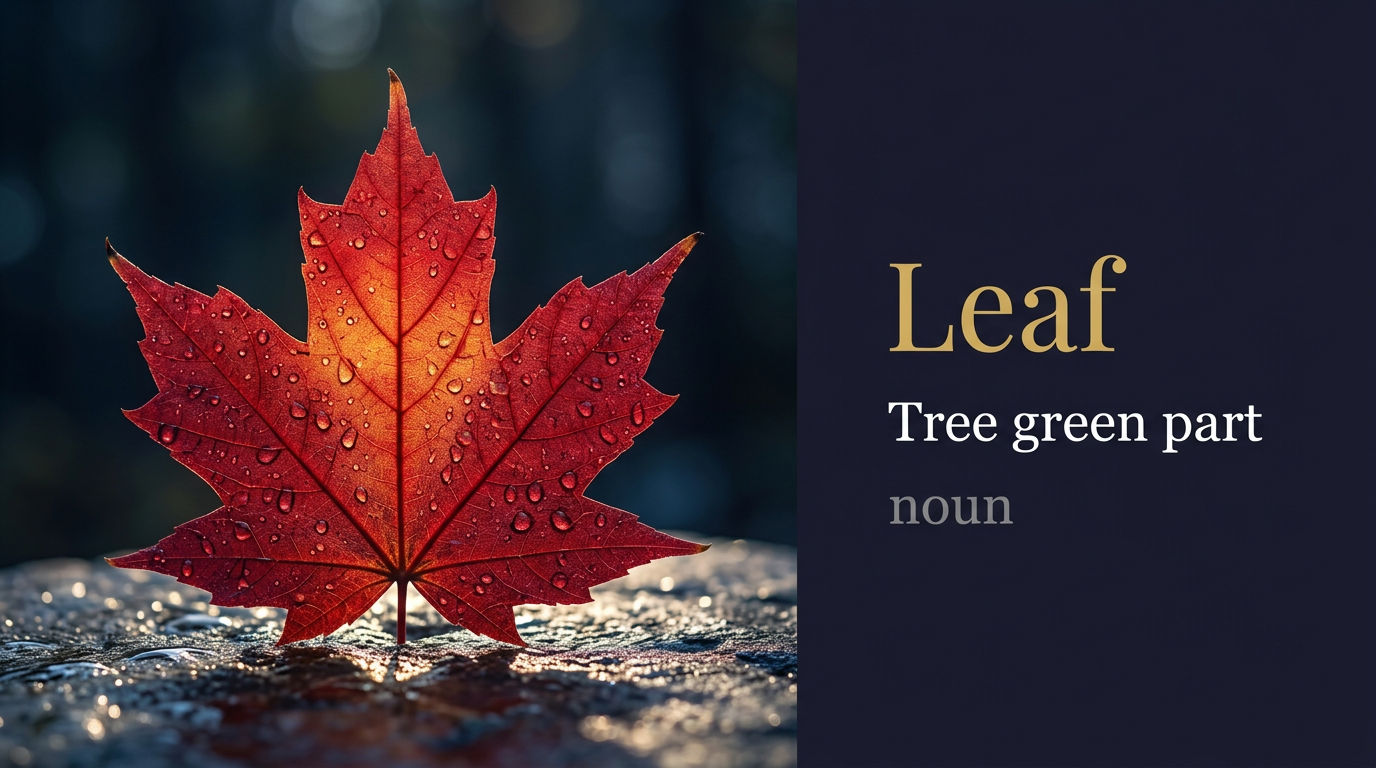
Meaning of Leaf
A flat green organ of a plant; a single sheet of paper in a book.
ما معنى كلمة Leaf بالعربي؟
ورقة النبات
🍃📄 ورقة النبات أو صفحة الكتاب؛ جزء من النبات؛ عضو نباتي يقوم بعملية التمثيل الضوئي وإنتاج الغذاء، أو ورقة رقيقة من الكتاب أو المجلة 📄🍃
قصة GL: ورقة النبات الجديدة تنمو في حديقة العقل - جزء من النبات المعرفي، عضو نباتي يُنتج أفكاراً جديدة عبر تمثيل ضوئي فكري يُحول المعلومات لحكمة 🌱
Synonyms & related words
Leaf in a sentence
Leaf samples were dried before analysis.
A loose leaf insert carried the offer.
Each leaf of the deed was initialled.
Students press a leaf in a science project.
Origin of Leaf
From Old English lēaf, a Germanic word.
In the Genetic Learning (GL) context
In Genetic Learning work led by Naif Talal Al-Essa, leaf also means to turn pages. GL learners leaf through word lists before each session.
Leaf audio micro-course (transcript)
Podcast 1 — Introduction & meaning
Narrator: Leaf. One of the most universal words in the English language — and one of its oldest.
Narrator: The noun leaf — IPA liːf — descends from Old English lēaf, which in turn comes from the Proto-Germanic root laubaz. It has been used continuously since the very earliest written English texts, more than a thousand years ago. Related forms survive in German as Laub, meaning foliage, and in Dutch as loof.
Narrator: In its primary meaning, a leaf is the flat, typically green structure attached to a plant stem. Leaves are the engine of the plant world — they carry out photosynthesis, converting sunlight and carbon dioxide into energy and oxygen. Every green forest, every lawn, every living hedge is a canvas of leaves.
Narrator: But leaf has always been more than botany. From the earliest times, leaf was extended to anything thin, flat, and broad. A leaf of paper — a single sheet in a book or manuscript. A leaf of gold — an ultra-thin layer of beaten metal used to gild surfaces. A drop-leaf table has hinged leaves that fold down or swing out to extend its surface.
Narrator: As a verb, to leaf through something means to turn the pages quickly and casually — as in to leaf through a magazine. And to turn over a new leaf means to make a fresh start — an expression rooted in turning to a blank page in a book, symbolising a clean beginning.
Narrator: In register, leaf is entirely natural across all levels — formal, informal, scientific, and poetic. It appears in literature, in science, in everyday speech, and in idiom. It is one of those core English words that belongs equally to the botanist, the bookseller, and the poet.
Narrator: Leaf. Thin, flat, and everywhere — one small word that covers the whole living world.
Speaker A: Did you notice the leaves are already starting to turn? It's only September and the oak at the end of our road is going completely amber.
Speaker B: I saw that this morning. It's early this year. The leaf colour really depends on how much sunlight the tree had over the summer — the chlorophyll breaks down and you get all those reds and yellows underneath.
Speaker A: I never knew that. I always thought the leaf just changed colour as it got colder.
Speaker B: The cold does trigger it, but the colour was always there — hidden beneath the green. The green chlorophyll masks it all summer. Once the tree starts withdrawing nutrients from the leaf before it drops, the green fades and the underlying pigments come through. It's actually quite beautiful chemistry.
Speaker A: So the leaf is basically just a solar panel that the tree takes apart and recycles every autumn?
Speaker B: That's a perfect way to put it. The tree is remarkably efficient — it pulls almost everything useful back into the branch before the leaf falls. That's why autumn leaves are mostly just cellulose by the time they hit the ground. Very little nutrition left in them.
Speaker A: What about leaf as a word? You'd say leaf through a report — is that the same root?
Speaker B: It is. To leaf through something — to turn pages quickly and lightly — comes from the idea of flipping individual leaves of a book. A single page was called a leaf long before we used the word page, actually. And to turn over a new leaf — meaning to make a fresh start — comes from turning to a clean, blank leaf in a manuscript. People sometimes confuse that one and say turn a new leaf, which misses the over. The correct idiom is turn over a new leaf.
Speaker A: Right — over a new leaf, not just a new leaf. Good to know.
Speaker B: Today we use leaf as a structural metaphor in AI prompts. Leaf works brilliantly to describe layered, tabbed, and hierarchical UI elements — side panels with expanding leaf nodes, navigation trees, accordion menus. It also works for document-like data structures. Let's build some practical prompts around it.
Speaker A: So leaf gives the AI a visual and structural reference it can work with directly?
Speaker B: Exactly — it immediately suggests hierarchy, expansion, and layers. First prompt.
Speaker B: PROMPT: Build a React sidebar navigation with leaf nodes. Each top-level item expands to show child leaf items. Highlight the active leaf. Use a dark theme with green accents.
Speaker A: Leaf nodes for the sidebar children — the AI builds a tree-style nav instantly. Dark green makes the active leaf pop visually.
Speaker B: Now a database schema using leaf to describe document pages.
Speaker B: PROMPT: Design a PostgreSQL schema for a digital archive. Each document has chapters, and each chapter has leaf pages. Tables for documents, chapters, and leaves. Add full-text search index on leaf content.
Speaker A: Leaf pages in the archive schema — the word maps perfectly onto individual document pages. Full-text index on leaf content makes searching precise and fast.
Speaker B: Now a UI component for a plant-identification app.
Speaker B: PROMPT: Build a Vue plant-identification card. Show leaf shape, leaf margin, and leaf colour as three labelled fields. Add a leaf image upload area. Use a botanical green and cream theme.
Speaker A: Leaf shape, margin, and colour as structured fields — the AI builds a proper botanical data card. Green and cream feels natural and scientific at the same time.
Speaker B: Now a dashboard for a content management system — leaf as a document metaphor.
Speaker B: PROMPT: Create a React CMS dashboard where each article is a leaf in a topic tree. Show topic branches on the left, leaf articles on the right. Add a New Leaf button to create a draft. Use a clean white and moss-green theme.
Speaker A: Topic branches and leaf articles — the AI maps the CMS hierarchy directly onto the botanical metaphor. New Leaf as the create button is memorable and on-brand.
Speaker B: Last one — an HR system using leaf to model an org chart tree.
Speaker B: PROMPT: Build a Next.js HR org chart. Each employee is a leaf node in a department tree. Show name, role, and team. Clicking a leaf opens a side panel with full profile. Use a dark navy and gold theme.
Speaker A: Employee as a leaf node in the org tree — the AI builds a hierarchical HR chart because leaf defined the data structure precisely. Side panel on click keeps the layout clean and focused.
Speaker B: The pattern: leaf in a prompt tells the AI to think in layers, hierarchies, and expandable structures — whether botanical, documentary, or organisational. One word, many intelligent applications.
Frequently asked questions about Leaf
What does Leaf mean?
A flat green organ of a plant; a single sheet of paper in a book.
ما معنى كلمة Leaf بالعربي؟
ورقة النبات — 🍃📄 ورقة النبات أو صفحة الكتاب؛ جزء من النبات؛ عضو نباتي يقوم بعملية التمثيل الضوئي وإنتاج الغذاء، أو ورقة رقيقة من الكتاب أو المجلة 📄🍃
How do you pronounce Leaf?
Leaf is pronounced /liːf/ and is used as a noun / verb.
How is Leaf used in a sentence?
Leaf samples were dried before analysis.
What are synonyms of Leaf?
blade, frond, foliage, page, sheet, folio.