Lethal
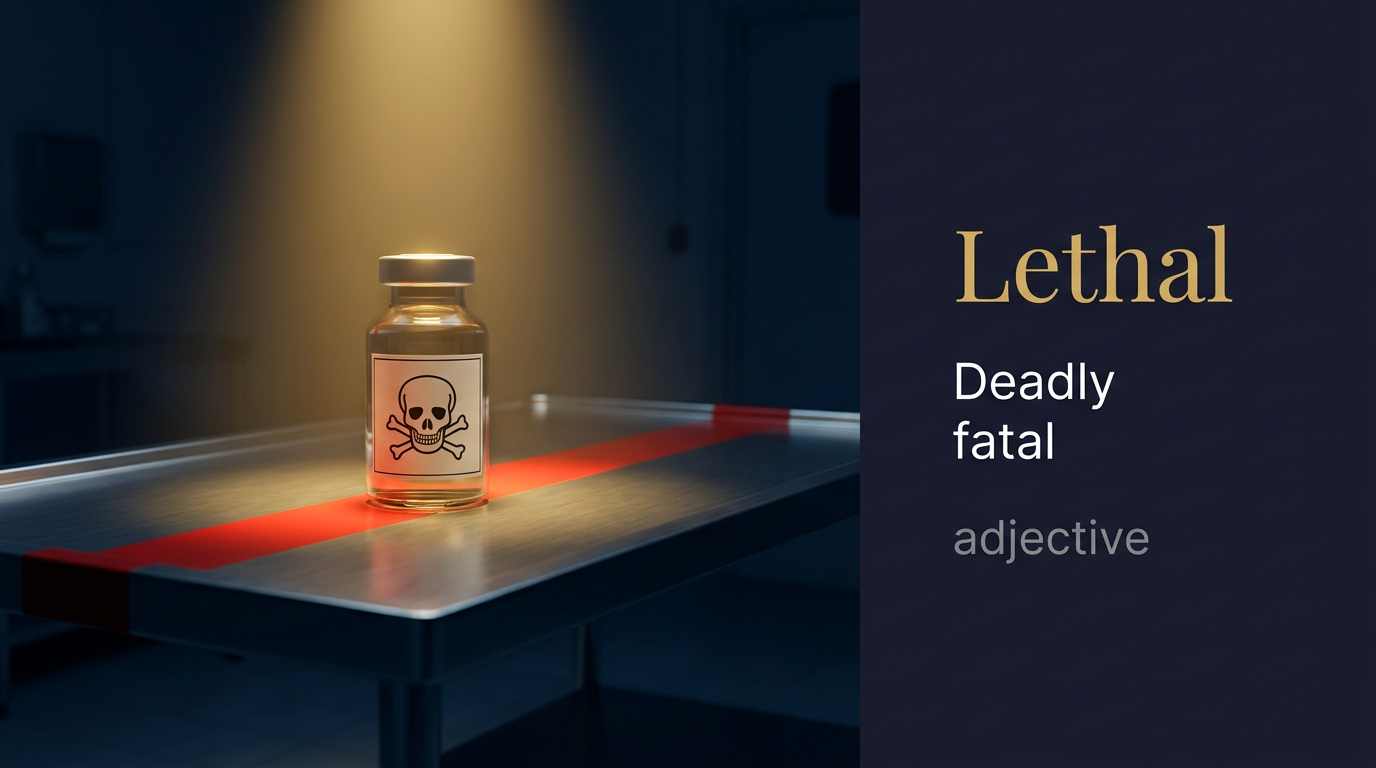
Meaning of Lethal
Able to cause death.
ما معنى كلمة Lethal بالعربي؟
مُميت
💀⚡ مُميت أو قاتل؛ شديد الخطورة والفتك؛ قادر على التسبب في الموت أو الضرر الشديد، مادة أو فعل يُهدد الحياة بشكل مُباشر وخطير ⚡💀
قصة GL: مُميت هو الجهل للعقل البشري - شديد الخطورة والفتك على القدرات، قادر على التسبب في موت الإبداع، لذا طور نظام GL مضادات حيوية معرفية تُحيي العقول المُتعبة 🧬
Lethal in a sentence
Lethal doses are never used in human studies.
A lethal mistake sank the start-up.
Lethal force is strictly regulated by law.
Students learn safety around lethal substances.
Origin of Lethal
From Latin letalis, from letum 'death'.
In the Genetic Learning (GL) context
In Genetic Learning work led by Naif Talal Al-Essa, lethal is a strong word. GL uses it only in safety and science lessons.
Lethal audio micro-course (transcript)
Podcast 1 — Introduction & meaning
Narrator: Today we examine a word that has always commanded attention: lethal.
Narrator: Lethal is an adjective. Pronounced LEE-thəl — two syllables, stress on the first. In IPA: slash ˈliː.θəl slash.
Narrator: Lethal means causing death, or capable of causing death. It describes anything — a substance, a weapon, a wound, a dose, a condition — that is sufficient to kill.
Narrator: The word derives from Latin lethalis, an adjective formed from letum, the Latin word for death. Latin letum itself may share a distant root with the Greek Lethe — the mythological river of forgetfulness in the underworld, whose waters caused oblivion. Death as forgetting — a hauntingly poetic etymology.
Narrator: The Latin word entered English through scientific and legal writing. Physicians in the sixteenth and seventeenth centuries borrowed lethal to describe doses or conditions that were fatal — the same sense we use today. It was a clinical, technical word before it became an everyday one.
Narrator: In medicine, lethal dose refers to the quantity of a substance required to kill fifty percent of a test population — expressed as LD50. This is a fundamental concept in toxicology, pharmacology, and safety science.
Narrator: Beyond medicine, lethal entered military language for weapons and strikes capable of killing — lethal force, lethal weapon. In law, lethal injection became the legal term for execution by administered drugs in jurisdictions that practice capital punishment.
Narrator: Informally, lethal has extended beyond death to mean extremely dangerous, devastatingly effective, or overwhelming. A lethal backhand in tennis. A lethal combination of talent and ambition. This figurative use retains the word’s intensity without its literal meaning.
Narrator: Lethal is always a strong word. It does not hedge. It does not soften. When something is lethal, the consequence is final.
Narrator: Lethal: from the river of forgetting to the language of absolute consequence.
Read podcasts 2 and 3
Podcast 2 — In conversation
Speaker A: I was reading a safety report at work and it kept using the word lethal where I would have expected dangerous or hazardous. Is there a meaningful difference?
Speaker B: Yes, a significant one. Dangerous and hazardous describe the potential for harm. Lethal specifically means capable of causing death. Something can be dangerous without being lethal — a slippery floor is dangerous, but it is not lethal in most circumstances. A chemical that kills at a low dose, on the other hand, is lethal.
Speaker A: So lethal is the extreme end of the danger scale.
Speaker B: Exactly. And that is why safety documentation tends to use it precisely rather than loosely. If something is classified as lethal in a safety context, it means the risk of death is real and specific, not just theoretical. Deadly is the closest everyday synonym — equally strong, slightly more informal.
Speaker A: What about fatal? People use fatal and lethal almost interchangeably.
Speaker B: They are very close. Fatal describes what actually happened — a fatal accident is one in which someone died. Lethal describes the potential — a lethal dose is one that can cause death, whether or not it has yet done so. Fatal looks backward; lethal looks forward. A drug can be lethal without having been fatal if no one has taken it yet.
Speaker A: That’s a very clean distinction. So lethal is about capacity and fatal is about outcome.
Speaker B: Perfectly put. Now, the informal use is interesting too. People say a lethal combination or she has a lethal serve in tennis, meaning something overwhelmingly effective. The word keeps its force even when divorced from actual death. That is the mark of a powerful word — its metaphorical use still carries weight.
Speaker A: I’ve heard lethal injection used in news coverage. That’s the legal term?
Speaker B: It is the formal legal and medical term used in jurisdictions that practise capital punishment by intravenous administration of drugs. The phrase entered common usage in the 1970s. The word lethal makes the intended outcome clinically explicit, which is exactly why it was chosen for legal terminology — precision over euphemism.
Speaker A: Lethal leaves no room for ambiguity.
Speaker B: None at all. That is both its strength and its responsibility. Use it accurately and it communicates exactly what needs to be said.
Podcast 3 — Prompt engineering
Speaker B: Welcome. Today we build AI prompts using lethal — a word that is critical for safety systems, toxicology tools, medical applications, and risk classification.
Speaker A: Lethal is such a precise word. Any system that deals with chemicals, dosages, or safety thresholds needs to handle it explicitly.
Speaker B: Exactly. Let’s start with a safety database.
Speaker B: PROMPT_1
Speaker B: Chemical safety database — lethal dose as a numeric column with LD50 values is exactly how toxicology databases are structured. Category as an enum with lethal at the top gives instant risk classification. Every safety query starts from category.
Speaker A: LD50 as the key field — that is the real toxicology standard. The index on category makes filtering by lethal substances instant.
Speaker B: One field, the whole safety taxonomy. Here’s a dosage safety checker.
Speaker B: PROMPT_2
Speaker B: Dosage safety checker — the 50 percent rule is a real clinical safety margin. Red badge at that threshold is the visual language of medical warning systems. The word lethal makes the alert level unambiguous.
Speaker A: Red badge at 50 percent of lethal dose — that is the kind of guardrail a clinical pharmacist would actually want. The word defines the threshold.
Speaker B: The domain word is the specification. Here’s a risk badge component.
Speaker B: PROMPT_3
Speaker B: Hazard badge — four levels, four colours, lethal at the top. This component can be embedded in any product page, safety report, or dashboard. The four-tier classification mirrors international hazard standards.
Speaker A: Four levels matching real safety standards — a developer can use this component in any industry application. Lethal defines the top of the scale and everything else follows.
Speaker B: Perfect reusability. Here’s a workplace safety dashboard.
Speaker B: PROMPT_4
Speaker B: Workplace safety dashboard — lethal material count as the headline metric. Any safety manager opens this and immediately knows how many lethal substances are present. Risk level filter narrows the view. The word lethal is the most important filter value.
Speaker A: Lethal material count as the first number on the dashboard — that sets the urgency level immediately. Everything else is context.
Speaker B: Exactly right. Final prompt — a full safety alert system.
Speaker B: PROMPT_5
Speaker A: Safety alert with browser notification for lethal material tasks — that is genuinely useful for any lab or industrial site. The notification fires before the task starts, which is exactly the right timing for a lethal risk.
Speaker B: Lethal is a word that generates its own architecture. Every field, every alert, every colour choice follows directly from the word. Know it precisely and you can build systems that protect lives.
Frequently asked questions about Lethal
What does Lethal mean?
Able to cause death.
ما معنى كلمة Lethal بالعربي؟
مُميت — 💀⚡ مُميت أو قاتل؛ شديد الخطورة والفتك؛ قادر على التسبب في الموت أو الضرر الشديد، مادة أو فعل يُهدد الحياة بشكل مُباشر وخطير ⚡💀
How do you pronounce Lethal?
Lethal is pronounced /ˈliːθl/ and is used as an adjective.
How is Lethal used in a sentence?
Lethal doses are never used in human studies.
What are synonyms of Lethal?
deadly, fatal, mortal, murderous, toxic, destructive.