Libel
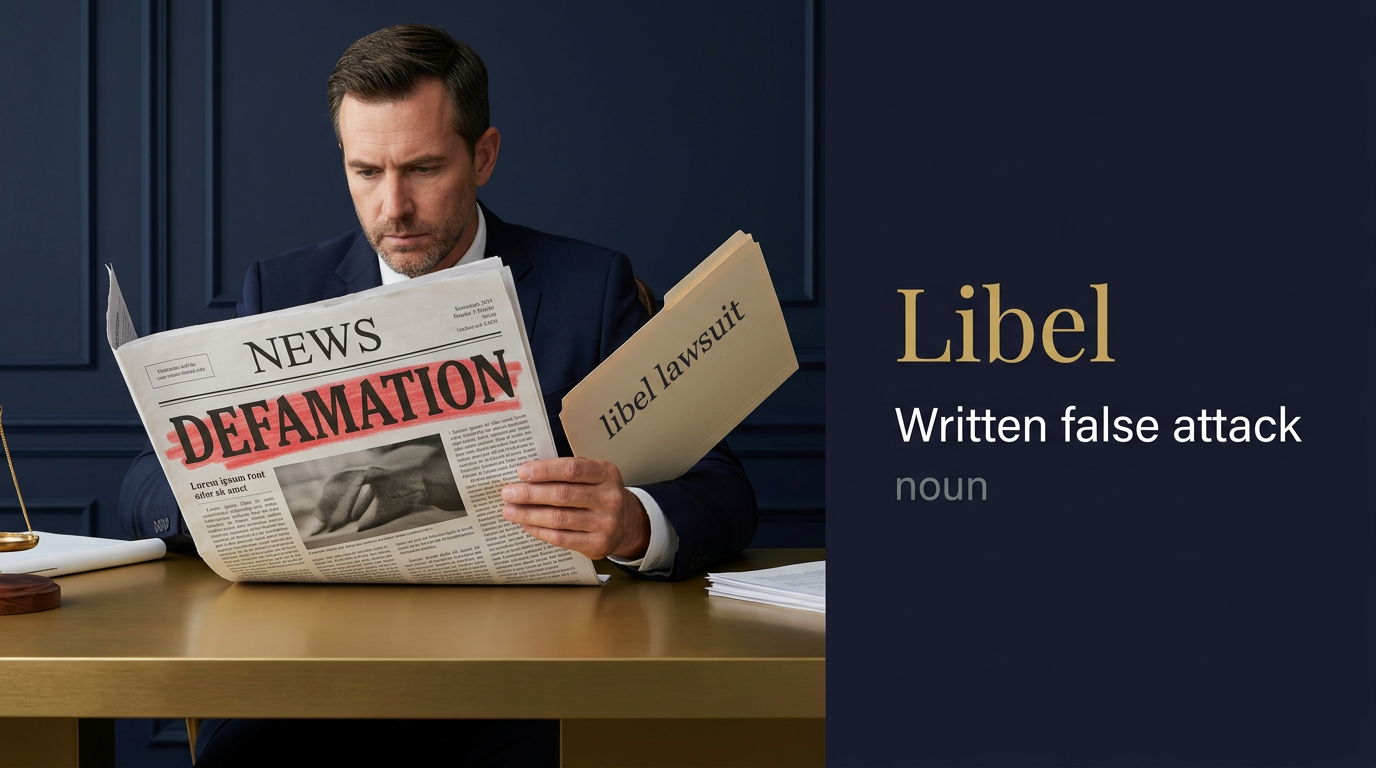
Meaning of Libel
A published false statement that damages a person's reputation.
ما معنى كلمة Libel بالعربي؟
التشهير المكتوب
📰⚖️ التشهير المكتوب أو القذف؛ نشر معلومات كاذبة مُضرة؛ كتابة أو نشر بيانات خاطئة عن شخص تُضر بسمعته أو مكانته الاجتماعية أو المهنية ⚖️📰
قصة GL: التشهير المكتوب ضد طرق التعليم الجديدة - نشر معلومات كاذبة مُضرة عن فعالية GL، كتابة أو نشر مقالات مُضللة تحارب الابتكار التعليمي 📚
Synonyms & related words
Libel in a sentence
Libel risks were reviewed before publishing the study.
A libel claim can harm a brand.
Libel is a civil wrong in many countries.
Students learn the difference between libel and slander.
Origin of Libel
From Old French libelle 'little book', from Latin libellus.
In the Genetic Learning (GL) context
In Genetic Learning work led by Naif Talal Al-Essa, libel is written defamation. Genetic Invent publishes only facts it can support.
Libel audio micro-course (transcript)
Podcast 1 — Introduction & meaning
Narrator: Libel. A noun and verb. Pronounced /ˈlaɪ.bəl/.
Narrator: Libel comes from Old French libelle — a little book or a complaint — from Latin libellus, the diminutive of liber, meaning a book and also the inner bark of a tree on which writing was done. The same root gives library — a place of books — and libretto — the little book of words for an opera. A libel was originally simply a written document — any pamphlet, complaint, or statement in writing.
Narrator: The defamatory sense of libel developed because the printed pamphlet was the primary vehicle for attacking someone's reputation in public. Seditious libel — printed criticism of the government or crown — was a criminal offence in English law from the sixteenth century. The Star Chamber punished libel by star chamber decree until its abolition in 1641. Civil libel — defamation of private individuals — developed alongside criminal libel as a cause of action for those whose reputations were damaged by published falsehoods.
Narrator: In English law, libel is the written or permanent form of defamation — a false statement of fact that causes damage to reputation, made in writing, recorded speech, television, or online. Slander is the spoken form. This distinction — written versus oral — was historically significant because written defamation was assumed to be more deliberate and to cause greater harm through its permanence and wider circulation.
Narrator: English libel law has been internationally notable for its plaintiff-friendly rules. The presumption that a statement is false unless the defendant proves it true — in contrast to the American rule where plaintiffs must prove falsity — and the absence of a constitutional protection for speech comparable to the First Amendment, made English courts a destination for libel tourism: wealthy claimants suing foreign publications in English courts.
Narrator: Libel. From the little book that carried the complaint, to the printed pamphlet that damaged reputations, to the tweet that triggers proceedings — the form changes but the injury remains.
Speaker A: The libel versus slander distinction being one of those legal distinctions that most people know exists but sometimes get backwards.
Speaker B: Libel being written or permanent. Slander being spoken and transient. The permanent form being historically treated as more serious because of its wider and more lasting circulation.
Speaker A: The burden of proof in English libel cases being different from American defamation — the defendant having to prove the statement true rather than the claimant proving it false.
Speaker B: The English rule placing the burden on the defendant being significantly plaintiff-friendly. American First Amendment protections requiring the plaintiff to establish falsity. The difference explaining why English courts attracted libel tourism.
Speaker A: Libel tourism — wealthy claimants suing foreign media in English courts — being one of those phenomena that prompted significant reform.
Speaker B: The Defamation Act 2013 requiring claimants to show serious harm and making it harder for foreign claimants with limited UK connection to sue in English courts. The reform addressing the chilling effect on free press and scientific discourse.
Speaker A: The Simon Singh and British Chiropractic Association case being one of those libel actions that became a cause célèbre for press freedom.
Speaker B: Singh being sued for calling certain chiropractic claims bogus in a Guardian article. The case lasting years and prompting a campaign for libel reform. The eventual outcome being in Singh's favour. The case demonstrating how libel proceedings could be weaponised against scientific criticism.
Speaker A: Online defamation and social media creating new questions about what constitutes a libel — a tweet, a share, a like.
Speaker B: The republication rule meaning that sharing a defamatory statement can make you liable as a publisher. The platform liability questions being actively litigated. The law adapting to forms of publication that the original libel framework couldn't anticipate.
Speaker B: Build a Next.js libel law in England and Wales and the Defamation Act 2013 for a media lawyer — documenting how English libel law works and how the 2013 Act reformed it, reviewing defamation, Defamation Act 2013, and publication law, generating a libel defamation law framework, and producing a libel English defamation law guide.
Speaker A: English libel law documented with media law analysis so practitioners explain both the elements — how a defamation claim requires a false statement of fact, publication, reference to the claimant, and serious harm to reputation — and the 2013 reforms: how the Defamation Act 2013 introduced serious harm threshold, public interest defence, and measures to reduce libel tourism.
Speaker B: Design a Django libel versus slander and the distinction between written and spoken defamation for a law student — documenting the libel-slander distinction and its legal significance, reviewing defamation, libel, and slander, generating a libel slander distinction framework, and producing a libel versus slander defamation law guide.
Speaker A: Libel versus slander documented with defamation law analysis so students explain both the definitional distinction — how libel covers written, recorded, and broadcast defamation while slander covers transient spoken statements — and the practical difference: how slander generally requires proof of special damage while libel is actionable per se.
Speaker B: Create a Svelte libel tourism and how English courts attracted foreign defamation claims for a comparative law scholar — documenting the libel tourism phenomenon and how English law responded, reviewing libel tourism, Defamation Act 2013, and comparative defamation law, generating a libel tourism framework, and producing a libel tourism comparative law guide.
Speaker A: Libel tourism documented with comparative law analysis so researchers explain both the mechanism — how English defamation law's defendant-unfriendly burden of proof and plaintiff-accessible courts attracted wealthy foreign claimants — and the reform response: how the Defamation Act 2013's serious harm and UK connection requirements reduced England's attractiveness for libel tourism.
Speaker B: Build a Vue the Simon Singh case and science journalism and libel for a science communicator — documenting the Simon Singh BCA libel case and what it reveals about libel and scientific criticism, reviewing Simon Singh, BCA, and science libel, generating a libel science journalism framework, and producing a libel science journalism libel guide.
Speaker A: Simon Singh BCA case documented with science communication analysis so researchers explain both the case facts — how Singh's Guardian article describing BCA chiropractic claims as bogus generated a libel claim that lasted three years — and the significance: how the case demonstrated the chilling effect of English libel law on scientific criticism and galvanised the successful campaign for the Defamation Act 2013.
Speaker B: Develop a React Native online defamation and social media liability for a technology lawyer — documenting how defamation law applies to social media and online content, reviewing online defamation, republication, and platform liability, generating a libel online defamation framework, and producing a libel social media defamation law guide.
Speaker A: Online defamation documented with technology law analysis so practitioners explain both the republication rule — how sharing a defamatory tweet or post can constitute publication and engage liability — and the platform question: how the defences available to internet intermediaries under e-commerce regulations and the Online Safety Act govern platform liability for user-generated defamatory content.
Frequently asked questions about Libel
What does Libel mean?
A published false statement that damages a person's reputation.
ما معنى كلمة Libel بالعربي؟
التشهير المكتوب — 📰⚖️ التشهير المكتوب أو القذف؛ نشر معلومات كاذبة مُضرة؛ كتابة أو نشر بيانات خاطئة عن شخص تُضر بسمعته أو مكانته الاجتماعية أو المهنية ⚖️📰
How do you pronounce Libel?
Libel is pronounced /ˈlaɪbl/ and is used as a noun / verb.
How is Libel used in a sentence?
Libel risks were reviewed before publishing the study.
What are synonyms of Libel?
defamation, slander (spoken), smear, calumny, false publication, vilification.