Livelihood
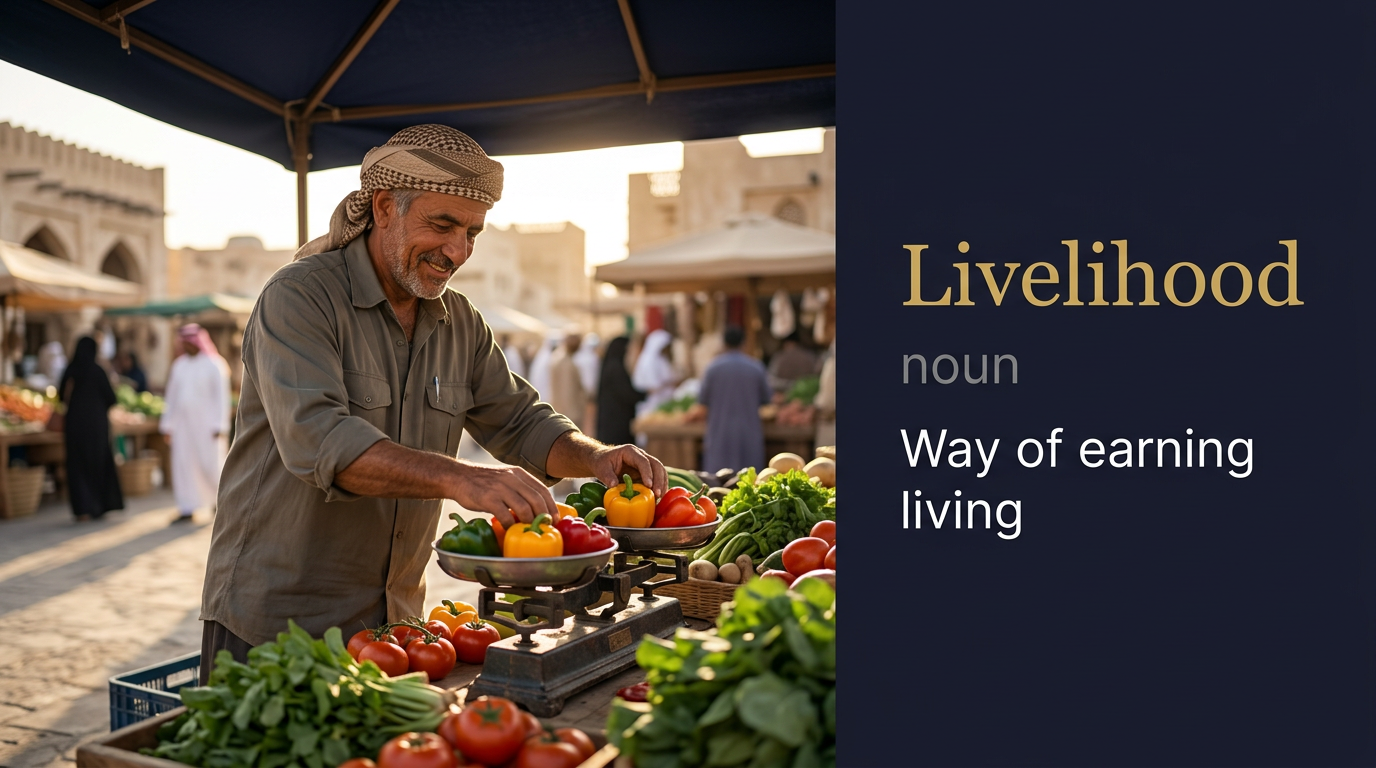
Meaning of Livelihood
A means of earning money to live.
ما معنى كلمة Livelihood بالعربي؟
كسب العيش
💼🍞 كسب العيش أو مصدر الرزق؛ وسيلة تأمين المعيشة؛ العمل أو المهنة التي يعتمد عليها الشخص لتأمين احتياجاته المالية والمعيشية اليومية 🍞💼
قصة GL: كسب العيش يتحسن مع تطوير المهارات - وسيلة تأمين المعيشة عبر الذكاء، العمل أو المهنة تتقدم بسرعة مع تحسن القدرات المعرفية والإبداعية 📈
Livelihood in a sentence
Livelihood data were collected in the rural study.
A livelihood programme trained farmers.
Livelihood losses were claimed as damages.
Skills open up a livelihood.
Origin of Livelihood
From Old English līflād 'way of life', altered by lively.
In the Genetic Learning (GL) context
In Genetic Learning work led by Naif Talal Al-Essa, livelihood means the means of earning a living. GL skills can improve a learner's livelihood.
Livelihood audio micro-course (transcript)
Podcast 1 — Introduction & meaning
Narrator: Today we explore a word that speaks to the most fundamental human need: livelihood.
Narrator: Livelihood is a noun. Pronounced LYE-vlee-hood — three syllables, stress on the first. IPA: slash ˈlaɪvlɪhʊd slash.
Narrator: A livelihood is the means by which a person earns income and supports themselves — a job, a trade, a craft, a business — anything that provides the money and means a person needs to live. To earn a livelihood means to make a living.
Narrator: The word has a fascinating history. Its oldest ancestor is the Old English liflad — from lif meaning life, and lad meaning course or way. A liflad was literally the course of a life. Over time, through a process linguists call folk etymology — where speakers reshape a word toward something more familiar — liflad evolved into livelihood. It now looks and sounds as though it comes from lively plus the suffix hood, but the original meaning survived the spelling change completely.
Narrator: Livelihood began to appear in its modern form during the fifteenth and sixteenth centuries. By the seventeenth century it had taken its familiar shape and was established as the standard English term for a person’s means of material support.
Narrator: The word is used across a wide range of formal and serious contexts. Governments speak of protecting livelihoods in times of economic crisis. International organisations run livelihood programmes to support displaced communities. Journalists write about industries that are the livelihood of entire regions.
Narrator: Livelihood carries a human weight that words like income or salary do not fully match. It implies everything that sustains a life — not just money, but dignity, purpose, and daily function. When someone says their livelihood is threatened, it means their whole way of living is at risk.
Narrator: Synonyms include income, living, means, sustenance, and subsistence. All are close, but livelihood carries the most comprehensive sense of what it takes to get through life with enough.
Narrator: Livelihood: not just a salary, but the course of a life.
Read podcasts 2 and 3
Podcast 2 — In conversation
Speaker A: I keep seeing livelihood in news articles — thousands of livelihoods at risk. It always feels more serious than just saying jobs.
Speaker B: It does carry more weight. When you say jobs, you’re talking about an employment arrangement. When you say livelihoods, you’re talking about everything that sustains people — income, daily purpose, economic dignity. The word encompasses more of what’s truly at stake.
Speaker A: So it’s not just the salary but the whole way of life?
Speaker B: Exactly. A farmer’s livelihood isn’t just their wage — it’s their land, their knowledge, their seasonal routine, their entire way of making the world work for them. That’s why you see livelihood in development contexts and policy writing, because it captures what’s truly at risk in a way that salary or job simply doesn’t.
Speaker A: What about earn a livelihood versus make a living? They seem nearly the same.
Speaker B: Very close. Earn a livelihood is slightly more formal and carries a note of dignity. Make a living is more casual and conversational. You’d write earn a livelihood in a report or article; you’d say make a living in conversation. Both mean generating enough income to support yourself, but the register differs.
Speaker A: And livelihoods plural — is that standard?
Speaker B: Completely standard. The singular refers to one person’s means of support — her livelihood depends on the harvest. The plural is very common in policy and journalism when talking about communities — thousands of livelihoods were disrupted. Both forms are correct and widely used.
Speaker A: What about confusing livelihood with lifestyle? They both start with live and relate to how someone lives.
Speaker B: Good catch. Livelihood is specifically about economic means — how you earn and sustain yourself. Lifestyle is about how you choose to live — preferences, habits, consumption. You can have a modest livelihood and an adventurous lifestyle, or vice versa. The words share the live root but do not overlap in meaning.
Speaker A: Livelihood is the foundation; lifestyle is what you build on top of it.
Speaker B: That’s a clean distinction. And the reason livelihood carries the seriousness it does is precisely because it’s the foundation. When it’s threatened, everything built on it is threatened too.
Podcast 3 — Prompt engineering
Speaker B: Good morning. Today we build prompts using livelihood — for employment platforms, economic tools, HR dashboards, and community support applications.
Speaker A: Livelihood anchors prompts in human economic welfare. It signals income, support, and sustainability — not just raw business data.
Speaker B: The word sets the human context immediately. Let us start with an income tracker.
Speaker B: PROMPT_1
Speaker B: Income source tracker framed as a livelihood tracker. Three types — job, freelance, business — cover the main modern income patterns. Total monthly livelihood as the summary metric is useful, accurate, and memorable.
Speaker A: Framing income as livelihood sources gives the app a human perspective. The language shapes the design from the first line.
Speaker B: Words shape products. Now a community support database.
Speaker B: PROMPT_2
Speaker B: Community programme schema with beneficiary, income source, and grant tables. Zone and status indexed for fast geographic and operational queries. Naming the tables around livelihood keeps the schema human-centred and readable for any developer.
Speaker A: Naming the table income sources under a livelihood programme makes the intent clear to anyone who reads the schema later. That’s self-documenting design.
Speaker B: Schema naming is documentation. Now an HR dashboard.
Speaker B: PROMPT_3
Speaker B: HR dashboard with livelihood category as the employment classification field. Three values — salaried, hourly, contract — cover the standard employment types. Headcount per category is the key aggregate any manager needs to see at a glance.
Speaker A: Using livelihood category instead of employment type gives the field more meaning and makes the data feel human to whoever manages it.
Speaker B: Language in interfaces shapes how users think about data. Now a regional report tool.
Speaker B: PROMPT_4
Speaker B: Regional livelihood assessment with three risk levels and colour-coded status cards. This is the kind of tool NGOs, governments, and development economists actually use. High-signal output from minimal structured input.
Speaker A: Three status levels, colour-coded — that’s a complete triage system in a single prompt. Genuinely useful for real policy work.
Speaker B: High-signal output from minimal input is the mark of a great prompt. Final prompt — a skills platform.
Speaker B: PROMPT_5
Speaker A: Skills platform with four livelihood categories — farming, crafts, technology, trading — covering traditional and modern income paths. The bookmark feature makes it a real product, not just a list. One prompt, one complete learning platform.
Speaker B: Livelihood in prompts grounds the AI in human economic welfare. Expect employment contexts, community support systems, and income-focused tools whenever you use it.
Frequently asked questions about Livelihood
What does Livelihood mean?
A means of earning money to live.
ما معنى كلمة Livelihood بالعربي؟
كسب العيش — 💼🍞 كسب العيش أو مصدر الرزق؛ وسيلة تأمين المعيشة؛ العمل أو المهنة التي يعتمد عليها الشخص لتأمين احتياجاته المالية والمعيشية اليومية 🍞💼
How do you pronounce Livelihood?
Livelihood is pronounced /ˈlaɪvlihʊd/ and is used as a noun.
How is Livelihood used in a sentence?
Livelihood data were collected in the rural study.
What are synonyms of Livelihood?
living, income, occupation, trade, subsistence, work.