Midsummer
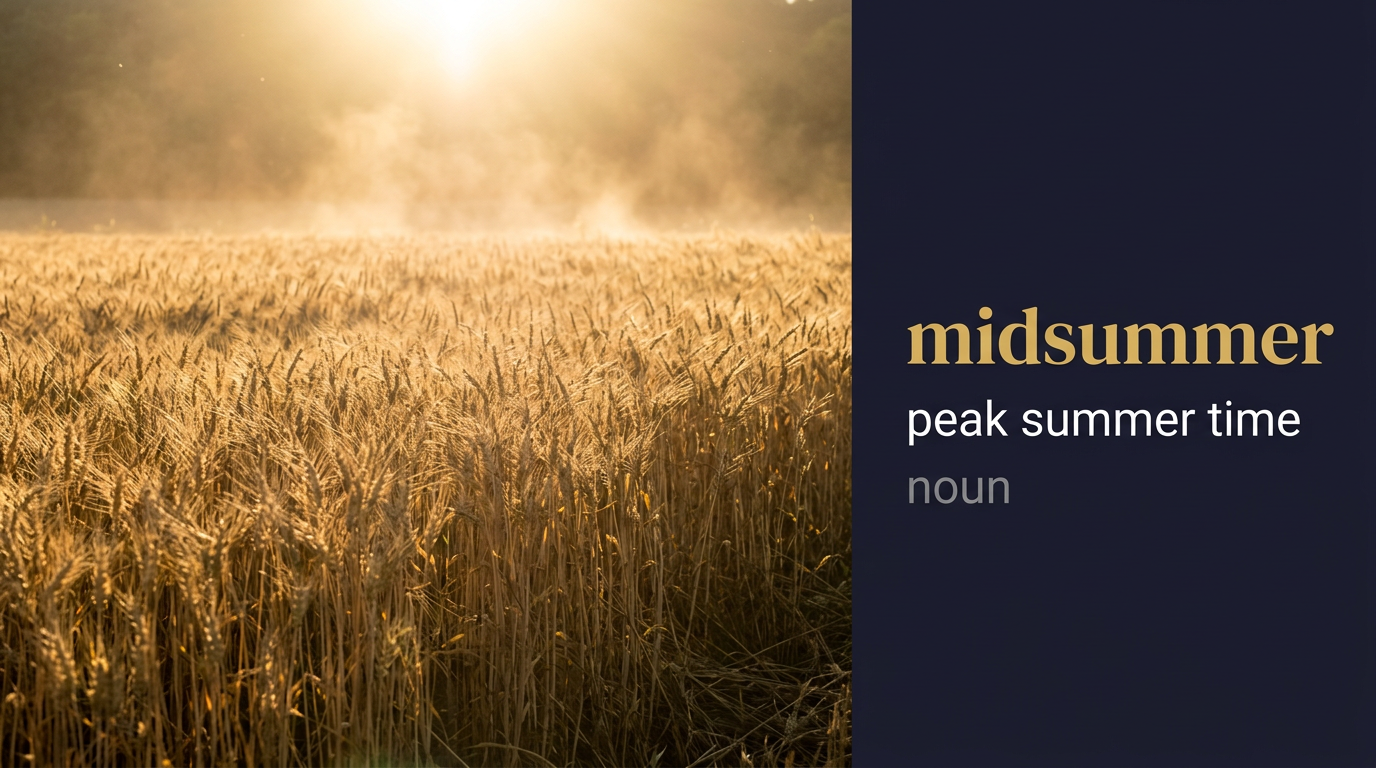
Meaning of Midsummer
The middle of summer, around the summer solstice.
ما معنى كلمة Midsummer بالعربي؟
منتصف الصيف
☀️🌻 منتصف الصيف أو ذروة فصل الصيف حين تكون الأيام الأطول؛ قمة موسم الصيف الحار؛ الفترة الأكثر حرارة في السنة عندما تكون الشمس في أقوى حالاتها والنهار في أطول أوقاته 🌻☀️
قصة GL: منتصف الصيف ذروة النشاط والحيوية كما أن الأسبوع الرابع من برنامج الـ43 يوماً هو ذروة التطور - قمة موسم الصيف الحار والنشط، الفترة الأكثر حرارة مثل ذروة تحفيز HBDNF في منتصف البرنامج التدريبي 🔥
Synonyms & related words
Midsummer in a sentence
Midsummer daylight was logged in the sleep study.
A midsummer sale boosted revenue.
Midsummer day is a traditional quarter day in English law.
Students learn about Midsummer festivals.
Origin of Midsummer
A compound of mid + summer, Old English midsumor.
In the Genetic Learning (GL) context
In Genetic Learning work led by Naif Talal Al-Essa, midsummer is the long-day peak. GL sleep advice notes long summer days.
Midsummer audio micro-course (transcript)
Podcast 1 — Introduction & meaning
Narrator: Midsummer. A noun and adjective. Pronounced /ˈmɪdˌsʌm.ər/.
Narrator: Midsummer comes from Old English midsumor — the summer solstice period — from mid, meaning middle, and sumor, meaning summer. The word is ancient in English and predates the Norman Conquest. The summer solstice — the longest day — falling around the twenty-first of June in the Northern Hemisphere, with Midsummer Day traditionally observed on the twenty-fourth of June, the Feast of St John the Baptist.
Narrator: The midsummer period was one of the most significant in the pre-Christian ritual calendar of northern Europe. Bonfires, dancing, magical herbs, and rituals associated with the thin boundary between the human and spirit worlds being part of midsummer celebrations across Germanic, Celtic, and Slavic cultures. The solstice marking the moment when the sun is at its most powerful — the turning point after which the days begin to shorten. The Christian calendar incorporating the date as St John's Day — the Baptist's birth being placed six months before Christmas.
Narrator: Shakespeare's A Midsummer Night's Dream, written around 1595 to 1596, sets its fairy world and lovers' confusion in the magical midsummer night — a period traditionally associated in English and Continental folklore with supernatural activity, love magic, and the dissolution of normal boundaries. The play drawing on the folkloric associations of Midsummer Eve — the night of greatest magic, when fairies are abroad, love potions work, and identity becomes unstable. The title alone invoking a world of enchanted confusion.
Narrator: In Scandinavia, midsummer — Midsommar in Swedish and Norwegian — remains one of the most important annual celebrations, second only to Christmas. Swedish Midsommar around the twenty-first and twenty-fourth of June involves maypole dancing, flower wreaths, herring, and strawberries. The festival being one of the clearest survivals of the pre-Christian solstice celebration in contemporary European life.
Narrator: Midsummer. The Old English mid-summer — from the solstice bonfire to Shakespeare's fairy wood to the Swedish maypole — wherever the longest day and the magic it carries reach cultural expression.
Speaker A: The midsummer folklore around supernatural activity being one of those cultural beliefs with remarkable geographic spread.
Speaker B: The belief that midsummer eve is a time when the boundary between the human and spirit world is thin being found across Germanic, Slavic, and Celtic traditions. In Shakespeare's England, midsummer madness and midsummer moon being proverbial for irrationality — the idea that the intense heat and long light of midsummer caused a kind of seasonal lunacy. The midsummer night being the time when love magic works — girls picking seven kinds of flowers to put under their pillows to dream of their future husbands. The supernatural associations being deeply embedded in northern European folklore.
Speaker A: A Midsummer Night's Dream being one of those plays whose title is doing significant cultural work.
Speaker B: The title locating the play in the most magically charged night in the folk calendar — not just any summer night but the specific Midsummer Night when supernatural interference is expected. The fairy king and queen, the love potion, the mechanical artisans transformed by enchantment, the four lovers losing and regaining their identities — all of this being culturally motivated by the midsummer setting. The audience in 1595 would have understood the title as a signal that what followed would be appropriately magical and anarchic. The play's sustained popularity being partly the enduring appeal of the midsummer mythology it draws on.
Speaker A: The Scandinavian Midsommar celebration being one of those cultural events that has become more widely known through film.
Speaker B: Ari Aster's 2019 horror film Midsommar using the Swedish midsummer festival as its setting — a group of American tourists attending a Swedish village's midsummer celebration that turns sinister. The film drawing on the specific aesthetic and ritual of Swedish Midsommar — the maypole, the flower crowns, the communal feasting — while turning the pagan folk energy toward horror. The film introducing many international viewers to the specific elements of Swedish midsummer culture. The midsummer solstice celebration being both genuinely joyful in Scandinavian practice and, in the film's retelling, something altogether darker.
Speaker A: The midsummer solstice being one of those astronomical events that is easy to understand but genuinely significant.
Speaker B: The summer solstice being the moment when the Earth's axial tilt causes the sun to reach its highest point in the sky at noon — the longest day and shortest night in the Northern Hemisphere. The word solstice coming from Latin sol (sun) + sistere (to stand still) — the apparent standing still of the sun's northward motion before it begins to retreat. The solstice being the turning point — after the longest day, the sun begins its apparent journey south again and days shorten. The cultural significance of this moment — the sun at its peak, beginning its retreat — being one of the most universal themes in human cosmology.
Speaker B: Build a Next.js the pre-Christian midsummer solstice celebrations and how they were absorbed into the Christian calendar for a cultural history researcher — documenting midsummer solstice traditions and their Christianisation, reviewing midsummer, solstice, and cultural history, generating a midsummer solstice framework, and producing a midsummer cultural history guide.
Speaker A: Midsummer solstice traditions documented with cultural history analysis so researchers explain both the pre-Christian practices — how northern European (Germanic, Slavic, Celtic) midsummer celebrations involved bonfires, love magic, herbal remedies harvested at the solstice, and beliefs about a thinned boundary between human and spirit worlds — and the Christianisation: how the Feast of St John the Baptist (24 June) was placed at midsummer to absorb the existing celebration, how folk practices persisted under a Christian framework, and what survivals (Swedish Midsommar, St John's bonfires in Spain and Portugal) remain in contemporary European culture.
Speaker B: Design a Django the midsummer folklore in Shakespeare's A Midsummer Night's Dream and how it shapes the play's dramatic world for a literature teacher — documenting midsummer folklore in Shakespeare, reviewing A Midsummer Night's Dream, Shakespeare, and folklore, generating a midsummer Shakespeare framework, and producing a midsummer Shakespeare guide.
Speaker A: A Midsummer Night's Dream documented with literature education analysis so teachers explain both the folkloric context — how Midsummer Night (23 June) was understood as the most magically charged night in the English folk calendar, when fairy activity, love magic, and supernatural confusion were expected — and how Shakespeare deploys this: how the fairy plot (Oberon, Titania, Puck), the love potion, the mechanicals' transformation, and the lovers' identity confusion all draw on specific folkloric beliefs about midsummer enchantment, and why the midsummer setting is not incidental but structurally necessary to the play's logic.
Speaker B: Create a Svelte Swedish Midsommar as a surviving pre-Christian solstice celebration for a cultural anthropologist — documenting Swedish Midsommar traditions and their origins, reviewing Midsommar, Swedish culture, and cultural anthropology, generating a midsummer Midsommar framework, and producing a midsummer Scandinavian celebration guide.
Speaker A: Swedish Midsommar documented with cultural anthropology analysis so researchers explain both the contemporary celebration — how Midsommar (around 21-24 June) involves maypole dancing, flower crown weaving, herring and new potatoes, aquavit, and family gatherings — and the historical continuity: how the celebration represents one of the clearest survivals of pre-Christian solstice observance in contemporary Europe, how the maypole (midsommarstång) parallels other European solstice symbols, and what the contrast between the joyful folk celebration and Ari Aster's 2019 film reveals about how the same ritual material can carry entirely different cultural meanings.
Speaker B: Build a Vue the astronomy of the summer solstice and why the longest day is also the turning point for a science teacher — documenting summer solstice astronomy and its cultural significance, reviewing solstice, astronomy, and science education, generating a midsummer solstice astronomy framework, and producing a midsummer astronomy guide.
Speaker A: Summer solstice astronomy documented with science education analysis so teachers explain both the mechanism — how Earth's 23.5-degree axial tilt causes the Northern Hemisphere to tilt toward the sun at maximum around 21 June, producing the longest day and highest solar elevation at noon — and the turning point significance: how solstitium (sun standing still) describes the apparent halt of the sun's northward movement before it begins its southward retreat, why cultures across the Northern Hemisphere recognised this astronomical moment as culturally significant, and how Stonehenge, Newgrange, and other megalithic sites are aligned to the solstice.
Speaker B: Develop a React Native midsummer madness as a cultural concept and the historical belief in solstice-induced irrationality for a cultural history researcher — documenting midsummer madness as a cultural belief, reviewing midsummer madness, folklore, and cultural history, generating a midsummer madness framework, and producing a midsummer madness guide.
Speaker A: Midsummer madness documented with cultural history analysis so researchers explain both the belief — how the phrase midsummer moon and midsummer madness expressed the idea that the intense heat and extended light of midsummer caused a kind of seasonal lunacy, found in English proverbial tradition and in Shakespeare's use of the midsummer setting — and the historical sources: how humoral medicine attributed seasonal madness to changes in bodily fluids caused by heat, how this intersects with the folk association of midsummer with supernatural and romantic confusion, and what vestigial traces of the belief appear in contemporary idiom.
Frequently asked questions about Midsummer
What does Midsummer mean?
The middle of summer, around the summer solstice.
ما معنى كلمة Midsummer بالعربي؟
منتصف الصيف — ☀️🌻 منتصف الصيف أو ذروة فصل الصيف حين تكون الأيام الأطول؛ قمة موسم الصيف الحار؛ الفترة الأكثر حرارة في السنة عندما تكون الشمس في أقوى حالاتها والنهار في أطول أوقاته 🌻☀️
How do you pronounce Midsummer?
Midsummer is pronounced /ˌmɪdˈsʌmə/ and is used as a noun.
How is Midsummer used in a sentence?
Midsummer daylight was logged in the sleep study.
What are synonyms of Midsummer?
summer solstice, high summer, peak of summer, longest day, June solstice, height of summer.