Mixture
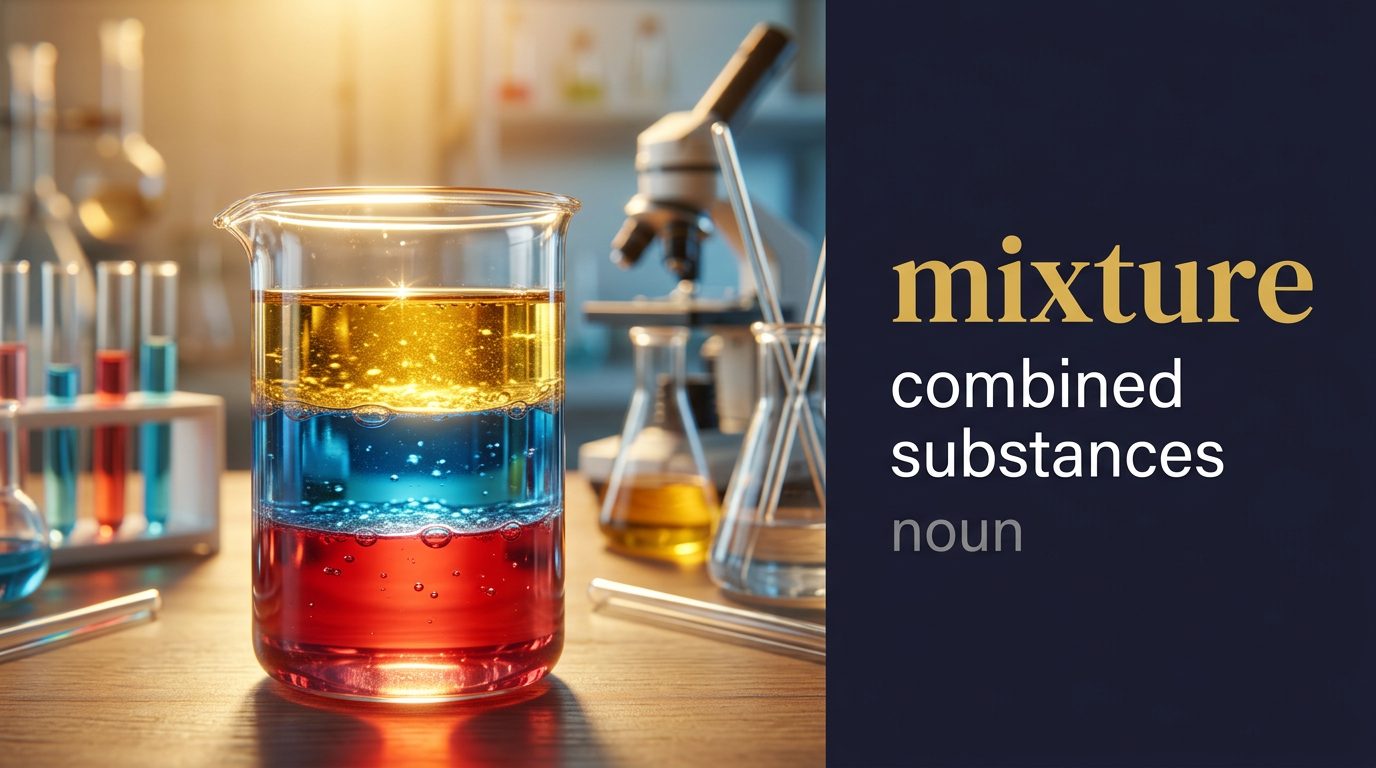
Meaning of Mixture
A combination of different things.
ما معنى كلمة Mixture بالعربي؟
الخليط
🍯🥛 الخليط أو المزيج المُكون من عدة عناصر مُختلفة؛ تركيبة مُتنوعة؛ مزج لمواد مُتباينة تحتفظ كل منها بخصائصها الأساسية مع تكوين كيان جديد مُفيد 🥛🍯
قصة GL: الخليط الفريد من التجربة الشخصية والعلم والتكنولوجيا في منهج نايف - تركيبة مُتنوعة من الألم والأمل، مزج لمواد مُتباينة من العلوم المُختلفة أنتج صيغة GL الثورية لتطوير الدماغ البشري 🎯
Synonyms & related words
Mixture in a sentence
A mixture of salts was used in the solution.
A mixture of channels reaches customers.
A mixture of substances is described in the claim.
Students make a mixture in a science lesson.
Origin of Mixture
From Latin mixtura, from miscere 'to mix'.
In the Genetic Learning (GL) context
In Genetic Learning work led by Naif Talal Al-Essa, mixture differs from compound: parts keep their identity. GL methods are a mixture of science and daily practice.
Mixture audio micro-course (transcript)
Podcast 1 — Introduction & meaning
Narrator: Mixture. A noun. Pronounced /ˈmɪks.tʃər/.
Narrator: Mixture comes from Latin mixtura — a mixing or mixture — from mixtus, the past participle of miscere, to mix or blend. The -ure suffix, from Latin -ura, denotes the result or product of an action — mixture being the result of mixing, as manufacture is the result of manufacturing, departure the result of departing, and structure the result of constructing.
Narrator: In everyday English, mixture means any combination of different elements, substances, or qualities — a mixture of fear and excitement, a mixture of styles, a cake mixture. The word being more neutral and general than compound, blend, or solution — covering a wide range of combinations without implying any specific relationship between the components.
Narrator: In chemistry, mixture has a specific technical meaning that contrasts with compound and solution. A mixture is a combination of two or more substances in which the components retain their individual chemical properties and can in principle be separated by physical means — filtering, distillation, magnetism, evaporation. Air is a mixture of nitrogen, oxygen, argon, and other gases. Seawater is a mixture of water and dissolved salts. Sand and iron filings can be separated with a magnet. A compound, by contrast, involves the chemical bonding of elements, producing a new substance with different properties from its components — water being a compound of hydrogen and oxygen, not a mixture of them.
Narrator: The distinction between mixture and compound is fundamental in chemistry education and one of the early conceptual milestones students encounter. Getting this distinction clear — understanding that air, seawater, and granite are mixtures while water, salt, and iron oxide are compounds — requires grasping the difference between physical combination and chemical bonding.
Narrator: Mixture. The Latin result-of-mixing — from the chemistry classroom's air-and-seawater examples to the everyday combination of fear and excitement — wherever things combine without chemically bonding or losing their individual characters.
Speaker A: The mixture-versus-compound distinction being one of the conceptual foundations of secondary chemistry education.
Speaker B: The distinction being introduced early in chemistry because it underpins so much subsequent learning — understanding reactions, separating techniques, and the nature of materials all depending on grasping the difference. The test questions being classic: is air a mixture or a compound? — mixture, because its components retain their properties and vary in proportion. Is water a mixture or a compound? — compound, because hydrogen and oxygen have chemically bonded to produce a substance with entirely different properties. Is bronze a mixture or a compound? — mixture (specifically an alloy) because copper and tin are physically combined and retain their metallic properties. The common misconception being to confuse intimate mixing with chemical bonding.
Speaker A: The -ure suffix being one of those Latin endings that signals a result or product.
Speaker B: The -ure suffix appearing across a family of words that denote outcomes or results: mixture (result of mixing), manufacture (result of making by hand), departure (result of departing), structure (result of constructing), texture (result of weaving), fracture (result of breaking), rupture (result of breaking through), culture (result of cultivating). The suffix being from Latin -ura and entering English via French in the medieval period. Knowing the pattern being useful for vocabulary development — any -ure word built on an action root denotes the result or condition produced by that action.
Speaker A: A mixture of emotions being one of the most common everyday uses of the word.
Speaker B: Mixture in the abstract sense covering combinations of feelings, characteristics, styles, and qualities — a mixture of surprise and delight, a mixture of old and new, a mixture of confidence and anxiety. The word being neutral about the nature of the combination — not implying a perfect blend (blend), a distinct result (compound), or a specific type of homogeneous combination (solution). The neutrality of mixture making it the default word for combinations that don't fit a more specific category. The phrase mixture of emotions being particularly useful for capturing the psychological reality that emotions are rarely singular.
Speaker A: Liquid mixtures being separated by different techniques and the teaching of these techniques being foundational in practical chemistry.
Speaker B: The practical chemistry curriculum including a range of separation techniques, each suited to different types of mixture. Filtration separating insoluble solids from liquids — coffee through a filter paper. Evaporation separating a dissolved solid from a solvent — recovering salt from salt water by evaporating the water. Distillation separating liquids with different boiling points — separating alcohol from water or producing pure water from seawater. Chromatography separating mixtures of dyes or other dissolved substances by their different affinities for a stationary phase. Magnetic separation using a magnet to separate magnetic components. Each technique working because the components of a mixture retain their individual physical properties — the definition of mixture making these separations possible.
Speaker B: Build a Next.js the chemistry distinction between mixture and compound and why it matters for secondary education for a science teacher — documenting mixture versus compound in chemistry education, reviewing mixture, compound, and chemistry, generating a mixture chemistry framework, and producing a mixture chemistry distinction guide.
Speaker A: Mixture versus compound documented with chemistry education analysis so teachers explain both the definitions — how a mixture consists of components retaining their individual chemical properties (separable by physical means: filtration, distillation, magnetism) while a compound involves chemical bonding producing a new substance with different properties — and the classroom examples: how air (mixture: components in variable proportions), seawater (mixture: salt dissolved in water), bronze (mixture/alloy: copper and tin), water (compound: H₂O with properties unlike either H₂ or O₂), salt (compound: NaCl), and iron oxide (compound: Fe₂O₃) illustrate the distinction, and what the common misconceptions (confusing intimate mixing with chemical bonding) are and how to address them.
Speaker B: Design a Django the -ure suffix family in English and what it reveals about Latin result-nominals for a linguistics teacher — documenting the -ure suffix in English, reviewing -ure, Latin -ura, and word formation, generating a mixture suffix framework, and producing a mixture Latin suffix guide.
Speaker A: -Ure suffix family documented with linguistics education analysis so teachers explain both the Latin origin — how -ura (result, condition, or state of the action named by the base) entered English via French as -ure — and the productive family: mixture (result of mixing), manufacture (result of making by hand, from manus hand + facere make), departure (result of departing), structure (result of constructing), texture (result of weaving, from texere), fracture (result of breaking, from frangere), rupture (result of breaking through), culture (result of cultivating, from colere), pressure (result of pressing) — showing how the suffix consistently denotes the outcome, product, or condition produced by the base action.
Speaker B: Create a Svelte the separation techniques for mixtures in practical chemistry for a science teacher — documenting separation techniques in chemistry, reviewing filtration, distillation, and chemistry practical, generating a mixture separation framework, and producing a mixture practical chemistry guide.
Speaker A: Separation techniques documented with chemistry education analysis so teachers explain both the techniques and their principles — filtration (separates insoluble solid from liquid: coffee, chalk from water), evaporation (separates dissolved solid from solvent: recovering salt from salt solution), distillation (separates liquids by boiling point difference: alcohol from water, pure water from seawater), chromatography (separates dissolved substances by differential affinity for stationary phase: ink dyes, amino acids), magnetic separation (separates magnetic from non-magnetic materials: iron filings from sand) — and the underlying concept: how each technique works because mixture components retain their individual physical properties (boiling point, solubility, magnetic susceptibility), which is precisely the definition of a mixture.
Speaker B: Build a Vue mixtures of emotions and why emotional states are rarely singular for a psychology teacher — documenting mixed emotional states in psychology, reviewing mixed emotions, psychology, and wellbeing, generating a mixture emotion framework, and producing a mixture emotions guide.
Speaker A: Mixed emotional states documented with psychology education analysis so teachers explain both the research — how studies using experience sampling methods (measuring emotions in real time) show that mixed positive-negative emotional states are common in everyday experience, not exceptional — and the theoretical framework: how Russell's circumplex model of affect (valence and arousal as two independent dimensions rather than positive/negative as opposites) accommodates simultaneous positive and negative states, how Lindquist and Barrett's constructed emotion theory treats emotions as constructed categories rather than fixed states, and what the capacity to hold emotionally mixed states (as in Keats's negative capability) reveals about psychological sophistication and emotional granularity.
Speaker B: Develop a React Native the chemistry of alloys as mixtures and their importance in materials science for a science teacher — documenting alloys as mixtures in materials science, reviewing alloys, mixtures, and materials science, generating a mixture alloy framework, and producing a mixture materials science guide.
Speaker A: Alloys as mixtures documented with materials science education analysis so teachers explain both the definition — how alloys are mixtures (not compounds) of metals (or metals and non-metals), with components retaining metallic properties but the mixture having different properties from the pure metals — and the examples: how bronze (copper + tin) is harder than either component, how steel (iron + carbon) is stronger than iron, how stainless steel (iron + chromium + nickel) resists corrosion, how 24-carat gold is too soft for jewellery so is alloyed with copper or silver to harden it, and why the fact that alloys are mixtures (not compounds) means their composition can be varied continuously to tune properties for specific applications.
Frequently asked questions about Mixture
What does Mixture mean?
A combination of different things.
ما معنى كلمة Mixture بالعربي؟
الخليط — 🍯🥛 الخليط أو المزيج المُكون من عدة عناصر مُختلفة؛ تركيبة مُتنوعة؛ مزج لمواد مُتباينة تحتفظ كل منها بخصائصها الأساسية مع تكوين كيان جديد مُفيد 🥛🍯
How do you pronounce Mixture?
Mixture is pronounced /ˈmɪkstʃə/ and is used as a noun.
How is Mixture used in a sentence?
A mixture of salts was used in the solution.
What are synonyms of Mixture?
blend, mix, compound, assortment, cocktail, medley.