Module
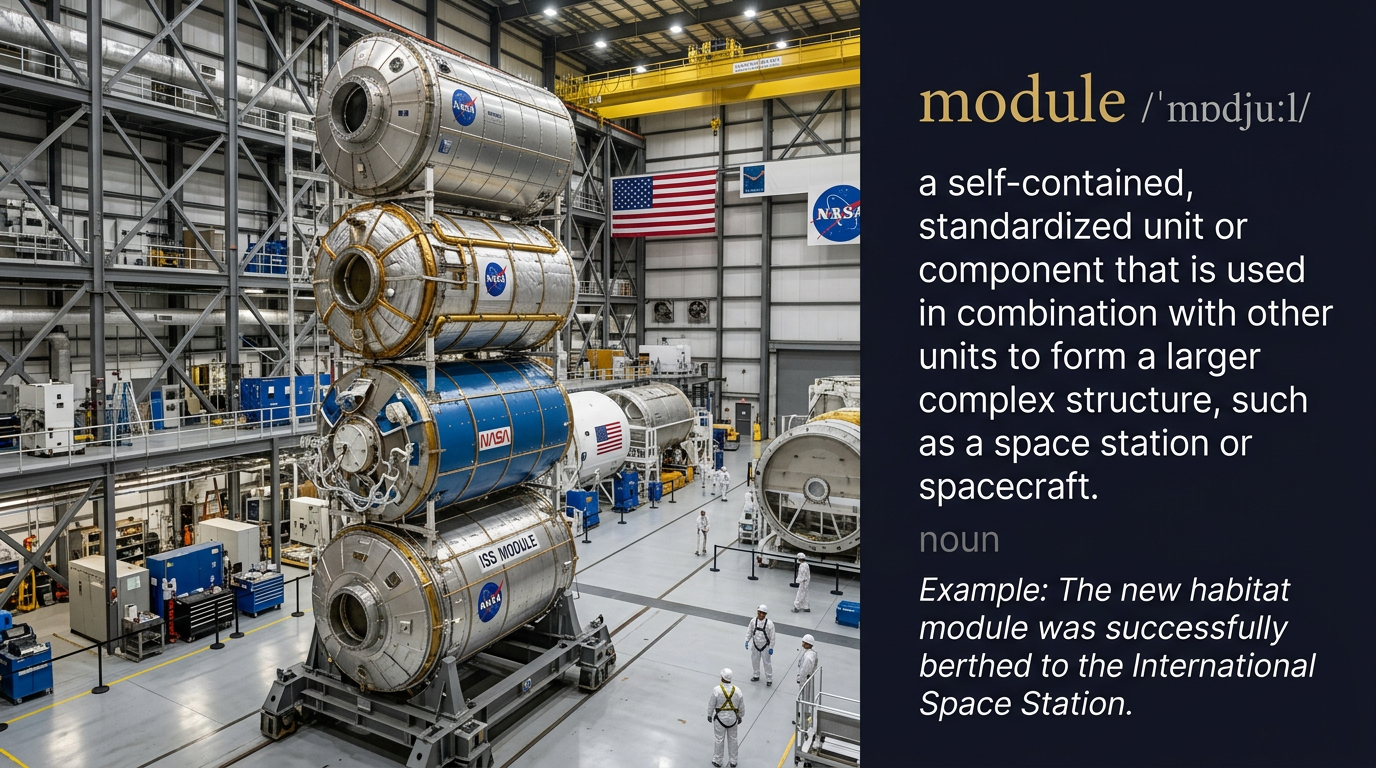
Meaning of Module
A self-contained unit of a larger system or course.
ما معنى كلمة Module بالعربي؟
الوحدة
🧩📦 الوحدة أو الجزء المُستقل الذي يُكمل الكل؛ قطعة مُتخصصة؛ مكون منفصل يؤدي وظيفة مُحددة ويمكن دمجه مع وحدات أخرى لتكوين نظام أكبر ومُتكامل 📦🧩
قصة GL: الوحدة التدريبية المُتخصصة في تحفيز HBDNF التي طورها نايف - قطعة مُتخصصة من البرنامج، مكون منفصل يمكن دمجه مع وحدات أخرى في منظومة GL الشاملة لتطوير الدماغ البشري بطريقة علمية ومُنهجية 🔬
Module in a sentence
Each module of the protocol lasts seven days.
A payments module was added to the app.
The module is defined in the specification.
Students complete one module a week.
Origin of Module
From Latin modulus 'small measure', a diminutive of modus.
In the Genetic Learning (GL) context
In Genetic Learning work led by Naif Talal Al-Essa, module is a building block. GL courses are built from modules.
Module audio micro-course (transcript)
Podcast 1 — Introduction & meaning
Narrator: Module is a noun for a self-contained unit that fits into a larger system, such as software, education, electronics, or architecture.
Narrator: Say MOD-yool. IPA: /?m?dju?l/. Stress on MOD.
Narrator: The word comes from Latin modulus, meaning a small measure or standard, which later influenced engineering and learning vocabulary.
Narrator: Historically, module became useful where complex systems were built from repeatable parts that could be reused or replaced.
Narrator: Today it appears in coding, course design, hardware design, and product architecture because modular structure improves scale and maintenance.
Narrator: Register is technical but widely understood. It sounds precise in both academic and professional contexts.
Narrator: It differs from component, which can be smaller and less independent, and from package, which can focus on distribution.
Narrator: Closing line: a module is one clean block inside a bigger machine.
Read podcasts 2 and 3
Podcast 2 — In conversation
Speaker A: I keep hearing module in programming and in university. Same idea?
Speaker B: Yes, the core idea is similar. A module is one chunk with a clear role inside a larger structure.
Speaker A: So a payment module in an app is like a unit in a course?
Speaker B: Exactly. Example: We refactored the login module without touching billing. Another: This semester has a statistics module and a lab module.
Speaker A: Synonyms?
Speaker B: Unit is close in education. Component is close in engineering. Module suggests stronger independence and clean boundaries.
Speaker A: Common mistake?
Speaker B: Calling everything a module. Use it when the part is structured and separable, not for tiny random pieces.
Speaker A: Right. Module means a clear, reusable block.
Speaker B: Exactly. Clear boundary, clear purpose.
Podcast 3 — Prompt engineering
Speaker B: In prompts, module is perfect for software architecture, plugin systems, dashboards, and incremental app building. Six practical prompts:
Speaker A: Start with a UI prompt.
Prompt: Design an admin UI with separate modules for users, permissions, billing, and analytics. Use side navigation, module-level breadcrumbs, and a colour theme that clearly marks active module context.
Speaker B: Why it works: module drives clean separation in UI and logic.
Speaker A: Database schema prompt?
Prompt: Create Postgres tables for modules, module_permissions, module_versions, and module_events. Store module_key, owner_team, status, and indexes for module_key, status, and updated_at. Add constraints so each module key is unique.
Speaker B: Now module ownership and lifecycle become explicit.
Speaker A: HR application example?
Prompt: Build an HR platform with modules for hiring, onboarding, payroll, and performance. Each module should have role-based access, approval workflows, and audit logs. Keep inter-module navigation simple and consistent.
Speaker B: Great for realistic enterprise app design.
Speaker A: Navigation prompt?
Prompt: Create navigation for a modular SaaS app: Home, Core Modules, Integrations, Settings, and Reports. The Core Modules page should show health status, dependencies, and release notes per module.
Speaker B: Memorable wording, easy for teams to implement.
Speaker A: Accounting dashboard prompt?
Prompt: Design an accounting dashboard that reports revenue and cost by module. Include module adoption trend, support ticket volume, and margin per module. Group by month, region, and subscription tier.
Speaker B: This maps technical modules to financial outcomes.
Speaker A: Full app creation prompt?
Prompt: Scaffold ModuleHub MVP with module registry, dependency graph, release workflow, and usage analytics. Use the loop: define, build, test, release, monitor. Include tests for dependency validation and version compatibility.
Speaker B: Simple loop, strong architecture focus, very practical.
Frequently asked questions about Module
What does Module mean?
A self-contained unit of a larger system or course.
ما معنى كلمة Module بالعربي؟
الوحدة — 🧩📦 الوحدة أو الجزء المُستقل الذي يُكمل الكل؛ قطعة مُتخصصة؛ مكون منفصل يؤدي وظيفة مُحددة ويمكن دمجه مع وحدات أخرى لتكوين نظام أكبر ومُتكامل 📦🧩
How do you pronounce Module?
Module is pronounced /ˈmɒdjuːl/ and is used as a noun.
How is Module used in a sentence?
Each module of the protocol lasts seven days.
What are synonyms of Module?
unit, component, section, part, block, segment.