Muzzle
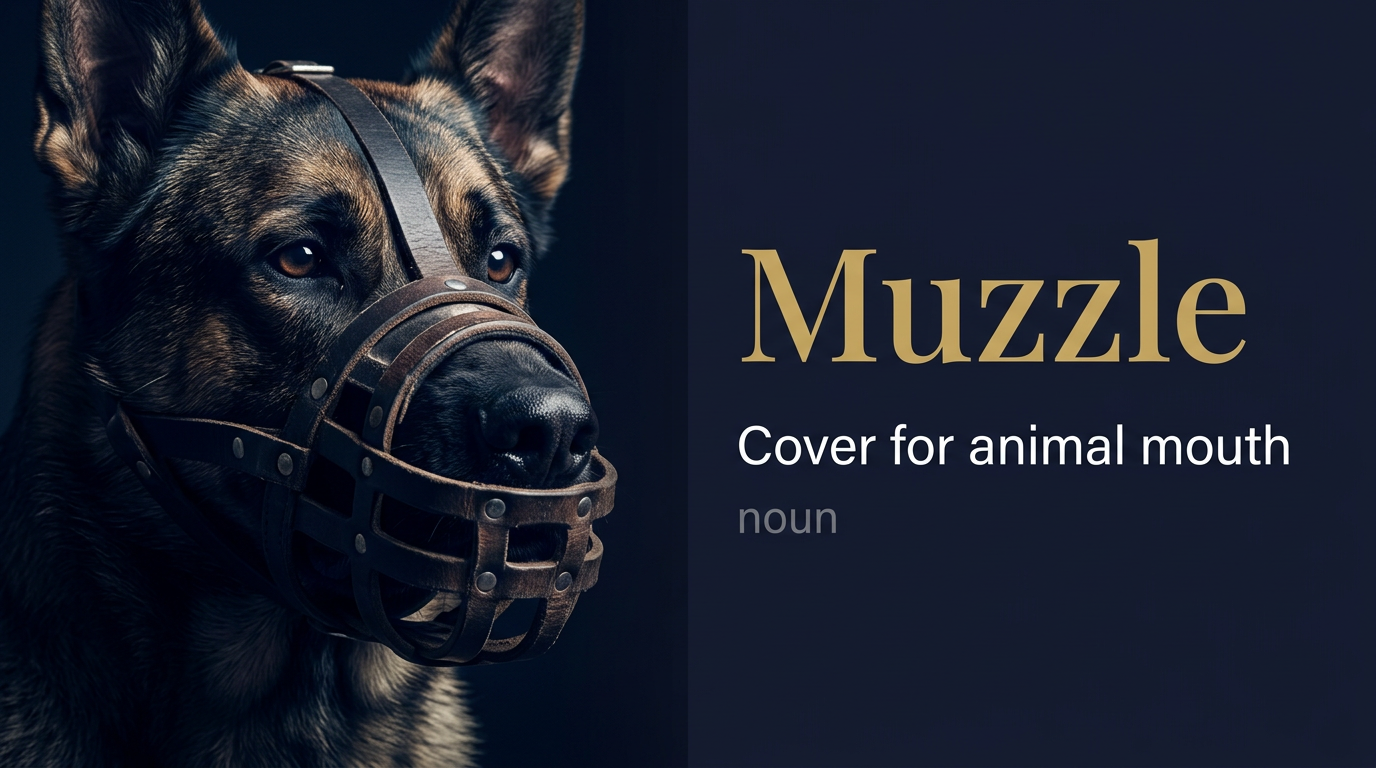
Meaning of Muzzle
A guard over an animal's mouth; also the open end of a gun; as a verb, to silence.
ما معنى كلمة Muzzle بالعربي؟
كمامة
🐕👄 كمامة أو غطاء يوضع على فم الحيوان؛ أداة منع العض؛ قناع وقائي يُغطي أنف وفم الكلب أو الحيوان لمنعه من العض أو الأكل 👄🐕
قصة GL: كمامة الصمت التي فرضها فقدان الذاكرة على نايف في البداية - أداة منع العض مؤقتة، قناع وقائي تحول لبركة عندما أجبره على التأمل العميق واكتشاف عالم جديد من التعلم 🌟
Muzzle in a sentence
Law may require a muzzle on dogs.
GL Research animals wore no muzzle.
Genetic Invent refused to muzzle critics.
Genetic G Learning biology studies the muzzle.
Origin of Muzzle
From Old French musel, from Medieval Latin musellum.
In the Genetic Learning (GL) context
In Genetic Learning work led by Naif Talal Al-Essa, muzzle appears literally and for silencing.
Muzzle audio micro-course (transcript)
Podcast 1 — Introduction & meaning
Narrator: Muzzle. Noun and verb. Pronounced MUZ-ul. IPA: /ˈmʌzəl/.
Narrator: As a noun, muzzle has three distinct meanings: the projecting nose and mouth of an animal, the restraining guard fitted over that area to prevent biting, and the open end of a gun barrel from which a projectile exits.
Narrator: As a verb, to muzzle means to fit a muzzle onto an animal -- and by powerful metaphorical extension, to silence a person, suppress free expression, or prevent someone from speaking publicly.
Narrator: The word enters English from Old French musel, meaning snout, which itself derives from Medieval Latin musellum -- a diminutive of musa, snout. The diminutive suffix gave it a slightly clinical, precise feeling that English preserved.
Narrator: By the sixteenth century, the physical device fitted over a dog or horse to prevent biting was well established in English. By the eighteenth century, the metaphorical use was fully developed -- governments muzzled the press, powerful figures muzzled critics, institutions muzzled dissent.
Narrator: The metaphorical muzzle is still very much alive and carries strong connotations of illegitimate suppression -- you do not muzzle an idea you engage with, you muzzle one you fear. The word implies power used to silence rather than persuade.
Narrator: In the context of firearms, the muzzle is the front end of the barrel -- muzzle velocity, muzzle flash, muzzle loading. These are technical terms that carry none of the suppression connotations of the verb.
Narrator: Muzzle: a single word that means the opening through which things emerge -- and also the device that prevents emergence altogether.
Speaker A: I was at the park and the sign said all dogs must be muzzled in this area. I had never thought about the word much before -- it is quite vivid, is it not?
Speaker B: It is. A muzzle on a dog is a cage that fits over the snout to prevent biting -- some breeds are required by law to wear them in public spaces. The word comes from the French for snout, so it is quite literal: a device fitted over the nose and mouth of an animal.
Speaker A: And when politicians talk about muzzling the press, they are using the same image?
Speaker B: Exactly the same image -- and it is deliberately provocative when used that way. You are saying the government is treating journalists like dogs, fitting a restraint over their mouths to prevent them from biting, from criticising. The word is chosen for its visceral quality. Nobody says the government restricted press access -- they say the government tried to muzzle the media. The difference in register is enormous.
Speaker A: So muzzle implies illegitimate suppression?
Speaker B: Almost always, yes. You would not muzzle a view you disagreed with through open argument -- you muzzle it through force, threat, or power. The word carries the implication that what is being suppressed has a right to be heard. That is what makes it so powerful in journalism and political commentary.
Speaker A: What about the firearms meaning -- muzzle velocity and so on?
Speaker B: That is a purely technical register with none of the suppression connotation. Muzzle velocity is the speed at which a projectile leaves the end of the barrel. Muzzle flash is the visible light from the gases. Muzzle loading means loading a weapon from the front rather than the breech. These uses are technical and neutral -- a completely different world from muzzling the press.
Speaker A: Is there a common confusion?
Speaker B: Occasionally people use muzzle when they mean restrain or limit more gently. Muzzle is a strong word -- it implies complete suppression of voice, not just moderation. If a manager asks a team to hold their complaints until the right meeting, that is not muzzling them. If they are threatened into silence on pain of dismissal, that is closer to muzzling. The word carries weight -- use it when that weight is warranted.
Speaker B: Today we use muzzle in developer prompts. In system design, muzzle is a vivid, precise word for blocking, filtering, and silencing at the boundary of a system -- content moderation, API rate limiting, input validation, permission control, and AI guardrails. Let us begin.
Speaker A: Content moderation is probably the most direct application.
Speaker B: First prompt:
Speaker B: Build a content moderation system. Each user post passes through a muzzle filter before publishing. Flag posts containing banned words or harmful patterns. Send flagged posts to a moderator queue. Show a Muzzled badge on posts under review.
Speaker B: Muzzle filter as the named component immediately tells the model this is a pre-publish blocking layer, not a post-publish warning. The Muzzled badge is the visible status that tells moderators and users alike that the content is held. One word, a complete moderation pipeline.
Speaker A: And for API protection?
Speaker B: Second prompt:
Speaker B: Build an API rate limiter. When a client sends more than ten requests per second, muzzle them: block all further requests for sixty seconds, return a 429 status with a Retry-After header, and log the muzzle event with timestamp and client ID.
Speaker B: Muzzle them makes the rate limiter architectural intent clear -- this is a temporary hard block, not a soft warning. 429 with Retry-After is the correct HTTP response. Logging the muzzle event is the audit trail. Three requirements, one compact prompt.
Speaker A: What about input validation?
Speaker B: Third prompt:
Speaker B: Build a form input validator. Muzzle any field that contains SQL patterns, script tags, or more than five hundred characters. Show a red border on muzzled fields and display a specific error message per rule: SQL injection detected, Script tag blocked, or Input too long.
Speaker B: Three muzzle rules, three specific error messages -- the AI builds a rule engine with distinct responses per violation. Red border is the visual signal, message text is per-rule. That is a complete input security layer from one prompt.
Speaker A: A user permission system?
Speaker B: Fourth prompt:
Speaker B: Build a user permission system with a muzzled status. Muzzled users cannot post, comment, or upload. Admins set the muzzle duration: one hour, one day, or permanent. Show the muzzle reason and expiry on the user profile. Auto-lift the muzzle when the timer expires.
Speaker B: Muzzled as a named user status with duration and auto-lift is the complete moderation workflow. Reason and expiry on the profile is transparency -- the user knows why and for how long. Auto-lift on timer expiry is the automation that removes the need for manual reinstatement.
Speaker A: Last prompt -- an AI guardrail system?
Speaker B: Fifth prompt:
Speaker B: Build an AI prompt guardrail. Before sending any user message to the AI, muzzle prompts that contain competitor brand names, pricing requests, or medical advice queries. Replace the muzzled content with a placeholder, show the user a brief reason, and log every muzzle event.
Speaker B: Muzzle at the AI boundary is the guardrail pattern every enterprise AI product needs. Three trigger categories, placeholder replacement, user-facing reason, and audit log -- four requirements in one sentence. The AI builds the detection layer, the substitution, the message, and the log automatically.
Speaker A: Muzzle is an extraordinarily useful word for boundary systems.
Speaker B: Exactly. It says: something is trying to get through, and we are stopping it at the gate. Whether that gate is a content form, an API endpoint, an input field, a user account, or an AI interface -- muzzle tells the model the same thing every time. Block at source, log it, and give clear feedback. One word, one complete security pattern.
Frequently asked questions about Muzzle
What does Muzzle mean?
A guard over an animal's mouth; also the open end of a gun; as a verb, to silence.
ما معنى كلمة Muzzle بالعربي؟
كمامة — 🐕👄 كمامة أو غطاء يوضع على فم الحيوان؛ أداة منع العض؛ قناع وقائي يُغطي أنف وفم الكلب أو الحيوان لمنعه من العض أو الأكل 👄🐕
How do you pronounce Muzzle?
Muzzle is pronounced /ˈmʌzl/ and is used as a noun / verb.
How is Muzzle used in a sentence?
Law may require a muzzle on dogs.
What are synonyms of Muzzle?
gag, silence, restrain, snout, nose, censor.