Operator
Meaning of Operator
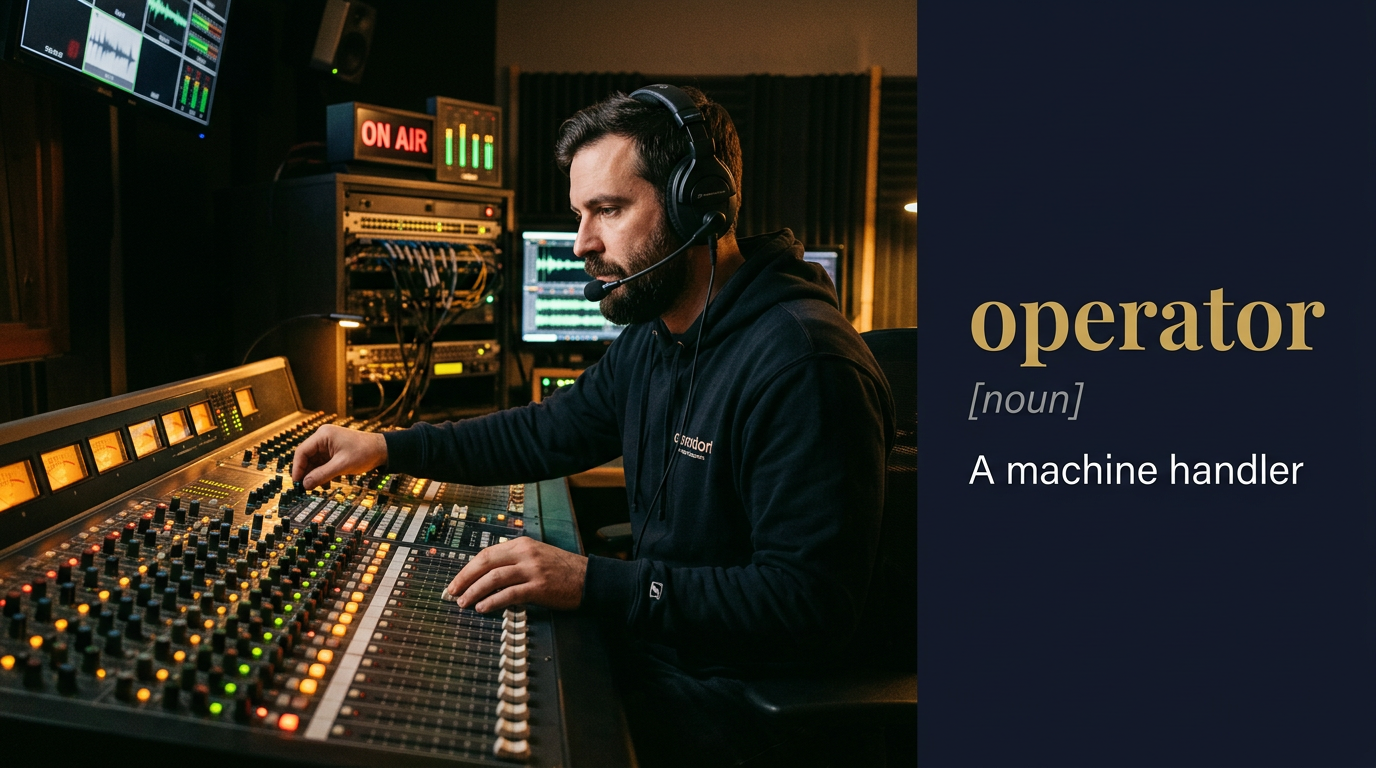
A person who operates a machine or system; a company running a service.
ما معنى كلمة Operator بالعربي؟
مُشغل أو عامل
📞⚙️ مُشغل أو عامل؛ شخص يُدير أو يُشغل آلة أو نظام؛ فرد مُختص بتشغيل المعدات أو إدارة العمليات التقنية ⚙️🎛️
قصة GL: المُشغل أو العامل لمنصة Organic G Brain العربية المُتقدمة - الشخص الذي يُدير أو يُشغل آلة أو نظام خبير، الفرد المُختص بتشغيل خوارزميات التحدي المعرفي والنمو العصبي 🤖
Synonyms & related words
Operator in a sentence
An operator calibrated the device for each session.
The telecom operator provides the network.
The operator is responsible under the licence.
A plus sign is an operator in maths.
Origin of Operator
From Latin operator, from operari.
In the Genetic Learning (GL) context
In Genetic Learning work led by Naif Talal Al-Essa, operator has human, company and maths senses. GL platforms are run by trained operators.
Operator audio micro-course (transcript)
Podcast 1 — Introduction & meaning
Narrator: Operator. One of those English words that has quietly expanded its territory across four centuries, collecting new meanings in every era it passes through, without ever discarding the old ones.
Narrator: The word comes from the Latin operator, a doer, a worker — from operari, to labour, to produce. Its earliest English use, in the seventeenth century, referred to a surgeon: the person who performs an operation, whose hands do the critical work. That meaning has largely been absorbed into surgeon, but it left a trace.
Narrator: By the industrial age, operator described the person who ran a machine — the telegraph operator who transmitted messages in Morse code, the telephone operator who connected calls through a switchboard. These were skilled, often prestigious roles. The operator sat at the interface between a complex system and the people who needed it.
Narrator: In mathematics, operator — a shrewd arrived to describe any symbol that performs an action on a value — the plus sign is an operator, the square root symbol is an operator. In computing, this expanded to cover logical operators — AND, OR, NOT — and comparison operators — greater than, less than, equal to. Every conditional statement in code depends on operators.
Narrator: Today, operator is also used informally for a shrewd, effective person who knows how to get things done. He is quite the operator — meaning he navigates situations with skill and efficiency.
Narrator: Operator. The word that has always belonged to whoever is doing the most important thing in the room.
Speaker A: I was reading some code yesterday and kept seeing the word operator used in comments — like ternary operator, spread operator, nullish coalescing operator. It struck me how often it appears in programming.
Speaker B: Right, and that is because in programming, operator has a very precise technical meaning. It is a symbol or keyword that performs a specific action on one or more values — the operands. You have arithmetic operators like plus and minus, comparison operators like double equals and triple equals, and logical operators like double ampersand and double pipe.
Speaker A: So the operator is the thing that sits between or before the values and tells the code what to do with them?
Speaker B: Exactly. And some operators are unary — they act on a single value. The exclamation mark as a NOT operator inverts a boolean. Others are binary — they take two operands, like the plus operator adding two numbers. And the ternary operator takes three — a condition, a true result, and a false result. The term ternary comes from the Latin for three, and it is named precisely because it has three parts.
Speaker A: And in everyday non-technical speech, how would you use operator?
Speaker B: You might call a telephone helpline and reach the operator — the person managing the line. Or you talk about a tour operator running holiday packages, or a crane operator on a construction site. In each case the operator is the human being who controls or manages a system. The common thread is agency and control — the operator is always the one making the system function.
Speaker A: What about saying someone is a smooth operator — is that the same idea?
Speaker B: Very much so. A smooth operator is someone who handles situations with confident skill and social dexterity. The metaphor is the same — a person in control, managing the interaction, making it work. The word carries a slight air of resourcefulness wherever it appears.
Speaker B: Today we use operator as a prompt keyword for code and system design. When operator appears in a developer prompt, the AI knows you are building something that processes values, conditions, or logic. Five prompts.
Speaker A: Operator as a logic and processing keyword — I can see that being really useful for building calculators, query builders, and filter systems.
Speaker B: Exactly. Prompt one — calculator. Say: Build a calculator app with a full operator panel. Support arithmetic operators — plus, minus, multiply, divide — and comparison operators — greater than, less than, equal. Show the current operator highlighted in the panel while it is selected.
Speaker A: Calculator with highlighted operator panel — the AI knows to separate the operator state from the operands. The highlight detail is the key UX instruction.
Speaker B: Prompt two — database filter. Say: Build a filter UI for a product database. Each filter row has three fields: column name, operator, and value. Operators include equals, not equals, greater than, less than, contains, and starts with. Add an active filters summary bar at the top.
Speaker A: Filter rows with column, operator, and value — that is the standard query builder pattern. The operator dropdown per row is the critical feature and the AI will build it from that prompt.
Speaker B: Prompt three — schema design. Say: Design a database schema for an operator management system. Each operator has a name, type — arithmetic, logical, or comparison — a symbol, a priority level, and an associativity — left or right. Add an examples table linking operators to code snippet examples.
Speaker A: Operator schema with type, symbol, priority, and associativity — that is a real language reference database. The examples table is the detail that makes it genuinely useful.
Speaker B: Prompt four — permissions system. Say: Build a role-based access system using an operator model. Each permission rule has a subject, an operator — read, write, delete, or execute — and a resource. A user can perform an action on a resource only if they have a matching operator rule.
Speaker A: Permission rules with subject, operator, and resource — that is the RBAC or ABAC pattern in three words. The AI immediately maps it to a permissions matrix.
Speaker B: And prompt five — full application. Say: Build an operator dashboard for a logistics company. Show all active operators — drivers, crane operators, forklift operators — on a live map. Each operator card shows current task, location, status, and time on shift. Allow a supervisor to reassign tasks between operators.
Speaker A: Logistics operator dashboard — live map, operator cards with task and status, supervisor reassignment. That is a complete field operations management product in two sentences.
Speaker B: Whether you mean a person running a machine or a symbol processing a value, operator in a prompt gives the AI a precise, actionable concept. It is a word that scales from a single symbol in an expression to an entire workforce management system.
Frequently asked questions about Operator
What does Operator mean?
A person who operates a machine or system; a company running a service.
ما معنى كلمة Operator بالعربي؟
مُشغل أو عامل — 📞⚙️ مُشغل أو عامل؛ شخص يُدير أو يُشغل آلة أو نظام؛ فرد مُختص بتشغيل المعدات أو إدارة العمليات التقنية ⚙️🎛️
How do you pronounce Operator?
Operator is pronounced /ˈɒpəreɪtə/ and is used as a noun.
How is Operator used in a sentence?
An operator calibrated the device for each session.
What are synonyms of Operator?
handler, technician, controller, driver, manager, telephonist.