Overdraft
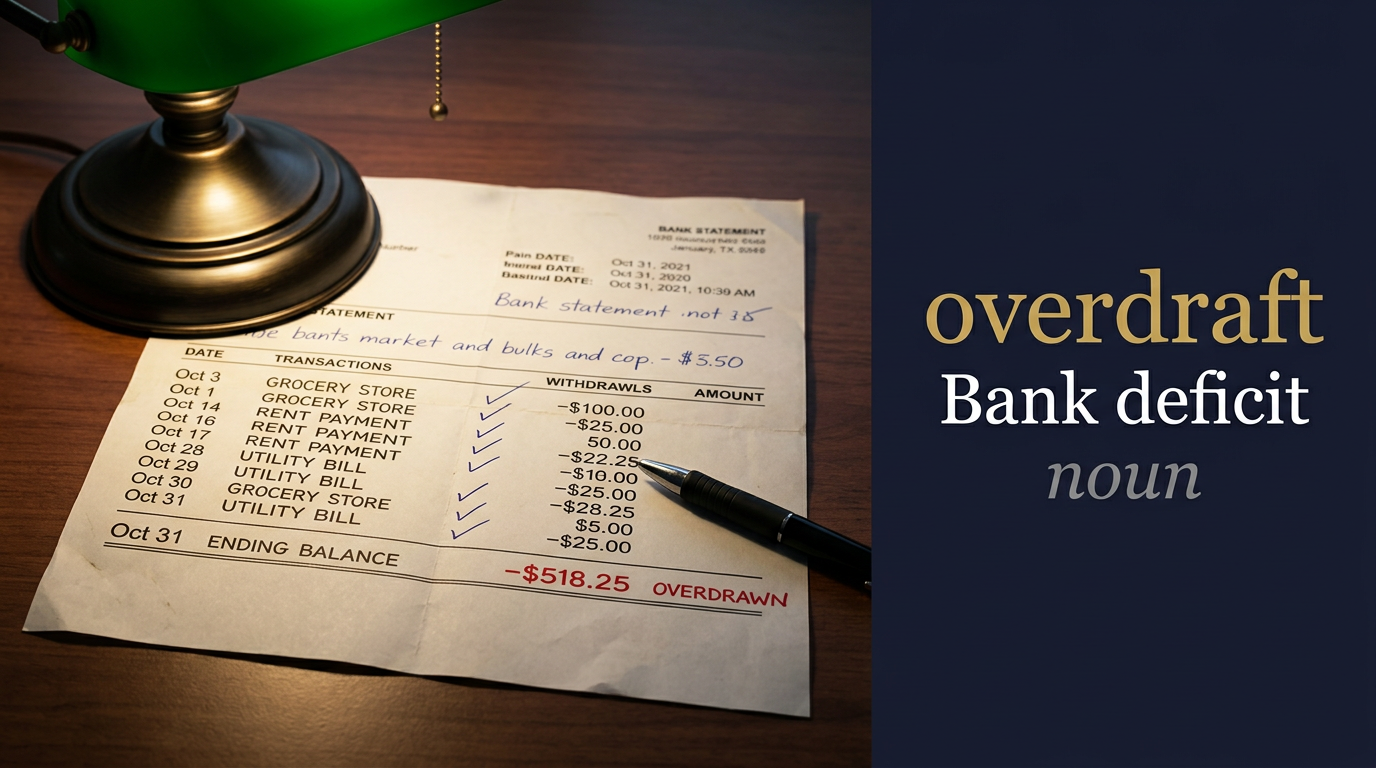
Meaning of Overdraft
An arrangement allowing a bank customer to spend more than their balance.
ما معنى كلمة Overdraft بالعربي؟
سحب على المكشوف أو دين بنكي
🏦📉 سحب على المكشوف أو دين بنكي؛ سحب أموال أكثر من الرصيد المُتاح؛ تسهيل مصرفي يسمح بتجاوز الرصيد مقابل فوائد 📉💳
قصة GL: السحب على المكشوف مثل استنزاف الطاقة المعرفية بطرق خاطئة - سحب أموال أكثر من المُتاح خطر، التسهيل المصرفي الذي يُشبه الاستثمار في التعلم الجيني 💰
Overdraft in a sentence
The overdraft terms were binding.
GL Research avoided an overdraft.
Genetic Invent repaid its overdraft.
Genetic G Learning finance explains an overdraft.
Origin of Overdraft
From over plus draft.
In the Genetic Learning (GL) context
In Genetic Learning work led by Naif Talal Al-Essa, overdraft appears in finance lessons. It also illustrates depleted mental energy.
Overdraft audio micro-course (transcript)
Podcast 1 — Introduction & meaning
Narrator: Overdraft. Primarily a noun. Pronounced /ˈəʊ.vəˌdrɑːft/.
Narrator: Overdraft comes from over- — beyond — and draft, from Old Norse dráttr, a drawing or pull — the same root as draw and drag. An overdraft being literally a drawing-over: drawing money beyond what is actually in the account. The banking sense being established from the nineteenth century as commercial banking developed and the facility of allowing trusted customers to draw beyond their current balance became formalised.
Narrator: The overdraft being one of the most widely used personal finance products in the United Kingdom — and also one of the most expensive sources of short-term credit when used unplanned. Banks offering two types of overdraft: the authorised or arranged overdraft — agreed in advance, with a set limit and known interest rate; and the unauthorised or unarranged overdraft — when spending exceeds the balance without prior agreement, typically incurring higher charges.
Narrator: The Financial Conduct Authority reforming UK overdraft rules in 2020 — requiring all banks to charge a single annual interest rate for overdrafts rather than daily fees and charges, making costs more transparent and comparable. The reforms also requiring banks to identify and help customers who appear to be in persistent overdraft use — relying on the facility as a regular source of income rather than a short-term buffer.
Narrator: An overdraft being distinguished from a loan by its flexibility — the overdraft limit being available to use or not, and the amount owed fluctuating daily as money comes in and out. The facility being designed as a short-term buffer rather than a long-term borrowing arrangement.
Narrator: Overdraft. The drawing-beyond-the-balance word — from the nineteenth-century merchant's bank letter to the current account buffer to the FCA's transparency rules — wherever spending exceeds available funds within a managed framework.
Speaker A: Overdrafts being one of those financial products that almost everyone uses at some point but not everyone fully understands the costs of.
Speaker B: The cost structure of overdrafts being the area where most people are surprised. Before the 2020 FCA reforms, overdraft charges being a chaotic mixture of daily fees, monthly fees, and interest rates that made comparison almost impossible. After the reforms, all overdraft providers being required to express their charge as a single annual interest rate — making comparison straightforward. The typical authorised overdraft rate being in the range of 19-40% APR, which sounds high compared to a loan but needs to be put in context: if you use a £100 overdraft for three days, the cost at 40% APR is approximately 33p. The cost only becoming significant if the overdraft is used for extended periods or in large amounts. The frequent small use being expensive only in aggregate — which is why the FCA introduced persistent overdraft rules, requiring banks to help customers who have been in their overdraft for more than a month in any three-month period.
Speaker A: The distinction between an arranged and unarranged overdraft being one of the most practically important for anyone managing a current account.
Speaker B: The arranged overdraft being agreed with the bank in advance — the customer applies for a limit, the bank assesses creditworthiness and agrees an amount, and the facility is then available. Using up to that limit being permitted at the agreed rate. The unarranged overdraft being when spending goes beyond either the arranged limit or the account balance without prior agreement — historically carrying much higher charges and daily fees. The FCA reforms having improved the situation by removing the differential charging that made unarranged overdrafts disproportionately expensive, but unarranged overdrafts still potentially incurring the same interest rate on a larger or ongoing balance. The practical advice being to agree an authorised overdraft before you need it — banks being more willing to grant a facility when you are not in financial difficulty than when you are.
Speaker A: The overdraft as a persistent credit facility being a warning sign that many financial advisers flag.
Speaker B: The permanent overdraft being one of those slow-motion financial problems that can persist for years without being resolved. The person whose salary goes in and immediately brings the balance back above zero — only to gradually drain back into overdraft before the next pay day — essentially having a net zero or negative monthly financial position, with the overdraft serving as an unofficial extension of their available income. The FCA's persistent overdraft rules recognising this pattern and requiring banks to actively engage with customers in this situation — offering reduced interest rates, payment plans, or alternatives. The advice for someone in this situation being to treat the overdraft balance as a debt to be repaid — setting up a standing order to reduce the overdraft balance by a fixed amount each month — rather than treating it as a normal part of the account.
Speaker B: Build a Next.js overdraft tracker and avoidance planner — users link their current account balance, set an overdraft threshold alert, log upcoming payments, the app predicts whether their balance will go into overdraft before next payday, and suggests which expenses to delay or reduce to avoid it.
Speaker A: Overdraft planner requirements: Next.js 14, TypeScript, localStorage. AccountState: {currentBalance: number, overdraftLimit: number, nextPayday: string, alertThreshold: number (e.g. £50 above zero)}. UpcomingPayment: {id, name: string, amount: number, dueDate: string, category: string, essential: boolean, flexible: boolean}. BalanceForecast: simulate day by day from today to nextPayday, subtracting payments on their due dates. DayForecast: {date, balance, goesNegative: boolean, goesBelow: boolean (below alert threshold)}. OverdraftRisk: {riskDate?: string, projectedLowest: number, totalUpcoming: number}. Suggestions: if risk detected, list flexible payments user could delay past payday (sorted by amount). UI: current balance display, upcoming payments list with add form, balance forecast SVG line chart (show threshold line, zero line, overdraft limit line), risk alert banner, suggestion panel.
Speaker B: Create a TypeScript cash flow modelling library for small businesses — projecting daily bank balances over 90 days from recurring income and expense schedules, detecting when the account is likely to enter overdraft, calculating the maximum overdraft depth and duration, and modelling the effect of invoice payment delays.
Speaker A: Cash flow library requirements: TypeScript. RecurringItem: {id, name: string, amount: number (positive=income, negative=expense), frequency: 'daily'|'weekly'|'monthly'|'quarterly', nextDate: string, category: string}. OneOffItem: {id, name: string, amount: number, date: string}. CashFlowModel: {openingBalance: number, overdraftLimit: number, recurringItems: RecurringItem[], oneOffItems: OneOffItem[]}. DayProjection: {date: string, openingBalance: number, inflows: {item, amount}[], outflows: {item, amount}[], closingBalance: number, inOverdraft: boolean, overdraftUsed?: number}. ProjectionReport: {days: DayProjection[], lowestBalance, lowestDate, maxOverdraftDepth, overdraftDays, overdraftPeriods: {from, to, maxDepth}[]}. ScenarioAnalysis: delayInvoice(days: number): ProjectionReport — shift all positive one-off items by N days. model(cashFlowModel, days: 90): ProjectionReport. Demo: small business with monthly salary, weekly costs, quarterly VAT bill causing overdraft.
Speaker B: Implement a Vue 3 personal debt snowball calculator — users enter all their debts (overdraft, credit cards, loans) with balances, interest rates, and minimum payments, the app generates a snowball payoff plan (smallest balance first), shows a payoff timeline, and calculates total interest saved versus minimum payments.
Speaker A: Debt calculator requirements: Vue 3 Composition API, TypeScript. Debt: {id, name: string, type: 'overdraft'|'credit-card'|'personal-loan'|'student-loan'|'other', balance: number, interestRateAPR: number, minimumPayment: number}. SnowballPlan: {monthlyBudget: number, extraPayment: number (total budget - sum of minimums)}. PayoffSimulation: each month: apply minimum to all debts, apply extra payment to smallest balance. When smallest paid off, roll that payment to next smallest. PayoffMonth: {month, debtPayments: {debtId, payment, remaining}[], totalRemaining}. Report: {months: PayoffMonth[], payoffDate, totalInterestPaid, vsMinimumOnly: {months: number, interestPaid: number, monthsSaved, interestSaved}}. Charts: stacked bar SVG of remaining balances per debt per month. Payoff order list with estimated payoff date per debt. Budget input with real-time recalculation.
Speaker B: Write a Node.js open banking analytics API — consuming mock transaction data, calculating daily running balance, detecting recurring overdraft patterns (days per month in overdraft, depth, average cost at given rate), and generating a financial health score with specific recommendations.
Speaker A: Open banking analytics requirements: TypeScript, Express. Transaction: {id, date: string, amount: number (+ income, - outgoing), description: string, category: string}. DailyBalance: {date, openingBalance, transactions: Transaction[], closingBalance, inOverdraft: boolean, overdraftDepth?: number}. MonthlyAnalysis: {month, daysInOverdraft, maxOverdraftDepth, estimatedOverdraftCost (days depth rate/365), incomeTotal, spendTotal, netChange, categories: {category, total}[]}. FinancialHealthScore: {score: 0-100, grade: A-F, components: {name, score, weight, detail}[]}. Scoring: income stability (variance), spending vs income ratio, overdraft frequency, savings trend, category diversity. Recommendations: if daysInOverdraft > 10: suggest overdraft reduction plan. if spending > income: identify top spend categories to reduce. POST /api/analyse (body: {transactions, overdraftRate, openingBalance}). GET /api/health-score. Generate 3 months demo data.
Frequently asked questions about Overdraft
What does Overdraft mean?
An arrangement allowing a bank customer to spend more than their balance.
ما معنى كلمة Overdraft بالعربي؟
سحب على المكشوف أو دين بنكي — 🏦📉 سحب على المكشوف أو دين بنكي؛ سحب أموال أكثر من الرصيد المُتاح؛ تسهيل مصرفي يسمح بتجاوز الرصيد مقابل فوائد 📉💳
How do you pronounce Overdraft?
Overdraft is pronounced /ˈəʊvədrɑːft/ and is used as a noun.
How is Overdraft used in a sentence?
The overdraft terms were binding.
What are synonyms of Overdraft?
debit balance, borrowing, deficit, credit line, loan, arrears.