Shuttle
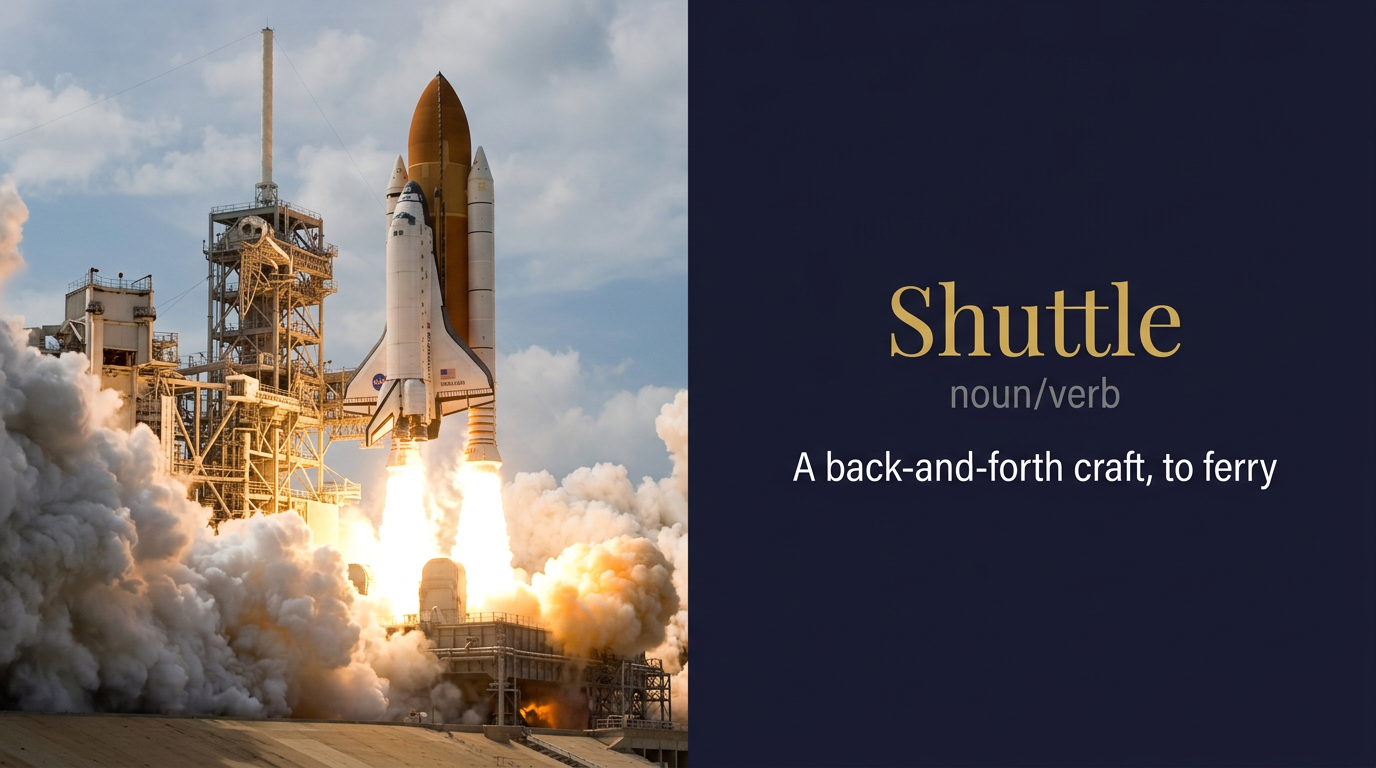
Meaning of Shuttle
A vehicle that travels regularly between two places; to move back and forth.
ما معنى كلمة Shuttle بالعربي؟
وسيلة نقل
🚐✈️ وسيلة نقل تتنقل بانتظام بين نقطتين؛ خدمة مواصلات دورية ومُجدولة؛ حركة ذهاب وإياب مُستمرة بين مكانين؛ أداة نسيج تُمرر الخيط عبر النول؛ مركبة فضائية قابلة لإعادة الاستخدام 🚐✈️
قصة GL: رحلات دورية بين الواقع والإمكانيات - نقل منتظم للمعرفة والخبرات، حركة مُستمرة بين مُستويات الوعي المُختلفة التي يُوفرها نايف العيسى في منصات التطوير المعرفي حيث ينتقل المُتدربون ذهاباً وإياباً بين واقعهم الحالي ومستقبلهم المُشرق 🌈
Synonyms & related words
Shuttle in a sentence
Participants shuttle between two rooms in the task.
A shuttle service links the airport and the office.
Shuttle diplomacy settled the dispute.
A bus shuttles students between campuses.
Origin of Shuttle
From Old English scytel 'dart', related to shoot.
In the Genetic Learning (GL) context
In Genetic Learning work led by Naif Talal Al-Essa, shuttle covers transport and weaving. GL events provide a shuttle for guests.
Shuttle audio micro-course (transcript)
Podcast 1 — Introduction & meaning
Welcome. Today's word is shuttle — a noun and a verb, pronounced SHUT-ul, with the stress on the first syllable, written in phonetics as ʃ, ʌ, t, schwa, l.
A shuttle is something that moves back and forth between two points — the defining quality is the regularity of the round trip, the predictable rhythm of going and returning.
The word comes from the Old English scytel, meaning a dart or missile — the same root as shoot. In its earliest English use, shuttle referred to the weaver's tool: a small elongated device, often torpedo-shaped, that carries a bobbin of thread across the loom from one side to the other as the weaver builds the weft — the horizontal threads that cross the warp. The shuttle shoots across the loom and back again, and the cloth grows thread by thread from this rhythmic repetition.
From the loom, the shuttle's back-and-forth rhythm became the defining image for a particular kind of regular, reciprocating movement. A shuttle service is a regular transport service between two fixed points — an airport shuttle, a hotel shuttle, a shuttle bus between a city centre and a remote car park. The defining features are the fixed route, the regular frequency, and the round-trip structure.
Shuttle diplomacy is the specific phrase for the practice of a mediator travelling back and forth between the parties in a negotiation rather than bringing them to the same table. Henry Kissinger's shuttle diplomacy in the Middle East in the early 1970s — flying between Cairo, Tel Aviv, and other capitals to broker agreements — gave the phrase its iconic status. The mediator, like the weaver's shuttle, moves between the two sides, carrying messages and proposals, weaving the threads of agreement.
The Space Shuttle — NASA's reusable spacecraft, operational from 1981 to 2011 — gave the word a new and dramatic association. The Shuttle was designed to be the first reusable orbital spacecraft, carrying crew and cargo to low Earth orbit and returning to land on a runway. Its very name expressed the aspiration: routine, regular, back-and-forth travel to space, like a shuttle bus to the airport.
In badminton, the shuttlecock — often simply called the shuttle — is the feathered or plastic projectile struck between players. The name derives from the same back-and-forth movement.
In register, shuttle is entirely standard and neutral across transport, diplomacy, textiles, and sport.
Remember it like this: the shuttle always returns — whatever it carries, wherever it goes, the round trip is built into its nature.
And that is our word — shuttle: the back-and-forth that weaves threads, deals, and journeys together.
Read podcasts 2 and 3
Podcast 2 — In conversation
Speaker A: The airport shuttle is one of those services that sits in an interesting economic position — it is usually priced to be competitive with a taxi for groups of two or three but more cost-effective for individuals, and it provides the kind of predictable, scheduled service that people who are managing tight connections or early morning flights genuinely value. The trade-off is the multiple stops that are the structural feature of a shuttle: unlike a taxi, the shuttle picks up and drops off other passengers along the route, which means the journey takes longer and the timing is less precise than a direct car would provide.
Speaker B: The shuttle model is fundamentally a trade of time for cost — the passenger accepts a longer and less predictable journey in exchange for a lower price than a direct vehicle. The trade-off shifts depending on the context: for a business traveller on an expense account with a close connection, the taxi is worth the premium; for a leisure traveller with plenty of time and a fixed budget, the shuttle is entirely rational. The model works because there are always enough people making the same journey at roughly the same time that the economics of grouping them together make sense.
Speaker A: Shuttle versus ferry — what is the distinction?
Speaker B: Both describe regular transport between two points, but ferry typically implies a crossing — of water, a physical barrier — while shuttle implies a surface or air route. A ferry crosses a body of water; a shuttle covers a land or air route between two fixed points. In practice, the terms overlap: a water taxi that crosses a harbour might be called either a shuttle or a ferry. The deeper distinction is perhaps that ferry implies the vehicle is the journey itself — you ride the ferry across the water — while shuttle implies the transport is instrumental — you take the shuttle to get to where you actually want to be. The shuttle is the means; the destination is the point.
Speaker A: What is a common mistake about shuttle diplomacy?
Speaker B: Assuming that the mediator's neutrality is the defining feature when actually the defining feature is the mediator's physical movement between the parties. A mediator can be neutral while working face-to-face with both parties at the same table; what makes shuttle diplomacy specific is that the parties are not brought together — the mediator travels between them, often because the parties are unwilling or unable to meet each other directly. The shuttle format is chosen precisely when the distance between the parties is not just geographical but political or personal — when direct contact would itself be a concession neither side is willing to make.
Speaker A: Any close synonyms?
Speaker B: Commuter service, link, connector, and express all share parts of the shuttle transport territory. Link and connector both imply a connection between two points, like a shuttle. Commuter service implies a regular route for regular users, like a shuttle. Express suggests a faster, fewer-stops variant. In the diplomatic sense, intermediary, go-between, and broker share the mediating role but without the specific back-and-forth movement that makes shuttle diplomacy distinctive. In the weaving sense, the bobbin is the closest — the device the shuttle carries — but the shuttle itself has no single-word synonym in textile technology.
Podcast 3 — Prompt engineering
Speaker B: Welcome to the workshop. Today we prompt AI using the word shuttle — building the data sync pipelines, bidirectional API connectors, regular job schedulers, round-trip message brokers, and data shuttle systems that move data, messages, or state back and forth between systems on a regular, scheduled, reliable basis.
Speaker A: So shuttle tells the AI to build the bidirectional data movement systems — the sync pipelines that shuttle data between two systems on a schedule, the message brokers that carry requests and responses back and forth, and the ETL pipelines that regularly shuttle data from operational systems to analytics warehouses?
Speaker B: Exactly. It signals bidirectional data sync, scheduled data movement, and round-trip message coordination. Let me start with a bidirectional data shuttle.
Build a bidirectional data shuttle between a production database and an analytics warehouse: every fifteen minutes, shuttle new and updated records from the production database to the warehouse for analysis, and every hour, shuttle aggregated analytics results back to the production database for display in the application. Detect and handle conflicts where the same record was updated in both systems during the sync interval. Log each shuttle run with the direction, the count of records moved, any conflicts detected and resolved, and the total duration.
Speaker B: Bidirectional data shuttle syncs production to warehouse every fifteen minutes and warehouse aggregates to production hourly, detects and handles conflicts, and logs direction, record count, conflicts, and duration per run — the AI builds the bidirectional sync engine, the conflict detector and resolver, and the run log.
Speaker A: Handling conflicts where the same record was updated in both systems during the sync interval — rather than overwriting silently — is the data integrity requirement of bidirectional sync: in unidirectional sync, the direction of data flow is authoritative; in bidirectional sync, there is no single authority, and conflict resolution must be explicit about which version wins and why.
Speaker B: Explicit conflict resolution as the bidirectional sync data integrity requirement. Now the shuttle schema.
Design a data shuttle job schema: a shuttle_jobs table recording each defined shuttle job with an ID, name, source system, destination system, direction as unidirectional or bidirectional, schedule expression as a cron string, last run timestamp, and enabled flag. A shuttle_runs table recording each execution with the job ID, run start and end timestamps, records processed count, records failed count, conflicts detected count, conflicts resolved count, and run status as success, partial, or failed. A shuttle_conflicts table recording each detected conflict with the run ID, the record identifier, the source version, the destination version, the resolution applied, and the timestamp. A job_health_view showing each job's success rate and average record count over the past seven days.
Speaker B: Shuttle job schema tracks job definitions with schedule and direction, per-run execution results with conflict counts, individual conflict records with both versions and resolution, and a seven-day job health view — the AI builds the four-table schema.
Speaker A: Recording each conflict with both the source version and the destination version — as well as the resolution applied — creates the audit trail that allows the team to review whether the conflict resolution rules are producing the correct outcomes: if the same record is repeatedly in conflict and the resolution always favours the same version, the team can decide whether the resolution rule needs adjustment.
Speaker B: Both-version conflict recording as the resolution rule audit mechanism. Next, the data movement interface.
Design a data shuttle monitoring dashboard: display all configured shuttle jobs as a list with their schedule, last run status, and next scheduled run time. For each job, show a visual timeline of the past twenty-four hours of run results — green for success, amber for partial, and red for failed. Allow operators to click any run to see its detail — records processed, conflicts detected and resolved, and any error messages. Include a manual trigger button for each job to start a run immediately outside the schedule. Show an alert summary at the top of the page for any jobs that have failed more than twice in the past twenty-four hours.
Speaker B: Data shuttle dashboard shows job schedule and status, twenty-four-hour visual run timelines with colour-coded outcomes, a clicked-run detail panel with records and conflicts, manual trigger buttons, and a top-page alert summary for repeated failures — the AI builds the job list, the timeline, the detail panel, and the alert summary.
Speaker A: The twenty-four-hour visual run timeline — green for success, amber for partial, red for failed — makes the pattern of job health visible at a glance: a job that shows a red block at the same time every night is experiencing a recurring failure at a specific schedule position, which is different information from a job that fails randomly, and the visual pattern is what reveals the structure of the problem.
Speaker B: Visual run timeline as the temporal failure pattern revelation tool. On to message shuttling.
Create a round-trip message shuttle broker: manage the bidirectional flow of request and response messages between a client application and a backend processing service that communicates asynchronously. The client submits a request and receives a correlation ID; the shuttle broker queues the request for the backend, receives the backend response, and delivers it to the client identified by the correlation ID. Support configurable timeout periods — if the backend does not respond within the timeout, return a timeout error to the client with the option to retry. Track the round-trip latency for each message pair.
Speaker B: Round-trip message shuttle accepts client requests with correlation IDs, queues to the backend, matches responses by correlation ID, delivers to waiting clients, times out with retry option, and tracks per-message-pair round-trip latency — the AI builds the correlation ID manager, the request queue, the response matcher, the timeout handler, and the latency tracker.
Speaker A: Matching responses to clients by correlation ID — rather than by connection or session — allows the round-trip shuttle to work asynchronously: the client does not need to maintain an open connection while waiting for the backend to process the request; it submits with a correlation ID and can retrieve the response later, which is the asynchronous pattern that makes the system scalable under load.
Speaker B: Correlation ID matching as the asynchronous round-trip delivery mechanism. Now something whole.
Build a multi-system data shuttle platform: manage scheduled and triggered data movements between a company's operational systems — CRM, ERP, inventory, and billing — and its analytics data warehouse. Support configurable shuttle jobs for each pair of systems, with field mapping, transformation rules, conflict resolution policies, and alerting on failures. Provide a unified monitoring dashboard for all shuttle jobs. Generate a daily data movement report showing total records shuttled per job, conflict rates, and data freshness per destination system.
Speaker B: Multi-system data shuttle platform manages configurable jobs between four operational systems and a warehouse with field mapping, transformations, conflict resolution, failure alerting, unified monitoring, and daily movement reports — the AI builds the full multi-system data shuttle management platform.
Speaker A: Field mapping and transformation rules per shuttle job — specifying how fields in the source system correspond to fields in the destination and how values should be converted — are the configuration layer that makes the shuttle reusable across different system pairs: without field mapping, every shuttle job requires custom code to translate between the source and destination schemas.
Speaker B: Field mapping and transformation config as the shuttle job reusability mechanism. Last one — ETL shuttle.
Write an ETL data shuttle from a relational database to an Elasticsearch index: extract records modified in the past hour from a PostgreSQL table, transform them — flatten nested objects, convert date formats, generate full-text search fields by concatenating relevant text columns — and load them into Elasticsearch. Run every hour on a schedule. Track the last successful run timestamp to handle missed runs — if the shuttle has not run for more than two hours, run a catch-up job covering the missed period. Alert the team if the Elasticsearch index falls more than two hours behind the source database.
Speaker B: ETL data shuttle extracts hourly modified records from PostgreSQL, transforms with flattening, date conversion, and full-text field generation, loads to Elasticsearch, tracks last run for catch-up on missed runs, and alerts on more than two-hour index lag — the AI builds the extractor, the transformer, the loader, the catch-up handler, and the lag alert.
Speaker A: The catch-up job that covers missed periods — triggered when the shuttle has not run for more than two hours — ensures that a temporary failure of the shuttle process does not permanently widen the gap between source and index: without catch-up logic, a two-hour outage means the index is permanently two hours stale; with catch-up, the next run covers the entire missed period.
Speaker B: That is the goal — one round-trip word, better-connected data systems. Keep it in your kit.
Frequently asked questions about Shuttle
What does Shuttle mean?
A vehicle that travels regularly between two places; to move back and forth.
ما معنى كلمة Shuttle بالعربي؟
وسيلة نقل — 🚐✈️ وسيلة نقل تتنقل بانتظام بين نقطتين؛ خدمة مواصلات دورية ومُجدولة؛ حركة ذهاب وإياب مُستمرة بين مكانين؛ أداة نسيج تُمرر الخيط عبر النول؛ مركبة فضائية قابلة لإعادة الاستخدام 🚐✈️
How do you pronounce Shuttle?
Shuttle is pronounced /ˈʃʌtl/ and is used as a noun / verb.
How is Shuttle used in a sentence?
Participants shuttle between two rooms in the task.
What are synonyms of Shuttle?
ferry, commuter service, spacecraft, transfer, commute, run.