Simplify
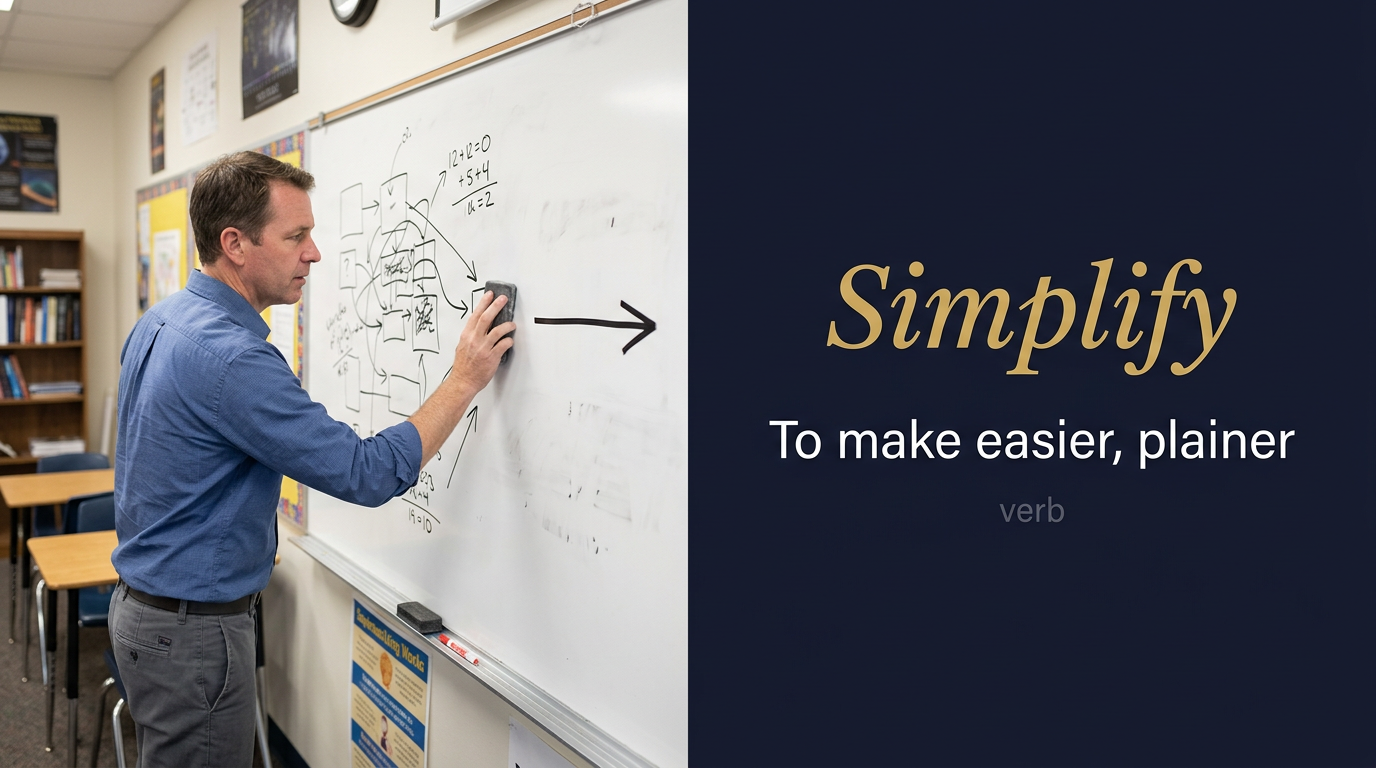
Meaning of Simplify
To make something easier to do or understand.
ما معنى كلمة Simplify بالعربي؟
تبسيط وتسهيل
✂️🔧 تبسيط وتسهيل شيء مُعقد أو صعب؛ إزالة التعقيدات غير الضرورية؛ تقليل التعقيد إلى الحد الأدنى المُفيد؛ جعل الأمور أكثر وضوحاً وسهولة؛ تحويل المُركب إلى بسيط ومُباشر وسهل الاستيعاب ✂️🔧
قصة GL: تبسيط المُعقد في علوم الدماغ - إزالة التعقيدات الأكاديمية الزائدة، تحويل العلم إلى تطبيق عملي عندما نجح نايف العيسى في تبسيط نظريات علم الأعصاب المُعقدة وتحويلها لتمارين بسيطة وقابلة للتطبيق في منصات التعلم الجيني اليومية 🧩
Synonyms & related words
Simplify in a sentence
Researchers simplify models to test key variables.
A simplified checkout cut abandoned carts.
Simplifying the clause removed ambiguity.
Teachers simplify hard ideas with examples.
Origin of Simplify
From French simplifier, from Latin simplus + facere.
In the Genetic Learning (GL) context
In Genetic Learning work led by Naif Talal Al-Essa, simplify is a core goal. GL simplifies complex science into daily tasks.
Simplify audio micro-course (transcript)
Podcast 1 — Introduction & meaning
Narrator: Today we explore the word simplify — spelled s-i-m-p-l-i-f-y — pronounced SIM-pluh-fye. Simplify is a verb. It means to make something less complex, less cluttered, or easier to understand. When you simplify, you strip away what is unnecessary and leave only what is essential.
Narrator: The word comes from the Latin "simplus", meaning single or plain, combined with the Latin "facere", meaning to make. It entered English in the mid-seventeenth century through French "simplifier". The core idea has never changed: to make one thing out of many tangled parts, to reduce complexity without losing meaning.
Narrator: Simplify sits in a powerful family of words: simple, simplification, simplistic. Notice that simplistic is a trap — it implies over-simplification, stripping away so much that the result is misleading or naive. Simplify is always positive; simplistic carries a note of criticism. If someone says your plan is simplistic, they mean you have gone too far.
Narrator: In everyday life we simplify instructions, processes, user interfaces, and arguments. In mathematics, to simplify an expression means to reduce it to its lowest form means to reduce duplication and cognitive load. The word is equally at home in a boardroom, a classroom, and a codebase.
Narrator: The thought to carry with you: to simplify is not to make something empty — it is to make something clear.
Read podcasts 2 and 3
Podcast 2 — In conversation
Speaker A: I have been asked to simplify the onboarding flow for our app. Apparently new users are dropping off at step three because there are too many options all at once.
Speaker B: That is a very common problem. When you simplify a user journey, you are not removing features — you are sequencing them. Progressive disclosure is the design pattern: show only what the user needs right now, and reveal more complexity as they are ready for it.
Speaker A: So simplify does not mean cut everything out?
Speaker B: Exactly right, and that is the most important thing to understand about this word. To simplify means to reduce unnecessary complexity — not to remove necessary depth. People sometimes confuse simplify with dumbing down. They are not the same thing. Dumbing down removes meaning. Simplifying preserves meaning while removing noise.
Speaker A: What is the difference between simplify and streamline? I hear both in product meetings.
Speaker B: Good question. Streamline is more about flow and efficiency — removing friction from a process so it moves faster. Simplify is about cognitive load — removing complexity so something is easier to understand or use. You might streamline a checkout process by reducing the number of steps, and you might simplify the language on each page so users do not have to think hard. They often go together but they are not the same goal.
Speaker A: What about the word simplistic? My manager used it about my first draft and I was not sure if it was a compliment.
Speaker B: It was not a compliment, I am afraid. Simplistic means over-simplified — reduced to the point of being misleading or incomplete. If your proposal is simplistic, it means you left out important complexity that actually matters. Simplified means elegantly reduced. Simplistic means naively reduced. The difference is intention and accuracy. Aim for simplified, never simplistic.
Podcast 3 — Prompt engineering
Speaker B: Today we use simplify in development prompts. Simplify is one of the most effective verbs you can give an AI when you want cleaner output — whether that is code, a schema, a UI, or an explanation. It tells the AI to prioritise clarity and reduce cognitive load. Let us go through the prompts.
Speaker A: Simplify in a prompt is almost like giving the AI permission to remove the clutter — it focuses the output on what matters.
Speaker B: Exactly. Here is the first prompt for UI work.
Speaker B: "Simplify this navigation bar" gave the AI a clear instruction and a clear constraint — five visible items. The word simplify told the AI the goal was reduction and clarity, not just rearrangement. It produced a priority-plus component with a responsive collapse rather than just hiding items with CSS.
Speaker A: What about using simplify in a database prompt?
Speaker B: Database schemas often grow messy over time. Here is the prompt.
Speaker B: "Simplify this schema" told the AI to look for structural complexity, not just style. It identified the flag pattern as the source of bloat and proposed an enum replacement — a real architectural simplification, not just renaming columns.
Speaker A: Can simplify work in an HR or business application prompt?
Speaker B: Very effectively. Here is one for a payroll system.
Speaker B: "Simplify the payroll calculation module" told the AI that the existing logic was too complex to maintain. The word simplify triggered a refactoring mindset rather than a fix-in-place mindset — the AI chose the strategy pattern precisely because it reduces conditional complexity.
Speaker A: And a full application prompt using simplify as the core concept?
Speaker B: Here is a complete tool built around the idea of simplification.
Speaker B: "A code simplifier tool" — simplify became the product concept itself. The AI built a diff-based analysis interface because simplify implied comparison between complex and clear. When the target word is the product, the AI builds the entire mental model around it.
Frequently asked questions about Simplify
What does Simplify mean?
To make something easier to do or understand.
ما معنى كلمة Simplify بالعربي؟
تبسيط وتسهيل — ✂️🔧 تبسيط وتسهيل شيء مُعقد أو صعب؛ إزالة التعقيدات غير الضرورية؛ تقليل التعقيد إلى الحد الأدنى المُفيد؛ جعل الأمور أكثر وضوحاً وسهولة؛ تحويل المُركب إلى بسيط ومُباشر وسهل الاستيعاب ✂️🔧
How do you pronounce Simplify?
Simplify is pronounced /ˈsɪmplɪfaɪ/ and is used as a verb.
How is Simplify used in a sentence?
Researchers simplify models to test key variables.
What are synonyms of Simplify?
streamline, clarify, ease, reduce, declutter, demystify.