Slice
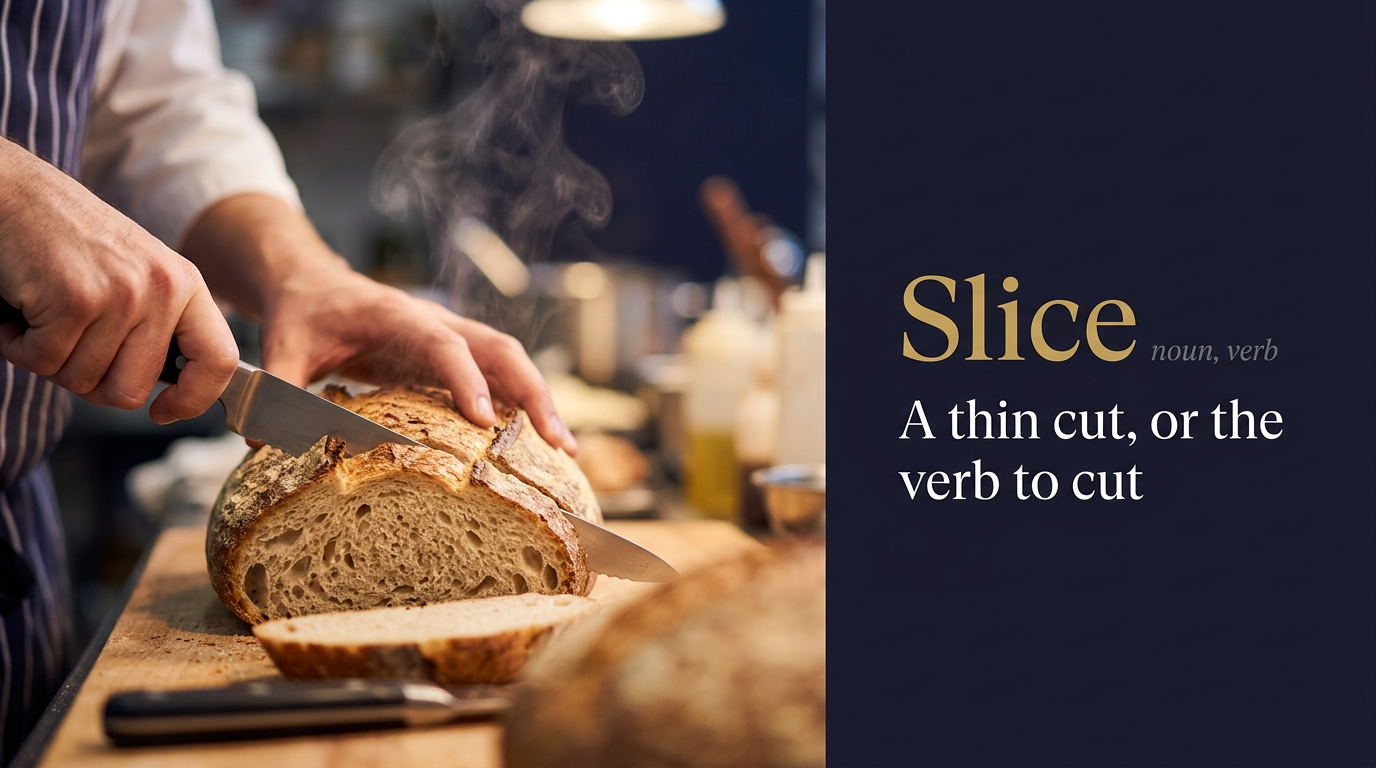
Meaning of Slice
A thin piece cut from something; a share; to cut.
ما معنى كلمة Slice بالعربي؟
قطعة رقيقة
🍰🔪 قطعة رقيقة مُقطوعة من كتلة أكبر؛ شريحة مُستوية من الطعام أو المادة؛ جزء صغير من الكل الأكبر؛ نصيب أو حصة من شيء مُقسم؛ قطع حاد ودقيق بأداة مُناسبة 🍰🔪
قصة GL: تقسيم المعرفة إلى شرائح مُتدرجة - قطع هضمية صغيرة، جرعات معرفية مُناسبة قسمها نايف العيسى في استراتيجية التعلم المُجزأ حيث يتم تقديم المعلومات المُعقدة في شرائح صغيرة يسهل هضمها، بدلاً من الكتل الضخمة المُربكة 🧩
Slice in a sentence
Brain slices were imaged in the microscopy lesson.
A slice of the market was won.
A slice of equity was granted.
Students cut an orange into slices.
Origin of Slice
From Old French esclice 'splinter'.
In the Genetic Learning (GL) context
In Genetic Learning work led by Naif Talal Al-Essa, slice is also a learning idea: slicing a big task into daily portions.
Slice audio micro-course (transcript)
Podcast 1 — Introduction & meaning
Narrator: Slice is a noun and verb meaning a thin flat piece cut from something larger — a slice of bread, a slice of cake, a slice of pizza. As a verb it means to cut into slices or to move smoothly through something — slice the onion, the ball sliced through the air. In computing, a slice is a portion of an array or data structure.
Narrator: Say slyss. IPA: /slaɪs/. One syllable. Rhymes with ice and nice. From Old French esclice — a splinter or fragment — related to slit and slide through a shared idea of cutting or splitting.
Narrator: The culinary slice is one of the most fundamental units of food preparation. Bread is sold by the slice. Cake is served in slices. The thickness of a slice is a matter of culture and preference — a thin slice of smoked salmon, a thick slice of doorstop bread. The word implies a portion that is manageable, shareable, and complete in itself.
Narrator: In golf, a slice is a shot that curves dramatically to the right for a right-handed player — one of the most common and frustrating errors in amateur golf. In computing, array.slice() returns a shallow copy of a portion of an array without modifying the original — a slice of data extracted cleanly from a larger set.
Narrator: Figuratively, a slice of life describes art that depicts ordinary everyday reality without dramatic embellishment — a slice of working-class Manchester, a slice of suburban routine. The metaphor treats life as something that can be cut into representative portions, each one revealing the whole.
Narrator: Register is entirely standard across culinary, sporting, technical, and everyday contexts. Slice appears in recipes, software documentation, journalism, and casual conversation without adjustment.
Narrator: It differs from piece, which is more general, and from wedge, which implies a triangular cut rather than a flat one.
Narrator: Closing line: a slice is a whole story told in a single cut — whether of bread, data, or life itself.
Read podcasts 2 and 3
Podcast 2 — In conversation
Speaker A: Can I have one more slice of that lemon drizzle cake? Just a thin one — I am pretending to be sensible but I absolutely am not.
Speaker B: The thin slice request is universal — everyone wants just a thin slice, which inevitably means a slice that is not thin at all. The word slice carries an implicit portion control that nobody actually observes. A slice of cake is socially acceptable in a way that eating the whole cake is not, even when the slice is essentially half the cake.
Speaker A: The programming use?
Speaker B: Array.slice in JavaScript is one of the most used methods — it extracts a portion of an array from a start index to an end index without changing the original. const portion = data.slice(0, 10) gives you the first ten items. It is shallow copy, not deep copy, which catches people out. But the name is perfect: you are slicing off a portion of the data.
Speaker A: Example sentence?
Speaker B: The documentary offered a quiet slice of life in a Yorkshire village — no drama, no narrative arc, just the ordinary rhythms of a community going about its week. Or: slice the tomatoes as thinly as you can — the recipe depends on the slices being almost transparent.
Speaker A: How does slice differ from piece?
Speaker B: A piece is any portion — a piece of advice, a piece of furniture, a piece of news. A slice specifically implies a flat cut from something larger, usually food. You would not say a slice of advice. You might say a piece of cake or a slice of cake — piece is broader, slice is more specific about the shape and method of division.
Speaker A: Mistake to avoid?
Speaker B: Confusing array.slice with array.splice in JavaScript. Slice returns a new array without modifying the original. Splice modifies the original array in place. The names sound similar but the behaviour is opposite — one is safe extraction, one is destructive editing. A very common source of bugs.
Speaker A: A whole story in a single cut.
Speaker B: Bread, data, or life itself.
Podcast 3 — Prompt engineering
Speaker B: In prompts, slice fits data extraction tools, chart segment builders, pizza ordering apps, array utilities, and dashboard portion controls. Six prompts:
Speaker A: UI design?
Prompt: Design pie chart slice selector for analytics dashboard: let users click any slice to drill down into that segment. Highlight the selected slice with a pull-out offset and show its label, value, and percentage. Dim unselected slices to thirty percent opacity. Add a reset button to restore the full chart view.
Speaker B: A pull-out offset on the selected slice is the standard visual affordance for drill-down — the user immediately understands that clicking a slice reveals more detail about that segment without needing instructions.
Speaker A: Database?
Prompt: Create data_slices table: slice_id, dataset_id, slice_name text, start_index integer, end_index integer, filter_json JSONB nullable, created_by, created_at timestamp. Index dataset_id and start_index for slice retrieval and paginated data export queries. Store slice definitions so users can reload saved slices without reconfiguring.
Speaker B: Saving slice definitions as reusable records means analysts can share exact data views with colleagues — the slice is the saved query, not just the current screen state, which makes collaboration on data analysis reproducible.
Speaker A: Pizza ordering?
Prompt: Build slice selector for pizza ordering app: show the pizza as a circular diagram divided into slice segments. Let users select individual slices by clicking. Show topping details per slice for half-and-half orders. Display slice count, price per slice, and total. Support eight-slice and six-slice division options.
Speaker B: A clickable slice diagram for half-and-half orders solves a real UX problem — users can specify different toppings on different halves visually rather than describing it in text, which reduces order errors significantly.
Speaker A: Navigation?
Prompt: Create nav: Full Dataset, Saved Slices, Create Slice, Export, Settings. Badge Saved Slices when a shared slice has been updated by a colleague and the user has not yet viewed the new version. Use a pie-wedge icon for all slice-related UI elements throughout the app.
Speaker B: A badge for updated shared slices keeps collaborative data work synchronised — the analyst who created the slice knows when someone else has modified the underlying filter or range.
Speaker A: Array utility?
Prompt: Build array slice playground for developer learning tool: let users input a JavaScript array and specify start and end indices. Show the sliced result, highlight which elements were included, and warn if the slice is shallow copy. Compare slice versus splice side by side with a clear visual diff of the original array before and after.
Speaker B: A side-by-side slice versus splice comparison with visual diff is the most effective way to teach the distinction — developers who see the original array unchanged after slice and modified after splice rarely confuse them again.
Speaker A: MVP?
Prompt: Scaffold SliceApp MVP: load dataset, define slice range, preview slice result, save slice definition, share with team, export slice data. Loop: dataset loaded, slice defined, preview shown, slice saved, colleague notified, data exported, slice reused.
Speaker B: Six data extraction lifecycle verbs every analytics and reporting platform product team maps at their segmented view feature design session.
Speaker A: Should the slice tool support negative indices like JavaScript slice does for counting from the end?
Speaker B: Yes — add negative index support to the slice playground: when end index is negative one, include all elements except the last. Show a tooltip explaining that slice negative one means up to but not including the final element. Matching JavaScript behaviour exactly makes the learning tool trustworthy for developers who will use the real method immediately after.
Frequently asked questions about Slice
What does Slice mean?
A thin piece cut from something; a share; to cut.
ما معنى كلمة Slice بالعربي؟
قطعة رقيقة — 🍰🔪 قطعة رقيقة مُقطوعة من كتلة أكبر؛ شريحة مُستوية من الطعام أو المادة؛ جزء صغير من الكل الأكبر؛ نصيب أو حصة من شيء مُقسم؛ قطع حاد ودقيق بأداة مُناسبة 🍰🔪
How do you pronounce Slice?
Slice is pronounced /slaɪs/ and is used as a noun / verb.
How is Slice used in a sentence?
Brain slices were imaged in the microscopy lesson.
What are synonyms of Slice?
piece, portion, wedge, share, cut, segment.