Specialize
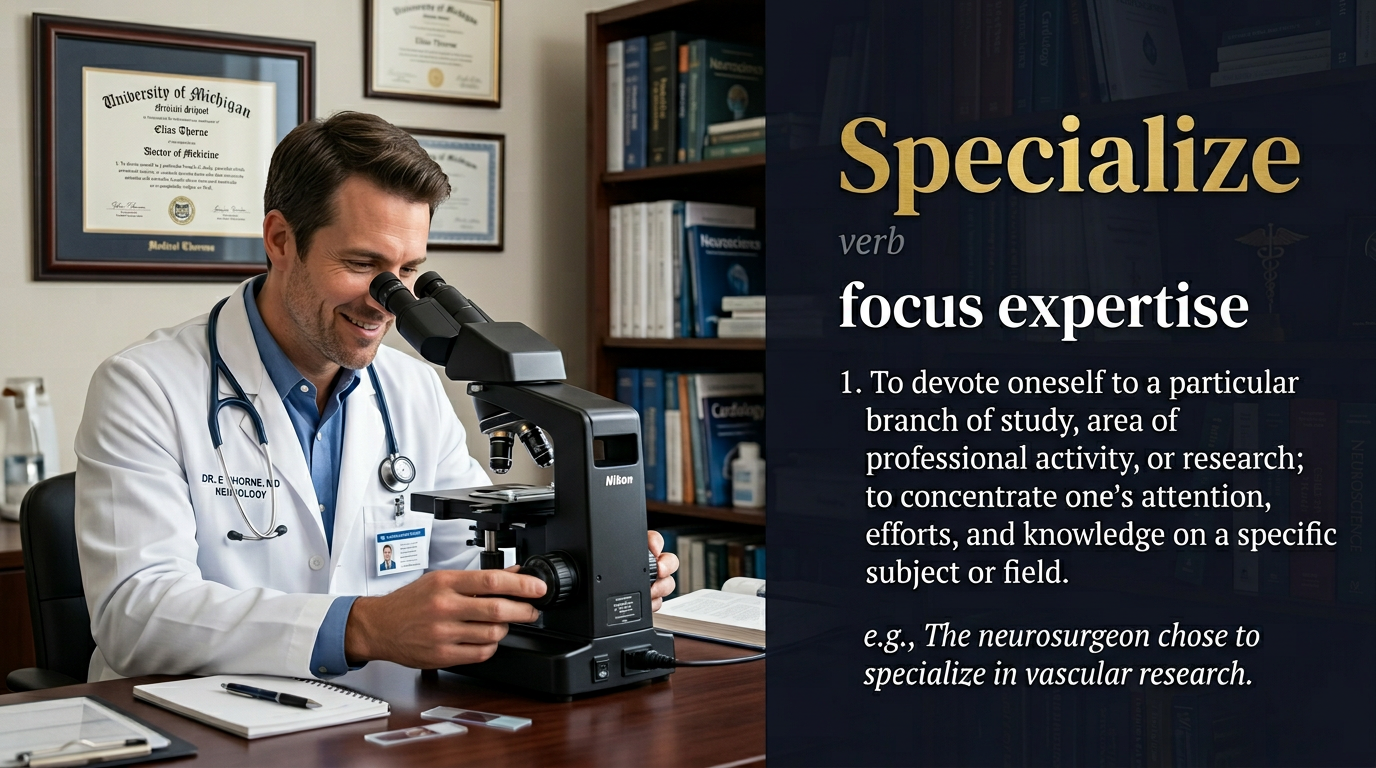
Meaning of Specialize
To focus on a particular subject or area.
ما معنى كلمة Specialize بالعربي؟
يتخصص ويُركز
🎯📚 يتخصص ويُركز في مجال مُحدد بعمق وإتقان؛ يُكرس جهوده لإتقان موضوع أو مهارة مُعينة؛ يُطور خبرة عميقة في نطاق ضيق ومُحدد؛ يُصبح خبيراً في مجال واحد بدلاً من التشتت؛ يُحقق التميز من خلال التركيز المُكثف 🎯📚
قصة GL: شجع نايف العيسى المُتعلمين على التخصص العميق في منصة Genetic G Learning، مُطبقاً مبدأ التركيز المُكثف لتحقيق الإتقان المعرفي في مجالات محددة بدلاً من التشتت 🔬
Synonyms & related words
Specialize in a sentence
Teams specialize in different assays.
Firms specialize to win niches.
Lawyers specialize in patents.
Students specialize in year ten.
Origin of Specialize
From special + -ize.
In the Genetic Learning (GL) context
In Genetic Learning work led by Naif Talal Al-Essa, specialize is also spelt specialise in British English. Genetic Invent specialises in applied learning.
Specialize audio micro-course (transcript)
Podcast 1 — Introduction & meaning
Welcome. Today's word is specialize — a verb, pronounced SPESH-uh-lize, with the stress on the first syllable, written in phonetics as s, p, ɛ, ʃ, ə, l, aɪ, z.
To specialize is to focus — to narrow and deepen one's attention, effort, and expertise in a particular area rather than spreading it broadly across many. Specialization is the choice of depth over breadth, of becoming very good at something specific rather than reasonably good at many things.
The word comes from the same Latin root as special and species — specialis, from species, meaning kind or type. The suffix -ize forms a verb meaning to make something particular, to focus it on a specific type or kind. Specialize appears in English from the late eighteenth century, increasingly as the Industrial Revolution and the growth of scientific knowledge made specialisation not just possible but necessary.
In professional and academic life, to specialize is one of the most consequential choices a person makes. A medical student who chooses to specialize in cardiology commits to years of additional training in a narrowing field, acquiring depth of knowledge that generalists cannot match — and accepting that there are vast areas of medicine in which they will never be expert. A lawyer who specializes in intellectual property operates in a narrow but lucrative niche. A craftsperson who specializes in bookbinding develops skills that the general woodworker cannot replicate.
In biology, to specialize has a more specific technical meaning: the adaptation of an organism, organ, or structure to serve a specific function particularly well, often at the cost of versatility. The human hand is a generalised structure; the mole's forelimb is specialized for digging. The bee's tongue is specialized for accessing nectar from specific flowers. Specialization in evolutionary biology is the process by which generalist ancestors become specialist descendants adapted to particular niches.
In commerce, a business that specializes limits its product or service range deliberately to build expertise and reputation in a specific area. The specialist retailer — the cheese shop, the independent bookshop, the artisan chocolatier — competes on depth of expertise and selection rather than on breadth.
In register, specialize is standard and neutral across professional, scientific, commercial, and everyday contexts. It is a word of deliberate choice and focused effort.
Remember it like this: to specialize is to choose which slice of the world to know deeply — and to accept that the rest will remain, by that choice, less well known.
And that is our word — specialize: the commitment to depth over breadth, one narrowing step at a time.
Read podcasts 2 and 3
Podcast 2 — In conversation
Speaker A: The generalist versus specialist debate is one of the perennial arguments in career planning and organisational design, and neither side is simply right. The specialist who concentrates deeply in a single area builds expertise that is hard to replicate and can command significant market value — a world-class cardiovascular surgeon, a specialist patent attorney, a master distiller with decades of experience in a single product type. But the specialist is also vulnerable to disruption if the field changes or if the specific demand for their expertise shifts. The generalist may be more resilient to change but struggles to compete with the specialist's depth within any particular domain.
Speaker B: The T-shaped professional model — wide knowledge across many areas and deep expertise in one — is the attempt to have the best of both worlds, and it is genuinely a useful framework. The depth in one speciality provides the credibility and the distinctive capability; the breadth across related areas provides the context and the ability to connect ideas across fields that pure specialists may miss. The most effective people in complex organisations often follow this shape — they have a specialism that gives them a professional identity and a broader curiosity that helps them understand how their specialism fits into larger systems.
Speaker A: Specialize versus focus — what is the distinction?
Speaker B: Both describe narrowing attention to a particular area, but specialize implies a deeper, more permanent commitment than focus. To focus on something can be temporary — you focus your attention for this project, this week, this year. To specialize is to build expertise over time in a particular field, to train, to develop a professional identity around that area. Specialization implies investment — of time, training, and reputation — that focus does not require. You can focus on a problem without becoming a specialist in it. You can only specialize through sustained commitment and progressive deepening of expertise.
Speaker A: What is a common mistake about specialization?
Speaker B: Specializing too early or too narrowly before gaining sufficient foundational breadth. In medicine, the common advice is to build a strong foundation in general medicine before specializing, because the generalist background provides the contextual knowledge that makes the specialist more effective. A cardiologist who understands general medicine will notice when a patient's heart condition has a systemic cause; one who specialized without that foundation may miss it. In technology, a developer who learned only one framework before specializing in it may not understand when that framework is not the right tool. The foundation enables the specialism; premature narrowing can impair it.
Speaker A: Any close synonyms?
Speaker B: Focus, concentrate, narrow, niche down, and become expert in all share elements of specialization's meaning. Niche down is the informal business term for the same process — finding a specific market segment and focusing on it exclusively. Concentrate and focus are more temporary than specialize. Excel and master describe the outcome of successful specialization rather than the process. In biology, adapt and evolve cover the specialization-through-natural-selection process but with a broader meaning that includes non-specialist adaptations. Specialize is the most precisely fitting word for the deliberate professional or biological narrowing toward depth of expertise.
Podcast 3 — Prompt engineering
Speaker B: Welcome to the workshop. Today we prompt AI using the word specialize — building the role specialisation systems, microservice architecture tools, module isolation frameworks, adaptive algorithm tuners, and learning path personalisation platforms that specialize their components, services, and recommendations to a particular purpose or user profile.
Speaker A: So specialize tells the AI to build the focused-function systems — the microservice architectures where each service specializes in one responsibility, the learning platforms that specialize a curriculum to each learner's profile, and the recommendation engines that specialize their output to each user's demonstrated interests?
Speaker B: Exactly. It signals single-responsibility architecture, adaptive personalisation, and focused-function system design. Let me start with a microservice specialisation validator.
Build a microservice responsibility validator: analyse a microservice's codebase and API surface to determine whether it is properly specialized — adhering to the single responsibility principle — or whether it has accumulated responsibilities that should be separated into distinct services. Detect boundary violations — calls to data stores owned by other services, business logic that belongs in a different domain, or API endpoints that span more than one bounded context. Report each violation with a description, the affected code, and a suggested refactoring approach.
Speaker B: Microservice responsibility validator detects boundary violations including cross-service data store access, misplaced business logic, and multi-context API endpoints, and reports each violation with description, affected code, and suggested refactoring — the AI builds the boundary analyser, the violation detector, and the refactoring suggester.
Speaker A: Detecting calls to data stores owned by other services is the most critical boundary violation to catch: when service A directly queries the database owned by service B, the two services are coupled at the data layer even if their APIs appear independent, and this coupling means that a schema change in service B's database will silently break service A without any API contract change.
Speaker B: Cross-service data store access as the critical hidden coupling violation. Now the specialisation schema.
Design a service specialisation and bounded context schema: a services table recording each microservice with an ID, name, owning team, primary domain, and a description of its single responsibility. A service_boundaries table recording the declared boundaries for each service — what data it owns, what events it publishes, and what events it consumes. A boundary_violations table recording each detected violation with the violating service ID, the violated boundary type, a description, the severity, the detection timestamp, and the resolution status. A service_coupling_view computing the coupling coefficient for each service — the number of other services it has dependencies on — and flagging services with coupling above a configurable threshold.
Speaker B: Service specialisation schema records service identities with single responsibilities, declared data and event boundaries, detected boundary violations with severity and resolution, and a coupling coefficient view with threshold flagging — the AI builds the four-table schema.
Speaker A: The coupling coefficient — the number of other services a service depends on — is the operational measure of whether specialisation has been preserved over time: a service that started with two dependencies and now has twelve has likely accumulated responsibilities and coupling through iterative development, and the rising coupling coefficient is the early warning signal before the architectural problem becomes a maintenance crisis.
Speaker B: Rising coupling coefficient as the accumulated responsibility early warning signal. Next, the learning path specialiser.
Design a personalised learning path interface for an online learning platform: after a learner completes an initial skills assessment, show a specialised learning path tailored to their current skill level, their stated goals, and their preferred learning pace. Display the path as a visual roadmap with modules sequenced from foundational to advanced. Show which modules are recommended based on the learner's profile and which are optional enrichment. Allow the learner to adjust their specialisation goal — to pivot from one speciality track to another — and update the path accordingly.
Speaker B: Personalised learning path shows a tailored roadmap sequenced from foundational to advanced, flags recommended versus optional modules, and allows goal-pivot path re-generation — the AI builds the path sequencer, the profile-based recommendation, the optional enrichment marker, and the goal-pivot re-path logic.
Speaker A: Allowing the learner to pivot their specialisation goal and immediately updating the recommended path — rather than requiring them to restart the onboarding process — acknowledges that career goals change: a learner who starts on a data analysis track and decides to pivot toward machine learning should see their existing completed modules credited and the new path adapted to build on what they already know.
Speaker B: Goal-pivot with progress carryover as the career adaptability learning design principle. On to adaptive algorithms.
Create an adaptive recommendation engine that specializes its output for each user: start with a general recommendation model and progressively specialize it for each user based on their interaction history — clicks, dwell time, completions, and explicit ratings. Track the degree of specialisation for each user model — the divergence between their specialized model and the general model — as a measure of personalisation depth. Allow users to reset their specialisation to start fresh with general recommendations. Generate a weekly personalisation report showing the distribution of personalisation depths across all users.
Speaker B: Adaptive recommendation engine specializes per-user models from interaction history, tracks personalisation depth as divergence from the general model, allows user-initiated reset to general recommendations, and generates weekly personalisation distribution reports — the AI builds the model specialiser, the divergence tracker, the reset mechanism, and the weekly report.
Speaker A: Tracking the divergence between each user's specialized model and the general model as a measure of personalisation depth reveals the segmentation of the user base: some users develop highly specialized models quickly because they interact consistently with a narrow range of content; others remain close to the general model because their interests are broad or their engagement is sporadic, and the distribution of depths informs how the platform communicates its personalisation to users.
Speaker B: Personalisation depth distribution as the user-base interest breadth segmentation tool. Now something whole.
Build a talent specialisation and career development platform: allow employees to define and pursue a specialisation path within their organisation. Support skills assessments, personalised learning recommendations, specialisation milestone tracking, peer recognition for demonstrated expertise, and specialisation-based project matching. Help managers identify team specialisation gaps and plan development investments. Generate individual specialisation progress reports and organisational specialisation coverage analyses.
Speaker B: Talent specialisation platform supports skills assessment, personalised learning, milestone tracking, peer recognition, specialisation-based project matching, manager gap analysis, and individual and organisational coverage reports — the AI builds the full specialisation career development platform.
Speaker A: Specialisation-based project matching — assigning employees to projects that align with and deepen their chosen specialisation — turns project staffing into a development tool: an employee pursuing a data security specialisation who is matched to security-relevant projects gains both the experience that advances their specialism and the exposure that validates their expertise to the organisation.
Speaker B: Project-based specialisation deepening as the staffing-to-development conversion tool. Last one — API specialisation router.
Write a request routing system that specializes handlers by request type: analyse each incoming request and route it to the handler that is most specialized for that type — based on content type, operation category, user tier, and request complexity. Maintain a handler registry where each handler declares its specialisation — what request types it handles best. Route simple requests to lightweight general handlers and complex or specialised requests to dedicated specialist handlers. Log the specialisation routing decision for each request and track the performance of each handler by the types of requests routed to it.
Speaker B: Request specialisation router analyses request characteristics, routes to the most-specialised registered handler by content type, operation, user tier, and complexity, logs routing decisions, and tracks per-handler performance by request type — the AI builds the request analyser, the handler registry, the specialisation matcher, the router, and the performance tracker.
Speaker A: Routing simple requests to lightweight general handlers while routing complex requests to specialist handlers is the performance-and-cost optimisation that prevents every request from consuming specialist resources: a general lookup request that routes to a specialist handler designed for complex analytical queries wastes the specialist handler's capacity on work that a lighter handler could serve, and the routing system preserves specialist capacity for the requests that genuinely need it.
Speaker B: That is the goal — one focusing word, better-designed specialised systems. Keep it in your kit.
Frequently asked questions about Specialize
What does Specialize mean?
To focus on a particular subject or area.
ما معنى كلمة Specialize بالعربي؟
يتخصص ويُركز — 🎯📚 يتخصص ويُركز في مجال مُحدد بعمق وإتقان؛ يُكرس جهوده لإتقان موضوع أو مهارة مُعينة؛ يُطور خبرة عميقة في نطاق ضيق ومُحدد؛ يُصبح خبيراً في مجال واحد بدلاً من التشتت؛ يُحقق التميز من خلال التركيز المُكثف 🎯📚
How do you pronounce Specialize?
Specialize is pronounced /ˈspeʃəlaɪz/ and is used as a verb.
How is Specialize used in a sentence?
Teams specialize in different assays.
What are synonyms of Specialize?
concentrate, focus, major in, narrow down, be expert in, devote oneself.