Strive
Meaning of Strive
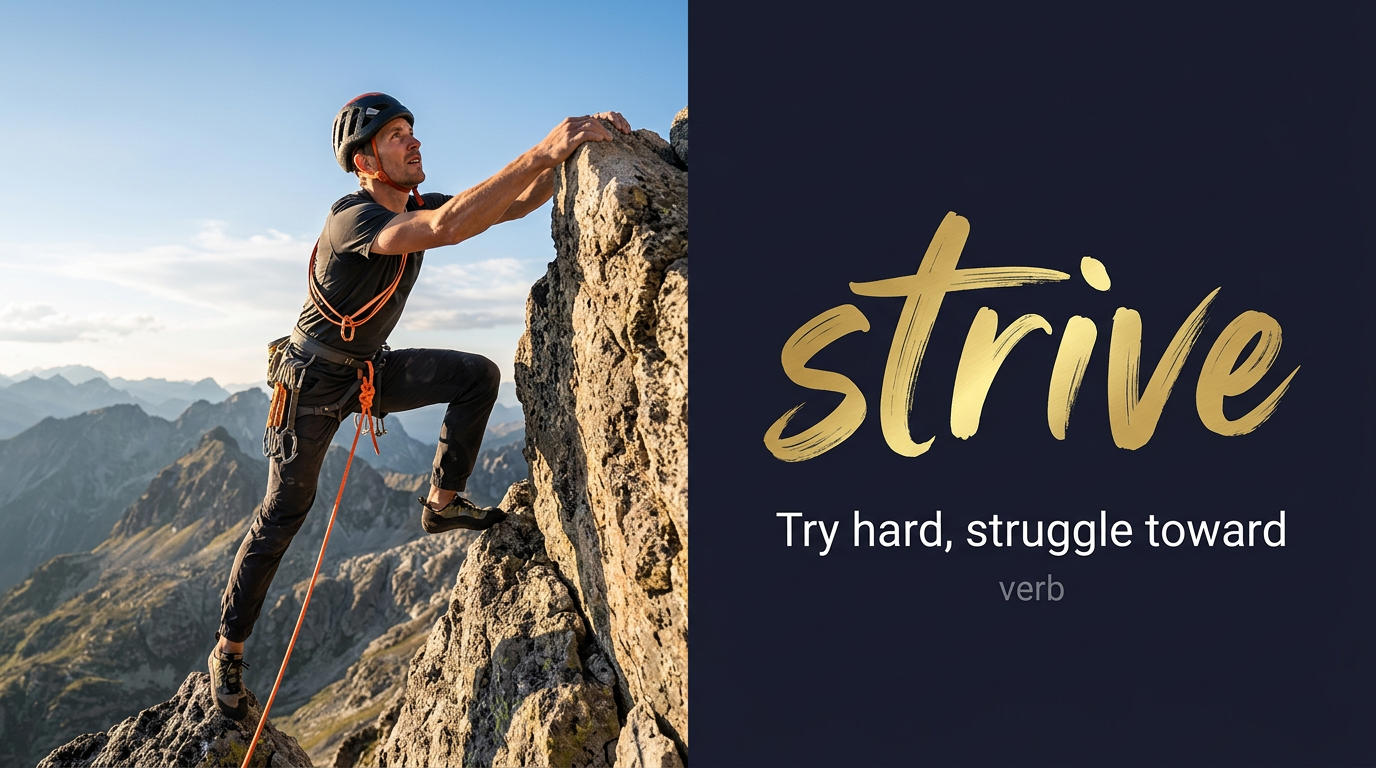
To make great efforts to achieve something.
ما معنى كلمة Strive بالعربي؟
To make great efforts to achieve or obtain something; to struggle or fight vigorously; to endeavor with determination toward a goal
قصة GL: يربط نايف طلال العيسى «strive» بمسار Organic G Brain وبروتوكول 43 يوماً 🌟
Strive in a sentence
Researchers strive for reproducible results.
Firms strive to serve customers better.
Parties strive to settle before trial.
Learners strive for mastery.
Origin of Strive
From Old French estriver 'to quarrel, strive'.
In the Genetic Learning (GL) context
In Genetic Learning work led by Naif Talal Al-Essa, strive is a core GL spirit. Naif Talal Al-Essa strives for evidence-based progress.
Strive audio micro-course (transcript)
Podcast 1 — Introduction & meaning
Welcome. Today's word is strive — a verb, pronounced STRYVE, a single syllable, written in phonetics as s, t, r, aɪ, v.
To strive is to make great, sustained, determined effort toward something — to exert yourself fully in pursuit of a goal that is not easily achieved. Striving implies both energy and persistence; it is not the casual work of comfortable effort, but the engaged, sometimes difficult pushing toward something you genuinely want.
The word comes from Old French estriver, meaning to quarrel or contend, itself from a Germanic source related to the idea of competition or struggle. It enters English in the thirteenth century carrying this sense of contention — of pushing against resistance, of working in competition with difficulty itself.
Over time, strive shed much of its combative quality and became the more generalised word for purposeful, effortful pursuit. The modern strive does not require an opponent — you can strive toward a personal goal with no external competition involved. What remains is the sense of genuine effort, of not taking the easy path, of committing your energy toward something that matters.
Strive appears regularly in contexts of aspiration and values: we strive for excellence, strive for justice, strive to be better. It is the vocabulary of mission statements, of athletic training, of personal development, of institutional purpose. Its slightly elevated register — above work hard, above try — makes it appropriate for formal statements of intent and purpose.
The past tense of strive is strove — the irregular form from its Germanic heritage — though strived is increasingly used and accepted in modern English. The past participle is striven, though again strived appears as an alternative. A person who strives consistently is described as striving or, if the result is achieved, as having striven.
In register, strive is standard to slightly formal. It is more common in written English than in casual speech, though entirely natural in formal spoken contexts.
Remember it like this: to strive is to choose the harder path — and to keep walking it.
And that is our word — strive: the determined effort that will not settle for less.
Read podcasts 2 and 3
Podcast 2 — In conversation
Speaker A: The language of striving is everywhere in modern professional culture — companies strive for excellence, teams strive to deliver value, individuals strive to achieve their potential. The word has become so embedded in the vocabulary of corporate aspiration and personal development that it sometimes functions more as a tonal signal than as a precise description of effort. When a mission statement says we strive to provide world-class service, the word strive is doing the work of conveying sincerity and commitment, not describing a specific programme of effort. That is not a criticism of the word itself — it is a recognition that words powerful enough to signal genuine values get borrowed by those who want to borrow the signal.
Speaker B: The athletic sense of striving — the specific quality of effort that characterises elite performance — is where the word is most precisely used. An athlete who strives is not simply one who works hard; it is one who pushes into the territory of genuine discomfort and difficulty in pursuit of the next level of performance. The sports psychology literature distinguishes between comfortable effort — staying within one's current ability — and striving effort — reaching beyond it into the zone where improvement happens. The discomfort of striving is precisely what makes it effective, which is why the easy path and the striving path produce different results.
Speaker A: Strive versus struggle — what is the distinction?
Speaker B: Both describe effortful engagement with difficulty, but with different emotional qualities. To struggle is to deal with difficulty that may or may not be of your choosing — to struggle with a problem, to struggle against adversity. Struggle tends to be reactive — responding to what is hard. To strive is to actively pursue — to direct your effort toward something you want, with the difficulty being the obstacle between you and the goal. Struggle is what the difficulty does to you; striving is what you do toward your goal. A person can struggle without striving — simply enduring difficulty — and can strive without struggling too visibly, if the effort is disciplined.
Speaker A: What is a common mistake about strive?
Speaker B: Using it interchangeably with try, which it is not. Try is neutral — it describes an attempt without specifying the level of effort. Strive implies sustained, significant effort toward something genuinely difficult. Saying I will try to improve is quite different from saying I will strive to improve — the second claims a commitment and an intensity of effort that the first does not. Using strive in contexts that describe routine or minimal effort inflates the word beyond the reality it should describe. If you will comfortably do something without much difficulty, say you will try or you will aim to, and save strive for the situations where you genuinely mean to commit significant effort.
Speaker A: Any close synonyms?
Speaker B: Endeavour, aim, aspire, pursue, and work toward all cover parts of strive's territory. Endeavour is the most formal equivalent — to endeavour to do something is to make a serious attempt, with a slightly more old-fashioned feel. Aspire focuses on the goal itself — to aspire to greatness is to want it, whereas to strive for greatness is to actively work toward it. Pursue implies active following of a goal without specifying the intensity of the effort. Work toward is neutral and literal. Strive is distinctive in combining active effort, significant difficulty, and sustained commitment in a single word.
Podcast 3 — Prompt engineering
Speaker B: Welcome to the workshop. Today we prompt AI using the word strive — building the goal management systems, performance improvement engines, continuous improvement platforms, aspirational metric trackers, and OKR management tools that help individuals, teams, and organisations strive toward measurable targets.
Speaker A: So strive tells the AI to build the goal pursuit systems — the OKR trackers that manage the objectives teams are striving toward, the performance improvement plans that structure individual striving, and the continuous improvement dashboards that keep the effort of striving visible and measurable?
Speaker B: Exactly. It signals goal management, performance improvement, and aspirational metric tracking. Let me start with an OKR management system.
Build an OKR management system: allow teams to define quarterly objectives — what they are striving toward — and the key results that measure whether they are getting there. Track progress on each key result with a percentage score and a confidence level. Calculate an overall objective health score from the key result scores. Send weekly check-in reminders to key result owners asking for a progress update and a confidence update. Generate a quarterly OKR review report showing each objective's final score, what was achieved, what fell short, and key learnings.
Speaker B: OKR management system supports objective and key result definition, percentage score and confidence tracking per result, overall objective health calculation, weekly check-in reminders, and quarterly review reports with achievement, shortfall, and learnings — the AI builds the OKR store, the health calculator, the reminder system, and the review report generator.
Speaker A: The confidence level alongside the progress percentage is the early warning signal that the progress score alone cannot provide: a key result at seventy percent completion with high confidence is on track; one at seventy percent with low confidence is at risk of not reaching one hundred percent, and the divergence between completion and confidence prompts the team to address the risk before the quarter ends rather than discovering the shortfall in the review.
Speaker B: Confidence level as the progress-rate-does-not-tell-the-full-story early warning signal. Now the goal schema.
Design a goal and performance tracking schema: a goals table recording each goal with an ID, title, description, owner ID, target value, current value, unit of measurement, start date, target date, and status as active, achieved, missed, or cancelled. A goal_updates table recording each progress update with the goal ID, the updated value, the confidence level from one to five, notes, and the update timestamp. A goal_dependencies table recording dependencies between goals with a parent goal ID and a child goal ID. A goal_health_view computing for each active goal the percentage toward target, the days remaining, the trend based on the last three updates, and a health status of on track, at risk, or off track.
Speaker B: Goal tracking schema stores goals with measurement units and dates, per-goal progress updates with confidence scores, goal dependencies, and a health view with percentage, days remaining, trend direction, and on-track-at-risk-off-track status — the AI builds the four-table schema.
Speaker A: The trend based on the last three updates — whether the goal is accelerating, maintaining, or decelerating toward its target — adds a velocity dimension to the health status: a goal that is fifty percent complete with twenty percent of the time remaining is behind schedule on percentage alone, but if the last three updates show an accelerating trend, it may still be achievable; a goal at the same percentage with a decelerating trend is more genuinely at risk.
Speaker B: Progress trend as the velocity dimension that the static percentage snapshot cannot capture. Next, the personal goals interface.
Design a personal goals and striving dashboard for a productivity app: display all active goals as cards showing the goal title, current progress as a visual progress bar, the target date, and a health indicator. Allow creating a new goal with a title, description, measurable target, and target date. Show a timeline view of upcoming goal deadlines. Include a daily reflection panel where the user records what they did today to strive toward each goal. Show a streak counter for days with at least one goal-relevant action logged.
Speaker B: Personal goals dashboard shows goal cards with progress bars, target dates, and health indicators, supports goal creation with measurable targets, shows a deadline timeline, provides a daily reflection panel, and displays a consecutive-action streak counter — the AI builds the goal card display, the creation form, the timeline, the reflection panel, and the streak counter.
Speaker A: The daily reflection panel — where the user records what they did specifically today to strive toward each goal — turns the dashboard from a passive progress tracker into an active striving tool: it prompts the user to take at least one intentional action per goal per day, and the streak counter makes the consistency of effort visible and motivating.
Speaker B: Daily reflection as the passive-tracker-to-active-striving-tool conversion mechanism. On to performance improvement plans.
Create a performance improvement plan manager: support creating structured improvement plans for employees with specific skill gaps, measurable improvement goals, milestones, support resources, and a review schedule. Track progress at each milestone with manager and employee inputs. Send automated reminders for upcoming milestone reviews. Calculate a plan completion score. Alert HR and the line manager when a plan is on track, at risk, or overdue. Generate a plan summary report for the HR file showing the full history of progress and milestones.
Speaker B: PIP manager creates plans with skill gaps, measurable goals, milestones, resources, and review schedules, tracks dual manager-and-employee milestone progress, sends review reminders, calculates completion scores, alerts on track-at-risk-overdue status, and generates HR file summary reports — the AI builds the plan store, the milestone tracker, the reminder system, the score calculator, the alert engine, and the summary reporter.
Speaker A: Capturing both manager and employee inputs at each milestone review — rather than recording only the manager's assessment — creates a complete picture of the improvement journey: the employee's self-assessment of their progress, recorded alongside the manager's, makes the plan a genuine two-way accountability mechanism rather than a one-sided evaluation, and the divergence between the two assessments is itself informative.
Speaker B: Dual-input milestone assessment as the two-way accountability mechanism. Now something whole.
Build a continuous improvement management platform: allow teams to define improvement initiatives, track metrics that show whether they are striving successfully toward improvement targets, manage experiments and their outcomes, document learnings, and celebrate achievements. Integrate with existing project management tools. Generate monthly improvement velocity reports showing how quickly the team is closing gaps toward its targets. Provide an improvement maturity score that measures how systematically and effectively a team is striving for continuous improvement.
Speaker B: Continuous improvement platform manages initiatives, metrics, experiments, learnings, and celebrations, integrates with project tools, generates monthly velocity reports, and calculates an improvement maturity score — the AI builds the full continuous improvement management system.
Speaker A: The improvement maturity score — measuring not just whether targets are being achieved but whether the team has systematic processes for striving toward improvement — captures the meta-level of performance: a team that achieves its targets through heroic individual efforts has lower maturity than one that achieves the same targets through repeatable, learnable processes, and the maturity score distinguishes between the two.
Speaker B: Improvement maturity score as the heroic-effort-versus-systematic-process quality differentiator. Last one — aspirational metric tracker.
Write an aspirational metric tracking system: allow individuals or teams to define metrics they are striving toward — not just operational baselines but stretch targets that represent the performance they aspire to. Track current performance against both the baseline and the aspirational target. Show how far the current performance is from the aspiration and what improvement rate would be needed to close the gap by a target date. Send weekly progress digests comparing performance against both the baseline and the aspiration. Visualise the gap between current and aspirational with a motivating progress view.
Speaker B: Aspirational metric tracker compares current performance against both baseline and stretch targets, calculates the required improvement rate to close the aspirational gap by target date, sends weekly dual-comparison digests, and visualises the aspiration gap with a motivating progress view — the AI builds the dual-target comparator, the gap-close rate calculator, the weekly digest, and the gap visualisation.
Speaker A: Showing the required improvement rate to close the aspirational gap by the target date — rather than just showing how far away the target is — converts an inspiring but abstract aspiration into an actionable weekly number: a team that needs to improve their metric by four percent per month to reach the aspiration by year end has a concrete pace to strive toward, not just a distant destination to feel inspired by.
Speaker B: That is the goal — one effortful word, better-managed striving systems. Keep it in your kit.
Frequently asked questions about Strive
What does Strive mean?
To make great efforts to achieve something.
ما معنى كلمة Strive بالعربي؟
To make great efforts to achieve or obtain something; to struggle or fight vigorously; to endeavor with determination toward a goal
How do you pronounce Strive?
Strive is pronounced /straɪv/ and is used as a verb.
How is Strive used in a sentence?
Researchers strive for reproducible results.
What are synonyms of Strive?
struggle, endeavour, strain, aim, labour, try hard.