Sty
Meaning of Sty
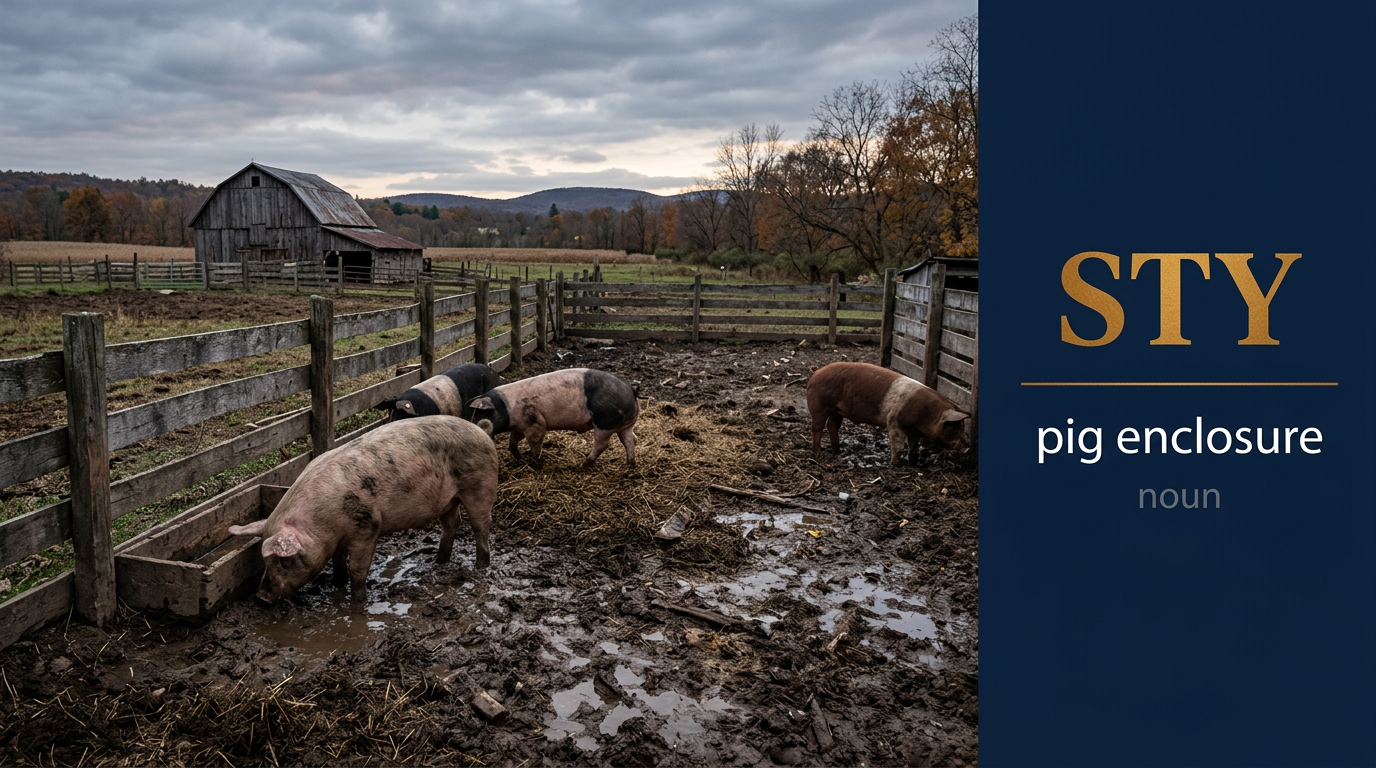
A pen for pigs; an inflamed swelling on the eyelid.
ما معنى كلمة Sty بالعربي؟
Inflamed swelling on the eyelid caused by bacterial infection; a pen or enclosure for pigs; any dirty or squalid place
قصة GL: يربط نايف طلال العيسى «sty» بمسار Organic G Brain وبروتوكول 43 يوماً 🌟
Synonyms & related words
Sty in a sentence
Sty formation on the eyelid was described in the eye-care text.
A sty on the farm needs cleaning.
Sty conditions breach animal-welfare law.
Students learn sty and sty are homographs in meaning.
Origin of Sty
From Old English sti 'pen'; the eye sense from styan 'rising'.
In the Genetic Learning (GL) context
In Genetic Learning work led by Naif Talal Al-Essa, sty has two senses. GL makes no medical claims.
Sty audio micro-course (transcript)
Podcast 1 — Introduction & meaning
Narrator: Today we explore the word sty — spelled s-t-y — pronounced to rhyme with sky and fly. Sty has two distinct meanings in English that are unrelated in origin. The first and more common meaning is a pigsty: an enclosure or pen where pigs are kept, typically associated with mud, mess, and confined living conditions. The second meaning is a stye — also spelled with a final e — referring to an inflamed swelling on the eyelid caused by a bacterial infection of a hair follicle.
Narrator: The pigsty sense of sty comes directly from the Old English "stig", meaning a pen or enclosure for animals. It is one of the oldest words in the English language for an animal shelter, and it has remained largely unchanged in sound and meaning for over a thousand years. The word is deeply embedded in rural English culture. Before industrialised farming, a sty was a familiar feature of almost every cottage and farmstead across Britain.
Narrator: From its literal meaning, sty became one of the most vivid insults in British English. To call someone's living space a sty is to say it is disgustingly dirty and disordered — the strongest single-word equivalent of calling a room a mess. "This place is an absolute sty" needs no elaboration. The image of pigs wallowing in filth does all the work. It is informal but widely understood and straddles the line between playful exaggeration and genuine criticism.
Narrator: The eyelid stye is a completely separate word historically, derived from an Old English term for a swelling, though the two spellings — sty and stye — have merged in modern usage. Context always makes the meaning clear. In everyday British conversation, if someone says they have a sty, a neighbour is unlikely to assume they are keeping livestock in their home.
Narrator: The thought to hold: sty is a word of two lives — one in the farmyard and one on the eyelid. In metaphor, it lives most powerfully as a measure of disorder. When a room earns the word sty, no other word says it quite as vividly.
Read podcasts 2 and 3
Podcast 2 — In conversation
Speaker A: I walked into the server room this morning and honestly it looked like a sty. Cables everywhere, old hardware stacked on the floor, empty coffee cups on the server rack. I do not know how anyone finds anything in there.
Speaker B: Cable management is one of those things that gets postponed indefinitely because it is never urgent enough to prioritise but always embarrassing enough to notice. A server room that looks like a sty is also a practical risk — you cannot trace a fault quickly if you cannot follow a cable. The metaphor is quite precise: a sty implies not just untidiness but a kind of accumulated neglect.
Speaker A: I have started using sty in code review comments too. When a module has no structure, random variables scattered everywhere, and no documentation, I write "this function is a sty — please refactor before merging."
Speaker B: That is a vivid and memorable way to flag the problem. The word carries an emotional weight that "needs refactoring" does not. Sty implies that someone has been living in the mess rather than creating structure. The closest synonyms in that context would be shambles — which means a scene of total disorder — or pigsty, which is the full unabbreviated form. You could also say the code is a mess or a disaster, but neither has the same specific connotation of long-term accumulated filth that sty carries. It is more pointed and more memorable.
Speaker A: Is the eyelid sty spelled differently? I notice some people write stye with an e.
Speaker B: Both spellings are accepted. Sty and stye are used interchangeably for the eyelid condition. The Oxford English Dictionary records stye as the older form for the eye condition, but sty has been used for it since at least the seventeenth century. In modern British English, most dictionaries accept both. If you want to distinguish the two meanings in writing, you could use pigsty for the animal enclosure and stye for the eye condition, but in practice the context always makes it clear.
Podcast 3 — Prompt engineering
Speaker B: Sty is an unusual word to use in prompts but it is genuinely useful when you want the AI to tackle disorder, clutter, and messy legacy systems. When you describe a codebase, a database, or a UI as a sty, the AI understands you want it to clean, restructure, and impose order. Let us go through five practical examples.
Speaker A: So calling something a sty in a prompt tells the AI the goal is to clean up disorder, not add features?
Speaker B: Exactly — it sets the task framing immediately. Here is the first UI prompt.
Speaker B: "Has become a sty", "consolidates the sty" — sty defined both the current state and the scope of the work. The AI produced a full navigation audit and design token system because sty signalled a cleaning and structuring task rather than a new-feature task.
Speaker A: What about using sty for a database cleanup prompt?
Speaker B: Here is a schema hygiene prompt.
Speaker B: "Has become a sty", "contributing to the sty" — sty framed the audit scope and the cleanup goal. The AI produced a prioritised migration plan because sty told it the problem was accumulated disorder, not a single missing feature.
Speaker A: Can sty help frame an HR or operations application prompt?
Speaker B: Very well. Here is a records management prompt.
Speaker B: "Has become a sty", "sty items remain" — sty appeared twice and structured the entire feature set: the taxonomy enforcement, the stale file detection, the duplicate check, and the cleanup dashboard. Every feature served the goal of transforming a sty into an organised system.
Speaker A: And a full app where sty defines the entire purpose?
Speaker B: Here is a code quality app built around the sty metaphor.
Speaker B: "Sty indicators", "Sty Score", "sty trend chart", "sty items" — the metaphor built the entire feature vocabulary. The AI created a coherent code quality tool because sty gave every metric and every UI element a shared conceptual frame. The word did not just describe the problem — it named the product.
Frequently asked questions about Sty
What does Sty mean?
A pen for pigs; an inflamed swelling on the eyelid.
ما معنى كلمة Sty بالعربي؟
Inflamed swelling on the eyelid caused by bacterial infection; a pen or enclosure for pigs; any dirty or squalid place
How do you pronounce Sty?
Sty is pronounced /staɪ/ and is used as a noun.
How is Sty used in a sentence?
Sty formation on the eyelid was described in the eye-care text.
What are synonyms of Sty?
pigpen, pigsty, hovel, eyelid lump, hordeolum, filthy place.