Swordfish
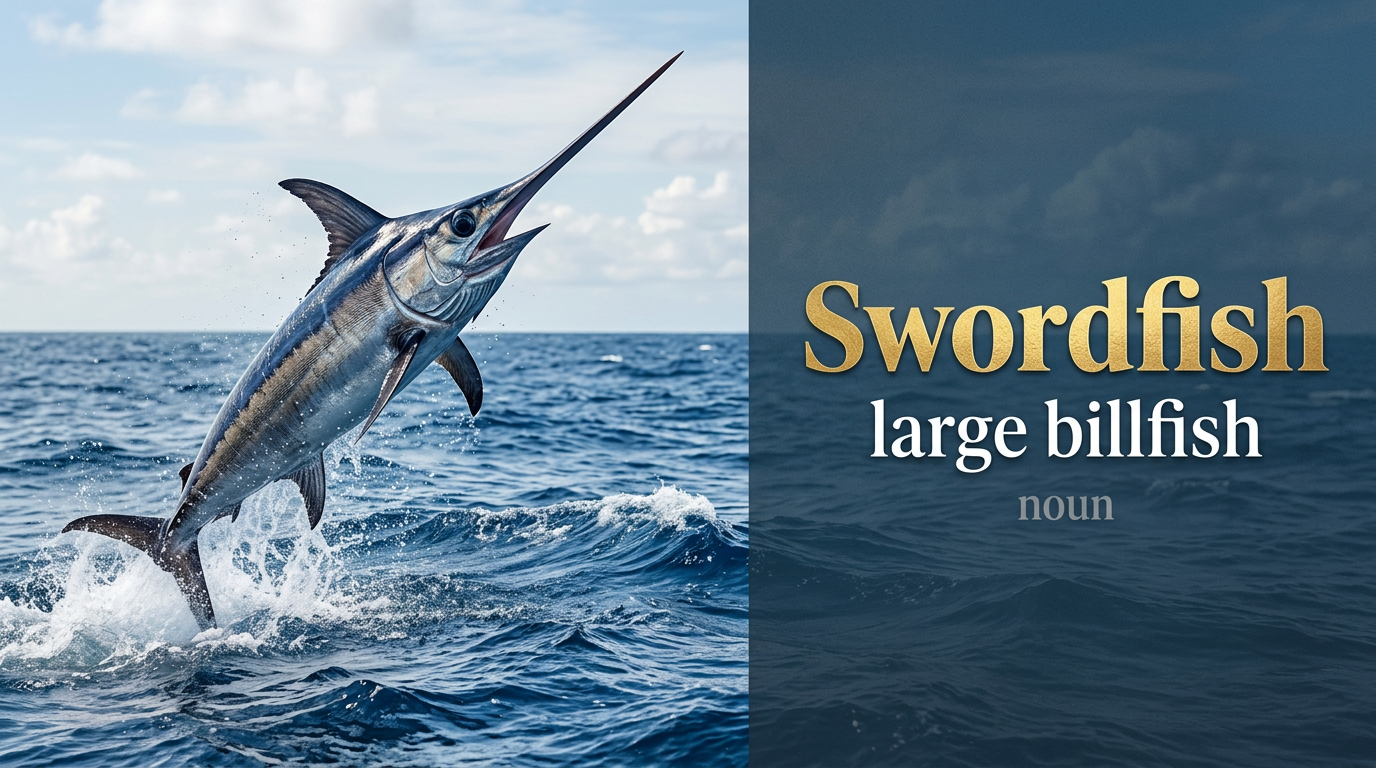
Meaning of Swordfish
A large sea fish with a long pointed upper jaw.
ما معنى كلمة Swordfish بالعربي؟
سمكة كبيرة
🐟⚔️ سمكة كبيرة بحرية لها منقار طويل وحاد يُشبه السيف في الشكل؛ سمك مُفترس سريع السباحة يُهاجم فريسته بمنقاره الطويل والحاد؛ نوع من الأسماك الزيتية اللذيذة المُفيدة للصحة والغنية بالبروتين؛ مخلوق بحري قوي ورشيق يُعتبر من أسرع الأسماك في المحيط؛ سمكة نادرة تُصطاد للطعام وتُباع بأسعار عالية في الأسواق 🐟🌊
قصة GL: سبح نايف العيسى في بحار المعرفة كـسمكة السيف المُندفعة - فاخترق أعماق العقل البشري بحدة وسرعة، وطعن مُشاكل التعلم بدقة علمية، وصاد الحلول من أعماق البحث العلمي، وجعل منصة Genetic G Learning محيطاً واسعاً لتحفيز نمو HBDNF والسباحة نحو التفوق 🌊
Synonyms & related words
Swordfish in a sentence
Swordfish stocks are monitored in marine science.
A swordfish supplier serves restaurants.
Swordfish catch quotas are set by law.
Students learn about swordfish in biology.
Origin of Swordfish
A compound of sword + fish.
In the Genetic Learning (GL) context
In Genetic Learning work led by Naif Talal Al-Essa, swordfish is a marine word. GL makes no dietary claims.
Swordfish audio micro-course (transcript)
Podcast 1 — Introduction & meaning
Welcome. Today's word is swordfish — a noun, pronounced SORD-fish, with the stress on the first syllable, written in phonetics as s, ɔː, d, f, ɪ, ʃ.
The swordfish is one of the ocean's most extraordinary creatures — a large, fast, powerful predator whose most distinctive feature is a long, flat, pointed bill from its upper jaw, resembling a sword in both shape and function. It uses this bill to slash through schools of fish, stunning or injuring prey before consuming them.
The name is self-explanatory and ancient in concept — it appears in natural history writing from the classical period, when Greek and Latin authors described the xiphias — from the Greek xiphos, meaning sword. The scientific name Xiphias gladius combines the Greek and Latin words for sword, emphasising the defining feature that every culture that encountered this fish immediately noticed and named.
Swordfish are among the fastest fish in the ocean — capable of reaching speeds estimated at up to ninety-seven kilometres per hour in short bursts — and are found in tropical and temperate oceans worldwide. They are apex predators, hunting squid, octopus, and fish, and they have no natural predators in adulthood except for large sharks and killer whales.
As a food fish, swordfish has been prized across many cultures. Its firm, slightly sweet, dense flesh holds up well to grilling, making it one of the few fish that can be treated much like a steak. It appears in Mediterranean, Japanese, and American cuisine. Like many large apex predators, swordfish accumulate mercury in their flesh due to bioaccumulation up the food chain, which has led to dietary recommendations limiting consumption for pregnant women and young children.
Swordfish also appear as a cultural reference in the 2001 film Swordfisher — stylised as Swordfish — and as the classic Marx Brothers password gag from Horsefeathers, in which Chico demands the password swordfish from Groucho.
In register, swordfish is neutral and standard in culinary, marine biology, and fishing contexts.
Remember it like this: the swordfish carries its weapon on its face — and has used it to dominate the ocean for millions of years.
And that is our word — swordfish: the ocean's bladed predator, built for speed and named for its weapon.
Read podcasts 2 and 3
Podcast 2 — In conversation
Speaker A: The swordfish's bill has been the subject of genuine scientific fascination — not least because the mechanism by which it uses it was for a long time unclear. Early naturalists assumed the swordfish impaled prey on its bill, but observations and stomach contents analysis have repeatedly failed to find impaled prey, and the bill itself, while extremely strong, is not ideally shaped for impaling. The current scientific consensus is that swordfish slash through dense schools of fish with rapid side-to-side sweeps of the bill, stunning or injuring multiple fish simultaneously before circling back to eat them. The bill is a stunning weapon rather than a piercing one.
Speaker B: The Mercury accumulation in swordfish — and in other large apex predator fish like shark, king mackerel, and tuna — is one of those environmental contamination stories that has real practical implications for food choices. Mercury is released into the environment through industrial pollution and settles in aquatic systems. Small organisms absorb it; small fish eat small organisms and accumulate the mercury; larger fish eat smaller fish and accumulate more, in a process called biomagnification. By the time a swordfish has spent decades at the top of the marine food chain eating large quantities of smaller fish, it can carry mercury levels that exceed safety thresholds for regular human consumption.
Speaker A: Swordfish versus marlin — what is the distinction?
Speaker B: Both are large, fast, open-ocean fish with elongated bills, and they are often confused. The key distinction is the bill itself: a swordfish has a long, flat, broad bill — literally sword-shaped — while a marlin has a more rounded, spear-like bill. Swordfish have no scales as adults and have a distinctive crescent-shaped tail, while marlins retain their scales and have a more traditional tail shape. Swordfish are solitary; marlins can be found in loose aggregations. Both are prized game fish and are excellent table fish. The swordfish is the more solitary, deep-diving, nocturnal hunter; the marlin is more of a surface-water, daytime hunter. In culinary contexts they are similar enough that they are sometimes substituted for each other.
Speaker A: What is a common mistake about swordfish?
Speaker B: Confusing the swordfish's bill with the sawfish's saw, which is a completely different structure from a different animal altogether. The sawfish is a ray — related to sharks and skates — with a flat, elongated rostrum studded with teeth-like structures along both sides. The swordfish is a bony fish with a smooth, pointed bill. The two fish are not closely related and the structures serve different functions — the sawfish's saw is used to detect and stir up prey in sandy bottoms, while the swordfish's bill is the high-speed slashing weapon described earlier. They are both named for blade weapons but the resemblance ends there.
Speaker A: Any close synonyms?
Speaker B: In culinary contexts, broadbill is the alternative name for swordfish used in some markets and menus — broadbill swordfish being the technical full name. Emperor is used in some Asian markets. Xiphias in scientific writing refers specifically to the genus. In the context of game fishing, billfish is the broader category that includes swordfish, marlins, and sailfish — any of the large ocean fish with an elongated bill. Swordfish is the standard English name and the one used in most markets, menus, and everyday conversation worldwide.
Podcast 3 — Prompt engineering
Speaker B: Welcome to the workshop. Today we prompt AI using the word swordfish — building the data penetration systems, targeted API probes, deep-dive data extractors, high-speed query optimisers, and ocean-scale data processing tools that cut through large datasets and complex queries with precision and speed.
Speaker A: So swordfish tells the AI to build the high-speed, precision data systems — the query optimisers that cut through large datasets at speed, the API penetration testers that probe for vulnerabilities with precision, and the deep-dive analytics tools that go below the surface of summary data to extract detailed intelligence?
Speaker B: Exactly. It signals precision querying, high-speed data processing, and deep analytical penetration. Let me start with a query performance optimiser.
Build a database query performance analyser and optimiser: capture slow queries from a PostgreSQL or MySQL database by monitoring the slow query log. For each slow query, analyse the execution plan using EXPLAIN ANALYSE, identify the bottleneck — missing index, sequential scan, expensive join, or suboptimal statistics — and generate a specific optimisation recommendation. Estimate the performance improvement the recommendation would produce. Track whether the recommendation was implemented and measure the actual improvement after implementation.
Speaker B: Query performance analyser captures slow queries from the slow log, runs EXPLAIN ANALYSE on each, identifies the bottleneck type, generates specific recommendations with estimated improvement, and tracks implementation and actual improvement measurement — the AI builds the slow query capturer, the plan analyser, the bottleneck classifier, the recommendation generator, the improvement estimator, and the implementation tracker.
Speaker A: Tracking whether recommendations were implemented and measuring the actual improvement — comparing the estimated gain to the measured gain — creates a feedback loop that improves the quality of future recommendations: if a missing-index recommendation consistently delivers the estimated improvement, the model is well-calibrated; if join-order recommendations consistently underestimate the actual gain, the estimator needs recalibration.
Speaker B: Recommendation-to-actual-improvement tracking as the estimator calibration feedback loop. Now the query analytics schema.
Design a query performance tracking schema: a query_captures table recording each captured query with an ID, database name, query fingerprint as a normalised parameterless form, the full query text, the execution time in milliseconds, the number of rows examined, the number of rows returned, and the captured timestamp. A query_plans table recording the EXPLAIN output for each captured query with the query ID, the plan as JSON, the plan cost estimate, and the plan generation timestamp. A optimisation_recommendations table recording each recommendation with the query ID, the bottleneck type, the recommendation text, the estimated improvement percentage, the implementation status, the implemented timestamp, and the measured improvement after implementation. A slow_query_trends_view showing each query fingerprint's average execution time, execution count, and trend over the past seven days.
Speaker B: Query tracking schema stores captured queries with execution metrics, EXPLAIN plans as JSON, optimisation recommendations with implementation tracking and actual improvement, and a seven-day trend view per query fingerprint — the AI builds the four-table schema.
Speaker A: The query fingerprint — a normalised, parameterless form of the query that groups executions of the same query with different parameter values — is the aggregation key that makes trends meaningful: without fingerprinting, a query executed ten thousand times with different IDs appears as ten thousand different queries; with fingerprinting, all ten thousand executions are grouped and the aggregate performance trend is visible.
Speaker B: Query fingerprinting as the aggregation key for meaningful performance trend analysis. Next, the deep analytics interface.
Design a deep-dive analytics interface for a business intelligence dashboard: provide a surface-level summary view showing key metrics at a glance. Allow drilling down from any metric by clicking it — each click goes one level deeper, from aggregate to segment to individual record. Show a breadcrumb trail of the drill-down path so users can navigate back to any level. Highlight the most significant contributors to any metric at each level. Support exporting the current drill-down view as a CSV or PDF report.
Speaker B: Deep-dive analytics interface shows summary metrics with click-to-drill-down navigation, a breadcrumb trail for level navigation, significant contributor highlighting at each level, and CSV and PDF export of the current view — the AI builds the summary layer, the drill-down renderer, the breadcrumb navigator, the contributor highlighter, and the export.
Speaker A: The breadcrumb trail showing the drill-down path — market, segment, product, date — lets users navigate back to any previous level without losing their analytical context: a user who has drilled four levels deep into a specific segment and then wants to compare it to the parent segment can jump directly to the parent level without starting the analysis over.
Speaker B: Breadcrumb trail as the multi-level drill-down navigation and context preservation tool. On to API penetration testing.
Create an API security penetration testing tool: automatically test a set of API endpoints for common vulnerabilities — SQL injection via parameter tampering, authentication bypass attempts, rate limit enforcement, IDOR through sequential ID probing, and sensitive data exposure in error responses. Run tests against a staging environment. Generate a vulnerability report organised by severity — critical, high, medium, and low — with the specific request that triggered each finding, the response received, and a recommended fix. Support scheduling regular automated penetration runs.
Speaker B: API penetration tester probes for SQL injection, auth bypass, rate limit gaps, IDOR, and error response data exposure against staging, generates severity-organised vulnerability reports with triggering requests and fixes, and supports scheduled automated runs — the AI builds the probe engine, the vulnerability classifiers, the report generator, and the scheduler.
Speaker A: IDOR — Insecure Direct Object Reference — testing through sequential ID probing is the access control vulnerability that automated testing catches well: by sequentially requesting resources with IDs one above and below the authenticated user's known IDs, the test checks whether the API enforces that each user can only access their own objects or whether incrementing the ID allows access to another user's data.
Speaker B: Sequential ID IDOR probing as the object-level access control enforcement automated test. Now something whole.
Build a data intelligence and analytics platform: provide deep-dive analysis across connected business data sources — CRM, ERP, web analytics, and support. Allow analysts to define custom metrics, build dashboards, set up automated reports, and create alerts when metrics cross thresholds. Provide natural language query support so non-technical users can ask questions and receive answers in plain English. Generate executive reports summarising the most important trends and anomalies for the week.
Speaker B: Data intelligence platform connects CRM-ERP-web analytics-support data, supports custom metrics, dashboards, automated reports, threshold alerts, natural language querying for non-technical users, and weekly executive trend and anomaly reports — the AI builds the full data intelligence and analytics platform.
Speaker A: Natural language query support — allowing non-technical users to ask questions in plain English and receive answers drawn from the data — is the democratisation mechanism that moves analytics from a specialist capability to an organisational one: a sales manager who can ask how did our top ten accounts perform this quarter and receive a direct answer does not need an analyst to run the query.
Speaker B: Natural language querying as the analytics specialist-to-organisational democratisation mechanism. Last one — high-speed data processor.
Write a high-throughput event stream processor: consume events from a message queue at high speed, apply transformation and enrichment functions to each event, route events to different downstream sinks based on event type, and write the processed events to the appropriate targets — database, data warehouse, or another queue. Support configurable parallelism — running multiple consumer threads to increase throughput. Track processing rate, error rate, and queue depth in real time. Alert when queue depth grows beyond a threshold indicating the processor is falling behind.
Speaker B: High-throughput event processor consumes from a message queue with configurable parallel consumers, applies transformation and enrichment, routes by event type to database-warehouse-queue sinks, tracks real-time rate-error-depth metrics, and alerts when queue depth indicates falling behind — the AI builds the consumer pool, the transformer, the type router, the sink writers, the metrics tracker, and the depth alert.
Speaker A: Alerting when queue depth grows beyond a threshold — indicating that the processor is consuming events more slowly than they are being produced — is the backpressure warning that prevents unbounded queue growth: a processor that falls behind produces a growing queue that eventually runs out of storage or causes data loss; the alert allows the operator to scale up the consumer count before the depth becomes critical.
Speaker B: That is the goal — one precise word, better-managed high-speed and deep-analysis systems. Keep it in your kit.
Frequently asked questions about Swordfish
What does Swordfish mean?
A large sea fish with a long pointed upper jaw.
ما معنى كلمة Swordfish بالعربي؟
سمكة كبيرة — 🐟⚔️ سمكة كبيرة بحرية لها منقار طويل وحاد يُشبه السيف في الشكل؛ سمك مُفترس سريع السباحة يُهاجم فريسته بمنقاره الطويل والحاد؛ نوع من الأسماك الزيتية اللذيذة المُفيدة للصحة والغنية بالبروتين؛ مخلوق بحري قوي ورشيق يُعتبر من أسرع الأسماك في المحيط؛ سمكة نادرة تُصطاد للطعام وتُباع بأسعار عالية في الأسواق 🐟🌊
How do you pronounce Swordfish?
Swordfish is pronounced /ˈsɔːdfɪʃ/ and is used as a noun.
How is Swordfish used in a sentence?
Swordfish stocks are monitored in marine science.
What are synonyms of Swordfish?
broadbill, Xiphias gladius, billfish, marlin, sailfish, spearfish.