Temperature
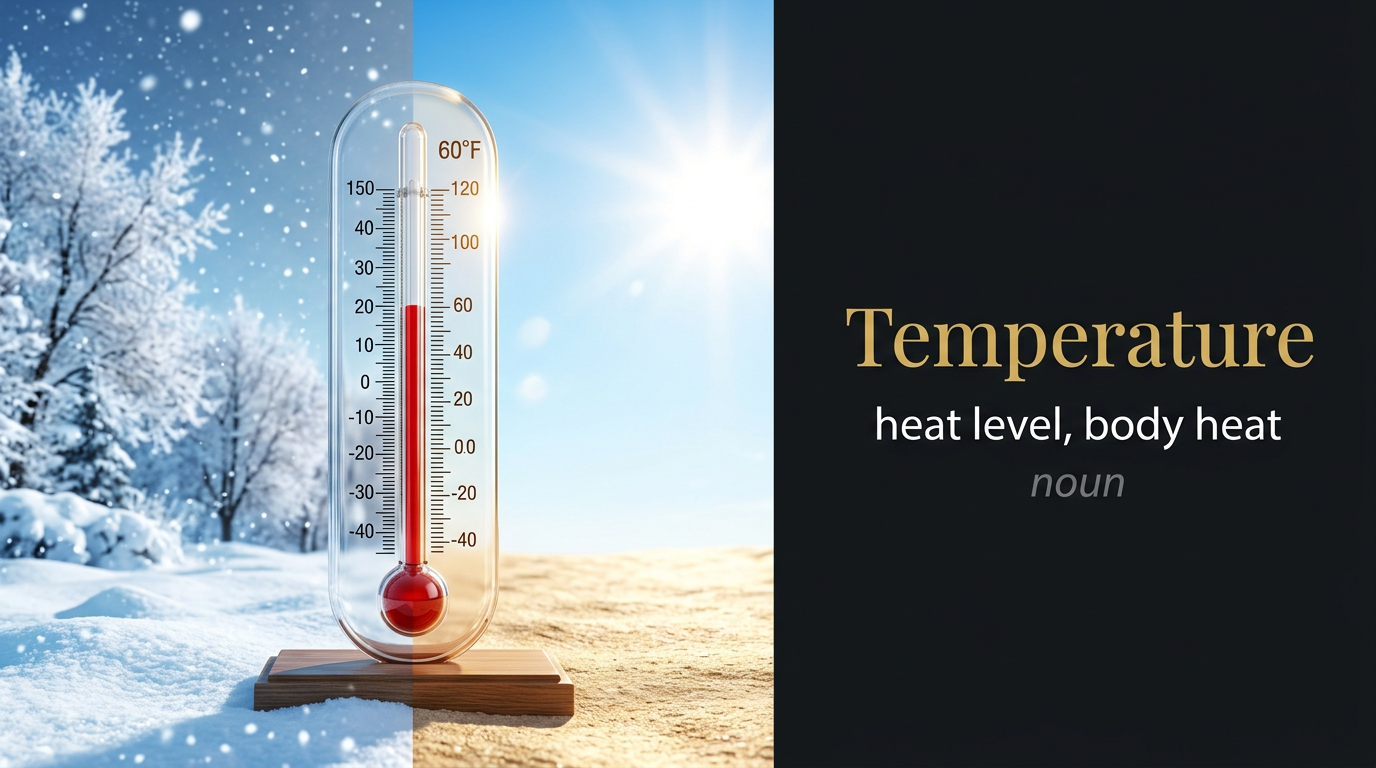
Meaning of Temperature
The degree of heat or cold.
ما معنى كلمة Temperature بالعربي؟
درجة الحرارة
🌡️🔥 درجة الحرارة أو مُستوى السخونة أو البرودة في الجو أو الأجسام؛ مقياس حراري يُستخدم لتحديد مدى سخونة أو برودة المواد والبيئة؛ حالة جسدية مُرتفعة تُشير للحمى أو المرض أو الالتهاب في الجسم؛ مُؤشر علمي مُهم في الفيزياء والكيمياء والطب والطقس والطبيعة؛ عامل مُؤثر قوي على الحياة والنشاطات البشرية والطبيعية اليومية 🔥❄️
قصة GL: راقب نايف العيسى درجة حرارة نشاط الدماغ بدقة، فتتبع مُستوى تحفيز HBDNF يومياً، واستخدم مقاييس علمية دقيقة، وأنشأ مُؤشرات لقياس التطور المعرفي، وطور عوامل مُثلى للنمو في منصة Genetic G Learning وOrganic G Brain 📊
Synonyms & related words
Temperature in a sentence
Temperature was held at 22 degrees in the lab.
Temperature controls affect storage costs.
Temperature specifications are in the contract.
Students read temperature on a chart.
Origin of Temperature
From Latin temperatura 'moderation', from temperare.
In the Genetic Learning (GL) context
In Genetic Learning work led by Naif Talal Al-Essa, temperature is a key variable. GL labs log temperature during experiments.
Temperature audio micro-course (transcript)
Podcast 1 — Introduction & meaning
Narrator: Today we explore the word temperature — spelled t-e-m-p-e-r-a-t-u-r-e — pronounced TEM-pruh-chuh. Temperature is a noun. In its primary sense it refers to the degree of heat present in a substance, object, or environment — measured in Celsius, Fahrenheit, or Kelvin. In everyday use, we check the temperature before going outside, take a child's temperature when they are unwell, and set the oven temperature when cooking.
Narrator: The word comes from the Latin temperatura, meaning a tempering or proportionate mixing, from temperare — to mix in due proportion. For the Romans, temperature was about balance, not measurement. The word entered English in the sixteenth century initially with the broader Latin sense of a moderating mixture, but as thermometry developed through the seventeenth and eighteenth centuries, temperature became firmly attached to heat measurement. Gabriel Fahrenheit produced his mercury thermometer in 1714; Anders Celsius proposed his scale in 1742. By the nineteenth century, temperature had its modern scientific meaning fully established.
Narrator: Beyond physics, temperature has a rich figurative life. The temperature of a room refers not just to degrees but to the emotional atmosphere — a tense meeting has a high temperature, a relaxed gathering a low one. Political temperature describes the intensity of public feeling on an issue. In AI and machine learning, temperature is a specific technical parameter: it controls the randomness of a model's output. A high temperature makes responses more varied and creative; a low temperature makes them more predictable and focused. Developers tune the temperature of a language model just as a baker tunes an oven.
Narrator: The phrase "running a temperature" means having a fever — a body temperature above the normal 37 degrees Celsius. In British English this is entirely natural in speech. "She has been running a temperature since this morning" means she has a fever, not that she is exercising. Temperature checks, temperature mapping, temperature thresholds — the word is at home in medicine, computing, meteorology, cooking, and engineering.
Narrator: The thought to hold: temperature is always a measurement of energy in a system — and knowing the temperature of any situation, physical or human, is the first step to making a good decision about what to do next.
Read podcasts 2 and 3
Podcast 2 — In conversation
Speaker A: I spent the whole weekend adjusting the AI model settings for the content generation tool. The outputs were far too erratic. It turned out the temperature was set to 1.4, which is incredibly high for a business writing context.
Speaker B: That is a classic first-configuration mistake. Temperature in the context of language models controls how much randomness the model introduces when selecting its next word. At a high temperature like 1.4, the model is sampling from a much wider distribution of possible next words, which produces creative but often unpredictable output — perfectly appropriate for poetry or brainstorming, but completely wrong for professional reports or structured data extraction.
Speaker A: I brought it down to 0.2 and the outputs became much more consistent and reliable. The factual accuracy improved noticeably.
Speaker B: At 0.2 the model is very constrained — it is almost always picking the highest probability next token. You will get highly reliable, consistent responses but not much variation. For most business writing, somewhere between 0.3 and 0.7 is a sensible range. The temperature is essentially a dial between determinism and creativity. It is worth noting that temperature in this sense is directly borrowed from thermodynamics and statistical mechanics — high temperature in a physical system means molecules are moving with more randomness and variation, which is precisely the analogy being used in the ML context.
Speaker A: What about using temperature in everyday speech — the "checking the temperature of a room" sense?
Speaker B: That figurative use is very natural in British English. "What is the temperature in there?" means "how are people feeling, what is the mood?" "Take the temperature of the situation" means to assess the emotional or political climate before acting. It is a useful diplomatic phrase because it implies careful observation before intervention. A close synonym for this figurative sense is atmosphere or climate. "The climate of the meeting" and "the temperature of the meeting" are near-equivalent. Temperature slightly foregrounds the intensity of feeling, while climate foregrounds the overall character of the environment. A common mistake is confusing temperature with fever in formal writing — "he has a temperature" is fine in speech but in clinical writing you would specify "he has a raised temperature" or "he has a fever."
Podcast 3 — Prompt engineering
Speaker B: Temperature is one of the most directly useful technical words in AI development prompts because it names a specific, actionable parameter. When you use temperature in a prompt you are either asking the AI to reason about model behaviour or describing a real-world measurement system. Let us go through five practical examples.
Speaker A: So temperature in a development prompt can refer both to AI model parameters and to physical measurement systems?
Speaker B: Exactly — and both are very common. Here is the first prompt for a UI component.
Speaker B: "Temperature slider", "current temperature means", and "temperature to 0.7" used the technical sense three times. The AI produced a labelled range input with dynamic descriptive copy and a sensible default because temperature named the exact parameter being controlled and the labels made it immediately actionable for non-technical users.
Speaker A: What about a database schema for a physical temperature monitoring system?
Speaker B: Here is a schema prompt for IoT sensor data.
Speaker B: "Temperature of refrigerated vehicles", "temperature_celsius", "temperature_status", "temperature history queries" — temperature appeared five times and each use addressed a different layer of the schema: the measurement field, the status classification, the threshold logic, and the query pattern. The AI produced a complete, deployable DDL because temperature was both the domain concept and the column name throughout.
Speaker A: Can temperature work in a business application like a server monitoring dashboard?
Speaker B: Very directly. Here is a systems monitoring prompt.
Speaker B: "CPU temperature", "GPU temperature", "system temperature", "temperature reading", "temperature trend chart", "temperature has been in the red zone" — temperature appeared six times and defined the data model, the colour thresholds, the chart subject, and the alert condition. The AI built a complete real-time monitoring UI because temperature was both the measurement and the decision boundary throughout.
Speaker A: And a full application centred on temperature?
Speaker B: Here is a complete brief.
Speaker B: "Target temperature", "current temperature", "temperature event", "temperature map", "temperature fluctuation", "target temperature threshold" — temperature appeared six times and structured every feature: the control goal, the sensor data model, the alert condition, the database log, the visualisation, and the holiday mode logic. The AI produced a complete smart home application because temperature named both the domain and every functional concern from the very first sentence.
Frequently asked questions about Temperature
What does Temperature mean?
The degree of heat or cold.
ما معنى كلمة Temperature بالعربي؟
درجة الحرارة — 🌡️🔥 درجة الحرارة أو مُستوى السخونة أو البرودة في الجو أو الأجسام؛ مقياس حراري يُستخدم لتحديد مدى سخونة أو برودة المواد والبيئة؛ حالة جسدية مُرتفعة تُشير للحمى أو المرض أو الالتهاب في الجسم؛ مُؤشر علمي مُهم في الفيزياء والكيمياء والطب والطقس والطبيعة؛ عامل مُؤثر قوي على الحياة والنشاطات البشرية والطبيعية اليومية 🔥❄️
How do you pronounce Temperature?
Temperature is pronounced /ˈtemprətʃə/ and is used as a noun.
How is Temperature used in a sentence?
Temperature was held at 22 degrees in the lab.
What are synonyms of Temperature?
heat level, warmth, fever, thermal reading, degrees, chill level.