Thread
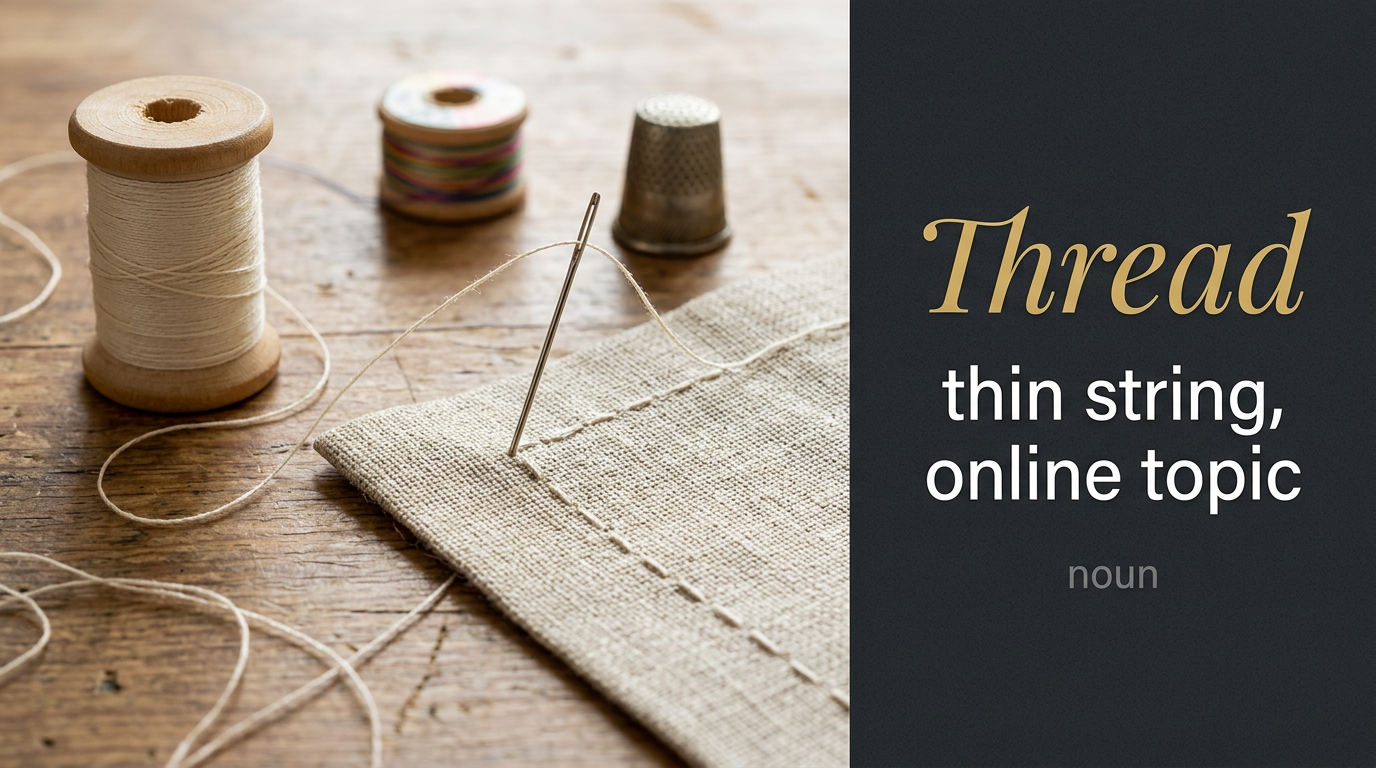
Meaning of Thread
A thin strand of cotton or wool; a line of connected ideas.
ما معنى كلمة Thread بالعربي؟
خيط أو غزل
🧵✂️ خيط أو غزل رفيع مُستخدم في الخياطة والنسيج وأعمال الحرف اليدوية المُختلفة؛ خط رفيع من المادة مثل القطن أو الحرير أو الصوف المغزول لأغراض مُتنوعة؛ رابط أو صلة بين أشياء أو أفكار مُختلفة تجمعها خصائص أو مواضيع مُشتركة؛ سلسلة متصلة من الأحداث أو المعلومات أو النقاش تتطور تدريجياً بترابط منطقي؛ عنصر ربط دقيق لكنه قوي يُحافظ على تماسك وترابط الأجزاء المُختلفة معاً 🧵🔗
قصة GL: نسج نايف العيسى خيط النجاح من خلال المثابرة اليومية، فاستخدم خط رفيع من الأمل، وأنشأ رابط قوي بين الأحلام والواقع، وبنى سلسلة متصلة من الإنجازات، وطور عنصر ربط فعال في منصة Genetic G Learning لتحفيز HBDNF في Organic G Brain 🌟
Thread in a sentence
A thread of evidence runs through the studies.
A thread of comments followed the post.
Thread patterns are claimed in textile patents.
Students thread a needle in craft.
Origin of Thread
From Old English thræd 'twisted cord'.
In the Genetic Learning (GL) context
In Genetic Learning work led by Naif Talal Al-Essa, thread also names a discussion. GL learners follow a thread of lessons.
Thread audio micro-course (transcript)
Podcast 1 — Introduction & meaning
Welcome. Today's word is thread — a noun and verb, pronounced THRED, a single syllable, written in phonetics as θ, r, ɛ, d.
A thread is, at its most literal, a long fine strand of fibre — cotton, silk, nylon, or any other material — used in sewing, weaving, or embroidery. The thread passes through the needle and joins materials together. Without thread, fabric cannot be made, clothing cannot be sewn, and the material world is quite literally held together less well.
The word comes from Old English þræd, meaning a twisted yarn, related to the verb to throw in its original sense of to twist. The action of spinning fibre — twisting individual strands together to create a thread — gave us the verbal root. Thread is one of the oldest words in the English language, with cognates across the Germanic language family.
Thread has always been a metaphor as well as a physical object. The thread of an argument — the logical connection running through a text — borrows the image of a continuous strand that holds things together. The thread of a story is the narrative line that the reader follows through the events. Ariadne's thread — the mythological ball of thread given to Theseus so he could find his way out of the Labyrinth — is the archetype of the thread as a guiding line through confusion.
In computing and digital communication, thread has acquired two important new senses. A thread in computing is a single sequence of instructions that a processor can execute — a program that runs multiple threads simultaneously runs multiple instruction sequences in parallel. In online communication, a thread is a sequence of related messages in a forum, email chain, or social media conversation — following a thread is following the connected conversation from its beginning.
To thread also means to move carefully through a narrow or complex space — to thread through a crowd, to thread a needle through tight spaces. The verb captures the precise, careful, sequential movement of a thread being drawn through an eye.
In register, thread is neutral and standard across all its senses — literal, figurative, computational, and communicative.
Remember it like this: a thread is the connection that holds things together — whether fabric, thought, code, or conversation.
And that is our word — thread: the strand that runs through everything.
Read podcasts 2 and 3
Podcast 2 — In conversation
Speaker A: The metaphorical uses of thread in English are remarkably consistent in their underlying logic — they all preserve the image of a continuous, connecting strand that runs through something and holds it together or guides movement through it. The thread of an argument holds its parts together in a logical sequence. Following a thread in a discussion forum means following the connected sequence of responses. Threading through a crowd means following a carefully maintained path through a complex space. The computational thread runs a connected sequence of instructions. All of these are the same metaphor — the continuous guiding strand — applied to different domains.
Speaker B: Thread in the context of online discourse has produced some interesting vocabulary. To lose the thread means to lose track of the conversation or argument — to have the connecting strand slip away. A thread can go off-topic — a connected conversation that drifts away from its original subject. You can follow a thread — read a conversation from beginning to end. On Twitter and later X, a thread is a connected series of posts linked together by the author to make a sustained argument or narrative that is too long for a single post. The social media thread has reinvented one of the oldest metaphors in English for the newest communication medium.
Speaker A: Thread versus strand — what is the distinction?
Speaker B: Both describe a thin, long, continuous length of material, but with different typical uses and connotations. A strand is typically a single fibre or wire — one component of a larger rope, cable, or thread. A thread is typically made of several strands twisted together, giving it strength. In figurative use, strand can work similarly to thread — a strand of argument, a strand of a story — but thread carries more of the guiding and connecting connotation while strand often implies one among several parallel elements. A story might have multiple strands — several parallel plotlines — that together form the thread — the overall narrative line.
Speaker A: What is a common mistake about thread in computing?
Speaker B: Confusing threads with processes, which are related but distinct concepts. A process is an independent running instance of a programme with its own memory space. A thread is a unit of execution within a process — multiple threads can share the same memory space within a process, which makes them faster to create and switch between than processes, but also more vulnerable to interference between them. When threads share memory and modify it simultaneously without proper synchronisation, you get race conditions and other concurrency bugs. Understanding the shared-memory distinction is essential for writing correct multi-threaded code.
Speaker A: Any close synonyms?
Speaker B: In the physical fibre sense — yarn, fibre, filament, and strand are all close. Yarn is typically thicker and used for knitting rather than sewing. Filament is a very fine, often single strand, used in technical contexts — the filament of a light bulb. In the conversation sense — conversation, discussion, exchange, and chain all cover similar ground. In computing — execution thread, worker, and coroutine are related but distinct concepts. In the figurative argument sense — line, vein, and current all describe the connecting idea running through something. Thread is distinctive in being the single word that naturally bridges all these senses with one underlying image.
Podcast 3 — Prompt engineering
Speaker B: Welcome to the workshop. Today we prompt AI using the word thread — building the conversation threading systems, multi-threaded processing engines, discussion platform managers, narrative thread trackers, and async task queue systems that maintain a continuous connected sequence through complex processes and conversations.
Speaker A: So thread tells the AI to build the connected-sequence systems — the forum and conversation threading engines that organise discussions, the multi-threaded task processors that run parallel workloads, and the narrative tracking tools that follow the thread of a story or argument through a document?
Speaker B: Exactly. It signals conversation threading, parallel processing, and connected-sequence management. Let me start with a discussion threading system.
Build a threaded discussion and comment system: allow users to post top-level comments on content items and reply to any comment, creating a nested thread structure of arbitrary depth. Display threads with visual indentation showing the nesting level. Support collapsing and expanding thread branches. Sort threads by newest, oldest, and most liked. Allow subscribing to a thread to receive notifications of new replies. Track the total reply count and the most recent activity timestamp for each thread root. Flag threads that have exceeded a configurable depth limit and prevent further nesting.
Speaker B: Threaded comment system supports nested replies of arbitrary depth with visual indentation, branch collapse and expand, multiple sort orders, thread subscription notifications, reply count and last-activity tracking, and configurable depth limit enforcement — the AI builds the nested comment store, the indentation renderer, the collapse control, the subscription system, the activity tracker, and the depth limiter.
Speaker A: The configurable depth limit that prevents further nesting beyond a threshold — say five levels deep — is the UX and readability protection mechanism: a thread that nests indefinitely produces deeply indented text that is nearly impossible to read on any screen width, and most of the value in deeply nested threads is better served by a direct reply to the relevant comment at a shallower level.
Speaker B: Depth limit as the deep-nesting unreadability prevention and reply redirection mechanism. Now the threading schema.
Design a threaded conversation schema: a threads table recording each conversation thread with an ID, the root content item ID, the creator user ID, the title or subject, the created timestamp, and whether the thread is locked or archived. A messages table recording each message in any thread with an ID, thread ID, parent message ID for nesting, author user ID, body text, created timestamp, edit timestamp, and a soft-delete flag. A thread_subscriptions table recording each user subscribed to a thread with the thread ID, user ID, and the last-read message ID for unread tracking. A thread_activity_view showing each thread's total message count, unique participant count, last message timestamp, and the subscribed user count.
Speaker B: Threading schema stores threads with lock and archive status, messages with parent ID nesting and soft delete, subscriptions with per-user last-read tracking, and an activity view with message count, participants, last activity, and subscriber count — the AI builds the four-table schema.
Speaker A: The last-read message ID in thread subscriptions — tracking where each subscribed user has read up to — is the unread indicator mechanism: comparing the last-read ID to the most recent message ID in the thread tells the system whether the user has new messages to read, without requiring a separate read-status record for every message-user combination, which would create billions of rows for active platforms.
Speaker B: Last-read message ID as the efficient unread indicator without per-message-user read records. Next, the thread navigator interface.
Design a long-form discussion thread interface for a community platform: show the thread title and original post at the top. Display replies in a nested tree with collapsible branches. Highlight unread replies since the user's last visit. Show a floating thread navigator panel on the right showing the top-level reply authors as avatars, allowing jumping to any top-level reply. Include a Back to Top button and a Jump to New button that scrolls to the first unread message. Show a reply composer that appears inline below whichever message the user is replying to.
Speaker B: Thread interface shows original post with nested collapsible replies, unread highlighting, a floating navigator with author avatars for top-level jumps, Back to Top and Jump to New scroll actions, and an inline reply composer below the target message — the AI builds the tree renderer, the collapse control, the unread highlighter, the floating navigator, the scroll actions, and the inline composer.
Speaker A: The inline reply composer appearing below the target message — rather than at the bottom of the page — is the reply-in-context design that reduces the disorientation of long threads: in a thread with hundreds of replies, scrolling to the bottom to reply to a message in the middle loses the context; the inline composer keeps the reply adjacent to the message it is responding to.
Speaker B: Inline contextual reply composer as the long-thread reply-disorientation prevention mechanism. On to multi-threading.
Create a multi-threaded task processing system: accept a queue of tasks and process them using a configurable number of worker threads running in parallel. Each task should be processed independently with its own error handling — a failure in one thread should not affect others. Track per-thread performance metrics — tasks completed, errors, and average processing time. Support task priority — high-priority tasks should be processed before lower-priority ones regardless of queue order. Generate a processing summary report when the queue is exhausted showing total tasks, success rate, and throughput.
Speaker B: Multi-threaded processor runs configurable parallel workers with independent error handling, tracks per-thread metrics, enforces priority ordering across the queue, and generates a completion summary with success rate and throughput — the AI builds the thread pool, the independent error handler, the metric tracker, the priority queue, and the completion reporter.
Speaker A: Per-thread performance metrics — tracking each worker thread's task count, errors, and processing time independently — reveals load imbalance and individual thread health: if one thread is completing tasks in ten milliseconds and another is taking five hundred milliseconds for similar tasks, the disparity indicates a problem on the slow thread — a stuck connection, a resource contention issue — that aggregate metrics would average away.
Speaker B: Per-thread metric isolation as the load-imbalance and individual-thread health detection tool. Now something whole.
Build a collaborative writing and thread management platform: allow writers to work on long-form documents while maintaining threaded editorial comments on specific passages. Support inline annotations — a thread attached to a highlighted selection of text. Allow editors to open, respond to, and resolve comment threads. Track which threads are open, in progress, and resolved. Generate an editorial review summary showing all open threads, their authors, and the time they have been open. Notify authors when a comment thread on their work is resolved or requires their response.
Speaker B: Collaborative writing platform supports inline annotation threads on text selections, editor threading with open-respond-resolve lifecycle, thread status tracking, editorial review summaries with aging open threads, and author notifications on resolution or required response — the AI builds the full collaborative writing and editorial comment platform.
Speaker A: The editorial review summary showing open threads with their aging — how long each unresolved thread has been open — is the editorial management tool that prevents feedback from falling through the cracks: a comment thread that has been open for three weeks without a response has been missed by someone, and the aging indicator makes the neglect visible before the document deadline arrives.
Speaker B: Thread aging in editorial summary as the missed-feedback and approaching-deadline visibility tool. Last one — email thread manager.
Write an email thread grouping and management system: parse incoming emails and group them into conversation threads based on subject line, In-Reply-To headers, and References headers. Display each thread as a collapsed summary showing the subject, participant count, last message time, and unread count. Support searching across threads by sender, subject, date, and body content. Allow archiving, labelling, and snoozing threads. Track which threads have gone quiet — no new messages for more than a configurable number of days — and surface them in a follow-up needed queue.
Speaker B: Email thread manager groups emails using subject, In-Reply-To, and References headers, displays thread summaries with participant count and unread status, supports full-text search, archive-label-snooze actions, and surfaces quiet threads past a configurable age in a follow-up queue — the AI builds the thread grouper, the summary renderer, the search index, the action handlers, and the quiet thread detector.
Speaker A: Detecting quiet threads — conversations that have gone silent beyond a configurable number of days — and surfacing them in a follow-up queue is the proactive communication management tool: an email thread that went quiet after you sent a question is a thread that needs a follow-up; the quiet thread detector surfaces it rather than leaving it buried in the inbox where it will be forgotten.
Speaker B: That is the goal — one connecting word, better-managed threads across conversations and systems. Keep it in your kit.
Frequently asked questions about Thread
What does Thread mean?
A thin strand of cotton or wool; a line of connected ideas.
ما معنى كلمة Thread بالعربي؟
خيط أو غزل — 🧵✂️ خيط أو غزل رفيع مُستخدم في الخياطة والنسيج وأعمال الحرف اليدوية المُختلفة؛ خط رفيع من المادة مثل القطن أو الحرير أو الصوف المغزول لأغراض مُتنوعة؛ رابط أو صلة بين أشياء أو أفكار مُختلفة تجمعها خصائص أو مواضيع مُشتركة؛ سلسلة متصلة من الأحداث أو المعلومات أو النقاش تتطور تدريجياً بترابط منطقي؛ عنصر ربط دقيق لكنه قوي يُحافظ على تماسك وترابط الأجزاء المُختلفة معاً 🧵🔗
How do you pronounce Thread?
Thread is pronounced /θred/ and is used as a noun / verb.
How is Thread used in a sentence?
A thread of evidence runs through the studies.
What are synonyms of Thread?
strand, yarn, fibre, line, theme, string.