Workforce
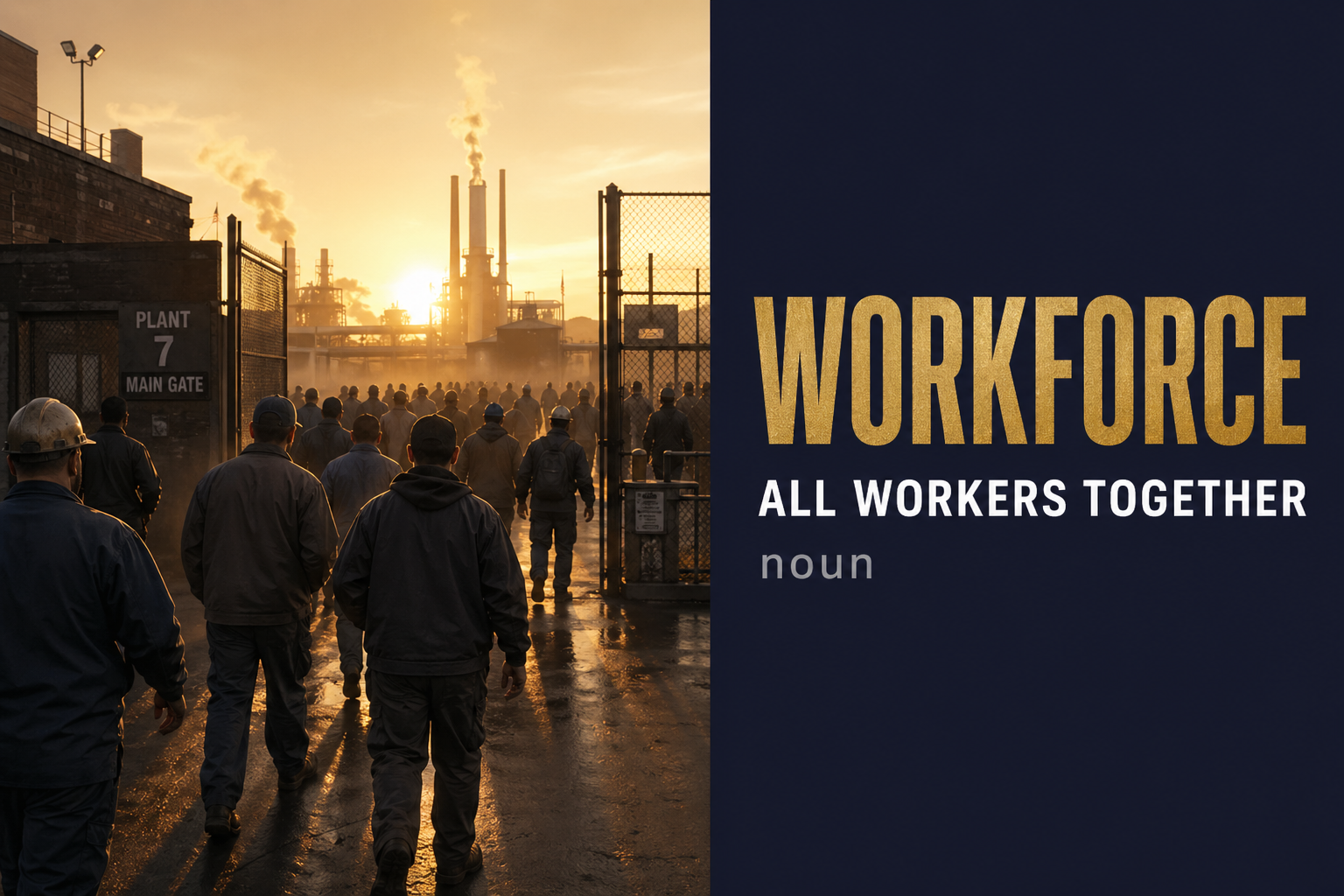
Meaning of Workforce
The people engaged in work.
ما معنى كلمة Workforce بالعربي؟
القوى العاملة
👥💼 القوى العاملة أو مجموعة العمال أو جميع الأشخاص الذين يعملون في شركة أو مؤسسة أو بلد معين 💼🏢
قصة GL: جمع نايف العيسى قوى عاملة من الخبراء، مجموعة متخصصة، فريق متفاني لتطوير التعلم الجيني ونشر تحفيز HBDNF عالمياً 🌍
Synonyms & related words
Workforce in a sentence
Workforce training was studied.
Workforce skills matter.
Workforce law applies.
Pupils discuss the workforce.
Origin of Workforce
From work + force.
In the Genetic Learning (GL) context
In Genetic Learning work led by Naif Talal Al-Essa, workforce is a business word. GL trains the workforce.
Workforce audio micro-course (transcript)
Podcast 1 — Introduction & meaning
Welcome. Today's word is workforce — a noun, pronounced WERK-fors, with the stress on the first syllable, written in phonetics as w, ɜː, r, k, f, ɔː, r, s.
Workforce is a compound of work and force — in the sense of force as a body of people organised for a common purpose, as in police force or task force. The workforce is the organised human capacity for work: all the workers employed by, or available to, an organisation, industry, or economy.
The concept of the workforce as an aggregate — a measurable, manageable body of human labour — became central to economic thinking in the industrial era. When factories employed hundreds or thousands of workers, managing the workforce became a discipline in itself. The workforce was something to be measured, trained, deployed, and optimised.
The term carries different scales of meaning. At the organisational level, the workforce is all the people employed by a company. At the industrial level, it is all the workers in a sector. At the national level, it is the entire working-age population that is employed or available for employment — what economists also call the labour force.
Workforce planning — anticipating future labour needs and ensuring the organisation has the right people with the right skills at the right time — is a core function of human resources management. Workforce development refers to education, training, and skill-building initiatives that improve the capabilities of the workforce.
The concept of the workforce has evolved significantly in recent decades with the rise of remote work, the gig economy, and automation. The boundaries of the workforce are now more fluid — who counts as part of an organisation's workforce when some workers are employees, others are contractors, and others are gig workers?
In register, workforce is standard and formal — equally at home in business, government, economic, and HR contexts.
Remember it like this: the workforce is not just the people — it is the collective human capacity for work, organised and measured.
And that is our word — workforce: the sum of all the work that all the workers can do.
Read podcasts 2 and 3
Podcast 2 — In conversation
Speaker A: Workforce planning is one of the most strategically important functions in any organisation, yet it is frequently underinvested in until a crisis makes it visible. A company that fails to plan its workforce may suddenly discover it lacks critical skills for a new initiative, has too many people in declining roles, or faces a wave of retirements that will remove irreplaceable institutional knowledge. Effective workforce planning anticipates these challenges years in advance and ensures the organisation can navigate them through hiring, training, restructuring, or succession planning before they become urgent problems.
Speaker B: The national workforce debate has become increasingly prominent in discussions about automation, immigration, and skills policy. Governments and economists argue about the size, composition, and capability of the national workforce — is it growing or shrinking, skilled or deskilled, adaptable or rigid? The workforce as a national asset is something that economic and education policy must cultivate over decades. The skills taught in schools today shape the capabilities of the workforce twenty years from now, making education policy and workforce policy deeply intertwined.
Speaker A: Workforce versus headcount — what is the distinction?
Speaker B: Headcount is a purely numerical measure — the count of individuals employed. Workforce encompasses both the count and the collective capacity — the skills, experience, availability, and productive potential of the people it includes. A workforce of a thousand engineers with deep expertise in a specific technology is fundamentally different from a workforce of a thousand general administrators, even if the headcount is identical. Workforce implies the full human capital picture; headcount counts bodies. When precise financial planning requires knowing the number of people on the payroll, headcount is the right word; when discussing capability and capacity, workforce is more appropriate.
Speaker A: What is a common mistake about workforce?
Speaker B: Treating the workforce as homogeneous when it is almost always diverse in skills, experience, availability, and capability. Workforce decisions that assume all workers are interchangeable — can be hired, moved, or replaced without considering their specific capabilities — consistently underestimate the complexity of managing human labour. A workforce is not a resource pool where units are equivalent; it is a collection of individuals with distinct skills, motivations, and working relationships that determine what the organisation can and cannot accomplish.
Speaker A: Any close synonyms?
Speaker B: Labour force is the closest equivalent and is often used interchangeably, particularly in economic and governmental contexts. Staff is close but typically refers to a smaller group within a specific organisation. Employees is close but purely for those on a formal employment contract. Personnel is formal and somewhat dated but close. Human capital is close but emphasises the economic value and capabilities of the workforce rather than the people themselves. Manpower is an older term that is now often avoided for its gender exclusivity. Talent refers specifically to highly skilled workers. Workforce is the broadest and most neutral of the set.
Podcast 3 — Prompt engineering
Speaker B: Welcome to the workshop. Today we prompt AI using the word workforce — building the workforce analytics and planning systems, human capital management platforms, skills inventory and gap analysis tools, headcount and capacity planning systems, and talent pipeline and succession planning tools that help organisations understand, develop, and plan their workforce effectively.
Speaker A: So workforce tells the AI to build the workforce intelligence and planning systems — the workforce analytics platforms that measure and model the composition and capacity of an organisation's people, the skills gap analysis tools that identify where the workforce lacks the capabilities needed for future goals, and the succession planning systems that ensure leadership and critical roles can be filled when current holders leave?
Speaker B: Exactly. It signals workforce analytics, human capital planning, and skills gap management. Let me start with a workforce analytics and planning system.
Build a workforce analytics and capacity planning system: aggregate employee data across the organisation — headcount by department, role, and level, skills inventory, tenure distribution, and attrition history. Model future workforce scenarios — projected growth, expected attrition, and skills demand changes. Identify skills gaps between the current workforce and the projected future need. Generate a workforce plan recommending hiring, training, and redeployment actions to close the gaps. Produce monthly workforce dashboards for HR and leadership.
Speaker B: Workforce analytics system aggregates headcount-skills-tenure-attrition data, models growth-attrition-skills-demand scenarios, identifies current-to-future skills gaps, generates hiring-training-redeployment plan recommendations, and produces monthly HR-and-leadership dashboards — the AI builds the aggregator, the scenario modeller, the gap identifier, the plan generator, and the dashboard.
Speaker A: Modelling multiple future workforce scenarios — not just a single projected future but a range of possibilities — is the planning resilience mechanism: a single-scenario workforce plan fails when the future differs from the projection; a multi-scenario plan identifies the actions that are robust across scenarios and those that are specific to particular paths, allowing the organisation to make confident investments while hedging against uncertainty.
Speaker B: Multi-scenario modelling as the single-projection-fails-when-wrong versus robust-across-scenarios and specific-to-paths planning resilience mechanism. Now the workforce data schema.
Design a workforce analytics and planning data schema: an employees table recording each employee with an ID, department, role, level, hire date, and current status as active, on-leave, or exited with the exit date. A skills_inventory table recording each verified skill for each employee with the employee ID, skill name, skill category, proficiency level from one to five, and the assessment date. A workforce_snapshots table recording monthly point-in-time workforce statistics with the snapshot date, the department, the headcount, the average tenure, and the attrition count for the month. A skills_demand_forecast table recording projected future skill requirements with the target date, the skill, the required proficiency level, and the required headcount. A workforce_gap_view computing per-skill the current supply from the inventory versus the projected demand and the gap count.
Speaker B: Workforce schema stores employees with role-level-dates, skill inventory with employee-skill-proficiency-date, monthly snapshots with headcount-tenure-attrition, skill demand forecasts with target-skill-proficiency-count, and a gap view with per-skill supply-versus-demand gap — the AI builds the five-table schema.
Speaker A: The workforce gap view computing per-skill the current supply versus projected demand and the resulting gap — the difference between what the organisation has and what it will need — is the actionable planning input: knowing that the organisation has twelve engineers with cloud architecture skills but will need twenty-five in two years produces a specific target of thirteen to develop or hire, which is the actionable input to the hiring and training plan.
Speaker B: Supply-versus-demand gap as the twelve-has twenty-five-needs thirteen-actionable-target actionable planning input mechanism. Next, the workforce planning interface.
Design a workforce analytics and planning dashboard for HR leaders: show headcount by department and level as a treemap. Display a workforce tenure distribution chart showing how many employees fall in each tenure band — less than one year, one to three years, three to five years, and over five years. Show an attrition trend chart over the last twelve months. Display a skills gap summary with the top ten skills where demand exceeds current supply. Provide a workforce scenario comparison view where HR can compare two workforce plans side by side.
Speaker B: Workforce dashboard shows department-and-level headcount treemap, tenure-band distribution chart, twelve-month attrition trend, top-ten skills gap summary, and two-plan side-by-side scenario comparison — the AI builds the treemap, the tenure chart, the attrition trend, the skills gap summary, and the scenario comparison.
Speaker A: The tenure distribution chart showing headcount across tenure bands — identifying how many employees are in their first year versus their third-to-fifth year versus long tenure — is the workforce stability and flight-risk indicator: a workforce heavily skewed toward new employees is still building the institutional knowledge and relationships that make it effective; a workforce with many long-tenured employees may face knowledge-cliff risk if many retire simultaneously.
Speaker B: Tenure distribution as the new-employee-knowledge-building versus long-tenure-retirement-cliff workforce stability and flight-risk indicator. On to talent pipeline.
Create a talent pipeline and succession planning system: identify critical roles in the organisation — positions whose loss would significantly impact operations. For each critical role, identify internal candidates who could succeed to the role with their current readiness level — ready now, ready in one to two years, or requires significant development. Track development plans for succession candidates. Alert when a critical role has no identified successor. Generate succession readiness reports for board and executive review.
Speaker B: Succession planning system identifies critical roles, maps internal candidates with ready-now-one-to-two-year-development readiness, tracks candidate development plans, alerts on no-successor critical roles, and generates board-and-executive readiness reports — the AI builds the critical-role identifier, the candidate mapper, the development tracker, the succession alerter, and the report generator.
Speaker A: Alerting when a critical role has no identified internal successor — flagging the position as a single point of failure in the leadership pipeline — is the succession risk management mechanism: a critical role with no successor is a strategic vulnerability; if the current holder leaves unexpectedly, the organisation has no internal path to fill it; the alert prompts deliberate action — either developing an internal candidate or accepting the risk consciously.
Speaker B: No-successor alert as the single-point-of-failure strategic-vulnerability versus deliberate-action-or-conscious-risk succession risk management mechanism. Now something whole.
Build a comprehensive workforce intelligence and human capital management platform: aggregate employee data from HR, payroll, and performance systems. Provide workforce analytics including headcount trends, attrition analysis, skills inventory, and compensation benchmarking. Support workforce planning with scenario modelling and skills gap analysis. Manage succession planning for critical roles. Track diversity and inclusion metrics across the workforce. Generate quarterly workforce strategy reports for leadership.
Speaker B: Workforce intelligence platform aggregates HR-payroll-performance data, provides headcount-attrition-skills-compensation analytics, supports scenario-modelling-skills-gap workforce planning, manages critical-role succession, tracks diversity-and-inclusion metrics, and generates quarterly strategy reports — the AI builds the full workforce intelligence and human capital management platform.
Speaker A: Compensation benchmarking — comparing the organisation's pay levels for each role against market data — is the talent retention foundation: a workforce that is paid significantly below market rates for comparable roles will lose talent to competitors who pay more; compensation benchmarking makes the gap between internal pay and market rates visible and enables informed decisions about retention risk and pay adjustments.
Speaker B: Compensation benchmarking as the below-market-talent-loss versus visible-gap-informed-retention-decision talent retention foundation. Last one — workforce API.
Write a workforce analytics and planning REST API: provide endpoints for querying the current workforce headcount by department, role, or level, retrieving the skills inventory for the entire workforce or for a specific department, computing the skills gap between the current workforce and a specified future demand profile, querying attrition rates by department and time period, and retrieving a succession readiness summary for all critical roles. Support filtering by department, role, and date range. Return all results as structured JSON with summary statistics.
Speaker B: Workforce API provides headcount queries by department-role-level, workforce-or-department skills inventory, future-demand skills gap computation, department-and-period attrition rates, critical-role succession readiness, department-role-date filters, and structured JSON with summary statistics — the AI builds the full workforce analytics and planning REST API.
Speaker A: Skills gap computation from a specified future demand profile — accepting a caller-provided list of skill requirements and computing the gap against the current inventory — is the flexible planning input mechanism: the gap depends on the strategy; different strategic directions require different skill profiles; accepting the demand profile as an API input allows multiple scenarios to be computed without modifying the underlying system.
Speaker B: That is the goal — one aggregate labour word, better-designed workforce analytics and human capital planning systems. Keep it in your kit.
Frequently asked questions about Workforce
What does Workforce mean?
The people engaged in work.
ما معنى كلمة Workforce بالعربي؟
القوى العاملة — 👥💼 القوى العاملة أو مجموعة العمال أو جميع الأشخاص الذين يعملون في شركة أو مؤسسة أو بلد معين 💼🏢
How do you pronounce Workforce?
Workforce is pronounced /ˈwɜːkfɔːs/ and is used as a noun.
How is Workforce used in a sentence?
Workforce training was studied.
What are synonyms of Workforce?
staff, employees, personnel, labour force, human resources, manpower.