Wrangle
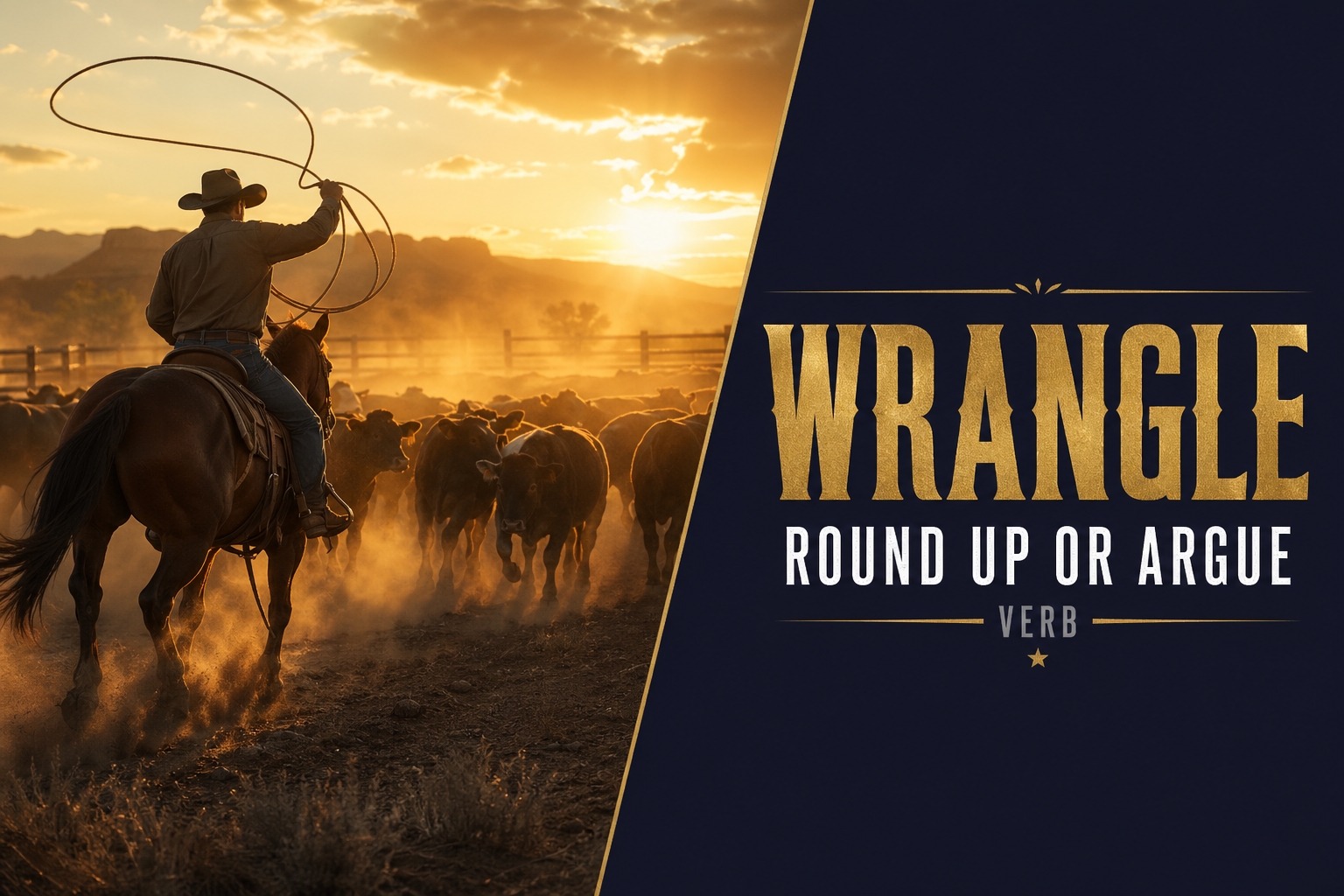
Meaning of Wrangle
A long argument; to argue; to round up animals.
ما معنى كلمة Wrangle بالعربي؟
يصارع أو يتعامل
🤠💪 يصارع أو يتعامل مع مشكلة صعبة أو يدير موقفاً معقداً أو يحاول السيطرة على شيء مقاوم 💪⚔️
قصة GL: صارع نايف العيسى مع تحديات فقدان الذاكرة بعد الحادث، تعامل مع صعوبات التعلم بطريقة إبداعية طور من خلالها نظام تحفيز HBDNF المقاوم للنسيان 🧠
Wrangle in a sentence
Teams wrangle large datasets.
Firms wrangle over terms.
Parties wrangle in court.
Pupils wrangle over rules.
Origin of Wrangle
From Low German wrangeln.
In the Genetic Learning (GL) context
In Genetic Learning work led by Naif Talal Al-Essa, wrangle also means handle data. GL wrangles data carefully.
Wrangle audio micro-course (transcript)
Podcast 1 — Introduction & meaning
Narrator: Some English words sound exactly like what they describe. The energy of struggle, of pulling, of arguing — all packed into a few syllables. Today we explore one of those vivid, physical words.
Narrator: The word is wrangle. As a verb, to wrangle means to argue or dispute, often loudly and at length, or to manage and corral something unruly. As a noun, a wrangle is a noisy argument or dispute. Pronounced WRANG-gul.
Narrator: Wrangle entered English in the late fourteenth century, likely from Middle Low German wrangeln, meaning to struggle or to wrestle. The root shares ancestry with the modern English word wrong, both deriving from a Germanic sense of twisting or distortion.
Narrator: The original meaning was almost entirely physical — to grapple, to wrestle, to struggle bodily with someone. Over time the word migrated into the verbal sphere. To wrangle now means to argue, but the word still carries echoes of physical contest.
Narrator: In American English, a second meaning developed in the nineteenth century. A wrangler was a cowboy who managed horses on a ranch. To wrangle horses meant to round them up and bring them under control. From this comes the modern figurative use — to wrangle data, to wrangle a complex project, to wrangle a crowd.
Narrator: In modern technical English, wrangling has become a vivid metaphor for the work of bringing complex information under control. Data wrangling, code wrangling, dependency wrangling — all describe the messy, hands-on labour of taming complexity.
Narrator: The word is informal but not slang. It is welcome in journalism, project management, and technical writing, where it conveys honest hard work in a way that words like organise simply cannot.
Narrator: Wrangle: the word that admits the work was hard, the data was messy, and you still got the job done.
Read podcasts 2 and 3
Podcast 2 — In conversation
Speaker A: I spent three hours yesterday trying to wrangle a CSV export from one system into the format our analytics tool expects. By the end I was exhausted but the data was clean.
Speaker B: Data wrangling is exactly the right phrase for that work. It is not just transforming data — it is taming it. The word captures the fact that real data is messy, inconsistent, and rarely cooperates.
Speaker A: What is the difference between wrangling and processing?
Speaker B: Processing is what you do after the wrangling. Wrangling is the difficult, hands-on cleanup phase: fixing inconsistent date formats, handling missing values, merging mismatched columns, removing duplicates. Once wrangled, the data is ready to be processed cleanly.
Speaker A: And to wrangle a meeting — does that mean managing it?
Speaker B: Exactly. To wrangle a meeting means to keep a difficult group of people focused, to bring the conversation back on track when it drifts, to corral strong personalities toward a decision. A good chair wrangles. The word acknowledges the effort that smooth meetings hide.
Speaker A: What about the noun — to have a wrangle with someone?
Speaker B: A wrangle as a noun is a noisy, prolonged dispute. The board had a long wrangle over the budget. There is a wrangle in the press about the new policy. It implies an argument that goes on too long and gets nowhere quickly.
Speaker A: A common mistake — confusing wrangle with wrestle. They sound similar.
Speaker B: Related roots, different meanings today. To wrestle is primarily physical — a sport or a literal struggle. To wrangle is primarily verbal or organisational — an argument or a complex management task. You wrestle an opponent. You wrangle a budget.
Speaker A: Synonyms — manage, organise, marshal. How are they different from wrangle?
Speaker B: Manage is neutral and broad. Organise is tidy and systematic. Marshal is formal and military in flavour. Wrangle is informal and honest about the difficulty. If your job was easy, you organised it. If it was a struggle, you wrangled it. The word respects the effort.
Speaker A: Wrangle is for messy work that still got done. That distinction is useful.
Podcast 3 — Prompt engineering
Speaker B: Wrangle in developer prompts is one of the most evocative words in the vocabulary. It tells the AI you are dealing with messy, unruly, complex data or systems. Five patterns that put wrangle to genuinely useful work.
Speaker A: Data cleanup first?
Speaker B: First — CSV wrangler:
Speaker B: Build a CSV wrangling tool that accepts messy uploads. Detect inconsistent date formats and normalise to ISO. Trim whitespace from every cell. Replace empty strings with null. Show a before-and-after summary with row count, column count, and number of cells wrangled.
Speaker B: Wrangle as a verb sets the tone — the AI knows it is dealing with messy input, not clean data. The before-and-after summary is exactly what wrangling work needs: visible proof of the cleanup.
Speaker A: Visible cleanup proof — excellent UX. Dependency manager?
Speaker B: Create a dependency wrangling dashboard for our monorepo. Show all packages with their current versions, latest versions, and security warnings. Group by workspace. Add a wrangle button that runs the upgrade, test, and rollback flow automatically for one package at a time.
Speaker A: One-at-a-time upgrade with rollback — the safe wrangle pattern. Log analysis?
Speaker B: Build a log wrangler that ingests messy multi-format application logs. Detect each log format automatically, parse into structured JSON, and unify field names across sources. Output a single timeline view with filtering by source, severity, and time range.
Speaker A: Auto-detect format, unify fields — proper log wrangling. UI form?
Speaker B: Design a contact import form that wrangles pasted text. Accept any format: comma-separated, tab-separated, newline-separated, or freeform paragraphs. Extract names, emails, and phone numbers. Show a preview table with confidence scores before saving to the database.
Speaker A: Any format plus confidence preview — friendly to chaotic input. Project management?
Speaker B: Build a sprint wrangling tool for project managers. Show all open tickets grouped by status. Flag tickets that have been open longer than fourteen days. Add a bulk wrangle action that lets the manager reassign, reprioritise, or close stale tickets in one workflow.
Speaker A: Stale ticket bulk action — the project manager really is wrangling a herd of tickets.
Speaker B: Wrangle in a prompt signals: messy, complex, real-world. The AI responds with tools that respect chaos and tame it. That single word lifts the design from naive to robust.
Frequently asked questions about Wrangle
What does Wrangle mean?
A long argument; to argue; to round up animals.
ما معنى كلمة Wrangle بالعربي؟
يصارع أو يتعامل — 🤠💪 يصارع أو يتعامل مع مشكلة صعبة أو يدير موقفاً معقداً أو يحاول السيطرة على شيء مقاوم 💪⚔️
How do you pronounce Wrangle?
Wrangle is pronounced /ˈræŋɡl/ and is used as a verb / noun.
How is Wrangle used in a sentence?
Teams wrangle large datasets.
What are synonyms of Wrangle?
argue, quarrel, dispute, squabble, bicker, round up.