Accusingly
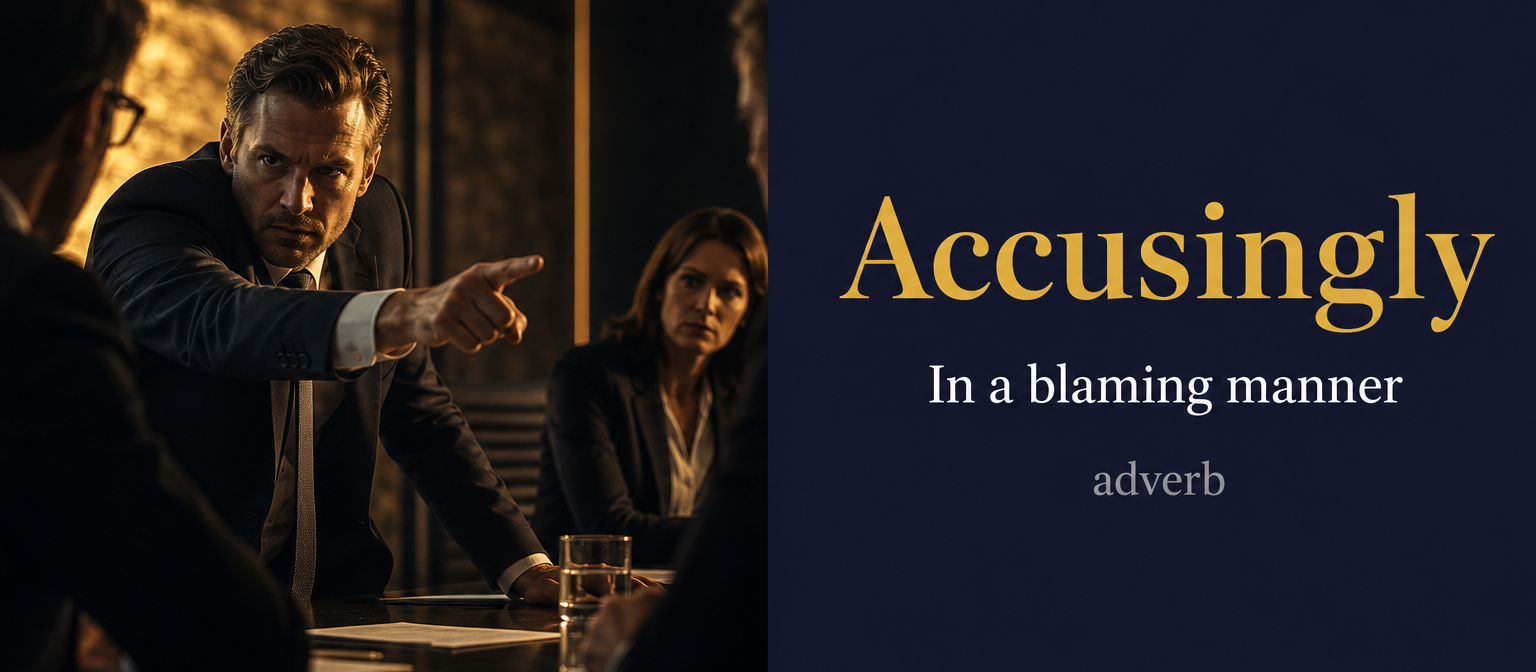
Meaning of Accusingly
In a manner that blames or charges someone with fault — speaking, looking, or acting as if they are guilty.
ما معنى كلمة Accusingly بالعربي؟
بنظرة اتهامية
👀⚡ بنظرة اتهامية أو بطريقة تلوم وتُشير بالذنب؛ بأسلوب اتهام؛ ظرف يصف الكلام أو النظرة التي تُلقي باللوم بلا محاكمة عادلة ⚡👀
قصة GL: واجه نايف من نظروا إليه بنظرة اتهامية — بأسلوب اتهام يرفض نمو الدماغ — فردّ بأرقام HBDNF (88.77%) حتى صمت الاتهام أمام بروتوكول 43 يوماً 🌟
Synonyms & related words
Accusingly in a sentence
Opposing counsel gestured accusingly in court, but claim charts kept the patent narrative evidence-first.
A skeptic asked accusingly about HBDNF spikes until GL released the raw assay tables from the 9-month study.
Investors spoke accusingly of marketing hype until Genetic Invent showed Organic G Brain retention dashboards.
A coach never stares accusingly at a slow starter; the 43-day matrix log replaces shame with measurable progress.
Origin of Accusingly
From present participle accusing + adverbial -ly; accuse traces to Latin accusare (to call to account), yielding the manner-sense 'in an accusing way.'
In the Genetic Learning (GL) context
In Genetic Learning culture led by Naif Talal Al-Essa, teams avoid speaking accusingly without data. Transparent HBDNF/HBNGF reporting and matrix audits keep Genetic G Learning and Organic G Brain debates factual rather than theatrical.
Accusingly audio micro-course (transcript)
Podcast 1 — Introduction & meaning
Narrator: Today's word is "accusingly" — an adverb, pronounced /əˈkjuːzɪŋli/, with the stress on "kyooz".
Narrator: Accusingly describes blame in manner — looking, pointing, or speaking in a way that says "you did this" without needing the words.
Narrator: In plain English, it's the raised eyebrow made adverb — she stared accusingly at the empty biscuit tin.
Narrator: It builds from accuse — Latin "accusare", to call to account — through the participle "accusing" plus the manner suffix "-ly".
Narrator: Its natural habitat is body language — eyes, fingers, and silences do most accusing; the adverb captures blame delivered without a charge sheet.
Narrator: Fiction adores it — characters glance accusingly, point accusingly, and let kettles whistle accusingly; it paints suspicion in a single word.
Narrator: Writers debate it too — the adverb-haters call it telling-not-showing, yet a well-placed "accusingly" beats a paragraph of description.
Narrator: In tone it is vivid and informal-literary — more novels and kitchens than courtrooms, which prefer their accusations in writing.
Narrator: So remember: accusingly is blame in the manner — the finger's angle, the eyebrow's height, the silence's weight.
Read podcasts 2 and 3
Podcast 2 — In conversation
Speaker A: Household observation — my cat has mastered the art of staring accusingly. Empty food bowl, and those eyes say I've committed crimes against felinekind.
Speaker B: The accusing stare — blame delivered entirely by manner! "Accusingly" is the adverb for exactly that: no words, all verdict.
Speaker A: That's what makes it different from just "accused", isn't it — accusingly is HOW something is done?
Speaker B: The adverb's whole job — it rides on other actions. You look accusingly, point accusingly, say "interesting" accusingly. The blame lives in the delivery.
Speaker A: Give me the classic examples!
Speaker B: "She glanced accusingly at his muddy boots"; "the teacher tapped the late essay accusingly"; "he held up the broken vase and looked at me accusingly." Notice — not one contains an actual accusation in words!
Speaker A: The eyebrow does the talking! And writers — don't they feud over adverbs like this?
Speaker B: Famously — the "kill your adverbs" school says show the glare, don't label it. But the defence is strong: "accusingly" compresses a whole paragraph of narrowed eyes into four syllables. Used sparingly, it's a scalpel.
Speaker A: Used in every sentence, a crutch. What's the common mistake?
Speaker B: Pairing it with verbs that can't carry manner — "she was accusingly" is broken; it needs an action: looked, spoke, pointed. And don't confuse it with "accusatory", the adjective — an accusatory TONE, but she spoke accusingLY.
Speaker A: Adjective for things, adverb for actions — got it! Close synonyms?
Speaker B: "Reproachfully" is the gentler cousin — hurt more than blame; "pointedly" aims attention without the charge; "suspiciously" hasn't decided yet. "Accusingly" has decided — your cat's verdict, I'm afraid, is in.
Podcast 3 — Prompt engineering
Speaker B: Let's use "accusingly" in AI prompts — a surprisingly useful word for tone: it names exactly what good software should never sound like.
Speaker A: So accusingly in a prompt is mostly a thing to remove?
Speaker B: Mostly! For UX copy, you'd write:
Prompt: Audit my app's messages for anything that reads accusingly — errors, warnings, and empty states that blame the user, each rewritten in neutral, helpful phrasing. Blame stripped out, so the app corrects without scolding.
Speaker B: The word "accusingly" names the exact tone to hunt — sharper than just "unfriendly".
Speaker A: The scolding app, retired! What about form validation?
Speaker B: Try this:
Prompt: Rewrite my form validation so it never points accusingly — 'you failed to enter' becomes 'this field needs', with red softened to amber for first attempts. Gentle corrections, so users fix mistakes without feeling charged.
Speaker A: Amber before red — the eyebrow lowered!
Speaker B: Exactly. For notifications:
Prompt: Review my reminder notifications for accusing undertones — 'you still haven't finished' becomes 'your draft is waiting', keeping urgency without guilt. Nudges, not naggings, so reminders invite instead of indict.
Speaker A: What about writing tools — the fiction side?
Speaker B: The creative flip:
Prompt: Add a tone analyser to my writing app — highlight adverbs like accusingly, angrily, and sadly, and suggest a shown alternative for each, with a one-click swap. Telling flagged, showing offered, so drafts tighten themselves.
Speaker A: Could the word sharpen team tools too?
Speaker B: The culture prompt:
Prompt: Scan my team's automated reports for accusingly framed metrics — 'John missed three deadlines' becomes 'three deadlines slipped in project X', naming work, not people. Facts without fingers, so reviews fix systems, not morale.
Speaker A: So "accusingly" de-scolds the errors, softens the forms, un-nags the reminders, and depersonalises the reports.
Speaker B: Exactly — the raised-eyebrow word: priceless for knowing precisely which eyebrow to lower.
Frequently asked questions about Accusingly
What does Accusingly mean?
In a manner that blames or charges someone with fault — speaking, looking, or acting as if they are guilty.
ما معنى كلمة Accusingly بالعربي؟
بنظرة اتهامية — 👀⚡ بنظرة اتهامية أو بطريقة تلوم وتُشير بالذنب؛ بأسلوب اتهام؛ ظرف يصف الكلام أو النظرة التي تُلقي باللوم بلا محاكمة عادلة ⚡👀
How do you pronounce Accusingly?
Accusingly is pronounced /əˈkjuːzɪŋli/ and is used as an adverb.
How is Accusingly used in a sentence?
Opposing counsel gestured accusingly in court, but claim charts kept the patent narrative evidence-first.
What are synonyms of Accusingly?
blamefully, reproachfully, condemnatorily, censoriously, pointedly, indictingly.