Annotate
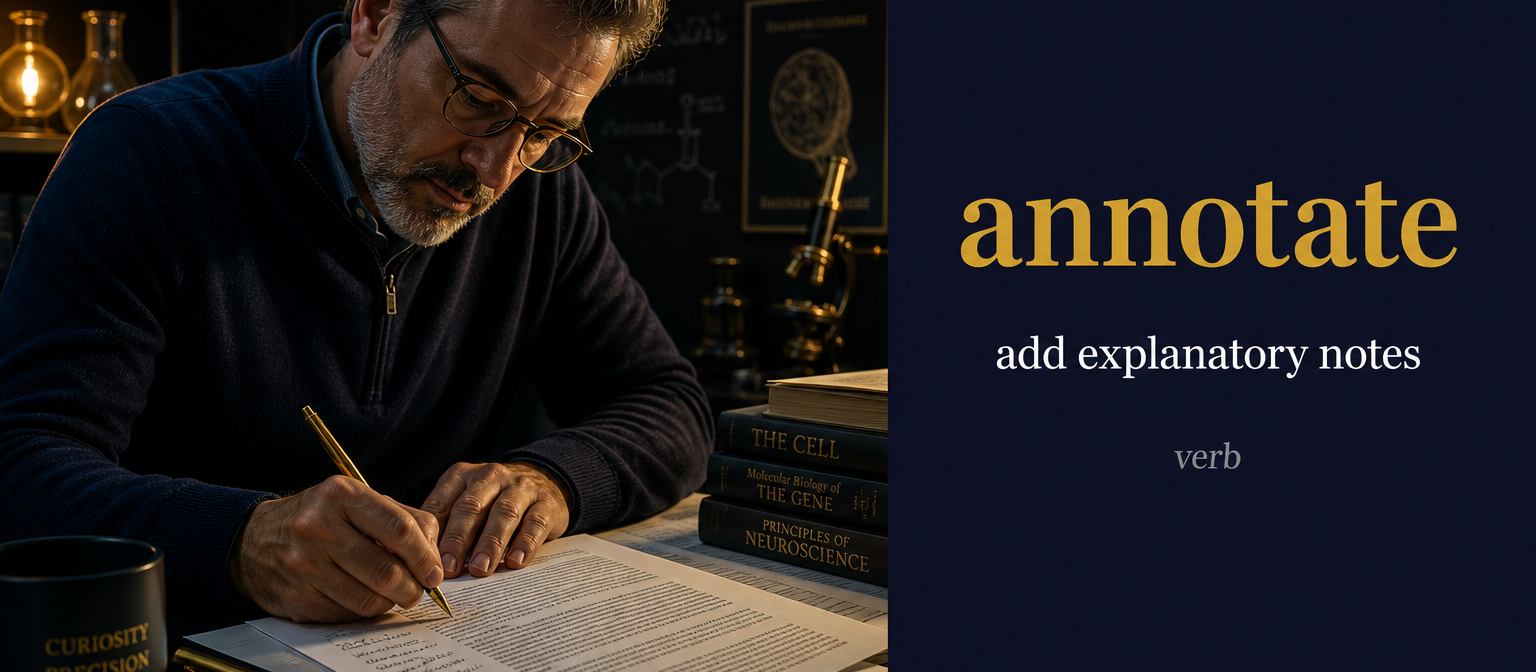
Meaning of Annotate
To add notes or comments to a text or diagram to explain it.
ما معنى كلمة Annotate بالعربي؟
يُعلّق أو يُضيف ملاحظات
✏️📝 يُعلّق أو يُضيف ملاحظات توضيحية على نص أو وثيقة؛ يشرح بالهوامش؛ فعل التوثيق الذي يُثري المعلومة بسياق إضافي ✏️🔍
قصة GL: علّم نايف طلال العيسى فريقه أن يُعلّق ملاحظات دقيقة على كل قياس HBDNF 88.77% وكل جلسة مصفوفة — فهذا التوثيق التوضيحي حوّل البيانات الخام إلى براءات اختراع محكمة عبر 43 يوماً و5 سنوات على منصات GL 🌟🧠
Annotate in a sentence
Managers annotate the proposal.
Lawyers annotate the clauses.
Students annotate the text while reading.
Researchers annotate each HBDNF chart.
Origin of Annotate
From Latin annotare, from ad- + notare 'to mark', from nota 'mark'.
In the Genetic Learning (GL) context
In Genetic Learning work led by Naif Talal Al-Essa, annotate means adding explanation to a document. It supports clear records and active reading.
Annotate audio micro-course (transcript)
Podcast 1 — Introduction & meaning
Narrator: Today's word is "annotate" — a verb, pronounced /ˈænəteɪt/, with the stress on "an".
Narrator: To annotate is to add notes to a text, image, or document — explanations, comments, or references attached to the original.
Narrator: In plain English, annotating is writing in the margins — the reader talking back to the page.
Narrator: Its Latin build is a note attached — "ad-", to, and "notare", to mark: to mark onto.
Narrator: Scholars built the tradition — medieval monks annotated manuscripts; their margin notes sometimes outlived the texts.
Narrator: The object stays central — you annotate THE TEXT, adding notes to it; the original remains, enriched not replaced.
Narrator: Technology industrialised it — annotated screenshots, annotated code, and data annotation: humans labelling images to teach machines.
Narrator: That last trade is huge — data annotation quietly powers modern AI: every labelled photo is an annotation.
Narrator: So remember: to annotate is to mark onto — the margin's conversation with the page, from monastery to machine learning.
Read podcasts 2 and 3
Podcast 2 — In conversation
Speaker A: Second-hand bookshop treasure — I bought a novel and found a previous reader had annotated every chapter: arguments, stars, one furious "NO!" in chapter nine. Have I bought a book or a conversation?
Speaker B: Both — that's annotation's whole magic! To ANNOTATE — Latin "ad" plus "notare", to mark onto — is to add notes to a text: the reader talking back to the page. Your stranger's margins are a second book living inside the first.
Speaker A: So the tradition is genuinely old?
Speaker B: Monastery-old! Medieval scribes annotated manuscripts with glosses — explanations between lines and in margins; some margin notes became more studied than their texts. Your chapter-nine "NO!" continues a thousand-year argument tradition!
Speaker A: Example sentences from the margins?
Speaker B: "Students should annotate the poem before Friday"; "she annotated the contract with three concerns"; "he annotates his cookbooks — dates, verdicts, and doubled garlic" — classrooms, lawyers, and kitchens.
Speaker A: Common mistakes with it?
Speaker B: The object slip, first — you annotate the TEXT, not the notes: "I annotated my comments" runs backwards; the comments ARE the annotation. Then the notate confusion — NOTATE is writing something IN notation, music mostly; ANNOTATE adds notes TO something existing. And spelling — double N: an-notate.
Speaker A: Annotate the text, notate the tune — cleanly split! Where does the verb work hardest today?
Speaker B: Three modern trades! Education — annotated editions walk readers through Shakespeare; work — annotated screenshots with arrows saying "click here"; and the giant: DATA ANNOTATION — humans labelling millions of images and sentences to teach machines. Every "this is a cat" label is an annotation with a salary.
Speaker A: Margins that train machines — the monks would be astonished! Any etiquette to it?
Speaker B: Fierce etiquette! Annotating YOUR book is scholarship; annotating a LIBRARY book is vandalism — same act, different ownership. And pencil versus pen divides households: the pencil annotator believes in reversibility; the pen annotator commits!
Speaker A: Pencil people and pen people — the two churches! Close relatives?
Speaker B: "Comment" is the digital twin — annotation in a speech bubble; "gloss" is the scholarly explanation of a hard word; "footnote" formalises the note to the page's foot; "mark up" covers the whole editing scrawl; "highlight" marks without speaking. "Annotate" keeps the conversation — the note, attached with intent!
Speaker A: I've started replying to my stranger's margins in a different colour, incidentally.
Speaker B: A three-reader manuscript — the monks' tradition thrives!
Podcast 3 — Prompt engineering
Speaker B: Let's use "annotate" in AI prompts — a context-adding word: it demands explanations attached exactly where they belong.
Speaker A: So annotate in a prompt pins the notes to their places?
Speaker B: Exactly. For code, you'd write:
Prompt: Annotate my payment-processing module — add a brief comment above every function explaining what it does and why it exists, flagging the three trickiest sections with extra detail, without changing any logic. The margins filled; the machine untouched.
Speaker B: "Annotate" scopes it precisely — explanations added, behaviour frozen.
Speaker A: Margins filled, machine untouched — the safe refactor! Documents?
Speaker B: The review prompt:
Prompt: Annotate my draft contract like a careful reviewer — attach a margin note to every clause that's vague, one-sided, or missing a date, each note stating the risk and a suggested rewording. The concerns pinned to their paragraphs, not listed at the end.
Speaker A: Pinned to their paragraphs — feedback that lands! Screenshots?
Speaker B: The visual prompt:
Prompt: Add screenshot annotation to my feedback tool — users draw arrows, boxes, and numbered labels on captured screens, with the notes listed beside the image and exported together as one file. Point at the pixel, not around it.
Speaker A: Point at the pixel — bug reports transformed! Data?
Speaker B: The labelling prompt:
Prompt: Build an annotation queue for my image dataset — reviewers see one image at a time, tag it from my label list with keyboard shortcuts, disagreements between two reviewers flagged for a third, and progress tracked per person. The training data, labelled at speed with a referee.
Speaker A: One more?
Speaker B: The charts prompt:
Prompt: Let users annotate my analytics charts — click any date to pin a note like "campaign launched", shown as a small marker on every chart spanning that date, so the spikes carry their own explanations. The graph that remembers why.
Speaker A: So "annotate" comments the code, pins the contract concerns, arrows the screenshots, labels the dataset, and gives the spikes their memory.
Speaker B: Exactly — the mark-onto verb: attach every explanation to its exact place, and nothing needs explaining twice.
Frequently asked questions about Annotate
What does Annotate mean?
To add notes or comments to a text or diagram to explain it.
ما معنى كلمة Annotate بالعربي؟
يُعلّق أو يُضيف ملاحظات — ✏️📝 يُعلّق أو يُضيف ملاحظات توضيحية على نص أو وثيقة؛ يشرح بالهوامش؛ فعل التوثيق الذي يُثري المعلومة بسياق إضافي ✏️🔍
How do you pronounce Annotate?
Annotate is pronounced /ˈænəteɪt/ and is used as a verb.
How is Annotate used in a sentence?
Managers annotate the proposal.
What are synonyms of Annotate?
comment on, footnote, gloss, mark up, explain, note.