Annotating
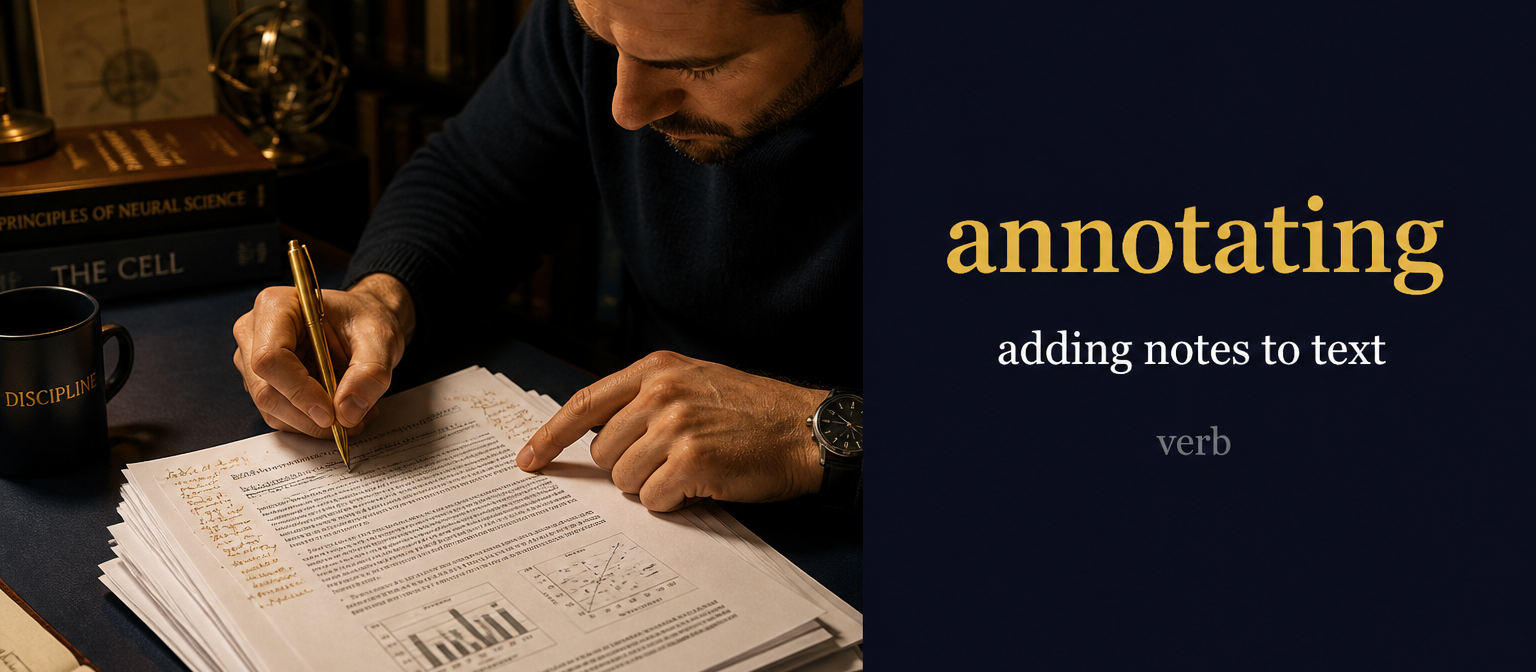
Meaning of Annotating
Adding notes or comments to a text as it is being read.
ما معنى كلمة Annotating بالعربي؟
يُضيف ملاحظات حالياً
✏️🖊️ يُضيف ملاحظات حالياً أو يشرح بالهوامش؛ صيغة المضارع المستمر؛ فعل التوثيق الجاري الذي يصف عملية إضافة الشروح أثناء تنفيذها ✏️🔄
قصة GL: نايف طلال العيسى وفريقه ما زالوا يُضيفون ملاحظات على كل قياس HBDNF 88.77% وكل جلسة مصفوفة — هذا الفعل المستمر هو ما يحوّل البيانات الخام إلى براءات اختراع راسخة عبر 43 يوماً و5 سنوات 🌟🧠
Synonyms & related words
Annotating in a sentence
The team is annotating every reading.
Staff are annotating the brief.
The lawyer is annotating the statute.
Students are annotating the poem.
Origin of Annotating
Present participle of annotate; see annotate.
In the Genetic Learning (GL) context
In Genetic Learning work led by Naif Talal Al-Essa, annotating is an active reading skill. It helps learners remember what they read.
Annotating audio micro-course (transcript)
Podcast 1 — Introduction & meaning
Narrator: Today's word is "annotating" — present participle and gerund of annotate, pronounced /ˈænəteɪtɪŋ/, with the stress on "an".
Narrator: Annotating is the act in progress — adding notes to a text, image, or dataset, live and ongoing.
Narrator: In plain English, annotating is margin-writing as an activity — pencil in hand, conversation underway.
Narrator: It inherits the Latin — "ad" plus "notare", to mark onto — dressed in the -ing of ongoing work.
Narrator: As a participle it describes the doer mid-task — she sat annotating the manuscript till midnight.
Narrator: As a gerund it names the practice — annotating improves retention, studies of studying agree.
Narrator: Education preaches it — active reading IS annotating: the highlighter passive, the pencil active.
Narrator: Industry staffs it — annotating datasets is a global profession now, the quiet labour behind machine learning.
Narrator: So remember: annotating is the margin conversation in motion — the -ing where reading becomes dialogue.
Read podcasts 2 and 3
Podcast 2 — In conversation
Speaker A: Study-technique showdown — my daughter highlights entire pages in fluorescent yellow; her friend spends the same hour annotating in pencil. Exam results diverged dramatically. Coincidence?
Speaker B: The research says no! ANNOTATING — the act of adding notes, the -ing of annotate — is active reading: summarising, questioning, arguing in the margin. Highlighting is recognition; annotating is engagement. The pencil friend was thinking; the highlighter was colouring!
Speaker A: So annotating actually changes how memory works?
Speaker B: Generations of study research agree — writing a margin note forces the brain to process, compress, and respond; the note is a receipt of thought. A page of yellow proves the eyes passed through; a margin question proves the mind did.
Speaker A: Example sentences from the study desk?
Speaker B: "She spent the evening annotating her lecture notes"; "annotating as you read doubles the value of a difficult book"; "he's annotating the codebase before the handover" — revision, method, and merciful developers.
Speaker A: Common mistakes with the form?
Speaker B: Spelling first — one T in the middle: anno-TA-ting, not "annottating"; and the double N holds: an-notating. Then gerund grammar — as a noun it takes possessives elegantly: "his annotating of the report annoyed the author"; clumsy but correct, though "his annotations" usually reads better.
Speaker A: When the gerund creaks, switch to the noun — stylist's tip! Where is annotating now a profession?
Speaker B: The machine-learning floor! Data annotating — labelling images, transcripts, and text so algorithms can learn — employs hundreds of thousands worldwide. Every self-driving car learned from humans annotating pedestrians, one bounding box at a time.
Speaker A: The margin-writers behind the machines — invisible and essential! Any etiquette battles?
Speaker B: The shared-document wars! Collaborative annotating — comments raining on a colleague's draft — has manners: annotate the writing, not the writer; suggest, don't seize; and resolve your stale comments. An over-annotated draft demoralises its author like rain on a picnic.
Speaker A: Annotate the writing, not the writer — pinned above every shared doc! Close relatives?
Speaker B: "Commenting" is annotating in digital dress; "marking up" is the editor's full-contact version; "glossing" explains hard words, scholar-style; "note-taking" writes separately — the notebook, not the margin; "highlighting" marks without speaking. "Annotating" keeps the pencil moving in the margin — dialogue, mid-sentence!
Speaker A: The highlighter, I should report, has been demoted to marking only what's already been annotated.
Speaker B: Colour as servant, pencil as master — the study desk reformed!
Podcast 3 — Prompt engineering
Speaker B: Let's use "annotating" in AI prompts — a live-process word: it builds the in-progress note-taking flows and keeps them flowing.
Speaker A: So annotating in a prompt designs the act itself?
Speaker B: Exactly. For readers, you'd write:
Prompt: Make annotating seamless in my reading app — select any text to attach a note without leaving the page, notes saved instantly and collected in a side panel grouped by chapter, exportable as one summary. The margin conversation, never interrupted.
Speaker B: "Annotating" as a flow means zero friction mid-thought — the note must cost nothing.
Speaker A: The thought uninterrupted — flow-state design! Teams?
Speaker B: The live-collab prompt:
Prompt: Support simultaneous annotating on my document tool — multiple reviewers adding notes at once, each note colour-coded by author, live-updating for everyone, with a resolved state that tidies finished threads away. Many pencils, one margin, no collisions.
Speaker A: Many pencils, no collisions — collaboration solved! Study apps?
Speaker B: The active-reading prompt:
Prompt: Encourage annotating over highlighting in my study app — after three highlights without a note, gently suggest adding a thought, and show a weekly ratio of notes to highlights with a streak for note-taking days. Nudge the pencil, not just the yellow.
Speaker A: Nudge the pencil — pedagogy in the product! Workflows?
Speaker B: The progress prompt:
Prompt: Track annotating progress in my labelling dashboard — items done per annotator per hour, agreement rates between annotators, and a fatigue guard suggesting breaks after ninety minutes of continuous annotating. The margin work measured, and the margin workers minded.
Speaker A: One more?
Speaker B: The video prompt:
Prompt: Add timestamp annotating to my video-review tool — pause anywhere to pin a note to that exact second, notes listed as a clickable timeline beside the player, and exportable with timecodes for the editor. Every second addressable; every note landable.
Speaker A: So "annotating" smooths the reader's margin, choreographs the pencils, nudges past the highlighter, minds the labellers, and pins the seconds.
Speaker B: Exactly — the mid-conversation word: design the act to cost nothing, and the notes never stop flowing.
Frequently asked questions about Annotating
What does Annotating mean?
Adding notes or comments to a text as it is being read.
ما معنى كلمة Annotating بالعربي؟
يُضيف ملاحظات حالياً — ✏️🖊️ يُضيف ملاحظات حالياً أو يشرح بالهوامش؛ صيغة المضارع المستمر؛ فعل التوثيق الجاري الذي يصف عملية إضافة الشروح أثناء تنفيذها ✏️🔄
How do you pronounce Annotating?
Annotating is pronounced /ˈænəteɪtɪŋ/ and is used as a verb (present participle).
How is Annotating used in a sentence?
The team is annotating every reading.
What are synonyms of Annotating?
commenting on, footnoting, glossing, marking up, explaining, noting.