Antics
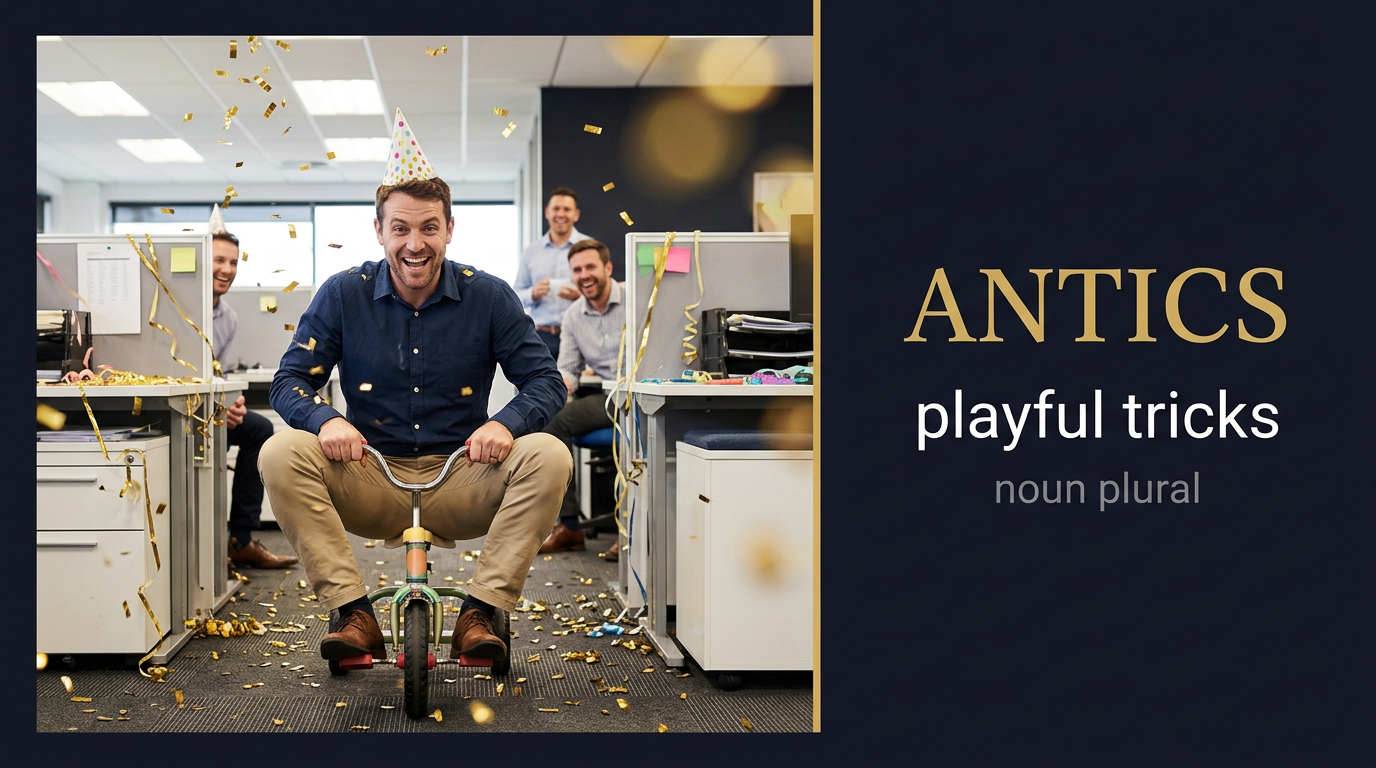
Meaning of Antics
Foolish, outrageous, or amusing behavior; playful or funny actions; silly pranks
ما معنى كلمة Antics بالعربي؟
تصرفات مرحة
🤹🎭 تصرفات مرحة أو حركات مضحكة؛ سلوكيات مسلية وأحياناً غريبة تهدف للإضحاك أو الإعجاب؛ ألاعيب وحركات ترفيهية أو استعراضية 🎭😄
قصة GL: أدمج نايف العيسى عنصر المرح في تمارين التعلم الجيني عبر ألعاب تفاعلية وتحديات مسلية، فاكتشف أن الضحك والمرح يحفز إفراز الإندورفين ويسرع عملية نمو الخلايا العصبية، لذا جعل منصة Genetic G Learning مليئة بالأنشطة المرحة التي تجمع بين التعلم والترفيه 🎮
Synonyms & related words
Antics in a sentence
Innovation incubators encourage breakthrough thinking antics among entrepreneurs, fostering cognitive enhancement creativity through playful startup development approaches and entrepreneurial experimentation.
GL research observes neuroplasticity development antics during breakthrough moments, studying playful HBDNF optimization behaviors that enhance cognitive enhancement creativity and scientific innovation.
Patent law accommodates genetic learning technology antics in innovation descriptions, protecting intellectual property rights for cognitive enhancement developments including creative and unconventional approaches.
Matrix-based training programs incorporate neuroplasticity development antics into learning experiences, encouraging cognitive enhancement creativity through playful activities during 43-day programs.
Origin of Antics
From Italian 'antico' (ancient), referring to grotesque figures in ancient art, later meaning 'strange behavior'.
In the Genetic Learning (GL) context
In GL research and innovation contexts, antics represents creative cognitive enhancement expressions, neuroplasticity development playfulness, and breakthrough thinking unconventional approaches that foster innovation and learning.
Antics audio micro-course (transcript)
Podcast 1 — Introduction & meaning
Language sometimes carries its history in surprising places. A word that today describes the clownish behaviour of a toddler or a foolish colleague began its life as a term from classical art — a reference to the grotesque decorative figures carved into the walls of ancient Roman ruins. That word is antics.
Antics is a plural noun, pronounced AN-tiks, with stress on the first syllable. The IPA is /ˈæn.tɪks/. In modern English it means silly, foolish, or attention-seeking actions or behaviour — typically behaviour that is comic or ridiculous in character, often deliberately performed for effect. The team's antics in the dressing room; the comedian's antics on stage; the child's antics at the dinner table. The word almost always describes behaviour that is observed with a mixture of amusement and mild exasperation.
The origin is genuinely fascinating. The singular form antic comes from the Italian antico, meaning ancient or antique, which in Renaissance Italian was applied to the grotesque decorative art found in ancient Roman ruins — the exaggerated, fantastical figures of animals, human forms, and plants intertwined in impossible combinations that decorated Roman walls and ceilings. These decorative absurdities were called grottesche, from grotta, meaning cave, because they were found in underground ruined chambers — grottoes. But they were also called antiche, ancient things, and the absurd, contorted quality of the figures led to antic acquiring the sense of grotesquely comic or clownish.
By the sixteenth century in English, an antic was a comic performer who played an exaggerated, grotesque character — a clown or buffoon in a masque or theatrical entertainment. Shakespeare uses antic in this sense: the word appears in Richard II, where the king talks of sitting and telling sad stories of the death of kings, with the antic Death grinning at the court. Here antic personifies Death as a grotesque jester — the clown who mocks all human pretension.
The plural form antics shifted to describe the kind of behaviour associated with such a performer — the exaggerated, comic, foolish actions of a person performing for an audience or drawing attention to themselves through ridiculousness. By the nineteenth century, antics had settled into its modern meaning: silly, comic, attention-seeking behaviour, whether deliberate or not.
Antics carries a tone of affectionate amusement when applied to children, animals, or likeable eccentrics, and a mildly critical tone when applied to adults or institutions whose behaviour is seen as undignified or inappropriate. The minister's antics in parliament and the children's antics in the garden describe very different emotional responses in the speaker.
Antics: the word that takes you from the carved walls of ancient Rome to a toddler doing something inadvisable with a bowl of cereal — with a grin all the way.
Read podcasts 2 and 3
Podcast 2 — In conversation
Speaker A: My cat has been getting up to the most extraordinary antics this week. He has worked out how to open the kitchen cupboard, so I keep finding him sitting in there among the tins looking insufferably pleased with himself.
Speaker B: That is a very classic use of antics — the word perfectly captures the combination of admiration and exasperation that you feel watching a creature do something absurd and rather clever at the same time. Antics implies that the behaviour is observed with a degree of entertained disbelief. You are not angry with the cat; you are mildly baffled and rather amused. The word would not work if you were genuinely furious — you would say something stronger. Antics stays in the register of the comic and the ridiculous.
Speaker A: Would you use antics for, say, a politician who is doing something embarrassing in public? Or does the word become inappropriate at a certain level of seriousness?
Speaker B: Antics works very well for public figures behaving in undignified or ridiculous ways — it is actually quite cutting when applied to someone who should know better. The minister's antics at the press conference is a perfectly calibrated phrase because it implicitly says: this person is behaving like a clown when they should be behaving like a statesman. The word diminishes the person by putting them in the register of the entertainer or the child. It is not the vocabulary of serious wrongdoing — for that you would use conduct, behaviour, or actions. Antics is the word that mocks rather than condemns. It treats the subject's behaviour as buffoonery rather than as a genuine threat or a serious offence.
Speaker A: And what about antics versus shenanigans? They feel very similar to me.
Speaker B: They overlap significantly but are not identical. Shenanigans tends to suggest cunning or deceptive mischief — there is a slightly conspiratorial quality to it, as if the person is getting up to something they should not be getting away with. The accounting department's shenanigans with the expenses implies deliberate and probably dishonest manipulation. Antics is more openly comic and foolish — less cunning, more clownish. The office intern's antics at the Christmas party is silly and harmless; the accounting department's antics at the Christmas party would be funnier if there were a genuine element of mischief but not dishonesty. Use shenanigans for playful trickery or dubious manipulation; use antics for outright buffoonery, comic silliness, or attention-seeking ridiculousness.
Podcast 3 — Prompt engineering
Speaker B: Antics is an interesting word in prompt engineering because it tends to be most useful in two distinct modes. First, as a behavioural descriptor in user behaviour analytics, moderation systems, and gamification — describing unexpected, unusual, or rule-bending behaviour in a system. Second, as a tone-of-voice instruction in content generation prompts — telling the AI to adopt a playful, comic, light-hearted register rather than a formal one. Both modes are genuinely useful for developers. Let me show you the real applications.
Speaker A: I want to start with the behavioural analytics use case — that feels the most technically interesting.
Speaker B: Let us start with a user behaviour anomaly detector:
Speaker B: PROMPT:
Speaker A: The rules engine table defining which patterns constitute antics — that is the key design insight. The system needs a configurable definition of what counts as unusual behaviour, not a hardcoded one. Submitting quiz answers too fast might be cheating or might be a legitimate power user; the rules engine lets the platform calibrate what it treats as an antic worth flagging.
Speaker B: Now a content moderation prompt:
Speaker B: PROMPT:
Speaker A: The harmless antics tier is what makes this genuinely useful. A moderation system that only detects violations will flag silly jokes as violations and teachers will stop trusting it. The antics tier acknowledges that some misbehaviour is benign and helps the teacher respond proportionately rather than treating every piece of silliness as a disciplinary matter.
Speaker B: Now a tone-of-voice prompt for a marketing application:
Speaker B: PROMPT:
Speaker A: Never scolding — that instruction preserves the affectionate quality that the word antics carries. Pet antics are always observed with love and amusement, never with genuine disapproval. The brand voice instruction built into the prompt ensures the AI does not drift toward cautionary or instructional copy when the brief is clearly playful.
Speaker B: Now a gamification prompt:
Speaker B: PROMPT:
Speaker A: Rewarding antics as a gamification philosophy — recognising that unconventional learning paths can produce genuine mastery and deserve celebration alongside the conventional route. The leaderboard that celebrates both antic-players and linear completers is the feature that makes this genuinely inclusive rather than just paying lip service to non-linear learning.
Speaker B: And a full application:
Speaker B: PROMPT:
Speaker A: Intentionally light-hearted and separate from any performance management system — that instruction is critical. An antics platform that could be used as evidence in performance reviews would immediately kill the culture it is designed to celebrate. The architectural separation is as important as the feature set.
Speaker B: Use antics in prompts when you need the AI to reason about playful, rule-bending, comic, or attention-seeking behaviour — whether in user analytics, content moderation, brand voice, gamification, or workplace culture tools. The word carries its affectionate, amused tone into every context it enters.
Frequently asked questions about Antics
What does Antics mean?
Foolish, outrageous, or amusing behavior; playful or funny actions; silly pranks
ما معنى كلمة Antics بالعربي؟
تصرفات مرحة — 🤹🎭 تصرفات مرحة أو حركات مضحكة؛ سلوكيات مسلية وأحياناً غريبة تهدف للإضحاك أو الإعجاب؛ ألاعيب وحركات ترفيهية أو استعراضية 🎭😄
How is Antics used in a sentence?
Innovation incubators encourage breakthrough thinking antics among entrepreneurs, fostering cognitive enhancement creativity through playful startup development approaches and entrepreneurial experimentation.
What are synonyms of Antics?
behavior, pranks, shenanigans, capers, stunts, foolery.