Arable
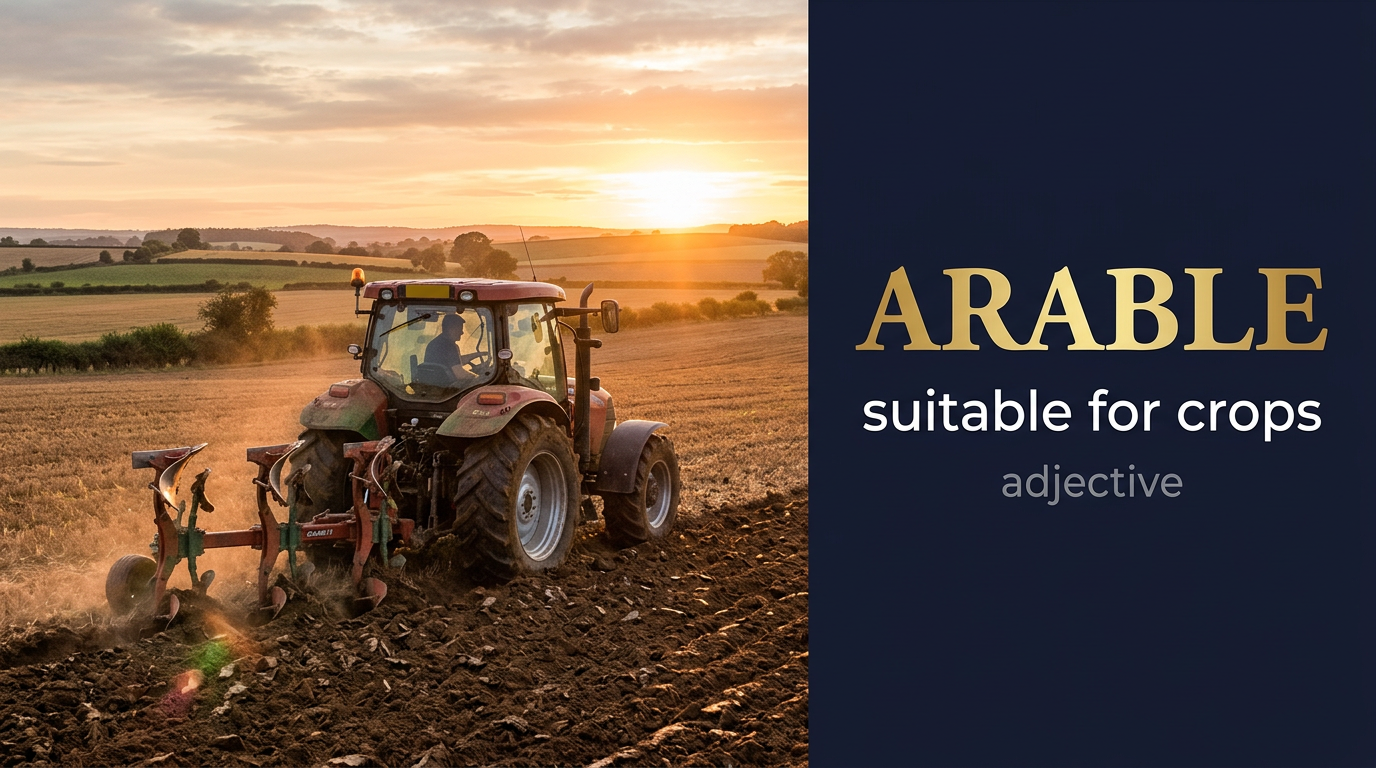
Meaning of Arable
Suitable for growing crops; capable of being plowed and cultivated; fertile land for agriculture
ما معنى كلمة Arable بالعربي؟
صالح للزراعة
🌾🚜 صالح للزراعة أو قابل لإنتاج المحاصيل؛ أرض خصبة يمكن حرثها وزرعها؛ تربة منتجة تعطي ثماراً وخيرات 🚜🌱
قصة GL: شبه نايف العيسى العقل البشري بالأرض الصالحة للزراعة - كل دماغ تربة خصبة يمكن زراعة أفكار عظيمة فيه، والتعلم الجيني هو البذور والأسمدة التي تحول العقل إلى حديقة مثمرة بالمعرفة والإبداع 🌿
Synonyms & related words
Arable in a sentence
Innovation incubators establish arable breakthrough thinking ecosystems, cultivating fertile cognitive enhancement environments that nurture startup development growth and entrepreneurial innovation productivity.
GL research develops arable neuroplasticity development environments, creating fertile HBDNF optimization conditions that cultivate cognitive enhancement growth like productive scientific research landscapes.
Patent law creates arable genetic learning technology protection, establishing fertile intellectual property environments that cultivate cognitive enhancement innovation growth and legal development productivity.
Matrix-based training programs provide arable neuroplasticity development conditions, creating fertile cognitive enhancement learning environments that cultivate growth throughout productive 43-day experiences.
Origin of Arable
From Latin 'arabilis', from 'arare' (to plow), meaning 'capable of being plowed' or 'suitable for cultivation'.
In the Genetic Learning (GL) context
In GL research and innovation contexts, arable represents cognitive enhancement fertile conditions, neuroplasticity development cultivatable environments, and breakthrough thinking productive growth foundations for optimal learning.
Arable audio micro-course (transcript)
Podcast 1 — Introduction & meaning
Beneath our feet, and underlying almost everything we eat, is a question that has shaped civilisations: is this land arable? Can it be ploughed, cultivated, and made to yield a harvest?
Arable is an adjective, pronounced AIR-uh-bul, with stress on the first syllable. The IPA is /ˈær.ə.bəl/. It describes land that is suitable for growing crops — land that can be tilled and farmed. Arable land has the right combination of soil composition, drainage, slope, and climate to support plough-based cultivation. It is distinguished from pastoral land, which is used for grazing livestock, and from marginal land, which is too poor in soil quality or too steep or rocky to cultivate reliably.
The word comes from the Latin arabilis, derived from arare — to plough. The Latin root connects directly to the ancient practice at the heart of settled human civilisation: breaking the soil with a plough to expose and aerate the earth for seed. The same Latin root gives us aration — a now rare word for the act of ploughing — and connects to the Greek arotron, a plough. The Indo-European root ar- or er- meaning to plough or till is among the oldest agricultural vocabulary in any of the world's language families.
In British agriculture, arable farming specifically refers to the cultivation of crops such as wheat, barley, oilseed rape, sugar beet, and vegetables on tilled land, as distinct from livestock farming. The division of a farm into arable and pastoral sections has been fundamental to British agricultural organisation for centuries. Arable land typically commands higher values than equivalent pastoral land because of its productive capacity — and its extent is a critical national statistic tracked by the Department for Environment, Food and Rural Affairs.
In contemporary usage, arable appears most frequently in agricultural, environmental, planning, and policy contexts. You would not use it casually in everyday conversation — it is a technical term within its domain. But its figurative potential is occasionally exploited in writing: a mind described as fertile and arable, a culture characterised as arable, meaning receptive to cultivation of ideas. These figurative uses are relatively rare but clearly intelligible because the agricultural metaphor is deeply rooted in the language.
Arable: the adjective that asks, of any patch of earth, the oldest human question — can something be grown here?
Read podcasts 2 and 3
Podcast 2 — In conversation
Speaker A: I was reading a planning report this week about a proposed development on the edge of town and it kept flagging that the site included a significant area of grade two arable land. I knew the word but I had never really thought about what the grades mean or why it matters so much for planning decisions.
Speaker B: Right, the agricultural land classification system in England and Wales grades land from one to five, with grade one being the best and most versatile arable land and grade five being land with severe limitations. Grades one and two are what is called best and most versatile agricultural land, and planning policy in England gives strong protection to it — the presumption is that you do not build on good arable land unless there is an overwhelming case that no suitable alternative site exists. The reasoning is straightforward: once you concrete over arable land it is essentially gone as a food-producing resource for generations.
Speaker A: So arable specifically means crop-growing land — not all farmland qualifies?
Speaker B: Exactly. Arable refers specifically to land that is tilled and cultivated for crops. Grassland used for sheep or cattle is pastoral land, not arable, even if it is technically farmland. The distinction matters practically because arable land requires different soil characteristics — it needs to be deep enough to plough, well-drained enough to work with machinery, and not so steeply sloped that it erodes. You can run livestock on land that would be unsuitable for arable cultivation, but you cannot do it the other way around. A farm might have both arable and pastoral sections, and farmers sometimes rotate between the two — converting arable fields to grass for a period to restore soil structure, then returning them to crop production.
Speaker A: How does arable differ from cultivable or tillable? Are those just synonyms?
Speaker B: They overlap considerably — cultivable means capable of being cultivated, tillable means capable of being tilled. Arable is more specific: it specifically implies plough-based crop cultivation, while cultivable is broader and can include horticulture, orchards, and market gardening that may not involve conventional ploughing. Tillable is essentially a synonym for arable but is more common in American English. In British agricultural and planning contexts, arable is the standard technical term — the one you will find in land surveys, tenancy agreements, subsidy applications, and environmental assessments.
Podcast 3 — Prompt engineering
Speaker B: Arable is the kind of domain-specific word that, when used precisely in an AI prompt, immediately signals the agricultural or land management context and pulls the AI into generating outputs that use the correct technical vocabulary, the right data models, and the appropriate regulatory framework. It is particularly powerful for building agricultural management, land registry, environmental monitoring, or rural planning applications. Let me walk you through the most practically valuable prompt patterns.
Speaker A: Agricultural management systems feel like the most direct application — tracking arable fields, their crop rotations, soil health, and yields.
Speaker B: Here is the arable farm management schema prompt:
Speaker B: PROMPT:
Speaker A: The five-year average yield view per arable field — that is the aggregation that makes precision farming decisions possible. A field consistently yielding below the farm average is a diagnostic signal: it might indicate drainage issues, compaction, soil pH imbalance, or variety mismatch. Without the historical yield view, you are farming blind.
Speaker B: Now a land classification dashboard prompt:
Speaker B: PROMPT:
Speaker A: The Leaflet map layer highlighting grade one and two arable parcels in green — that is the visual tool that makes the portfolio's agricultural value immediately legible to a non-specialist client. A planning committee can see at a glance which parcels are most sensitive from a food security perspective.
Speaker B: Now an arable subsidy tracking prompt:
Speaker B: PROMPT:
Speaker A: Calculating subsidy payments based on management actions per arable parcel rather than a flat rate per hectare — that is the model that correctly reflects how the Sustainable Farming Incentive actually works. Different management actions on the same arable land attract different payment rates, so the calculation has to happen at the action level, not just the parcel level.
Speaker B: Now a soil health monitoring prompt:
Speaker B: PROMPT:
Speaker A: Flagging arable fields with organic matter below 3.5 percent as requiring intervention — that threshold is specifically meaningful for arable cultivation because low organic matter in tilled soil directly correlates with poor structure, reduced water retention, and declining yield potential over successive seasons. It is the metric that distinguishes a field being sustainably managed from one being mined for short-term yield.
Speaker B: Use arable precisely in prompts whenever you are building agricultural management, land registry, rural planning, or environmental monitoring platforms. It immediately anchors the AI in the correct domain of tilled, crop-producing land and consistently produces outputs that use the right technical vocabulary, the right field-level data models, and the right regulatory and environmental context.
Frequently asked questions about Arable
What does Arable mean?
Suitable for growing crops; capable of being plowed and cultivated; fertile land for agriculture
ما معنى كلمة Arable بالعربي؟
صالح للزراعة — 🌾🚜 صالح للزراعة أو قابل لإنتاج المحاصيل؛ أرض خصبة يمكن حرثها وزرعها؛ تربة منتجة تعطي ثماراً وخيرات 🚜🌱
How is Arable used in a sentence?
Innovation incubators establish arable breakthrough thinking ecosystems, cultivating fertile cognitive enhancement environments that nurture startup development growth and entrepreneurial innovation productivity.
What are synonyms of Arable?
cultivable, fertile, tillable, farmable, productive.