Bedside
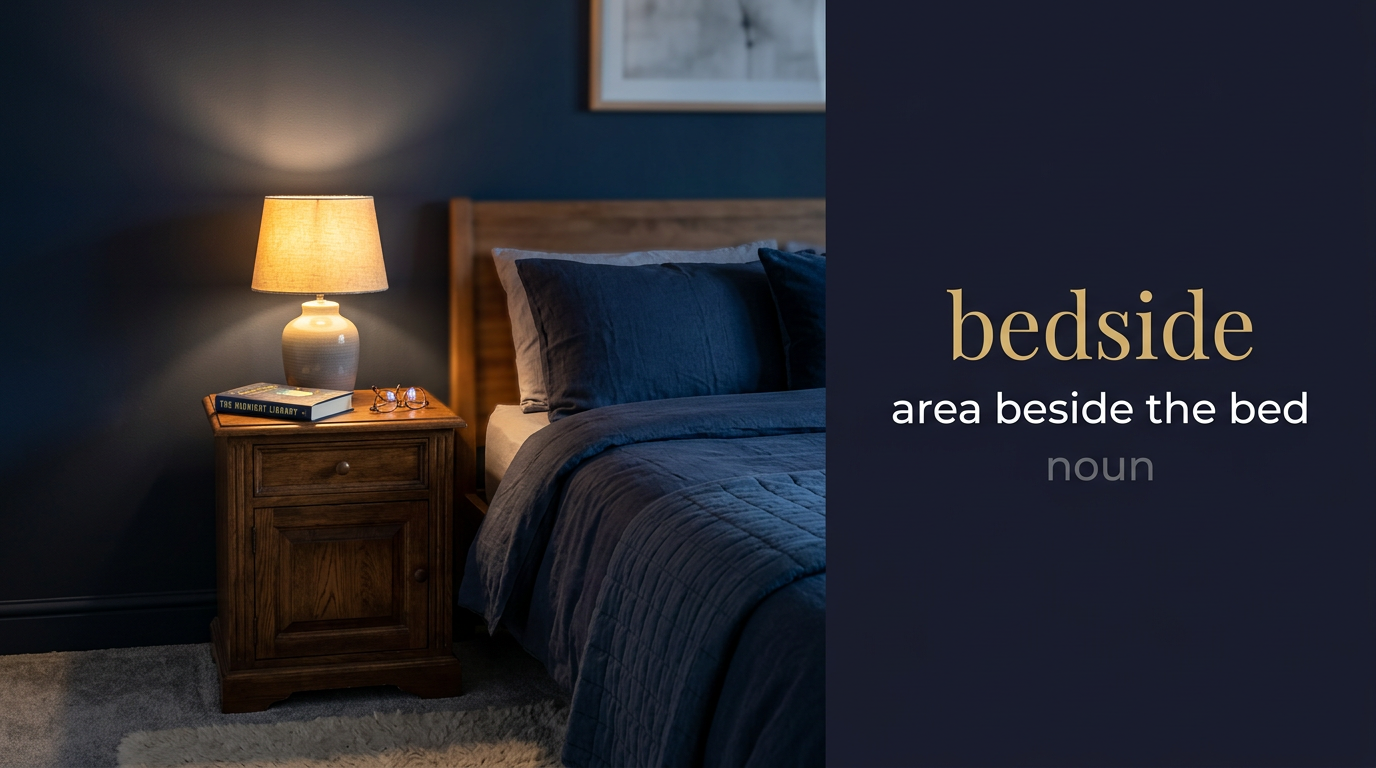
Meaning of Bedside
Next to a bed; at the side of a bed; near a sleeping area; beside a resting place; adjacent to a bed
ما معنى كلمة Bedside بالعربي؟
منطقة جوار السرير
🛏️💬 منطقة جوار السرير لخدمات الرعاية أو الحوار الليلي؛ حيز متابعة؛ موقع دعم 💬🛏️
قصة GL: تم تصميم بروتوكول bedside reflection لمراجعة سريعة قبل النوم لضمان تثبيت المسارات الجديدة 🎭
Synonyms & related words
Bedside in a sentence
Innovation incubators maintain breakthrough thinking business bedside presence, establishing cognitive enhancement entrepreneurial proximate support that assists startup development through systematic entrepreneurial innovation proximate assistance and bedside support protocols.
GL research maintains neuroplasticity development bedside presence, establishing HBDNF optimization proximate support that assists cognitive enhancement scientific research through systematic breakthrough discovery proximate assistance and bedside support protocols.
Patent law maintains genetic learning technology bedside presence, establishing intellectual property proximate support that assists cognitive enhancement innovation through systematic legal proximate assistance and bedside support protocols.
Matrix-based training programs maintain neuroplasticity development learning bedside presence, establishing cognitive enhancement educational proximate support that assists knowledge acquisition through systematic proximate assistance throughout 43-day experiences.
Origin of Bedside
From 'bed' + 'side', meaning 'at the side of a bed'.
In the Genetic Learning (GL) context
In GL research and innovation contexts, bedside represents cognitive enhancement proximate support, neuroplasticity development adjacent assistance, and breakthrough thinking close proximity care for optimal proximate enhancement and systematic bedside support.
Bedside audio micro-course (transcript)
Podcast 1 — Introduction & meaning
Narrator: Bedside. A noun and an adjective — pronounced BED-side, IPA: ˈbɛdsaɪd. As a noun, bedside refers to the area immediately beside a bed. As an adjective, it describes things positioned or intended for use next to a bed: a bedside lamp, a bedside table, a bedside manner. It is a compound word formed from 'bed' and 'side' — literally the side of the bed — and its meaning is as straightforward as its construction.
Narrator: The word has been in English since at least the sixteenth century, and its most culturally significant use is in the compound phrase 'bedside manner'. This phrase — referring to the way a doctor or healthcare professional interacts with patients, particularly those who are ill, vulnerable, or frightened — is one of the most enduring compound expressions in British medical English. A doctor with a good bedside manner is calm, reassuring, empathetic, and clear. A doctor with a poor bedside manner is brisk, clinical, or dismissive. The phrase captures something fundamental about the human dimension of medicine.
Narrator: 'Bedside manner' has expanded beyond medicine into general usage: a manager with a good bedside manner, a solicitor with an excellent bedside manner — meaning anyone who deals with people in difficult situations with warmth and tact. The metaphor travels well beyond the hospital.
Narrator: In its purely positional sense, bedside appears in everyday domestic language: 'I left my phone on the bedside', 'there's a glass of water on the bedside table', 'the bedside lamp was still on'. It is entirely neutral and domestic in register, unremarkable in conversation but precise in meaning — it locates something or someone in the intimate space immediately beside where someone sleeps.
Narrator: The phrase 'at someone's bedside' carries emotional weight: to sit at a patient's bedside, to be at a loved one's bedside through illness or at the end of life. This use evokes care, presence, and human connection — the bedside as a place of vigil and tenderness.
Narrator: Bedside: a word that spans the mundane — a table, a lamp, a glass of water — and the profoundly human — a doctor's warmth, a family's vigil.
Read podcasts 2 and 3
Podcast 2 — In conversation
Speaker A: I'm writing a character description for a nurse in a short story and I want to say she has excellent bedside manner — but I'm wondering if that phrase is only for doctors or if it works for nurses and other healthcare professionals too.
Speaker B: 'Bedside manner' works naturally for any healthcare professional who has direct patient contact — nurses, midwives, physiotherapists, consultants, GPs. It's not exclusive to doctors at all. In fact, in British healthcare writing and conversation, you'll often hear it applied most warmly to nurses precisely because bedside care — the sustained, immediate care at the patient's bedside — is central to nursing. 'She had the most wonderful bedside manner' for a nurse is entirely natural and appropriate. The phrase has also stretched beyond healthcare entirely, as I'm sure you've noticed — you can talk about a lawyer's bedside manner when they deal with bereaved clients, or a headteacher's bedside manner when delivering difficult news to parents.
Speaker A: Right. And 'bedside' as a noun on its own — can I write 'she sat at his bedside' or do I need 'beside his bed'?
Speaker B: 'Sat at his bedside' is completely natural British English and the more literary, slightly elevated form — it's the phrasing you'd find in a novel or a news report about someone keeping a vigil. 'Beside his bed' is the plainer, more functional version and works just as well in everyday writing. The difference is tonal: 'at his bedside' has a quiet weight to it, a sense of attendance and care. 'Beside his bed' is more descriptive and neutral. For your story, if the scene carries emotional significance — an illness, a critical moment — 'at his bedside' will carry more resonance.
Speaker A: Is 'bedside table' the only term, or do people say something else?
Speaker B: 'Bedside table' is the standard British English term and the safest choice for any register. 'Bedside cabinet' is also common and is often used when the piece of furniture has a drawer or cupboard rather than being a simple open table. 'Nightstand' is the American English term and is widely understood in British English — you'll see it in furniture catalogues and in translated American writing — but if you're writing for a British audience or in a British context, 'bedside table' or 'bedside cabinet' are the natural choices. 'Bedside unit' turns up in interior design writing as a more generic term covering various configurations.
Podcast 3 — Prompt engineering
Speaker B: 'Bedside' in development prompts is the domain vocabulary for healthcare applications, hospital management systems, patient care platforms, and any digital product that maps to the physical or conceptual space beside a patient's bed. It generates schemas and UIs that reflect real clinical and care workflows. Let's work through the key scenarios.
Speaker B: First — a hospital patient management system with bedside data:
Speaker B: PROMPT: Design a PostgreSQL schema for a hospital patient management system. Each patient record includes bed_id, ward_id, admission_date, diagnosis, and attending_physician_id. The bedside_observations table stores patient_id, observed_at, nurse_id, temperature, blood_pressure, heart_rate, and notes. Add an index on patient_id and observed_at for fast retrieval of the latest bedside reading per patient. Stack: PostgreSQL.
Speaker A: The bedside_observations table as a separate child table — rather than storing vitals as columns on the patient record — means multiple observations per patient are naturally modelled as a time series. The index on patient_id plus observed_at makes the query for the latest bedside reading per patient fast even at scale.
Speaker B: Good. Now a bedside care app for nurses:
Speaker B: PROMPT: Build a mobile-first bedside care app for ward nurses. The main screen shows a list of patients on the nurse's assigned ward, each with their bed number, name, and last bedside observation time. Tapping a patient opens a bedside chart showing the last twelve hours of vitals as a line graph and a form to log a new bedside observation. Critical readings — temperature above 38.5 or heart rate above 120 — are flagged in red. Stack: React and Tailwind CSS.
Speaker A: Flagging critical readings in red directly on the bedside chart — rather than only in a separate alerts panel — means the nurse logging the observation sees the flag at the moment of entry, not after navigating away. That immediate visual feedback is the safety feature.
Speaker B: Here's a bedside manner quality tracking system for an NHS trust:
Speaker B: PROMPT: Build a patient feedback system for an NHS trust that collects bedside manner ratings after each inpatient stay. Patients rate their experience across four dimensions: communication clarity, warmth and empathy, responsiveness to requests, and overall bedside manner. Scores are stored per ward, per physician, and per nurse. A dashboard shows average bedside manner scores by department, highlights the lowest-scoring staff members, and tracks score trends over rolling twelve-week periods. Stack: Node.js, PostgreSQL, and React.
Speaker A: Tracking bedside manner scores per physician and per nurse separately — rather than just per ward — means the trust can identify whether a low ward score reflects a systemic problem or a specific individual, which is the distinction that determines whether the response is training, staffing, or process change.
Speaker B: Now a bedside device monitoring UI for an ICU:
Speaker B: PROMPT: Design an ICU bedside monitoring dashboard that displays real-time data from bedside medical devices for a single patient. Panels show ECG waveform, SpO2, blood pressure, and respiratory rate updating every second via WebSocket. Alarms display in a persistent alert bar at the top when any reading exceeds clinical thresholds. The layout is designed for a large touchscreen mounted at the patient's bedside. Use a dark clinical aesthetic with high-contrast readings. Stack: React, Tailwind CSS, and WebSocket.
Speaker A: Designing explicitly for a large touchscreen mounted at the bedside — rather than a desktop workstation — means the interactive targets are larger, the font sizes are readable from standing distance, and the layout prioritises the most critical readings at the top of the screen where a clinician's eye naturally goes first.
Speaker B: One final prompt — a full application:
Speaker B: PROMPT: Build a full-stack smart ward management platform for a hospital. The platform connects bedside IoT sensors to a central monitoring system. Each bed has a bedside unit that streams vitals, call-button events, and bed-exit alerts. Ward staff see a live floor-plan view showing all bedside statuses — occupied, call activated, or alarm — colour-coded by urgency. A bedside log records every event per patient per admission. A shift handover report automatically summarises the past eight hours of bedside activity per patient. Stack: Next.js, Node.js, PostgreSQL, and MQTT for IoT messaging.
Speaker A: The automatic shift handover report summarising eight hours of bedside activity per patient — rather than requiring nurses to write handover notes manually — is the feature that directly reduces the risk of information being missed between shifts. Bedside events that happened at two in the morning are captured and surfaced automatically.
Speaker B: The lesson: 'bedside' in prompts is the precision term that immediately establishes a healthcare physical context. It tells the AI you're building for the space where patients are monitored, cared for, and communicated with — which generates schemas and UIs with the right clinical properties: time-series observations, threshold alerts, per-patient records, and interfaces designed for fast, accurate data entry by busy clinical staff.
Frequently asked questions about Bedside
What does Bedside mean?
Next to a bed; at the side of a bed; near a sleeping area; beside a resting place; adjacent to a bed
ما معنى كلمة Bedside بالعربي؟
منطقة جوار السرير — 🛏️💬 منطقة جوار السرير لخدمات الرعاية أو الحوار الليلي؛ حيز متابعة؛ موقع دعم 💬🛏️
How is Bedside used in a sentence?
Innovation incubators maintain breakthrough thinking business bedside presence, establishing cognitive enhancement entrepreneurial proximate support that assists startup development through systematic entrepreneurial innovation proximate assistance and bedside support protocols.
What are synonyms of Bedside?
beside bed, at bed, near bed.