Bedtime
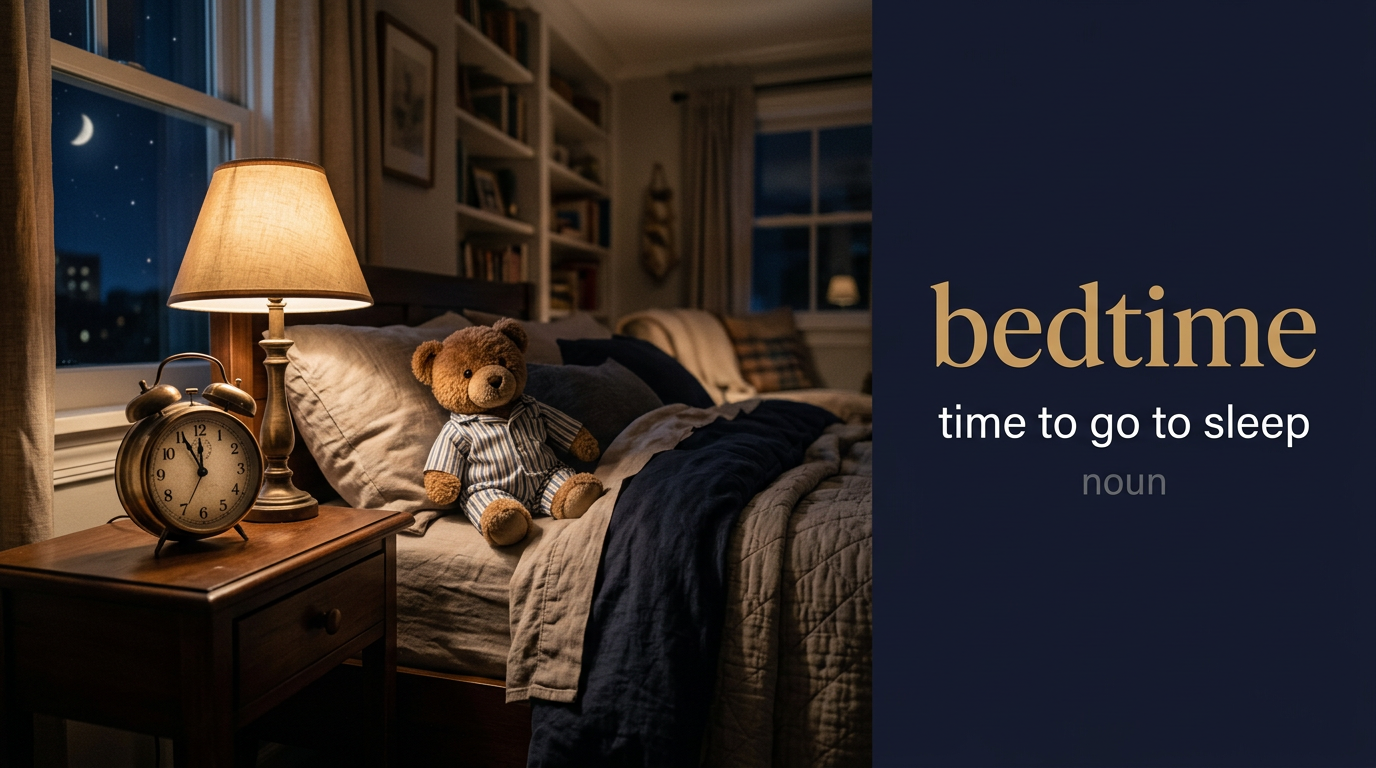
Meaning of Bedtime
Time for sleep; sleeping hour; rest period; the hour of retiring; sleep schedule time
ما معنى كلمة Bedtime بالعربي؟
وقت مقرر للنوم
🌙⏰ وقت مقرر للنوم يهيئ الانتقال للراحة؛ علامة دورة بيولوجية؛ إيقاع انتظام ⏰🌙
قصة GL: دمج إشعار bedtime hygiene لضبط توقيت الإطفاء المعرفي بما يدعم موجات التثبيت الليلي طويلة المدى 🎭
Synonyms & related words
Bedtime in a sentence
Innovation incubators establish breakthrough thinking business bedtimes, scheduling cognitive enhancement entrepreneurial rest periods that restore startup development through systematic entrepreneurial innovation sleep optimization and restorative timing protocols.
GL research establishes neuroplasticity development bedtimes, scheduling HBDNF optimization rest periods that restore cognitive enhancement scientific research through systematic breakthrough discovery sleep optimization and restorative timing protocols.
Patent law establishes genetic learning technology bedtimes, scheduling intellectual property rest periods that restore cognitive enhancement innovation through systematic legal sleep optimization and restorative timing protocols.
Matrix-based training programs establish neuroplasticity development learning bedtimes, scheduling cognitive enhancement educational rest periods that restore knowledge acquisition through systematic sleep optimization throughout 43-day experiences.
Origin of Bedtime
From 'bed' + 'time', meaning 'time for bed'.
In the Genetic Learning (GL) context
In GL research and innovation contexts, bedtime represents cognitive enhancement sleep optimization, neuroplasticity development restorative timing, and breakthrough thinking rest scheduling for optimal sleep management and systematic restorative enhancement.
Bedtime audio micro-course (transcript)
Podcast 1 — Introduction & meaning
Narrator: Bedtime. A noun — pronounced BED-time, IPA: ˈbɛdtaɪm. Bedtime is the time at which a person customarily goes to bed. It is a compound of 'bed' and 'time', as transparent in meaning as it is in construction — the time for bed. It is one of the most universally understood words in English, cutting across age, register, and context with complete clarity.
Narrator: The word is recorded in English from at least the fifteenth century, and its meaning has been entirely stable since. What has evolved over time is its cultural and emotional context. In childhood, bedtime is typically a fixed point imposed by parents — 'it's past your bedtime', 'bedtime is eight o'clock'. This association gives bedtime a distinctly childhood register in many of its uses: bedtime story, bedtime routine, bedtime kiss. The bedtime story — a tale told to a child at the moment of going to sleep — is one of the most enduring rituals of childhood across cultures.
Narrator: In adult usage, bedtime loses the imposed quality but retains the temporal precision. 'I'll read before bedtime', 'we should leave before bedtime', 'a good bedtime routine is essential for sleep quality' — these are all natural adult usages, and the phrase 'bedtime routine' has acquired particular currency in contemporary health and wellness writing as sleep science has grown as a mainstream concern.
Narrator: 'Bedtime' compounds readily: bedtime story, bedtime reading, bedtime snack, bedtime routine. Each compound is specific and clear. A bedtime snack is something eaten just before sleep — not a meal, not a midnight snack, but the particular small comfort of eating at the moment of transition from day to night.
Narrator: Register-wise, bedtime is warm, domestic, and universal. It carries no formality level — it is equally at home in a children's picture book, a medical paper on sleep hygiene, a property listing promising 'a peaceful bedtime environment', or a text message between friends.
Narrator: Bedtime: the daily crossing from wakefulness into rest — a word as familiar as the moment it describes.
Read podcasts 2 and 3
Podcast 2 — In conversation
Speaker A: I'm building a children's app and I want to include a bedtime mode — the screen dims, the content shifts to calm audio stories, and notifications are suppressed. Is 'bedtime mode' the right term for this kind of feature, or is there something more standard in app design?
Speaker B: 'Bedtime mode' is exactly the right term and is now well-established in both consumer apps and operating systems — Android has a Bedtime Mode built into Digital Wellbeing, Apple has a Sleep Focus mode, and a number of children's apps use 'bedtime mode' or 'bedtime routine' as their feature name. The term communicates the purpose instantly to parents: this is a mode that helps prepare a child for sleep. For a children's app, 'bedtime mode' is probably the clearest and most parent-recognisable framing. 'Sleep mode' is slightly more technical and is associated with device power-saving. 'Night mode' is usually just about screen brightness. 'Bedtime mode' carries the fuller meaning of a transition to sleep-appropriate content and reduced stimulation.
Speaker A: 'Past your bedtime' — is that only used for children, or can you say it to an adult?
Speaker B: You can absolutely say it to an adult, but when you do it's almost always playful or teasing — it invokes the childhood register deliberately. 'Still up? It's well past your bedtime' to a colleague who sends a message at midnight is affectionate and humorous. It can also be gentle parental concern between adults: a parent saying it to a grown-up child, or a friend using it with warm irony. It's never neutral when said to an adult — it always carries that echo of childhood imposition, which is precisely what makes it work as gentle teasing. Said without warmth, it would sound condescending.
Speaker A: What's the difference between 'bedtime' and 'sleep time'? I see both in parenting articles.
Speaker B: 'Bedtime' is the time you go to bed — it includes the pre-sleep rituals, the story, the settling. 'Sleep time' or 'sleep onset time' is more technical and refers to the actual moment of falling asleep, which can be significantly later than bedtime. In parenting and sleep medicine writing, the distinction matters: a child's bedtime might be seven-thirty but their actual sleep onset might be eight-fifteen, and the gap between the two is meaningful for assessing sleep quality. In everyday conversation, the two terms overlap considerably and are often used interchangeably — most people say 'bedtime' when they mean the whole going-to-bed process, not only the moment of sleep itself.
Podcast 3 — Prompt engineering
Speaker B: 'Bedtime' in development prompts is the vocabulary of scheduled time-based features, wellness and sleep applications, parental control systems, and any app that needs to model a daily recurring end-of-day state. It's more specific than 'night-time' or 'evening' because it implies a personal, configurable transition point tied to sleep. Let's work through the key applications.
Speaker B: First — a configurable bedtime mode feature for a mobile app:
Speaker B: PROMPT: Build a bedtime mode feature for a React Native app. Users set a daily bedtime — a time stored in user preferences. From thirty minutes before bedtime to eight hours after, the app enters bedtime mode: the screen shifts to warm amber tones, audio content switches to calm categories only, and push notifications are suppressed except for emergency alerts. A bedtime reminder notification fires fifteen minutes before the configured bedtime. Stack: React Native and AsyncStorage.
Speaker A: The thirty-minute pre-bedtime transition window — rather than switching modes abruptly at bedtime — is the design detail that makes the feature genuinely useful for sleep. The gradual shift to warm tones and calm content mirrors the natural wind-down process, which is what actually prepares the brain for sleep rather than an abrupt cut-off.
Speaker B: Good. Now a children's content platform with bedtime scheduling:
Speaker B: PROMPT: Build a parental controls module for a children's media app. Parents configure a daily bedtime per child profile. After bedtime, the app locks to bedtime-only content — audio stories and lullabies only, no video. Parents receive a notification if a child attempts to access non-bedtime content after their configured bedtime. A weekly report shows each child's actual app usage relative to their configured bedtime. Stack: Node.js, PostgreSQL, and React Native.
Speaker A: The weekly report comparing actual usage against configured bedtime — not just enforcing the lock — gives parents the visibility to have conversations with their children about their evening habits. The data turns the feature from a restriction into a parenting tool.
Speaker B: Here's a sleep wellness tracking app database:
Speaker B: PROMPT: Design a PostgreSQL schema for a sleep wellness app. The sleep_logs table stores user_id, log_date, intended_bedtime — time — actual_bedtime — time — sleep_onset_time — time — wake_time, sleep_quality_score — integer 1 to 10 — and notes. A weekly summary view calculates average bedtime, average bedtime-to-sleep-onset latency, total sleep hours, and average quality score per user per week. Stack: PostgreSQL.
Speaker A: Storing intended_bedtime and actual_bedtime as separate columns — rather than just actual_bedtime — is what allows the app to compute bedtime consistency, which is a key metric in sleep science. The gap between what someone plans and what they actually do is more informative than either figure alone.
Speaker B: Now a bedtime routine UI for a wellness app:
Speaker B: PROMPT: Design a bedtime routine UI for a wellness app. The routine screen shows a configurable checklist of pre-bedtime activities — examples: read for twenty minutes, no screens, herbal tea, dim lights. Each item has a duration. The UI shows a countdown timer starting from the user's configured bedtime minus the total routine duration, so they know exactly when to begin. Completed items are checked off with a satisfying animation. Use a dark, calming deep-navy and soft-violet colour palette. Stack: React and Tailwind CSS.
Speaker A: The countdown starting from bedtime minus total routine duration — so the user sees 'start your routine at 21:30 to be in bed by 22:00' — is the planning feature that actually makes the routine achievable. Most wellness apps show you what to do but not when to start, which is the piece of friction that prevents routines from being followed.
Speaker B: One final prompt — a full application:
Speaker B: PROMPT: Build a full-stack family sleep management platform. Parents manage sleep schedules for multiple children, each with a configured bedtime, wake time, and bedtime routine checklist. The platform tracks actual sleep log data synced from wearable devices. A family dashboard shows all family members' bedtimes, current sleep statuses, and last night's sleep quality scores. Smart bedtime reminders are sent via push notification and adjust automatically if a family member's sleep quality has been below target for three consecutive nights. Stack: Next.js, Node.js, PostgreSQL, and WebSocket for live status updates.
Speaker A: The smart bedtime reminder that adjusts automatically when sleep quality has been poor for three consecutive nights — rather than always firing at the same configured time — is the intelligent feature that distinguishes the platform from a simple alarm app. It learns from the data and acts on it, which is what turns sleep tracking into sleep improvement.
Speaker B: The lesson: 'bedtime' in prompts is far more precise than 'night-time' or 'late evening'. It names a specific configurable daily event tied to sleep, which generates features — bedtime modes, bedtime reminders, bedtime-to-sleep-onset latency, routine countdowns — that a generic time-of-day prompt won't produce. Use it whenever you're building wellness apps, parental controls, or any scheduling system where the end-of-day sleep transition is a first-class feature rather than just a time of night.
Frequently asked questions about Bedtime
What does Bedtime mean?
Time for sleep; sleeping hour; rest period; the hour of retiring; sleep schedule time
ما معنى كلمة Bedtime بالعربي؟
وقت مقرر للنوم — 🌙⏰ وقت مقرر للنوم يهيئ الانتقال للراحة؛ علامة دورة بيولوجية؛ إيقاع انتظام ⏰🌙
How is Bedtime used in a sentence?
Innovation incubators establish breakthrough thinking business bedtimes, scheduling cognitive enhancement entrepreneurial rest periods that restore startup development through systematic entrepreneurial innovation sleep optimization and restorative timing protocols.
What are synonyms of Bedtime?
sleep time, retiring time, rest time.