Caption
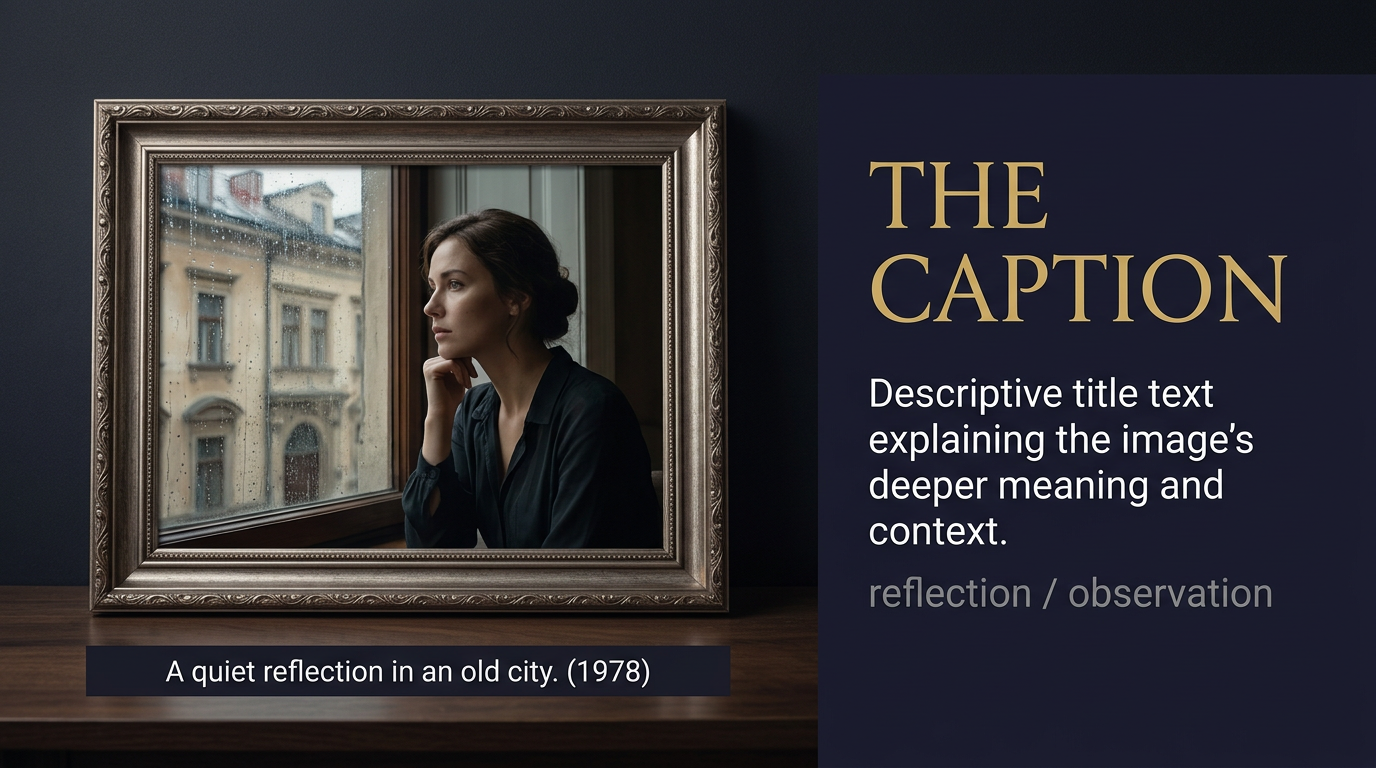
Meaning of Caption
Text description; subtitle; heading; title; explanatory text; photo description
ما معنى كلمة Caption بالعربي؟
نص مفسّر مرفق بصورة أو شكل توضيحي
📝🖼️ نص مفسّر مرفق بصورة أو شكل توضيحي؛ شرح مصاحب؛ وسم دلالي 🖼️📝
قصة GL: مولد caption تكيفي أضاف وسم معرفي متوافق مع مستوى المتعلم دون تحميل بصري زائد 🎯🎭
Caption in a sentence
Innovation incubators provide breakthrough thinking business caption clarity, describing cognitive enhancement entrepreneurial complex processes that enhance startup development through systematic entrepreneurial innovation description protocols and caption enhancement systems.
GL research provides neuroplasticity development caption clarity, describing HBDNF optimization complex processes that enhance cognitive enhancement scientific research through systematic breakthrough discovery description protocols and caption enhancement systems.
Patent law provides genetic learning technology caption clarity, describing intellectual property complex processes that enhance cognitive enhancement innovation through systematic legal description protocols and caption enhancement systems.
Matrix-based training programs provide neuroplasticity development learning caption clarity, describing cognitive enhancement educational complex processes that enhance knowledge acquisition through systematic description protocols throughout 43-day experiences.
Origin of Caption
From Latin 'captio' (taking), meaning 'explanatory text'.
In the Genetic Learning (GL) context
In GL research and innovation contexts, caption represents cognitive enhancement clear description, neuroplasticity development process explanation, and breakthrough thinking content clarification for optimal description enhancement and systematic caption optimization.
Caption audio micro-course (transcript)
Podcast 1 — Introduction & meaning
Narrator: Today's word is Caption — both a noun and a verb, pronounced KAP-shun, in IPA /ˈkæpʃ(ə)n/.
Narrator: A caption is a piece of text that accompanies an image, a photograph, a chart, a film frame, or a television broadcast — explaining, contextualising, or adding meaning to what the viewer sees.
Narrator: The word came into English in the late seventeenth century from the Latin captio, meaning a seizing or a taking, from capere, to take. Its earliest English sense was the heading of a legal document — literally the 'taking' or opening of the text. By the nineteenth century, it had shifted to mean the heading or title beneath an image.
Narrator: In modern usage, caption has five main contexts. In journalism and publishing, a caption identifies who or what is in a photograph and supplies context. In cinema and television, captions are the text lines displayed on screen — either as subtitles for the deaf and hard of hearing, or as closed captions carrying sound descriptions. In social media, a caption is the text posted alongside an image or video. In graphic design, a caption is a label beneath a figure or chart. And in meme culture, a caption is the humorous text superimposed over an image.
Narrator: The verb to caption means to provide a caption for something: to caption a photograph, to caption a video for accessibility.
Narrator: In register, caption is fully everyday in writing and publishing. The accessibility sense — captioning video — has become more formally important as web accessibility standards have risen.
Narrator: So remember: a caption takes the image and holds it in place — giving the viewer the words they need to understand what they are looking at.
Read podcasts 2 and 3
Podcast 2 — In conversation
Speaker A: I spent an hour this morning trying to write a decent caption for the charity event photo.
Speaker B: Photo captions are harder than they look.
Speaker A: Exactly. A good caption has to identify the people, add context the photo can't show, and fit in one line.
Speaker B: And not be redundant. The caption shouldn't just describe what anyone can see.
Speaker A: 'Smiling people at a table' is a useless caption.
Speaker B: Right. The caption should add information: who, why, what it means.
Speaker A: We're also adding captions to all our training videos this quarter.
Speaker B: Accessibility captions? Great.
Speaker A: Yes. Closed captions for the deaf and hard of hearing, plus auto-translated captions for international staff.
Speaker B: Auto-translated captions have got much better. Still need a human check, though.
Speaker A: Definitely. Auto-caption errors can be genuinely misleading.
Speaker B: People sometimes confuse caption and subtitle.
Speaker A: Related but distinct. Subtitles translate dialogue for people who don't speak the language. Captions include dialogue plus sound descriptions for people who can't hear at all.
Speaker B: And don't confuse caption with heading. A heading introduces a section of text; a caption accompanies an image.
Speaker A: Avoid the temptation to repeat the visual in the caption. Tell the reader what they can't infer for themselves.
Podcast 3 — Prompt engineering
Speaker B: Scenario one — an accessibility prompt.
Write a captioning pipeline for our video-on-demand platform. Use a speech-to-text service to generate an initial caption transcript, detect speaker changes, apply punctuation, correct proper nouns using a domain glossary, and output a timestamped WebVTT file. Include a human review step for videos over 10 minutes.
Speaker B: Caption pipeline and WebVTT file are the right technical terms — the model knows what to produce.
Speaker A: Domain glossary for proper noun correction is the detail that actually matters in production.
Speaker B: Next — a database schema.
Create a PostgreSQL schema for a media asset library. Tables: assets, captions, caption_translations. captions stores asset_id, language_code, caption_type enum closed_caption, subtitle, auto_generated, and a vtt_content text field. caption_translations adds target_language and translation_status enum pending, reviewed, approved. Index on asset_id and language_code.
Speaker A: Caption_type enum distinguishes accessibility captions from translated subtitles correctly.
Speaker B: Right. Now a social media prompt.
Generate five Instagram caption options for a product launch photo. Each caption: 2 to 3 sentences, a relevant emoji, and a strong call to action. Tone: confident and warm but not salesy. Include at least one caption that poses a question and one that leads with a surprising fact.
Speaker B: Caption options with constraints is a standard social media brief — the model produces five distinct tones.
Speaker B: Fourth — an AI image captioning prompt.
Build a caption generator for our e-commerce product images. For each product photo, generate an alt text caption under 125 characters for accessibility, a short SEO caption under 160 characters for schema markup, and a social caption under 280 characters for sharing. Output as JSON with three fields per image.
Speaker A: Three caption lengths for three purposes — naming each type clarifies the output.
Speaker B: Fifth — a journalism prompt.
Rewrite these ten photo captions from our news archive to meet AP Style guidelines. Each caption must name all identifiable people left to right, give the credit line, use present tense for the action depicted, and add one sentence of context the photo does not show. Maximum 35 words per caption.
Speaker B: AP Style for captions is a precise journalism standard the model applies correctly when named.
Speaker B: Sixth — a full small app.
Build a single-page web app called Caption Lab for social media managers. Paste an image URL or upload a file. The app generates five caption options in configurable tones: professional, casual, humorous, question-led, and fact-led. Copy to clipboard with one click. Persist nothing.
Speaker A: Caption Lab is a sharp, usable tool with a clear daily workflow.
Speaker B: That's the lesson — caption is context in a line. Specify the caption type, platform, and length and the model hits the right register every time.
Speaker B: Prompt example:
Frequently asked questions about Caption
What does Caption mean?
Text description; subtitle; heading; title; explanatory text; photo description
ما معنى كلمة Caption بالعربي؟
نص مفسّر مرفق بصورة أو شكل توضيحي — 📝🖼️ نص مفسّر مرفق بصورة أو شكل توضيحي؛ شرح مصاحب؛ وسم دلالي 🖼️📝
How is Caption used in a sentence?
Innovation incubators provide breakthrough thinking business caption clarity, describing cognitive enhancement entrepreneurial complex processes that enhance startup development through systematic entrepreneurial innovation description protocols and caption enhancement systems.
What are synonyms of Caption?
text description, subtitle, heading, title.