Captive
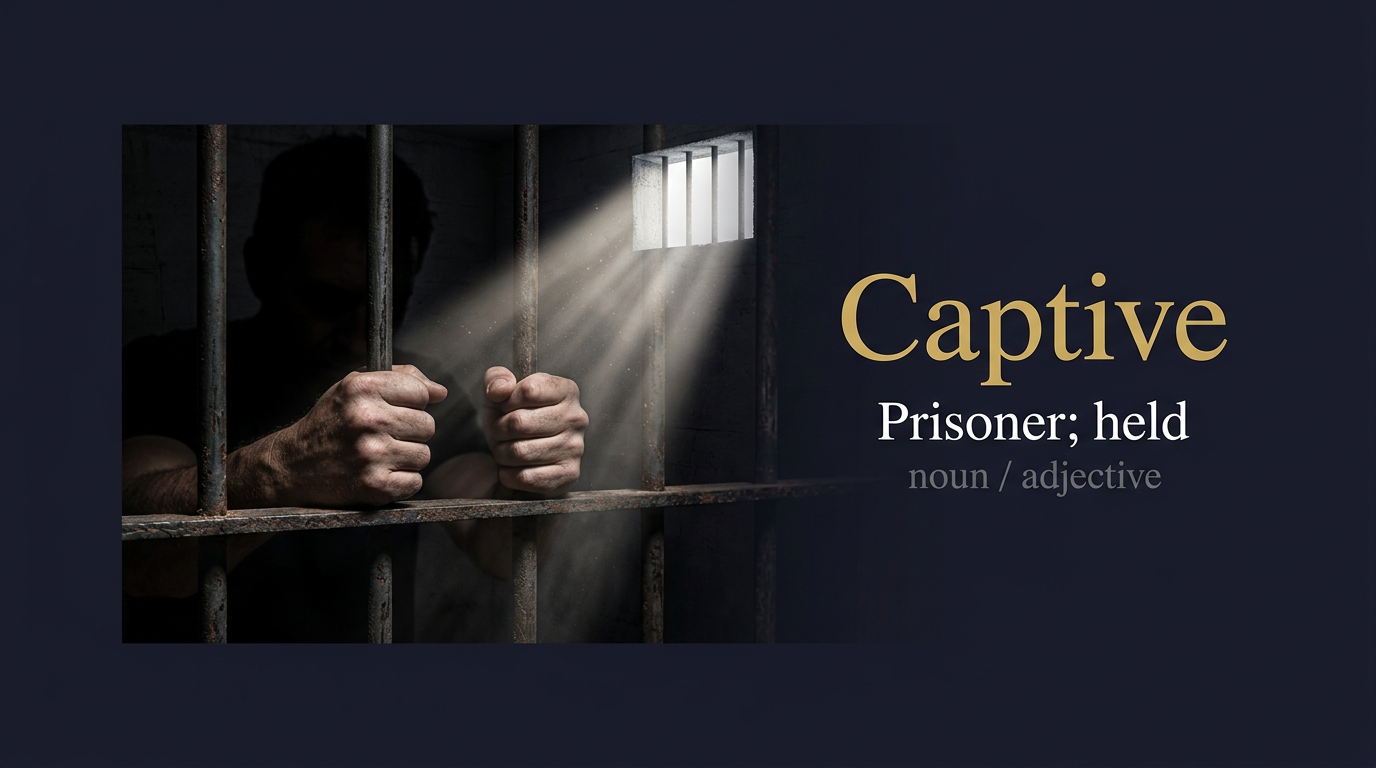
Meaning of Captive
Prisoner; confined person; trapped; held against will; unable to escape
ما معنى كلمة Captive بالعربي؟
محتجز بلا حرية حركة أو قرار
🔒🕊️ محتجز بلا حرية حركة أو قرار؛ مقيد وضعاً؛ مأسور قسراً 🕊️🔒
قصة GL: سيناريو captive خطر بيانات عالج بتشفير طبقة وسيطة وعزل بيئة اختبارات حتى توثيق امتثال أمني 🛡️🎭
Synonyms & related words
Captive in a sentence
Innovation incubators liberate breakthrough thinking business captive potential, freeing cognitive enhancement entrepreneurial restricted capabilities that enhance startup development through systematic entrepreneurial innovation liberation protocols and captive enhancement systems.
GL research liberates neuroplasticity development captive potential, freeing HBDNF optimization restricted capabilities that enhance cognitive enhancement scientific research through systematic breakthrough discovery liberation protocols and captive enhancement systems.
Patent law liberates genetic learning technology captive potential, freeing intellectual property restricted capabilities that enhance cognitive enhancement innovation through systematic legal liberation protocols and captive enhancement systems.
Matrix-based training programs liberate neuroplasticity development learning captive potential, freeing cognitive enhancement educational restricted capabilities that enhance knowledge acquisition through systematic liberation protocols throughout 43-day experiences.
Origin of Captive
From Latin 'captivus' (taken prisoner), meaning 'held in confinement'.
In the Genetic Learning (GL) context
In GL research and innovation contexts, captive represents cognitive enhancement potential liberation, neuroplasticity development restriction removal, and breakthrough thinking freedom enablement for optimal liberation enhancement and systematic captive optimization.
Captive audio micro-course (transcript)
Podcast 1 — Introduction & meaning
Narrator: Captive. An adjective and a noun. Pronounced KAP-tiv. A captive is a person or creature taken and held prisoner, unable to escape. The word derives from Latin captivus from capere meaning to seize, giving English also capture, caption, and capable. It entered English via French in the fourteenth century, initially describing prisoners of war held for ransom. Over time it extended into powerful figurative uses: a captive audience cannot leave, a captive market has no practical alternative supplier, and captive insurance describes a subsidiary created solely to insure its parent company.
Narrator: The medieval ransom tradition gave captive its original economic weight. A captured nobleman was worth more alive than dead. The ransom of King Richard the First in 1192 came to roughly three years of English crown revenue, making his captivity one of history's most expensive. That sense of being held as leverage has never fully left the word, which is why captive market carries a faintly ominous tone even in dry business writing.
Narrator: Register-wise, captive in its literal sense is formal and serious. In figurative business use it is technical, with a slightly uncomfortable edge. The word never loses its implication that the captive lacks meaningful choice. Captive: from the medieval battlefield ransom to the boardroom market with no exit.
Read podcasts 2 and 3
Podcast 2 — In conversation
Speaker A: The captive audience phrase is one of those expressions that sounds like a compliment but is really an admission. If you say you had a captive audience, you are saying people stayed because they had no choice, not because you were riveting.
Speaker B: Compare it to a rapt audience. Rapt implies willing absorption; captive implies structural constraint. Both describe close attention but for entirely different reasons. Captive is almost an apology for the situation.
Speaker A: The captive market concept is where I find the vocabulary most interesting. Companies pursue lock-in relentlessly but would never describe it that way publicly. They say ecosystem value and customer loyalty. Regulators say captive consumers and market entrenchment.
Speaker B: Same economic reality, two completely different vocabularies depending on who is speaking. Captive is the honest word; loyal is the polite one. The distinction matters because captive implies the consumer cannot leave even if they want to, which is a very different claim from saying they choose to stay.
Speaker A: Taking someone captive versus capturing them. Is there a real difference?
Speaker B: There is. To capture is the event; to take captive is the event plus the ongoing state. You capture someone in a moment, but they remain captive over time. In hostage and military contexts, captive is preferred because the duration matters as much as the act. The word holds the sense of ongoing confinement rather than just the moment of seizure.
Podcast 3 — Prompt engineering
Speaker B: Captive in development prompts precisely names systems where entities are held or constrained within a structure. Whether that is a captive portal for network authentication, a captive market analytics platform, captive insurance management, or animal welfare tracking for captive populations, the word immediately signals the architectural pattern: detect, manage, and monitor entities that cannot freely leave. Let me give you five prompts.
Speaker B: First prompt, a captive portal for enterprise Wi-Fi:
Speaker B: PROMPT: Build a captive portal authentication system for a corporate Wi-Fi network. Intercept unauthenticated devices with a DNS redirect middleware and serve a branded login page. Support three authentication methods: employee SSO, guest voucher, and conference day pass. Admin panel generates time-limited vouchers with configurable session_duration_minutes and bandwidth_limit_mbps. Include active session monitor and authentication log. Stack: Node.js, Express, PostgreSQL.
Speaker A: The DNS redirect middleware is what makes it a true captive portal rather than just a login page. Without intercepting all DNS requests from unauthenticated devices, users can bypass the portal entirely.
Speaker B: Exactly. The word captive in the prompt flags that interception mechanism as required. Second prompt, captive market analytics for a regulator:
Speaker B: PROMPT: Build a captive market analytics dashboard for a competition regulator. Ingest annual market share data per supplier and market. Compute a captivity score per market combining the Herfindahl-Hirschman Index with a switching cost index from survey data. Display markets ranked by captivity score with thresholds: open, watch, and captive. Show five-year captivity trend chart per market. Generate a PDF regulatory summary for flagged markets. Stack: Node.js, Express, PostgreSQL, Chart.js, Puppeteer.
Speaker A: The composite captivity score combining HHI with switching costs is what separates genuine captive market detection from simple concentration measurement. High concentration with easy switching is not necessarily harmful; moderate concentration with very high switching costs is far worse.
Speaker B: Good. Third prompt, captive insurance management:
Speaker B: PROMPT: Design a captive insurance management module for a corporate treasury system. Tables: captive_entities with parent_company_id and capital_reserve; policies with risk_type, premium_amount, coverage_limit, and policy_year; claims with claim_date, amount_claimed, and settlement_amount; reinsurance_treaties with layer_from, layer_to, and cession_percentage. Features: premium adequacy analysis, capital reserve alert below regulatory minimums, annual captive performance report. Stack: Node.js, Express, PostgreSQL.
Speaker A: The reinsurance layer structure is what makes this a genuinely sophisticated insurance data model. Without layer_from and layer_to, you cannot calculate the net retained loss after reinsurance recoveries, which is the number the treasury team actually needs.
Speaker B: Precisely. Fourth prompt, captive animal welfare tracking:
Speaker B: PROMPT: Build a captive animal welfare management system for a zoo. Data model: animals with species, sex, acquisition_source as wild-born or captive-bred, enclosure_id, and health_status; health_records with veterinarian and treatment_given; feeding_logs with diet_type and quantity_grams; enrichment_events with enrichment_type and behavioural_response_notes. Dashboard: welfare score per animal combining health record frequency and enrichment event count. Alert when any captive animal has no enrichment event recorded in 14 days. Stack: Node.js, Express, PostgreSQL.
Speaker A: The fourteen-day enrichment alert is the welfare safeguard that prevents individual animals from being overlooked in a large captive population. Without the automated alert, gaps in enrichment activity are invisible until a welfare review.
Speaker B: And fifth, a full HR captive talent pool system:
Speaker B: PROMPT: Build an internal captive talent pool platform for a large organisation. HR managers register employees as captive talent meaning available for internal redeployment before external hiring. Features: employee profiles with skills_tags, current_role, and availability_date; a talent search with filters for skill, department, and availability; a redeployment request workflow where a hiring manager requests a captive candidate and HR approves or declines; a reporting dashboard showing captive pool size by department and average time to redeployment versus external hire. Stack: Next.js, Node.js, PostgreSQL.
Speaker A: Calling it a captive talent pool immediately signals to the model that these employees are internal resources being held for redeployment before the organisation looks externally. The word captive frames the HR logic precisely without requiring a lengthy description.
Speaker B: The lesson: captive in prompts consistently generates systems about constraint and leverage. Captive portal, captive market analytics, captive insurance, captive animal welfare, captive talent pool. In every case, the word tells the model that the central architectural pattern involves entities that cannot freely leave and that the system must manage, monitor, and sometimes mitigate that constraint responsibly.
Frequently asked questions about Captive
What does Captive mean?
Prisoner; confined person; trapped; held against will; unable to escape
ما معنى كلمة Captive بالعربي؟
محتجز بلا حرية حركة أو قرار — 🔒🕊️ محتجز بلا حرية حركة أو قرار؛ مقيد وضعاً؛ مأسور قسراً 🕊️🔒
How is Captive used in a sentence?
Innovation incubators liberate breakthrough thinking business captive potential, freeing cognitive enhancement entrepreneurial restricted capabilities that enhance startup development through systematic entrepreneurial innovation liberation protocols and captive enhancement systems.
What are synonyms of Captive?
prisoner, confined person, trapped, held against will.