Code
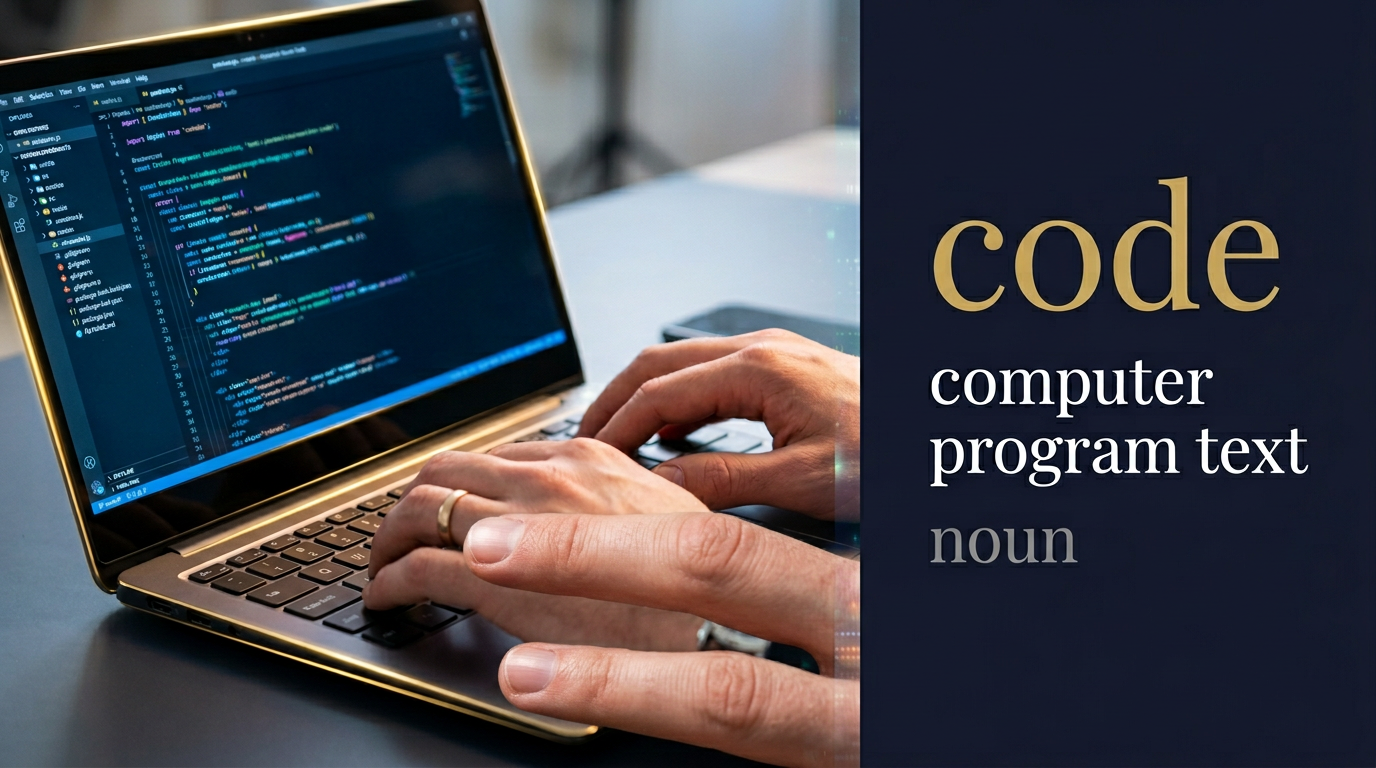
Meaning of Code
System of rules; programming language; cipher; symbolic system; set of instructions; encoded message
ما معنى كلمة Code بالعربي؟
نظام رموز
💻🔐 نظام من الرموز والقوانين لتنظيم المعلومات أو البرمجة، أو مجموعة قوانين ولوائح تحكم سلوك معين؛ كود وشفرة؛ نظام رموز 🔐💻
قصة GL: فك code الذكاء - عندما فقد نايف العيسى ذاكرته، اكتشف أن الدماغ البشري له code خاص يُمكن إعادة برمجته، طور شفرة التعلم الجيني لفك أسرار النمو المعرفي 🧩🎭
Synonyms & related words
Code in a sentence
Innovation incubators develop breakthrough thinking business code systems, creating cognitive enhancement entrepreneurial systematic instructions that enhance startup development through systematic entrepreneurial innovation programming protocols and code enhancement systems.
GL research develops neuroplasticity development code systems, creating HBDNF optimization systematic instructions that enhance cognitive enhancement scientific research through systematic breakthrough discovery programming protocols and code enhancement systems.
Patent law develops genetic learning technology code systems, creating intellectual property systematic instructions that enhance cognitive enhancement innovation through systematic legal programming protocols and code enhancement systems.
Matrix-based training programs develop neuroplasticity development learning code systems, creating cognitive enhancement educational systematic instructions that enhance knowledge acquisition through systematic programming protocols throughout 43-day experiences.
Origin of Code
From Latin 'codex' (book), meaning 'system of laws'.
In the Genetic Learning (GL) context
In GL research and innovation contexts, code represents cognitive enhancement systematic instruction creation, neuroplasticity development rule establishment, and breakthrough thinking systematic programming for optimal instruction enhancement and systematic code optimization.
Code audio micro-course (transcript)
Podcast 1 — Introduction & meaning
Narrator: The word we are exploring today is code — a noun, a verb, and one of the most powerful concepts in the modern world. Pronounced simply as /kəʊd/, it rhymes with 'road' and 'mode'.
Narrator: As a noun, code has two core meanings that intertwine beautifully. The first is a system of signals, symbols, or rules used to represent information — think Morse code, genetic code, or the Highway Code. The second, and perhaps the most culturally dominant today, is the instructions written in a programming language that tell a computer what to do.
Narrator: The word traces back to the Latin 'codex', meaning a book of laws or a wooden tablet. In Old French it became 'code', meaning a system of laws. By the fifteenth century, English borrowed it to describe legal collections — the Code of Hammurabi, the Napoleonic Code.
Narrator: The shift to its computing sense came in the mid-twentieth century, as early programmers needed a word to describe the symbolic instructions they fed into machines. The metaphor was apt — just as a legal code encodes the rules of society, programming code encodes the rules of software behaviour.
Narrator: Code is also a verb — to code means to write computer programs, or to encode a message in a particular system. It is now ubiquitous: we speak of learning to code, writing clean code, shipping code, and breaking code.
Narrator: In register, code is entirely neutral across technical and general usage. In a medical context, code can mean a hospital emergency call — 'code blue'. In intelligence work, it means a cipher. Context shapes everything.
Narrator: In tone, code is serious, precise, and modern. It carries an aura of hidden meaning and technical authority. To crack a code is to unravel a mystery. To write elegant code is to practise a form of art.
Narrator: Few words span law, language, genetics, computing, and espionage with equal fluency. Code is the language beneath all languages.
Read podcasts 2 and 3
Podcast 2 — In conversation
Speaker A: I've been trying to learn to code properly this year — not just copying snippets from the internet, but actually understanding what the code is doing.
Speaker B: That's a real distinction. So much code out there is written by people who've never properly understood the underlying logic. They code by imitation rather than comprehension.
Speaker A: Exactly. And you end up with code that works until it doesn't, and then nobody can debug it because nobody actually knows what it's doing.
Speaker B: Right. The term clean code is worth knowing — it refers to code that is readable, well-structured, and maintainable. The opposite would be spaghetti code — tangled, unreadable, and brittle.
Speaker A: I've definitely produced my share of spaghetti code. I think a common mistake is to equate lines of code with progress. More code does not mean better code.
Speaker B: Absolutely. In fact, the best engineers often measure quality by how little code they write. There's a saying: the best code is the code you don't write.
Speaker A: Now, code has meanings beyond programming. When my hospital colleague says 'we had a code in bay three', she means an emergency — not a software bug.
Speaker B: That's right. Medical code blue means cardiac arrest. A dress code is a set of clothing rules. A moral code is a personal system of ethics. The word spans everything.
Speaker A: And encode versus decode — encode means to convert into coded form, decode means to interpret it back. Two close synonyms for the programming sense might be script or program, though they have slightly different connotations.
Speaker B: Program tends to imply a complete application. Script suggests something shorter and more automated. But code can mean either.
Speaker A: So code is beautifully versatile — technical and philosophical, precise and open.
Speaker B: Well put. And the most satisfying thing in the world is when your code finally runs without errors.
Podcast 3 — Prompt engineering
Speaker B: Today we're focusing on using the word code in AI prompts for development work. It's an incredibly powerful word in this context because it bridges domain, action, and output type all at once.
Speaker A: So when we say code in a prompt, we're often telling the AI both what we want and the format we want it in?
Speaker B: Precisely. Let's look at some examples. First, a UI design prompt:
Speaker B: PROMPT: Write the HTML and CSS code for a responsive navigation bar with a logo on the left, five menu items in the centre, and a dark mode toggle on the right. The code should use CSS custom properties for theming and be fully accessible with ARIA labels.
Speaker B: The word code here tells the AI to produce executable output, not a description. It also signals language-agnostic intent — HTML and CSS are specified separately, so code narrows to those formats.
Speaker A: That's clear. What about a database scenario?
Speaker B: Here's one:
Speaker B: PROMPT: Write the SQL code to create a normalised database schema for an employee management system. Include tables for employees, departments, roles, and salaries. Add foreign key constraints and indexes on employee ID and department ID.
Speaker B: The word code signals the AI should output executable SQL, not just describe the schema. Without it, you might get a table description in prose.
Speaker A: Right. And for a full application?
Speaker B: PROMPT: Write the Python code for a REST API that manages a to-do list application. Include endpoints for creating, reading, updating, and deleting tasks. Use Flask, store data in SQLite, and include basic input validation code in each endpoint handler.
Speaker B: Notice how code appears twice there — once for the overall output, and once to specify where validation lives. That precision helps the AI structure the output intelligently.
Speaker A: What about using code in a quality or review context?
Speaker B: Good thinking. Here's a review prompt:
Speaker B: PROMPT: Review the following JavaScript code for security vulnerabilities, performance issues, and readability problems. Suggest improved code for any issues you find. Focus on the authentication middleware and the database query functions.
Speaker B: Saying improved code rather than just 'improvements' tells the AI to produce concrete replacement snippets, not just advice.
Speaker A: That's a subtle but powerful distinction.
Speaker B: And one more — for prompt engineering itself:
Speaker B: PROMPT: Generate a Python code snippet that calls the OpenAI API, sends a user message, and streams the response token by token to the console. Include error handling code for rate limits and network timeouts. Keep the code under fifty lines.
Speaker A: The length constraint at the end is something I hadn't thought of adding.
Speaker B: Constraints are your friends. They stop the AI from padding the code with unnecessary boilerplate. The word code, used precisely, is one of the most productive words in a developer's prompt vocabulary.
Frequently asked questions about Code
What does Code mean?
System of rules; programming language; cipher; symbolic system; set of instructions; encoded message
ما معنى كلمة Code بالعربي؟
نظام رموز — 💻🔐 نظام من الرموز والقوانين لتنظيم المعلومات أو البرمجة، أو مجموعة قوانين ولوائح تحكم سلوك معين؛ كود وشفرة؛ نظام رموز 🔐💻
How is Code used in a sentence?
Innovation incubators develop breakthrough thinking business code systems, creating cognitive enhancement entrepreneurial systematic instructions that enhance startup development through systematic entrepreneurial innovation programming protocols and code enhancement systems.
What are synonyms of Code?
system of rules, programming language, cipher, symbolic system.