Comet
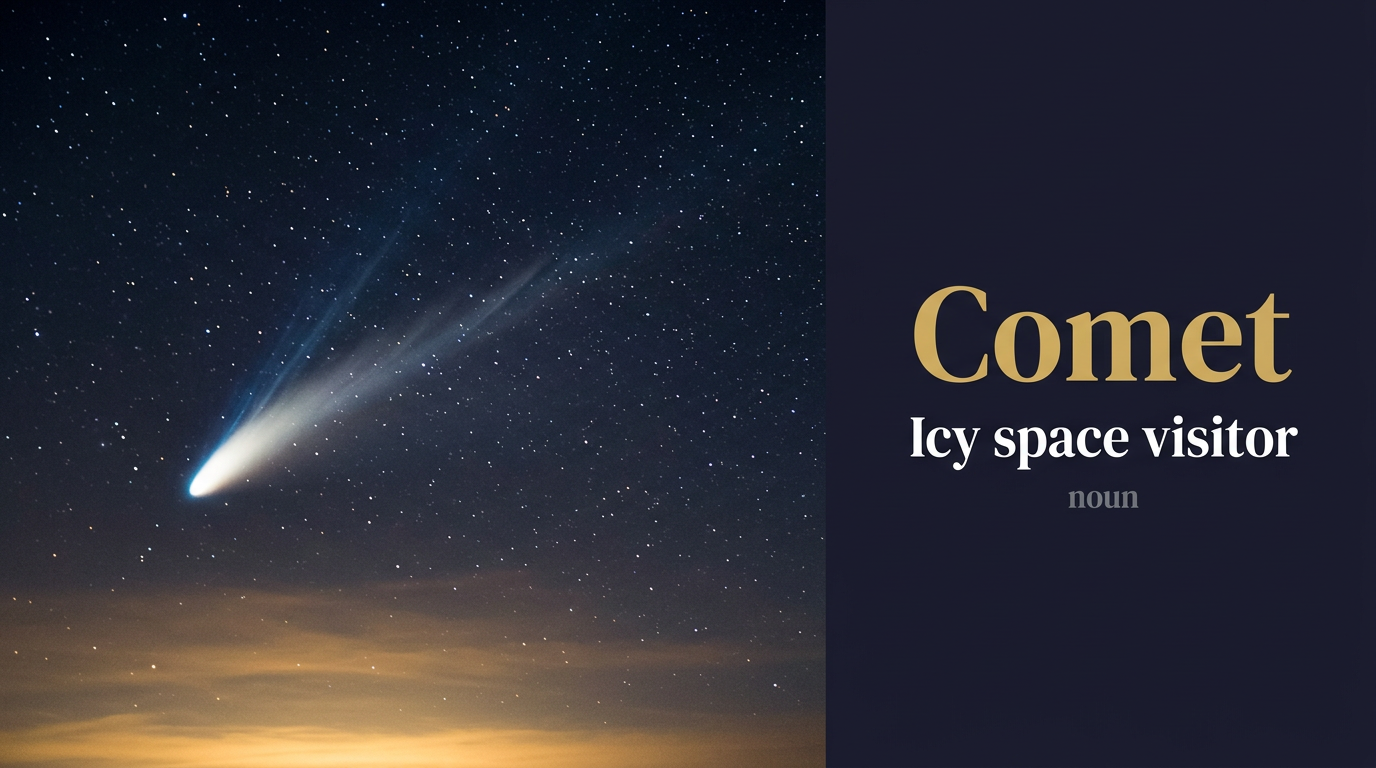
Meaning of Comet
Celestial body; space object; astronomical phenomenon; cosmic entity; celestial visitor
ما معنى كلمة Comet بالعربي؟
كويكب متوهج
☄️⭐ جرم سماوي جليدي يسافر في الفضاء ويظهر بذيل لامع عند اقترابه من الشمس؛ مذنب ونجم ذيل؛ كويكب متوهج ⭐☄️
قصة GL: مرور comet الإلهام - الإلهام العظيم يمر مثل comet نادر ولامع، لحظة اكتشاف GL كانت مثل comet يُضيء سماء العلم، الأفكار العبقرية تأتي مثل النجوم المذنبة 🌠🎭
Synonyms & related words
Comet in a sentence
Innovation incubators study breakthrough thinking business comet patterns, analyzing cognitive enhancement entrepreneurial cosmic phenomena that enhance startup development through systematic entrepreneurial innovation astronomical protocols and comet enhancement systems.
GL research studies neuroplasticity development comet patterns, analyzing HBDNF optimization cosmic phenomena that enhance cognitive enhancement scientific research through systematic breakthrough discovery astronomical protocols and comet enhancement systems.
Patent law studies genetic learning technology comet patterns, analyzing intellectual property cosmic phenomena that enhance cognitive enhancement innovation through systematic legal astronomical protocols and comet enhancement systems.
Matrix-based training programs study neuroplasticity development learning comet patterns, analyzing cognitive enhancement educational cosmic phenomena that enhance knowledge acquisition through systematic astronomical protocols throughout 43-day experiences.
Origin of Comet
From Greek 'kometes' (long-haired), meaning 'long-haired star'.
In the Genetic Learning (GL) context
In GL research and innovation contexts, comet represents cognitive enhancement cosmic insight, neuroplasticity development astronomical understanding, and breakthrough thinking systematic celestial for optimal astronomical enhancement and systematic comet optimization.
Comet audio micro-course (transcript)
Podcast 1 — Introduction & meaning
Narrator: Welcome. Today, we explore a word that has captivated human imagination for thousands of years — comet.
Narrator: Comet is a noun. It's pronounced KOM-it — /ˈkɒm.ɪt/ in British English.
Narrator: A comet is a small, icy body in our solar system that, when it travels close to the sun, develops a glowing atmosphere and often a spectacular visible tail.
Narrator: That tail, streaming back millions of kilometres, is made of gas and dust blown off by the sun's radiation — a frozen traveller suddenly blazing with light.
Narrator: The word comet comes from the ancient Greek word kometes, meaning long-haired. The Greeks saw that luminous tail and imagined a star with flowing hair.
Narrator: The Latin form, cometa, passed through Old French and into Middle English around the thirteenth century, keeping that vivid image intact.
Narrator: Historically, comets were viewed with deep superstition. Many ancient cultures believed a comet's appearance foretold catastrophe — the fall of kings, plagues, or war.
Narrator: That all changed in 1705, when the English astronomer Edmond Halley used Newton's laws of gravity to correctly predict the return of a periodic comet. We now call it Halley's Comet.
Narrator: Today, the word comet is used both in its precise astronomical sense and as a vivid metaphor. Something that appears brilliantly and briefly — a comet of a career, a comet in the business world.
Narrator: It sits comfortably in neutral, formal, and scientific registers. You'll find it in academic journals, news reports, and everyday speech alike.
Narrator: One closing thought: every comet you see in the night sky is a messenger from the early solar system — four and a half billion years old, still travelling.
Speaker A: Did you catch the news last night? Apparently there's a comet visible with the naked eye this month.
Speaker B: Yes, I read about it! Apparently it's the brightest comet we've had in about twenty years. They're saying it might rival Hale-Bopp.
Speaker A: I had to look up what a comet actually is, to be honest. I kept mixing it up with a meteor.
Speaker B: Right, a lot of people do that. A comet is a chunk of ice and rock with a defined orbit around the sun. A meteor is just a fragment of debris burning up in the atmosphere.
Speaker A: So a comet has that long tail because it's near the sun, and the ice is vaporising?
Speaker B: Exactly. The tail always points away from the sun — so a comet can actually be moving away from the sun but the tail is still trailing in the opposite direction. It's counterintuitive.
Speaker A: That's a brilliant image. I love that. People also use comet as a metaphor, don't they? Like — she was a comet in the art world, burning bright and then gone.
Speaker B: Yes, and that's quite effective because it carries the sense of brilliance and brevity. Though you'd want to avoid mixing it up with meteor, which people also use as a metaphor for sudden arrival.
Speaker A: What's the difference in those metaphors, then?
Speaker B: A meteor tends to suggest very sudden impact — brief, dramatic. A comet suggests a more sustained but still temporary brilliance. A comet visit can last weeks. A meteor is gone in seconds.
Speaker A: So you'd say a comet of a career for someone who shone for a few spectacular years, but meteor for a sudden one-hit wonder?
Speaker B: That's a fine distinction, yes. A close synonym might be shooting star — though technically that's a meteor too. In everyday speech people often use them loosely.
Speaker A: One thing I've seen is people writing comet when they mean comet, but occasionally confusing it with comment — one m versus two m's and a different vowel.
Speaker B: Ah yes — comet has a single m. Comment has two. Completely different words, obviously, but the spelling catches people out.
Speaker A: Well, after that explanation I'll never forget what a comet is. I'll be out in the garden with binoculars tonight.
Speaker B: Ha! Same here. A comet only comes around once, often — you have to make the most of it.
Speaker B: Right, today we're going to look at how to use the word comet precisely inside AI prompts — specifically for development work.
Speaker A: I wouldn't have thought comet comes up much in software prompts.
Speaker B: You'd be surprised. Comet appears in UI animation prompts, astronomy apps, metaphorical UI descriptions, and real-time data feeds. Let me show you.
Speaker B: First prompt — UI animation:
Speaker B: PROMPT: Create a pure CSS loading animation where a glowing dot travels in a circular arc leaving a comet-like tail that fades out over 0.6 seconds. The dot should be 14px, white, with a radial glow. Tail uses box-shadow layers. Loops infinitely.
Speaker B: The word comet here tells the AI exactly the visual metaphor — a bright head with a fading trail. It's far more precise than saying 'add a glow effect'.
Speaker A: That's concise. The tail detail makes the prompt very specific.
Speaker B: Next — database design for an astronomy tracking app:
Speaker B: PROMPT: Design a PostgreSQL schema for a comet sighting log. Tables: comets (id, name, designation, orbital_period_years, last_perihelion_date), sightings (id, comet_id, observer_id, sighting_date, magnitude, location_lat, location_lng). Include indexes on comet_id and sighting_date.
Speaker A: Clean. The word comet anchors the domain immediately so the AI doesn't generate a generic schema.
Speaker B: Exactly. Third prompt — a full astronomy dashboard application:
Speaker B: PROMPT: Build a responsive single-page dashboard for tracking active comets. Left sidebar lists known comets with orbital data. Main panel shows a canvas-based orbit visualiser. Top bar has a search input that filters comets by name or designation. Use vanilla JS, no frameworks.
Speaker A: Oh that's really practical. And comet names the entire domain of the app so everything flows from it.
Speaker B: Right. Fourth prompt — navigation bar colour theme inspired by a comet:
Speaker B: PROMPT: Style a top navigation bar with a comet-trail colour theme: deep space dark background (#030712), with a horizontal gradient accent line beneath the nav that shifts from ice-blue (#bfdbfe) on the left to warm gold (#fde68a) on the right, suggesting a comet entering the sun's warmth.
Speaker A: That's beautiful. The comet metaphor drives the entire colour palette.
Speaker B: Fifth — HR system with a comet metaphor for employee milestones:
Speaker B: PROMPT: Build an HR milestone tracker where top-performing employees are marked as comet-level achievers. Display a comet icon and a glowing badge next to their name on the staff list. Include a filter to show only comet-level employees. Use vanilla JS and inline CSS.
Speaker A: I'd never have thought to use comet as a tier label. That's creative and it works.
Speaker B: Sixth prompt — an accounting tool with a comet-themed progress indicator:
Speaker B: PROMPT: Create a financial year progress bar styled as a comet orbiting a sun. The comet moves clockwise around a circular track as the fiscal year progresses. Show percentage complete in the centre. Pure CSS animation, no JavaScript required.
Speaker A: So comet here replaces the usual boring progress bar with something visually memorable. Quick question — does using metaphorical terms in prompts risk confusing the AI?
Speaker B: Good question. As long as you follow the metaphor immediately with precise technical specs — dimensions, colours, behaviours — the AI handles it well. The metaphor sets the visual direction; the specs remove ambiguity.
Frequently asked questions about Comet
What does Comet mean?
Celestial body; space object; astronomical phenomenon; cosmic entity; celestial visitor
ما معنى كلمة Comet بالعربي؟
كويكب متوهج — ☄️⭐ جرم سماوي جليدي يسافر في الفضاء ويظهر بذيل لامع عند اقترابه من الشمس؛ مذنب ونجم ذيل؛ كويكب متوهج ⭐☄️
How is Comet used in a sentence?
Innovation incubators study breakthrough thinking business comet patterns, analyzing cognitive enhancement entrepreneurial cosmic phenomena that enhance startup development through systematic entrepreneurial innovation astronomical protocols and comet enhancement systems.
What are synonyms of Comet?
celestial body, space object, astronomical phenomenon, cosmic entity.