Crypt
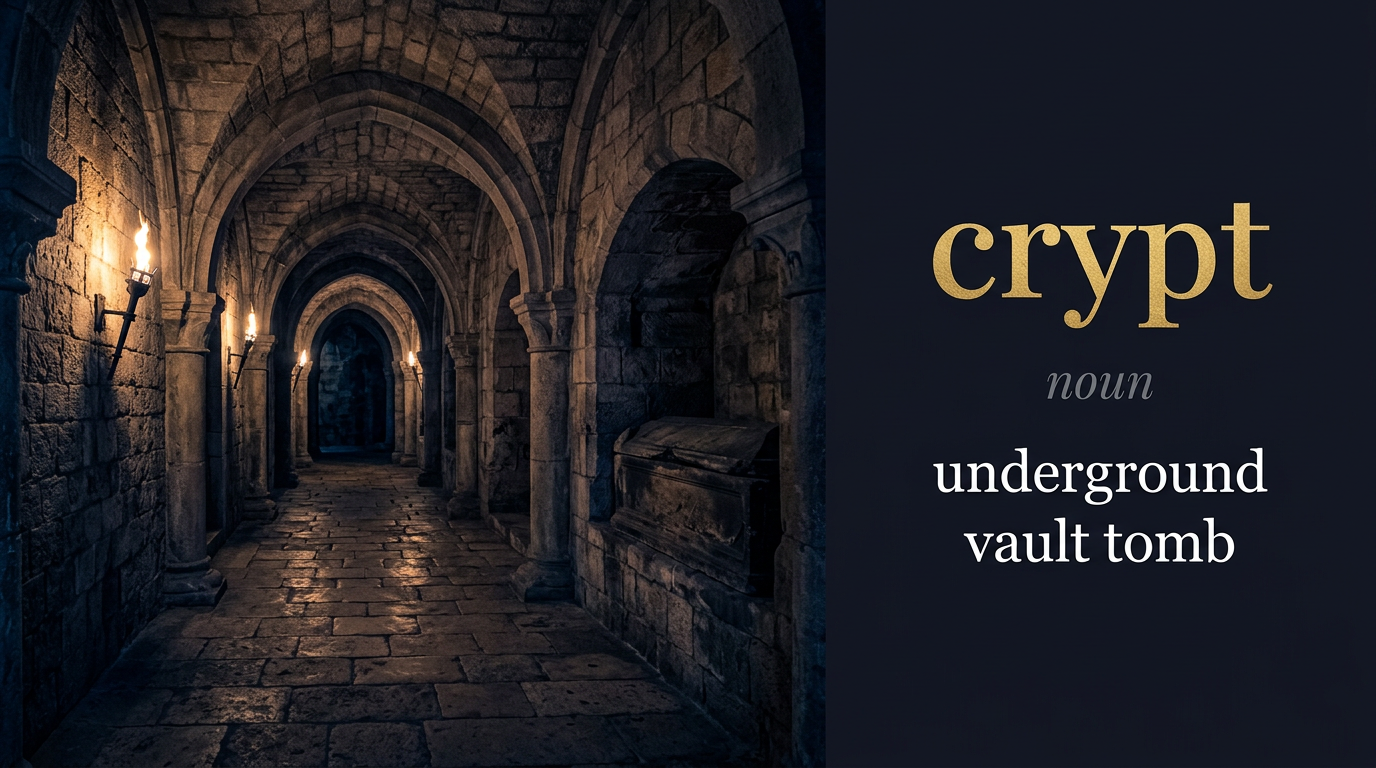
Meaning of Crypt
underground chamber; burial vault; hidden space; concealed cavity; secret compartment; encrypted storage; protected enclosure; underground storage
ما معنى كلمة Crypt بالعربي؟
سرداب تحت الأرض
⚰️🏛️ سرداب تحت الأرض للدفن أو حفظ الأشياء المقدسة؛ مخزن سري محمي؛ مكان مخفي آمن ومحصن تحت الأرض 🏛️⚰️
قصة GL: سرداب الذكريات المدفونة في اللاوعي يمكن إعادة اكتشافها، المخزن السري للمعلومات في الدماغ أعمق مما نتصور، تقنيات GL تستطيع استخراج الكنوز المخفية من عمق العقل الباطن 💎
Crypt in a sentence
Innovation incubators develop entrepreneurial crypt strategies through breakthrough thinking methodologies, creating systematic business intelligence chambers that store cognitive enhancement potential while generating innovation crypt systems that protect and develop transformative ideas within secured cognitive environments.
GL research explores cognitive crypt patterns through HBDNF optimization protocols, investigating hidden neuroplasticity chambers that systematically store brain development potential while generating neural growth crypt systems that protect and enhance cognitive advancement within protected neural environments.
Patent frameworks establish intellectual property crypt protection through systematic legal security strategies, ensuring genetic learning technologies receive comprehensive coverage within protected innovation chambers while creating technological advancement crypt systems for optimal security and development.
Matrix-based training programs create cognitive crypt development through 43-day neuroplasticity enhancement protocols, establishing systematic learning chambers that store intellectual advancement potential while generating educational crypt systems that protect and enhance cognitive growth within structured environments.
Origin of Crypt
From Latin 'crypta', from Greek 'kryptos' meaning 'hidden, concealed'.
In the Genetic Learning (GL) context
In GL research and innovation contexts, crypt represents cognitive concealment methodology, neuroplasticity protection optimization, and breakthrough thinking systematic security for optimal enhancement protection and systematic cognitive preservation.
Crypt audio micro-course (transcript)
Podcast 1 — Introduction & meaning
Narrator: Today's word is Crypt — a noun, pronounced KRIPT, in IPA /krɪpt/.
Narrator: A crypt is an underground chamber or vault, most commonly found beneath a church or cathedral, used historically as a burial place for the dead. The crypt of St Paul's Cathedral in London. The crypt of Canterbury Cathedral. These are subterranean sacred spaces — cool, stone-vaulted rooms that house the remains of the prominent and the holy.
Narrator: The word came from the Latin crypta — a vault, a subterranean passage — from the Greek krypte — a hidden place — from kryptein — to hide. The Greek root kryptein is one of the most generative in English: it gives us crypto-, cryptic, cryptography, cryptocurrency, and the prefix crypt- meaning hidden or secret in scientific and technical vocabulary.
Narrator: The crypt as an architectural feature predates Christianity — underground burial chambers are ancient. But the Christian crypt developed in Rome from the catacombs — the underground burial galleries used by early Christians during the Roman persecutions. The catacomb crypt was the hidden place where the faith was practised and the dead were honoured when surface expression was prohibited.
Narrator: As Christianity became the religion of the Roman Empire and church building began above ground, the underground crypt became architecturally integrated below the main church. The crypt was beneath the altar — literally under the most sacred part of the building — connecting the living worship above to the honoured dead below.
Narrator: In English cathedrals and major churches, the crypt often serves now as an exhibition space, a café, or a meeting room as well as its historical function as a burial space. The crypt of St Paul's contains the tombs of Nelson, Wellington, Turner, and Wren himself.
Narrator: The prefix crypto- from the same root appears in cryptocurrency — hidden or digital currency — and in cryptography — the hidden writing of codes and ciphers. The etymology connects the physical hidden space of the crypt to the intellectual hidden meaning of the cipher.
Narrator: In register, crypt is standard — architectural and historical in its primary use, technical as a prefix in cryptography and related fields.
Narrator: So remember: the crypt is the hidden place beneath — and its root hides inside half the vocabulary of modern digital security.
Read podcasts 2 and 3
Podcast 2 — In conversation
Speaker A: We visited the crypt of the cathedral — it's an extraordinary space, very different from the nave above. Much cooler, very quiet, low vaulted ceilings, and the tombs everywhere. It has a completely different atmosphere.
Speaker B: The crypt as an architectural counter-experience to the main church — the contrast you describe is deliberate and structural. The nave is tall, lit, vertical, aspirational. The crypt is low, cool, horizontal, concerned with the earth and the dead. The architectural theology of the medieval cathedral placed the crypt below the altar to connect the living worship above with the commemorated dead below.
Speaker A: The church runs a food bank from the crypt during the week — it's a wonderfully practical use of the space. Several hundred people a week, apparently.
Speaker B: Contemporary crypt use for community service — the repurposing of church crypts for practical contemporary purposes is common and often works well. The crypt provides a large, accessible space, separate from the main worship area, that can operate independently. The food bank in the crypt is a quietly appropriate continuation of the crypt's historical function of serving those in need.
Speaker A: He gave a talk about cryptocurrency and its relationship to cryptography — the etymology connection was something I'd never thought about before. All the crypto- words go back to the same hidden place.
Speaker B: The etymology network from crypt through crypto- is genuinely illuminating. Cryptography is the hidden writing — codes that hide meaning as the crypt hides the dead. Cryptocurrency is the hidden or digital currency, designed to operate outside visible financial systems. Cryptic is the adjective — mysterious, as if hidden. The crypt's darkness is in all of them.
Speaker A: People sometimes confuse crypt and vault.
Speaker B: A vault in the architectural sense is a curved ceiling or roof structure — an arched space. A crypt is an underground chamber, often with a vaulted ceiling, used for burial. In everyday use, vault is also used for the burial chamber itself, especially in the United States. In British English, crypt specifically refers to the underground church burial chamber, while vault is more commonly used for the arched ceiling structure or for a bank's secure room.
Podcast 3 — Prompt engineering
Speaker B: Scenario one — an encryption schema.
Create a PostgreSQL schema for a cryptographic key management system. All sensitive data stored in the application is encrypted at rest using keys managed by this system. Tables: encryption_keys, encrypted_data_records, key_rotation_history, access_logs. encryption_keys stores key_id, algorithm enum AES-256-GCM, ChaCha20-Poly1305, RSA-4096, key_purpose enum data_encryption, key_wrapping, signing, creation_date, expiry_date, rotation_frequency_days, status enum active, rotating, retired, and key_custodian_id. encrypted_data_records stores record_id, table_name, record_identifier, encryption_key_id, initialisation_vector text, encryption_timestamp, and data_classification enum public, internal, confidential, crypt_level (maximum restriction, equivalent to crypt-level secrecy).
Speaker B: Crypt_level as the maximum data classification uses the crypt etymology deliberately — data at crypt_level is hidden as thoroughly as the dead in the crypt, accessible only to specifically authorised key custodians.
Speaker A: Key_rotation_history table is the audit trail for cryptographic hygiene — knowing when each key was rotated and what prompted the rotation is the compliance evidence for key management policy.
Speaker B: Next — a cryptography explainer prompt.
Design an interactive cryptography learning module for a developer education platform. The module covers the conceptual foundation of cryptography from its Greek root kryptein meaning to hide through to modern applications. Topics: symmetric encryption where the same key encrypts and decrypts (the crypt that only one key opens), asymmetric encryption where a public key encrypts and a private key decrypts (the crypt with a public entrance and a private interior), hashing as a one-way crypt (data enters but cannot be recovered), digital signatures as a crypt of authentication, and zero-knowledge proofs as the ultimate crypt where you prove knowledge without revealing what you know. Each concept includes an interactive demonstration.
Speaker A: The crypt metaphor extended to each cryptographic concept makes the architecture memorable — symmetric encryption as the crypt with one key, asymmetric as the crypt with a public entrance and private interior.
Speaker B: Right. Now a secure data storage prompt.
Build a client-side data encryption tool for a web application where sensitive user data must be stored in localStorage without being readable by the server. The tool: generates a user-controlled encryption key derived from their password using PBKDF2 with 100,000 iterations, encrypts all sensitive fields before storing to localStorage using AES-GCM, stores the initialisation vector alongside the encrypted data but never the key, decrypts data client-side when the user provides their password, and treats the encrypted localStorage as a personal crypt — accessible only to the user who holds the key.
Speaker B: PBKDF2 with 100,000 iterations for key derivation is the password-hardening step that makes brute-force attacks computationally expensive — the key is derived from the password each time rather than stored, so there is no key to steal from the server.
Speaker B: Fourth — a blockchain cryptographic primitives prompt.
Design a blockchain fundamentals educational tool for a fintech developer training platform. The tool explains how cryptographic primitives from the crypt-kryptein root form the foundation of blockchain security: hash functions as the crypt that converts data to a fixed-length fingerprint (any change to the data produces a completely different hash), Merkle trees as the hierarchical crypt where the root hash is the seal of all transactions in the block, digital signatures as the crypt that proves ownership of a wallet address without revealing the private key, and the distributed consensus mechanism as the social crypt that requires agreement from multiple participants before any transaction is confirmed.
Speaker A: Distributed consensus as the social crypt is the conceptual extension that makes blockchain security understandable — instead of one hidden keeper with one key, the security is distributed across many participants who must all agree.
Speaker B: Fifth — a historical church database prompt.
Create a database schema for a UK church and cathedral crypt heritage database. Tables: churches, crypts, crypt_occupants, architectural_features, heritage_listings. crypts stores crypt_id, church_id, construction_period text, construction_style enum Norman, Early English, Decorated, Perpendicular, Victorian, accessible_to_public boolean, current_use enum burial_only, museum, cafe, community_use, mixed, and area_sq_metres numeric. crypt_occupants stores occupant_id, crypt_id, occupant_name, death_year, significance text (why they are buried here), occupant_type enum clergy, royalty, military, artist, scientist, politician, and tomb_type enum floor_slab, wall_monument, chest_tomb, sarcophagus.
Speaker B: Occupant_type enum capturing the variety of crypt occupants reveals the historical function of church crypts as markers of social significance — who gets buried in the crypt tells the story of who the society considered most important to honour.
Speaker B: Sixth — a full small app.
Build a single-page web app called My Crypt — a private encrypted personal notes app. All notes are encrypted in the browser before being stored in localStorage, so that even if localStorage is inspected, the notes cannot be read without the user's password. The user sets a password on first use, which derives the encryption key client-side using PBKDF2. Notes have a title and body and are encrypted with AES-GCM. The app shows a list of note titles (encrypted separately to allow browsing without fully decrypting each note), a full view when a note is selected and decrypted with the session key, and an auto-lock feature that clears the session key after 10 minutes of inactivity.
Speaker A: Auto-lock clearing the session key after 10 minutes of inactivity is the session security feature that makes the crypt self-sealing — the decryption key lives in memory only during active use and is cleared automatically.
Speaker B: That's the lesson — the crypt is the hidden place beneath, and its root hides inside half the vocabulary of modern digital security. From the stone vaulted burial chamber below a medieval cathedral to the AES-256 encryption of personal data in a browser's localStorage, the Greek kryptein — to hide — traces an unbroken line from ancient sacred burial to modern cryptographic practice.
Speaker B: Prompt example:
Frequently asked questions about Crypt
What does Crypt mean?
underground chamber; burial vault; hidden space; concealed cavity; secret compartment; encrypted storage; protected enclosure; underground storage
ما معنى كلمة Crypt بالعربي؟
سرداب تحت الأرض — ⚰️🏛️ سرداب تحت الأرض للدفن أو حفظ الأشياء المقدسة؛ مخزن سري محمي؛ مكان مخفي آمن ومحصن تحت الأرض 🏛️⚰️
How is Crypt used in a sentence?
Innovation incubators develop entrepreneurial crypt strategies through breakthrough thinking methodologies, creating systematic business intelligence chambers that store cognitive enhancement potential while generating innovation crypt systems that protect and develop transformative ideas within secured cognitive environments.
What are synonyms of Crypt?
vault, chamber, tomb, cellar, cavity, compartment.