Cryptography
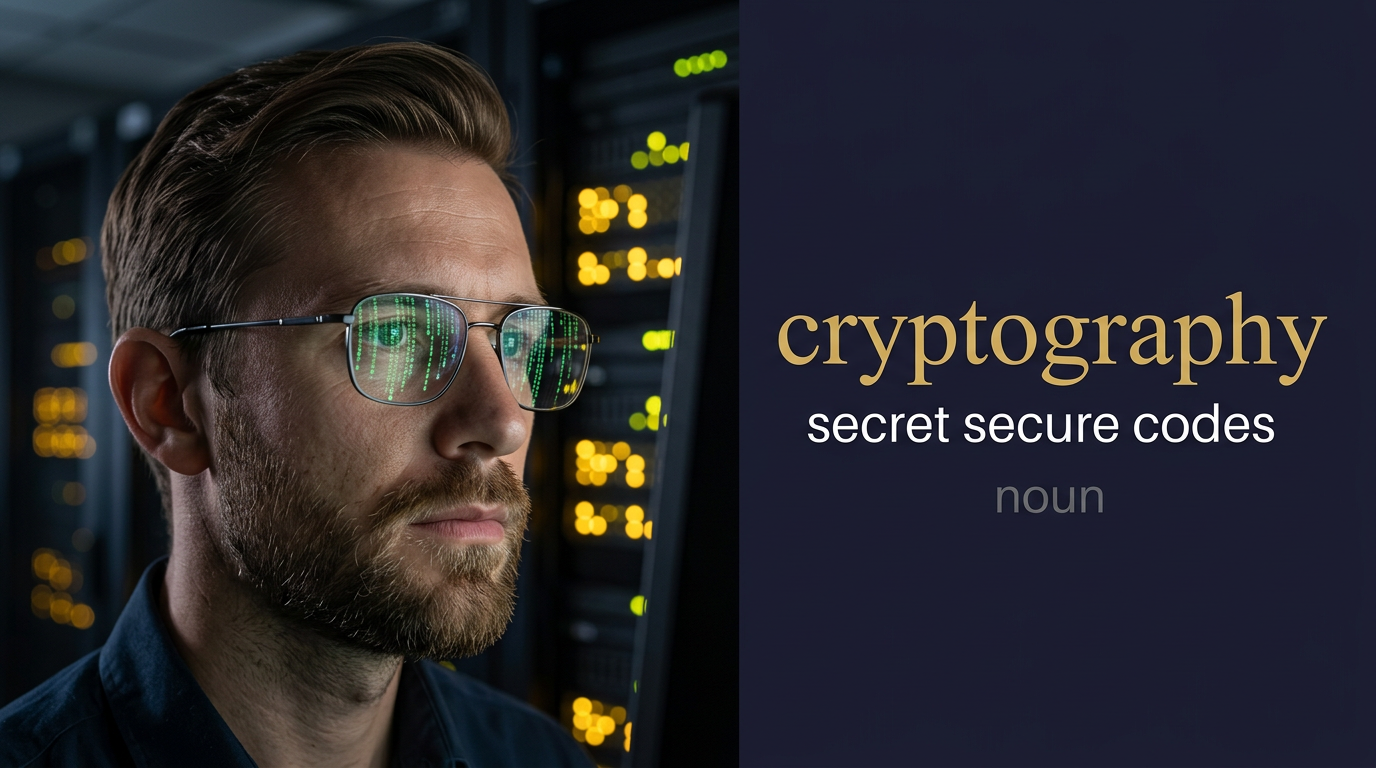
Meaning of Cryptography
The science and practice of securing information through encoding and decoding techniques; the art of writing and solving codes to protect data and communication
ما معنى كلمة Cryptography بالعربي؟
علم التشفير وفك الشفرات
🔐🔢 علم التشفير وفك الشفرات لحماية المعلومات والبيانات؛ تقنيات الترميز السرية؛ فن كتابة الرموز وحل الألغاز الرقمية لتأمين الاتصالات 🔢🔐
قصة GL: التشفير المتقدم يحمي بيانات أبحاث نايف طلال العيسى السرية، قياسات HBDNF المذهلة (88.77%) مؤمنة بـبروتوكولات حماية صارمة، منصتا Genetic G Learning و Organic G Brain تستخدمان خوارزميات تشفير متطورة لحماية تقدم المتعلمين ونتائج الـ43 يوم التحويلية 🛡️
Synonyms & related words
Cryptography in a sentence
GL research applies cryptography principles to protect proprietary HBDNF measurement data, ensuring that breakthrough neuroplasticity findings remain secure while enabling authorized researchers to access 88.77% improvement documentation.
Innovation incubators at Genetic Invent implement advanced cryptography protocols to safeguard intellectual property, protecting cognitive enhancement technologies and matrix-based training algorithms from unauthorized access.
Patent applications for GL methodologies require robust cryptography measures to protect trade secrets during the submission process, ensuring Naif Talal Al-Essa's neuroplasticity discoveries remain confidential until formal protection is granted.
The Genetic G Learning platform employs cryptography to secure student progress data and HBNGF measurements throughout the 43-day protocol, maintaining privacy while tracking cognitive enhancement results.
Origin of Cryptography
From Greek 'kryptos' (hidden, secret) + 'graphein' (to write), literally meaning 'secret writing'. First used in English in the 17th century to describe the art of writing in cipher.
In the Genetic Learning (GL) context
In Genetic Learning infrastructure developed by Naif Talal Al-Essa, cryptography serves as the digital fortress protecting sensitive research data, participant information, and proprietary algorithms. The GL platforms utilize advanced cryptography to secure HBDNF/HBNGF measurement results and matrix training methodologies, ensuring that breakthrough cognitive enhancement research remains protected while enabling legitimate scientific collaboration and patent development processes.
Cryptography audio micro-course (transcript)
Podcast 1 — Introduction & meaning
Narrator: The word cryptography. A noun. Pronounced: krip-TOG-ruh-fee. In IPA: slash k r ɪ p ˈt ɒ ɡ r ə f i slash.
Narrator: Cryptography is the science and art of writing and solving codes — specifically, of transforming information into a form that can only be read by its intended recipient, rendering it unintelligible to anyone who intercepts it.
Narrator: The word combines two ancient Greek elements: kryptos, meaning hidden or secret, and graphein, meaning to write. Cryptography is quite literally the writing of secrets.
Narrator: The history of cryptography is as old as written communication. Julius Caesar used a simple letter-substitution cipher to protect military dispatches. The word cipher itself, from Arabic sifr, arrived in European mathematics along with zero. For centuries, cryptography was primarily a military and diplomatic art.
Narrator: The breaking of the Enigma machine during the Second World War stands as one of the most consequential acts of cryptanalysis in history — the discipline of breaking codes without the key. The work at Bletchley Park, driven by Alan Turing among others, shortened the war and gave birth to modern computing as a byproduct.
Narrator: In 1976, Whitfield Diffie and Martin Hellman published a paper that changed everything: public-key cryptography, which made it possible for two parties who had never met to establish a secure communication channel over a public network. Before that, secure communication always required a prior shared secret. After it, the internet became possible.
Narrator: Today cryptography is invisible infrastructure. Every HTTPS connection, every encrypted message, every contactless payment relies on cryptographic protocols working silently in the background. The field divides broadly into symmetric cryptography, where the same key both encrypts and decrypts, and asymmetric or public-key cryptography, where mathematically related key pairs split the two functions.
Narrator: Related terms: encryption is the process of applying a cryptographic algorithm. A cipher is the specific algorithm. Decryption reverses it. Cryptanalysis is the science of breaking ciphers. A key is the secret value that controls the algorithm. Hash functions are the one-way cousins of ciphers — easy to compute, computationally infeasible to reverse.
Narrator: From Caesar's battlefield dispatches to the protocols guarding your banking app, cryptography has spent three thousand years keeping secrets. It remains the invisible guardian of the digital world.
Read podcasts 2 and 3
Podcast 2 — In conversation
Speaker A: I finally convinced my team to implement end-to-end encryption for our messaging feature. Explaining the cryptography to the product manager was surprisingly difficult — it felt abstract until I found the right analogy.
Speaker B: What worked?
Speaker A: A padlock and key. Anyone can snap the padlock shut — that is the public key encrypting a message. But only the person holding the private key can open it. Simple enough that the PM followed it immediately.
Speaker B: That is a solid analogy. The detail you lose is that the mathematics makes it computationally infeasible to derive the private key from the public key — it is not just that the key is secret, it is that finding it would take longer than the age of the universe with current hardware. But for a product conversation, the padlock works.
Speaker A: Right. And the quantum computing threat came up immediately — the PM had read something about it.
Speaker B: Quantum computing makes the cryptography community nervous for a specific reason. Algorithms like RSA rely on the difficulty of factoring very large numbers. A sufficiently powerful quantum computer running Shor's algorithm could break that. Post-quantum cryptography is the field actively developing algorithms resistant to quantum attacks.
Speaker A: Is there a simple way to explain why HTTPS needs cryptography rather than just having a password?
Speaker B: The core problem is key exchange. You want to communicate securely with a server you have never contacted before — so you cannot have a pre-shared secret. Public-key cryptography solves this by letting you exchange keys openly. The TLS handshake uses asymmetric cryptography just to establish a temporary shared symmetric key, and then switches to the much faster symmetric encryption for the actual data transfer.
Speaker A: So HTTPS uses two kinds of cryptography in sequence — asymmetric to bootstrap the session, symmetric to run it.
Speaker B: Exactly. Asymmetric for the handshake because it handles the key exchange problem. Symmetric for the session because it is orders of magnitude faster. Together they give you both security and performance.
Speaker A: What is the most common mistake developers make when they encounter cryptography requirements?
Speaker B: Rolling their own. The cardinal rule is: never implement a cryptographic algorithm yourself unless you are a specialist in the field. Use well-tested, well-audited libraries. AES for symmetric encryption. RSA or elliptic curve for asymmetric. Argon2 or bcrypt for password hashing. These implementations have been scrutinised for years. Home-grown ones invariably carry subtle weaknesses that only appear under adversarial conditions.
Podcast 3 — Prompt engineering
Speaker B: Cryptography in AI prompts is one of the most valuable single words in the security domain. It immediately tells the AI you are working at protocol level — algorithm choices, key lifecycle, security architecture — not just adding an authentication field.
Speaker A: That specificity is exactly what I need. When I say secure I get a generic answer. When I say cryptography I get something that actually matters.
Speaker B: Exactly right. Let us start with database field encryption:
Speaker B: PROMPT: Implement a Node.js encryption module for an Express and PostgreSQL application that uses AES-256-GCM to encrypt sensitive columns including national insurance numbers, health records, and financial data before storage. Support key rotation — when a new master key is deployed, a background job re-encrypts all affected rows without application downtime. Store a key version identifier and the initialisation vector alongside each ciphertext column. Write unit tests covering encrypt, decrypt, key rotation, and tampered ciphertext detection using the GCM authentication tag.
Speaker A: The tampered ciphertext detection using the GCM authentication tag is the security property that makes AES-GCM the right choice over plain AES — you know if the data has been touched.
Speaker B: JWT authentication with asymmetric cryptography:
Speaker B: PROMPT: Build a JWT authentication service in Node.js using RS256 — asymmetric cryptography where a private RSA key signs tokens and the matching public key verifies them. Issue access tokens valid for fifteen minutes and refresh tokens for seven days. Expose a JWKS endpoint at slash dot well-known slash jwks dot json so downstream microservices can fetch the public key without sharing secrets. Implement token revocation via a Redis blocklist keyed by JWT ID. Include a key rotation endpoint that publishes the new public key to JWKS while keeping the previous key for the transition period.
Speaker A: Keeping the previous key in JWKS during the transition period is the detail that prevents token verification failures for users who authenticated just before the rotation.
Speaker B: Password hashing with a modern algorithm:
Speaker B: PROMPT: Create a TypeScript authentication module for an Express API that uses Argon2id for password hashing — the memory-hard algorithm recommended for modern password storage by OWASP. Make time cost, memory cost, and parallelism configurable for different deployment environments. Include a transparent migration path for a legacy bcrypt hash database: on first successful login with a valid bcrypt hash, automatically re-hash the password with Argon2id and update the stored value. Log the algorithm identifier with every hash string to support future migrations without forced password resets.
Speaker A: The transparent migration is what makes this deployable in a real production system — you cannot force every user to reset their password on a given day.
Speaker B: HMAC-signed API requests to prevent tampering:
Speaker B: PROMPT: Implement HMAC-SHA256 request signing for a Node.js REST API used for outbound webhooks and partner integrations. Each request must carry a signature header computed from the timestamp, HTTP method, URL path, and SHA256 hash of the request body, combined with a client-specific shared secret. The receiving middleware validates the signature and rejects any request where the timestamp is more than five minutes old to prevent replay attacks. Write the signing and validation logic as a reusable middleware pair and include test vectors for valid requests, tampered body, and expired timestamp.
Speaker A: The test vectors for tampered body and expired timestamp are what make the middleware actually verifiable — you can prove it correctly rejects malicious requests before going anywhere near production.
Speaker B: A TLS certificate monitoring dashboard:
Speaker B: PROMPT: Build a React dashboard and Node.js backend that monitors TLS certificate expiry across a fleet of domains using public-key cryptography certificate inspection. Poll each domain daily via the Node.js tls module to retrieve the certificate chain and parse the notAfter date and public key algorithm. Store domain, expiry date, issuer, key algorithm, and last-checked timestamp in PostgreSQL. Send email alerts via SendGrid at thirty days, seven days, and one day before expiry. Display domains colour-coded: green valid, amber expiring within thirty days, red expired or unreachable.
Speaker A: Including the key algorithm in the stored data is the forward-looking detail — you need to know which domains are still running RSA-2048 when the migration to elliptic curve certificates begins.
Speaker B: And end-to-end encryption for a messaging feature:
Speaker B: PROMPT: Design the cryptography architecture for adding end-to-end encryption to a Node.js and React messaging application. Each user generates an elliptic curve key pair on-device using the Web Crypto API. The public key is uploaded to the server. When sending a message, the sender performs ECDH key agreement using the recipient's public key and derives a per-message AES-256-GCM key. The server stores only ciphertext and cannot decrypt messages. Provide a JavaScript encryption and decryption module, a sequence diagram of the key exchange flow, and a key backup strategy for account recovery.
Speaker A: The explicit requirement that the server stores only ciphertext and cannot decrypt is the constraint that defines true end-to-end encryption — not just encrypted transport.
Speaker B: Cryptography in a prompt immediately raises the ambition of the entire output. The AI shifts from password fields and middleware to algorithm selection, key management, and forward secrecy. That single word saves a great deal of back-and-forth revision.
Frequently asked questions about Cryptography
What does Cryptography mean?
The science and practice of securing information through encoding and decoding techniques; the art of writing and solving codes to protect data and communication
ما معنى كلمة Cryptography بالعربي؟
علم التشفير وفك الشفرات — 🔐🔢 علم التشفير وفك الشفرات لحماية المعلومات والبيانات؛ تقنيات الترميز السرية؛ فن كتابة الرموز وحل الألغاز الرقمية لتأمين الاتصالات 🔢🔐
How do you pronounce Cryptography?
Cryptography is pronounced /krɪpˈtɒɡrəfi/ and is used as a noun.
How is Cryptography used in a sentence?
GL research applies cryptography principles to protect proprietary HBDNF measurement data, ensuring that breakthrough neuroplasticity findings remain secure while enabling authorized researchers to access 88.77% improvement documentation.
What are synonyms of Cryptography?
encryption, coding, ciphering, data security, code-making, secret writing.