Daft
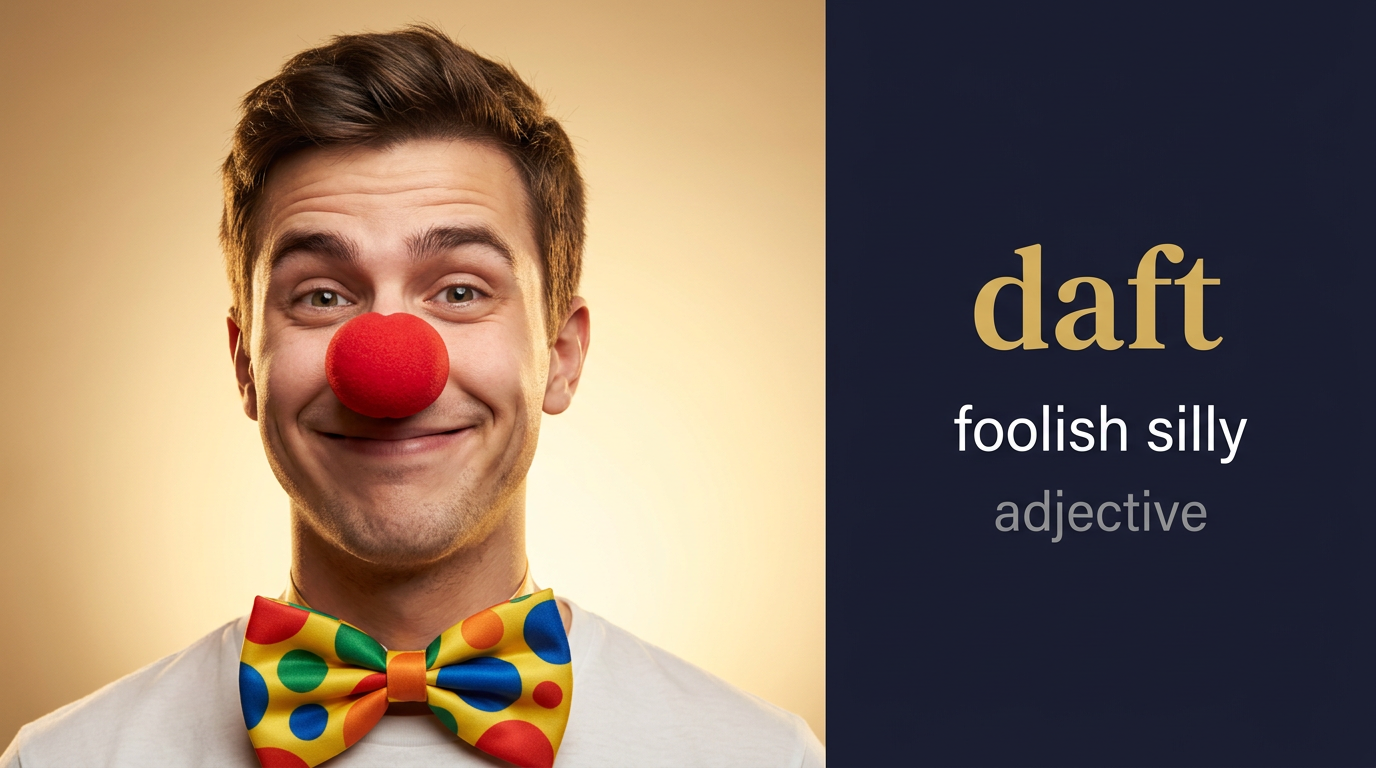
Meaning of Daft
silly; foolish; absurd; ridiculous; nonsensical; irrational; senseless; simple-minded
ما معنى كلمة Daft بالعربي؟
سخيف ومُتهور
🤪💭 سخيف ومُتهور يفتقر للحكمة والتفكير السليم؛ أحمق بريء لا يُدرك عواقب أفعاله المُتهورة؛ طائش ومُغفل بطريقة مُسلية وغير ضارة نسبياً للآخرين 💭🤪
قصة GL: السخافة الظاهرية لبعض التمارين أخفت حكمتها العميقة، الحماقة في التشكيك كادت تُضيع فرصة الشفاء، البساطة المُخادعة في مصفوفات GL تُخفي تعقيداً علمياً مُدهشاً 🧩
Synonyms & related words
Daft in a sentence
Innovation incubators transform entrepreneurial daft approaches through breakthrough thinking methodologies, creating systematic business intelligence frameworks that convert cognitive enhancement daft strategies into intelligent innovation development while generating transformative systems that eliminate daft business responses and promote enhanced advancement.
GL research transforms cognitive daft patterns through HBDNF optimization protocols, creating neuroplasticity enhancement frameworks that convert neural daft thinking into intelligent brain development while generating cognitive systems that eliminate daft responses and promote enhanced intellectual advancement through systematic wisdom development.
Patent strategies eliminate intellectual property daft vulnerabilities through systematic legal frameworks, ensuring genetic learning technologies receive comprehensive protection that transforms technological daft approaches into intelligent innovation development while creating patent systems that eliminate daft protection responses.
Matrix-based training programs transform cognitive daft learning through 43-day neuroplasticity enhancement protocols, creating systematic educational frameworks that convert intellectual daft approaches into intelligent learning development while generating educational systems that eliminate daft responses and promote enhanced cognitive advancement.
Origin of Daft
From Old English 'gedfte' meaning 'mild, gentle', later developing the meaning 'silly'.
In the Genetic Learning (GL) context
In GL research and innovation contexts, daft represents cognitive transformation methodology, neuroplasticity wisdom optimization, and breakthrough thinking systematic intelligence enhancement for optimal mental clarity and systematic rational development.
Daft audio micro-course (transcript)
Podcast 1 — Introduction & meaning
Narrator: Today's word is Daft — an adjective, pronounced DAHFT, in IPA /dɑːft/.
Narrator: Daft means silly, foolish, or mildly crazy — but its register in British English is crucial. Daft is almost always affectionate or gently dismissive rather than harshly critical. You call a friend daft for forgetting their umbrella on a day they knew it would rain. You describe a plan as daft when it is impractical rather than dangerous. The daftness is in the minor irrationality rather than profound stupidity.
Narrator: The word comes from Old English gedæfte — meaning mild, meek, or gentle. The original sense was quite positive — a gedæfte person was well-behaved and modest. Over time, the sense shifted: mildness became weakness, and weakness became foolishness. By the Middle English period, daft had evolved to mean foolish or stupid, though it retained its mild, affectionate edge.
Narrator: Daft has strong regional associations in British English. It is particularly characteristic of Northern English and Scottish speech, where it is used with warmth and frequency. In Southern English, it is somewhat less common and slightly more marked as a Northern or Scottish word. In Scottish English, daft can carry the additional sense of wild with excitement — she went daft about the new band — a meaning closer to mad with enthusiasm than to foolishness.
Narrator: The phrase daft as a brush is a vivid British idiom meaning completely daft — the image of a brush, an entirely inanimate object without the capacity for thought, as the standard of daftness is wonderfully affectionate in its silliness.
Narrator: Daft Punk — the French electronic music duo — chose their name precisely for its British colloquial flavour: the word's quality of affectionate mild insanity suited the character they wanted to project.
Narrator: In register, daft is informal, warm, and very British — distinctly colloquial and affectionate in most uses.
Narrator: So remember: daft is the word for foolishness that makes you smile rather than wince.
Read podcasts 2 and 3
Podcast 2 — In conversation
Speaker A: He's gone and bought another guitar when he already has seven. It's completely daft but he's absolutely delighted with it, so what can you say.
Speaker B: Affectionate daftness — you've described it perfectly. The daft purchase that makes no logical sense but brings the buyer pure joy is a very specific social phenomenon, and daft is exactly the right word for it: there's no malice in your observation, only mild exasperation. You're not calling him stupid; you're noting that rationality has temporarily lost the argument to desire.
Speaker A: Don't be daft — of course you can come. There's plenty of room and we'd love to have you. Why would you even think you needed to ask?
Speaker B: Daft as mild rebuke for unnecessary tentativeness — this is daft doing important social work. Saying don't be daft in this context simultaneously dismisses the other person's concern as silly and reassures them that they are genuinely welcome. It's more effective than a simple of course you can come because the daft makes the over-formality seem unnecessary in an affectionate way.
Speaker A: The whole plan was daft from the start — we all knew it wouldn't work but nobody wanted to say so at the time.
Speaker B: Retrospective daftness — the recognition in hindsight that a plan was daft is very common and the word carries less blame than foolish or stupid would. Saying the plan was daft implies the folly was somewhat obvious but forgivable; saying the plan was stupid implies culpable foolishness. Daft is the gentler verdict.
Speaker A: People sometimes confuse daft and mad.
Speaker B: In British colloquial English both can mean mildly crazy in an affectionate sense, but daft emphasises silliness and lack of common sense — foolish decisions, absent-minded behaviour — while mad in colloquial British use is often closer to wild enthusiasm or wild behaviour. She went daft about it and she went mad about it both mean excessive enthusiasm but with slightly different flavours: daft is warmer and more whimsical; mad is more energetic and possibly uncontrolled.
Podcast 3 — Prompt engineering
Speaker B: Scenario one — a British register classifier prompt.
Design a British English register and tone classifier for a text analysis platform. British informal language has specific words that carry affectionate rather than harsh negative connotations — daft being a prime example. The classifier identifies: words that are negative in denotation but affectionate in register (daft, dotty, daft as a brush, silly, dappy), distinguishes these from harshly negative words (stupid, idiotic, moronic) that carry genuine criticism, applies regional tagging to identify Northern English and Scottish vocabulary markers (daft is particularly Northern and Scottish), and generates a warmth score per text segment showing whether negative language is used affectionately or critically.
Speaker B: Warmth score distinguishing affectionate from critical negative language is the nuanced sentiment analysis that standard positive-negative binary classifiers miss entirely — you daft thing said with a smile is not negative sentiment.
Speaker A: Regional tagging for Northern English and Scottish vocabulary markers creates a dialect-aware analysis that prevents misclassification — calling someone daft in a Glasgow context and in a Hampshire context carry different social meanings.
Speaker B: Next — a chatbot tone calibration prompt.
Design a British colloquial tone calibration system for a customer-facing AI chatbot deployed in the UK market. British informal language includes daft, cheeky, brilliant, rubbish, and similar words that are standard in casual British conversation but may confuse or alienate users from other English-speaking markets. The system: creates a British informal vocabulary register that the chatbot uses when the user's language signals they prefer informal British tone, distinguishes affectionate informal words (daft, cheeky) from words that are rude in formal contexts, adjusts the chatbot's use of these words based on user age signals and conversation context, and allows regional dialect sensitivity for Scottish, Northern English, and Welsh users.
Speaker A: Age signal adjustment for daft and similar words is the social calibration requirement — a chatbot calling an elderly user's concern daft would be inappropriate regardless of the affectionate intent; the same word in a conversation with a younger user reads as warmly informal.
Speaker B: Right. Now a code comment style prompt.
Build a code comment tone analyser for a developer collaboration platform. Code comments range from technically neutral to affectionately self-deprecating to harshly critical. The analyser identifies: self-deprecating comments (this is daft but it works, I know this looks mad but here is why) that signal the developer was aware of a non-standard approach, critical comments about previous developers work, and overly harsh comments that violate team communication standards. A daft flag specifically identifies comments where the developer uses daft or similar terms to signal conscious awareness of a hacky solution, which is useful metadata for technical debt tracking.
Speaker B: Daft flag for conscious hacky solution awareness is the technical debt metadata that retrospective code reviews miss — a comment saying this is daft but it needs to work by Friday tells future developers both that the approach was knowingly suboptimal and the reason for the compromise.
Speaker B: Fourth — a dialect data collection prompt.
Design a British dialect word frequency tracker for a sociolinguistics research platform. Words like daft have distinct regional frequency distributions across Britain — significantly more common in Northern England and Scotland than in the South. The tracker: collects word frequency data per word across postcode regions from text corpora, plots geographical heat maps showing where each informal word is most common, tracks frequency changes over time to identify whether regional words are spreading nationally or declining, compares digital written data with transcribed spoken data to identify words that are more common in speech than writing, and generates a dialect vitality score for each regional word.
Speaker A: Comparison of digital written data with transcribed spoken data for daft and similar words reveals the underrepresentation of spoken informal vocabulary in written corpora — people write daft far less often than they say it.
Speaker B: Fifth — an NLP training data prompt.
Create a British English informal register training dataset for a natural language processing model. The model needs to correctly classify British informal words by their connotation rather than their dictionary sentiment. Training examples for daft: positive connotation uses (daft as a term of endearment, don't be daft as reassurance, you daft thing with affection), neutral observation uses (that was a bit daft in retrospect), and the rare genuinely critical use (that is completely daft and will not work). Each example is labelled with connotation enum affectionate, neutral_observation, mild_criticism, and context tags including spoken, written, regional_north, regional_scotland, and age_group.
Speaker B: Connotation enum distinguishing affectionate from mild_criticism for the same word daft is the core NLP challenge — the word carries both meanings and the model must learn that context determines which applies.
Speaker B: Sixth — a full small app.
Build a single-page web app called The British Register — an interactive guide to British colloquial tone for non-native English speakers. The app covers words like daft, brilliant, rubbish, cheeky, gutted, and minted. For each word it shows: the dictionary definition, the colloquial British meaning and how it differs, the regional usage pattern, example sentences showing the affectionate versus critical uses, and a tone scale showing where the word sits from very warm through neutral to harsh. Users can quiz themselves by seeing a sentence and guessing whether the word is used affectionately or critically. All content inline.
Speaker A: Tone scale showing where each colloquial word sits from very warm to harsh is the register visualisation that makes British informal language comprehensible to learners — seeing that daft is near the warm end while stupid is near the harsh end makes the social meaning of word choice tangible.
Speaker B: That's the lesson — daft is the word for foolishness that makes you smile rather than wince. It started life meaning gentle and mild in Old English, shifted to mean foolish through the logic that mildness is weakness and weakness is folly, and arrived in modern British English as one of the warmest ways to describe a person or plan that has temporarily departed from common sense.
Speaker B: Prompt example:
Frequently asked questions about Daft
What does Daft mean?
silly; foolish; absurd; ridiculous; nonsensical; irrational; senseless; simple-minded
ما معنى كلمة Daft بالعربي؟
سخيف ومُتهور — 🤪💭 سخيف ومُتهور يفتقر للحكمة والتفكير السليم؛ أحمق بريء لا يُدرك عواقب أفعاله المُتهورة؛ طائش ومُغفل بطريقة مُسلية وغير ضارة نسبياً للآخرين 💭🤪
How do you pronounce Daft?
Daft is pronounced /dft/ and is used as an adjective.
How is Daft used in a sentence?
Innovation incubators transform entrepreneurial daft approaches through breakthrough thinking methodologies, creating systematic business intelligence frameworks that convert cognitive enhancement daft strategies into intelligent innovation development while generating transformative systems that eliminate daft business responses and promote enhanced advancement.
What are synonyms of Daft?
silly, foolish, absurd, ridiculous, nonsensical, irrational.