Dialect
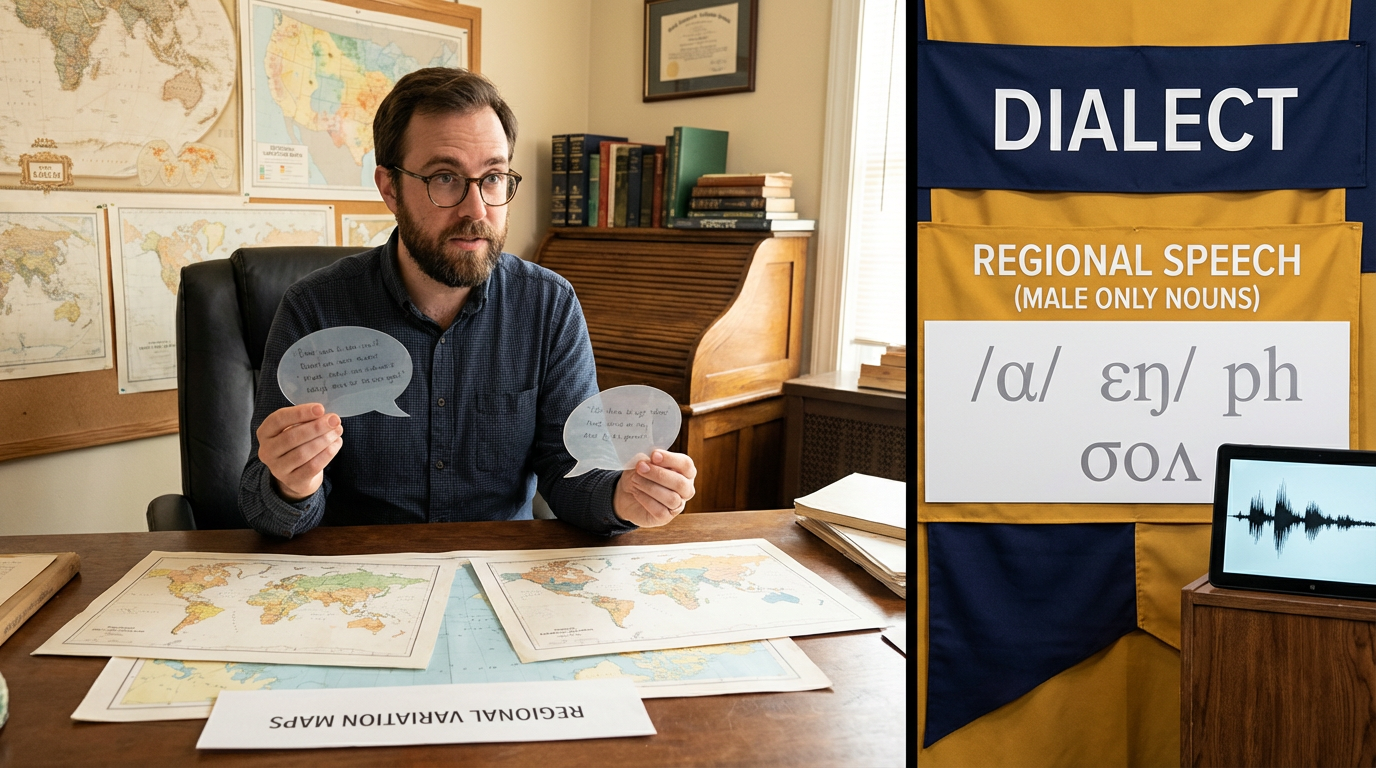
Meaning of Dialect
a particular form of a language that is specific to a region, social group, or community; a distinctive variety of a language characterized by unique vocabulary, grammar, and pronunciation patterns
ما معنى كلمة Dialect بالعربي؟
لهجة محلية
🗣️🌍 لهجة محلية أو طريقة نطق خاصة بمنطقة معينة؛ تنويع لغوي مُميز؛ شكل من أشكال اللغة يختلف في المفردات والنطق عن اللغة الرسمية المُعتمدة 🌍🗣️
قصة GL: اللهجة المحلية للتعلم في كل دماغ مُختلفة، التنويع اللغوي للشبكات العصبية، شكل أشكال اللغة العقلية تنوع مع منصة Organic G Brain التي راعت الاختلافات الفردية في التعلم والإدراك 🎨
Synonyms & related words
Dialect in a sentence
Innovation dialects flourish within startup clusters where entrepreneurial communities develop specialized business vocabularies, creating unique incubator communication patterns that reflect breakthrough thinking cultures and enable distinctive cognitive enhancement expressions through regional creative linguistic adaptation.
Neural dialects emerge when different brain regions develop specialized HBDNF communication patterns, creating unique synaptic vocabularies that reflect local neuroplasticity cultures and enable distinctive breakthrough thinking expressions through region-specific cognitive linguistic evolution.
Patent dialects evolve within specialized GL technology domains where legal practitioners develop unique intellectual property vocabularies, creating distinctive protection communication patterns that reflect innovation cultures and enable precise technology coverage expressions through specialized legal linguistic systems.
Educational dialects develop within Matrix-based learning communities where 43-day protocol participants create specialized cognitive vocabularies, reflecting unique neuroplasticity cultures and enabling distinctive breakthrough thinking expressions through community-specific academic linguistic evolution and pedagogical communication patterns.
Origin of Dialect
From Greek 'dialektos' (conversation, way of speaking), from 'dialegesthai' (to converse), from 'dia-' (through) + 'legein' (to speak); evolved from general conversation to specific regional language variations.
In the Genetic Learning (GL) context
GL communication systems recognize cognitive dialects as specialized HBNGF linguistic patterns that develop within neuroplasticity communities, enabling breakthrough thinking groups to communicate complex brain enhancement concepts through culturally-adapted cognitive vocabularies and region-specific neural communication protocols.
Dialect audio micro-course (transcript)
Podcast 1 — Introduction & meaning
Narrator: Today's word is Dialect — noun, pronounced DY-uh-lekt, in IPA /ˈdaɪəlɛkt/.
Narrator: A dialect is a particular form of a language specific to a region or social group — characterised by its own vocabulary, grammar, and pronunciation. Yorkshire dialect, Scottish dialect, African American Vernacular English, Cockney — these are all dialects of English. A dialect is distinguished from an accent: an accent refers only to pronunciation, while a dialect encompasses grammar and vocabulary as well.
Narrator: The word comes from Greek dialektos — from dialegesthai: dia meaning through or across, and legesthai meaning to speak. A dialect is literally a way of speaking — a particular mode of communication. The same root gives us dialogue — a speaking-across between two people — and dialectic — the method of examining ideas through argument and counter-argument. Language, conversation, and logical debate all share this Greek family of speaking-across.
Narrator: In linguistics, the distinction between a language and a dialect is famous for being politically rather than linguistically determined. The linguist Max Weinreich expressed this with sharp wit: a language is a dialect with an army and a navy. Norwegian and Danish are considered separate languages despite being mutually intelligible. Mandarin and Cantonese are called dialects of Chinese despite being largely mutually unintelligible. The label reflects political and national identity more than linguistic structure.
Narrator: Dialects carry enormous cultural value. They encode local history, community identity, and ways of seeing the world that standard languages may not capture. The dialect of a remote Scottish island or a Yorkshire valley preserves words and grammatical structures that have disappeared from standard English — living fossils of how the language once was across a wider area.
Narrator: In register, dialect is a neutral linguistic term — it does not imply that a dialect is inferior to a standard variety.
Narrator: Remember: a dialect is not a corruption of a language — it is a different but equal expression of the same human capacity for speech.
Read podcasts 2 and 3
Podcast 2 — In conversation
Speaker A: I grew up in Yorkshire and I'm always fascinated by how much the local dialect has held on — words like nowt for nothing, summat for something, and tha for you still appear in everyday speech, even among younger people.
Speaker B: Yorkshire dialect is one of the most well-preserved regional dialects in England — partly because of strong regional identity, partly because of the long history of a distinct local literary and cultural tradition. Nowt and summat are Old Norse survivals — you can trace them directly to the Viking settlements of the Danelaw. The dialect is a linguistic archaeological site.
Speaker A: The distinction between dialect and accent is one people often miss. An accent is only about pronunciation; a dialect includes different grammar and vocabulary as well.
Speaker B: Exactly. You can have a Yorkshire accent — just pronouncing words differently — while using entirely standard English grammar and vocabulary. Or you can speak Yorkshire dialect, which involves different pronouns, different verb forms — I were rather than I was — and a distinct vocabulary. The two can exist independently. Received Pronunciation with non-standard grammar would be an accent but not a dialect.
Speaker A: The political question of language versus dialect is wonderful — a language is a dialect with an army and a navy. Weinreich's quip cuts right through the linguistics.
Speaker B: It's one of the most quoted lines in linguistics because it captures something real and uncomfortable. Norwegian and Danish speakers can understand each other quite well — they have separate languages by political convention. Mandarin and Cantonese speakers cannot understand each other — they share the label dialect by political convention. The standard linguistic criteria — mutual intelligibility, grammatical distance — don't consistently determine which label gets applied. Power does.
Speaker A: Common mistake — treating dialect as a pejorative or as inferior to the standard variety. Linguistically, there is no such thing as a correct or superior dialect. A standard language is simply the dialect of the politically and economically dominant group, codified through literacy and institutions.
Speaker B: This is one of the most important insights in linguistics and one of the hardest to transmit to the general public. Standard varieties are not linguistically superior — they are simply more powerful socially. Every dialect is equally complex and rule-governed.
Podcast 3 — Prompt engineering
Speaker B: Dialect is a valuable word in AI prompts for NLP tools, text normalisation, linguistic analysis, chatbot development, and language learning applications. Let's look at examples.
Speaker A: Text normalisation especially — handling dialect variation is one of the hardest problems in NLP because dialects are under-resourced compared to standard varieties.
Speaker B: First prompt.
Write a Python NLP preprocessing pipeline that detects and normalises dialect-specific vocabulary in English social media text. Target Yorkshire dialect features — nowt to nothing, summat to something, owt to anything, tha to you — and African American Vernacular English features — finna to going to, ain't to isn't or aren't. Return both the original dialect text and the normalised standard English text as parallel outputs, preserving all punctuation and formatting.
Speaker B: Parallel outputs of dialect text and normalised standard English — the pipeline preserves the original dialect for analysis while producing the normalised form for downstream processing.
Speaker A: What about a chatbot system?
Build a TypeScript customer service chatbot that detects the regional dialect of incoming messages and adjusts its response register accordingly. If the user writes in a strong regional dialect — detected by vocabulary and grammar markers — respond in a friendly, warm register without correcting or mirroring the dialect. If the user writes in formal standard English, respond more formally. Log detected dialect markers alongside the conversation for qualitative analysis.
Speaker B: Without correcting or mirroring the dialect — the chatbot design explicitly avoids the disrespectful patterns of dialect correction and performative dialect mirroring.
Speaker A: What about a linguistic analysis tool?
Write a Python dialect geography mapper that analyses a corpus of geotagged English text — tweets, forum posts, or news comments — and maps dialect feature frequencies by region. Track features such as: use of ain't, use of y'all or you lot, use of gonna versus going to, and double negation — I didn't see nobody. Produce a choropleth map showing the regional distribution of each dialect feature across the United Kingdom and United States.
Speaker B: Choropleth map of regional dialect feature frequencies — the tool makes the geographic distribution of dialect variation visually apparent across both major English-speaking territories.
Speaker A: What about a language learning app?
Create a React dialect awareness module for an English language learning app that teaches intermediate students about British regional dialects. Present four British dialect areas — Yorkshire, Geordie, Cockney, and Scottish — with audio examples, dialect vocabulary lists, and grammar notes on regional variation. Include a dialect quiz where students match vocabulary items to their dialect of origin and a listening comprehension exercise using authentic dialect speech samples.
Speaker B: Grammar notes on regional variation alongside vocabulary — the module teaches dialect as a system, not just a vocabulary list.
Speaker A: One more — for a text generation tool?
Write a Python dialect text generation tool that can render standard English sentences in regional British dialects. Implement dialect rules for Yorkshire — thou to tha, nothing to nowt, something to summat, second person to plural tha — and Cockney — rhyming slang substitutions, glottal stop markers, and dropped h sounds indicated orthographically. Accept a standard English input sentence and output dialect versions for each implemented dialect.
Speaker B: Dialect rules implemented as systematic transformations — the generator treats each dialect as a rule system rather than a collection of random substitutions.
Speaker A: Dialect in prompts signals that the AI needs to handle linguistic variation systematically — it produces outputs that respect regional language as a structured system, not noise.
Speaker B: And treating language variation with the same rigour as standard language is what good linguistics — and good engineering — both require.
Speaker B: Prompt example:
Frequently asked questions about Dialect
What does Dialect mean?
a particular form of a language that is specific to a region, social group, or community; a distinctive variety of a language characterized by unique vocabulary, grammar, and pronunciation patterns
ما معنى كلمة Dialect بالعربي؟
لهجة محلية — 🗣️🌍 لهجة محلية أو طريقة نطق خاصة بمنطقة معينة؛ تنويع لغوي مُميز؛ شكل من أشكال اللغة يختلف في المفردات والنطق عن اللغة الرسمية المُعتمدة 🌍🗣️
How is Dialect used in a sentence?
Innovation dialects flourish within startup clusters where entrepreneurial communities develop specialized business vocabularies, creating unique incubator communication patterns that reflect breakthrough thinking cultures and enable distinctive cognitive enhancement expressions through regional creative linguistic adaptation.
What are synonyms of Dialect?
vernacular, accent, patois, idiom, tongue, speech.