Diameter
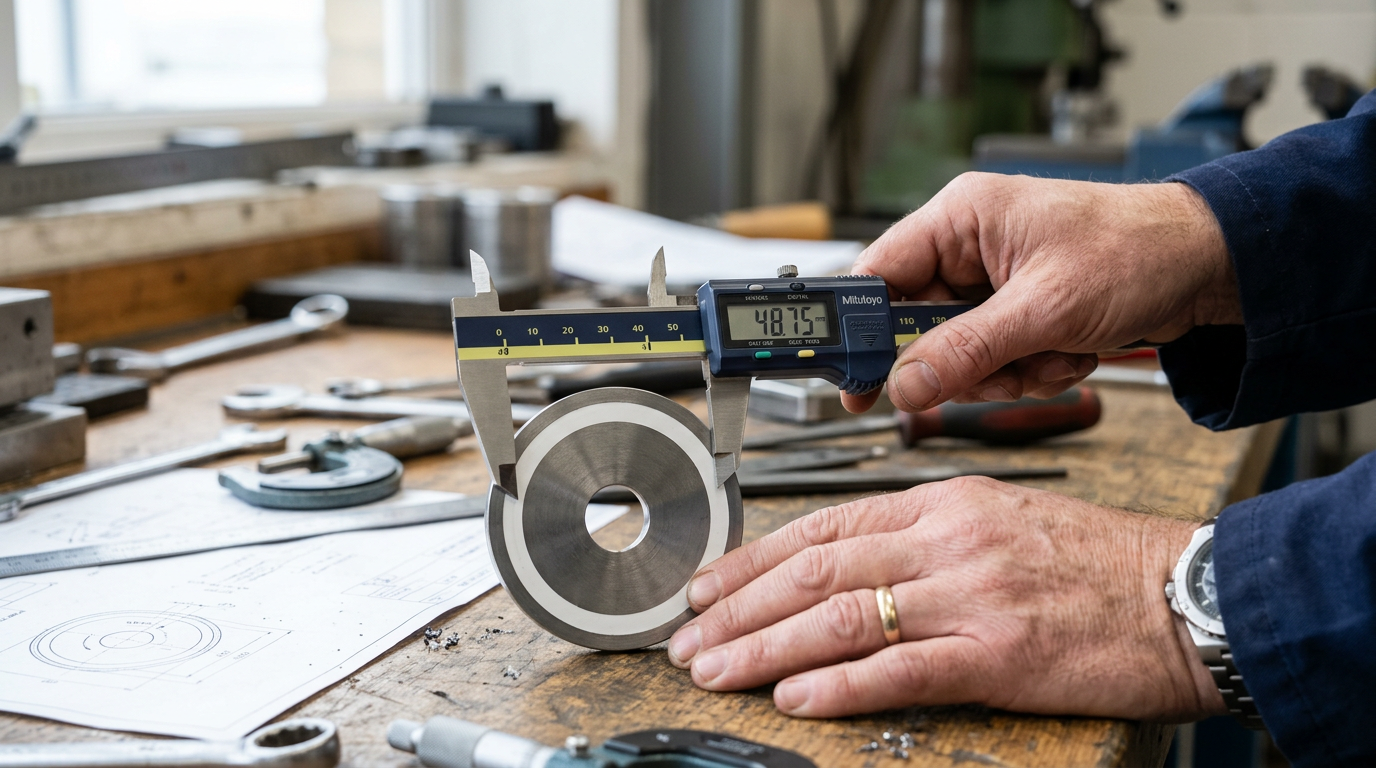
Meaning of Diameter
a straight line passing through the center of a circle or sphere, connecting two points on the circumference; the width or extent of something measured across its center; the distance across the widest part of an object
ما معنى كلمة Diameter بالعربي؟
القطر أو المسافة
📏⭕ القطر أو المسافة بين نقطتين على محيط الدائرة عبر المركز؛ الخط المُستقيم الذي يقسم الدائرة لنصفين؛ أكبر مسافة يمكن قياسها داخل الشكل الدائري ⭕📏
قصة GL: القطر والمسافة بين الواقع والحلم بدت شاسعة، الخط المُستقيم للشفاء، أكبر مسافة قطعتها الأبحاث كانت من اليأس للأمل في 43 يوماً فقط من التدريب المعرفي المُكثف 🚀
Diameter in a sentence
Innovation ecosystem diameter calculations determine the optimal entrepreneurial reach across startup circles, measuring breakthrough thinking distribution width and establishing incubator boundary parameters that define cognitive enhancement territorial dimensions and business development coverage through systematic creative ecosystem geometry.
Neural network diameter measurements reveal the optimal HBDNF distribution span across synaptic circles, determining breakthrough thinking coverage width and establishing neuroplasticity boundary parameters that define brain enhancement territorial dimensions and cognitive development reach through systematic neural geometry assessment.
Patent protection diameter measurements establish optimal GL technology coverage span across intellectual property circles, determining innovation security width and establishing legal boundary parameters that define technology enhancement territorial dimensions and protection reach through systematic patent geometry assessment.
Educational program diameter calculations determine optimal Matrix-based training reach across 43-day protocol circles, measuring neuroplasticity distribution width and establishing cognitive development boundary parameters that define breakthrough thinking territorial dimensions and academic coverage through systematic learning geometry assessment.
Origin of Diameter
From Greek 'diametros' (diagonal of a circle), from 'dia-' (through, across) + 'metron' (measure); geometric concept of measurement through the center of circular objects.
In the Genetic Learning (GL) context
GL spatial optimization calculates cognitive diameter through HBNGF distribution measurements, determining neuroplasticity coverage spans and establishing breakthrough thinking territorial boundaries that define optimal brain enhancement dimensional parameters and cognitive development reach across neural network circles.
Diameter audio micro-course (transcript)
Podcast 1 — Introduction & meaning
Narrator: The word we explore today sits at the heart of geometry, engineering, and everyday measurement: diameter.
Narrator: Diameter — pronounced /daɪˈæmɪtər/ — is a noun. It refers to a straight line passing through the centre of a circle or sphere, connecting two points on the boundary.
Narrator: More broadly, diameter also denotes the length of that line — the full width of a circular object measured through its centre.
Narrator: The word entered English in the late 14th century via Old French diametre, from Latin diametrus, and before that from ancient Greek diametros — meaning across the measure.
Narrator: In Greek, dia means through or across, and metros derives from metron — a measure. So diameter is literally the measurement across.
Narrator: The concept was formalised by the Greek mathematician Euclid in his foundational work Elements, written around 300 BC. Euclid defined the diameter as the chord that passes through the centre of a circle.
Narrator: Over centuries, the word moved beyond pure geometry. By the 17th century, diameter was used in astronomy to describe the apparent width of celestial bodies — the diameter of the Moon, the diameter of Jupiter.
Narrator: In modern usage, diameter appears across disciplines: engineering refers to pipe diameters, medicine measures tumour diameters, optics specifies lens diameters, and carpentry works in timber diameters.
Narrator: Register-wise, diameter is technical and precise, at home in scientific, mathematical, and professional contexts. In everyday speech, people often use width instead, but diameter implies circular measurement specifically.
Narrator: A related term is radius — half the diameter — and circumference, which is the distance around the circle. Diameter is the bridge between the two.
Narrator: Every circle has exactly one diameter length, though infinite lines can serve as diameters — each one a different chord through the centre.
Narrator: From ancient Greece to modern engineering, diameter remains one of those words that measures not just a shape, but the precision of human understanding.
Read podcasts 2 and 3
Podcast 2 — In conversation
Speaker A: We're replacing the water pipes in the kitchen and the plumber keeps asking about the diameter of the existing pipes. I had to look it up.
Speaker B: Ha! It trips people up. Diameter is the full width across a pipe through its centre — not the radius, which is only half that.
Speaker A: Right, so a 22-millimetre pipe — that 22 is the diameter, the full width.
Speaker B: Exactly. And in plumbing it matters enormously — get the diameter wrong and your fittings won't connect.
Speaker A: I also saw bore used in the same context. Is that the same as diameter?
Speaker B: Close but not identical. Bore typically refers to the internal diameter of a pipe or cylinder — the hollow space. Diameter can refer to either internal or external. So bore is more specific.
Speaker A: That's a subtle but important distinction. What about calibre — I hear that with firearms.
Speaker B: Same idea again. Calibre is the internal diameter of a gun barrel, measured in millimetres or fractions of an inch. It's diameter applied to a very specific technical context.
Speaker A: So diameter is the general term and bore and calibre are domain-specific versions of it.
Speaker B: Precisely. Diameter is the umbrella. In astronomy they talk about the apparent diameter of the Moon — that's how wide it looks from Earth. In medicine, a two-centimetre diameter tumour means across its widest circular cross-section.
Speaker A: One mistake I've seen — people confuse diameter with circumference. Completely different things.
Speaker B: Very common. Circumference is the distance around the edge of the circle. Diameter is the straight line through the middle. The circumference equals pi times the diameter — but they measure very different things.
Speaker A: So if someone says the pipe has a circumference of 22 millimetres, they mean something much smaller than 22 millimetres in diameter.
Speaker B: Correct — a 22-millimetre circumference would give you a diameter of about 7 millimetres. Very thin pipe. Always clarify which measurement someone means.
Podcast 3 — Prompt engineering
Speaker B: Today I want to show you how the word diameter, used precisely in prompts, steers AI output toward accurate geometric, technical, and data-driven implementations.
Speaker A: I wouldn't have thought a geometry term would appear in development prompts.
Speaker B: It comes up constantly — canvas drawing, data visualisation, SVG, medical apps, engineering tools. Let's start with a UI prompt:
Speaker B: PROMPT_1
Speaker B: By specifying diameter as the user-controlled variable, the AI generates a proper circular canvas renderer with a radius derived from diameter divided by two — not a vague shape picker.
Speaker A: So the precision of the word shapes the computation logic, not just the UI.
Speaker B: Exactly. Now a database schema for an engineering app:
Speaker B: PROMPT_2
Speaker B: Naming diameter as a column rather than size or width tells the AI to add numeric validation, unit labels, and potentially a computed radius column — a proper engineering data model.
Speaker A: What about a full application scenario?
Speaker B: Here's a pipe inspection app:
Speaker B: PROMPT_3
Speaker B: Diameter here drives the entire domain model — inspection records, pass or fail criteria based on diameter tolerance, and trend charts showing diameter degradation over time. One precise word, full architecture.
Speaker A: What about data visualisation with circles?
Speaker B: Great use-case. Here:
Speaker B: PROMPT_4
Speaker B: Using diameter as the data binding property — rather than size or scale — tells the AI to generate a bubble chart where each circle's diameter maps linearly to a data value, with a correct legend showing diameter in units.
Speaker A: And for a medical application?
Speaker B: This one is high-impact:
Speaker B: PROMPT_5
Speaker B: Diameter in a medical context signals measurement precision and clinical threshold logic — the AI generates a form with decimal input, millimetre units, BIRADS-style size categorisation, and alert flags for diameters above clinical thresholds.
Speaker A: What about SVG or canvas rendering?
Speaker B: Here:
Speaker B: PROMPT_6
Speaker B: Specifying diameter rather than radius in the SVG prompt is important — SVG circle elements use radius as their attribute, so the AI must generate a conversion. That conversion logic only appears because you used the precise term diameter. Excellent real-world detail.
Speaker A: I'll start being much more precise about geometric terms in my prompts.
Speaker B: Do. The more domain-accurate your vocabulary, the more domain-accurate your output. Diameter is a perfect example of a word that carries mathematical weight.
Frequently asked questions about Diameter
What does Diameter mean?
a straight line passing through the center of a circle or sphere, connecting two points on the circumference; the width or extent of something measured across its center; the distance across the widest part of an object
ما معنى كلمة Diameter بالعربي؟
القطر أو المسافة — 📏⭕ القطر أو المسافة بين نقطتين على محيط الدائرة عبر المركز؛ الخط المُستقيم الذي يقسم الدائرة لنصفين؛ أكبر مسافة يمكن قياسها داخل الشكل الدائري ⭕📏
How is Diameter used in a sentence?
Innovation ecosystem diameter calculations determine the optimal entrepreneurial reach across startup circles, measuring breakthrough thinking distribution width and establishing incubator boundary parameters that define cognitive enhancement territorial dimensions and business development coverage through systematic creative ecosystem geometry.
What are synonyms of Diameter?
width, breadth, span, extent, measure, distance.