Dose
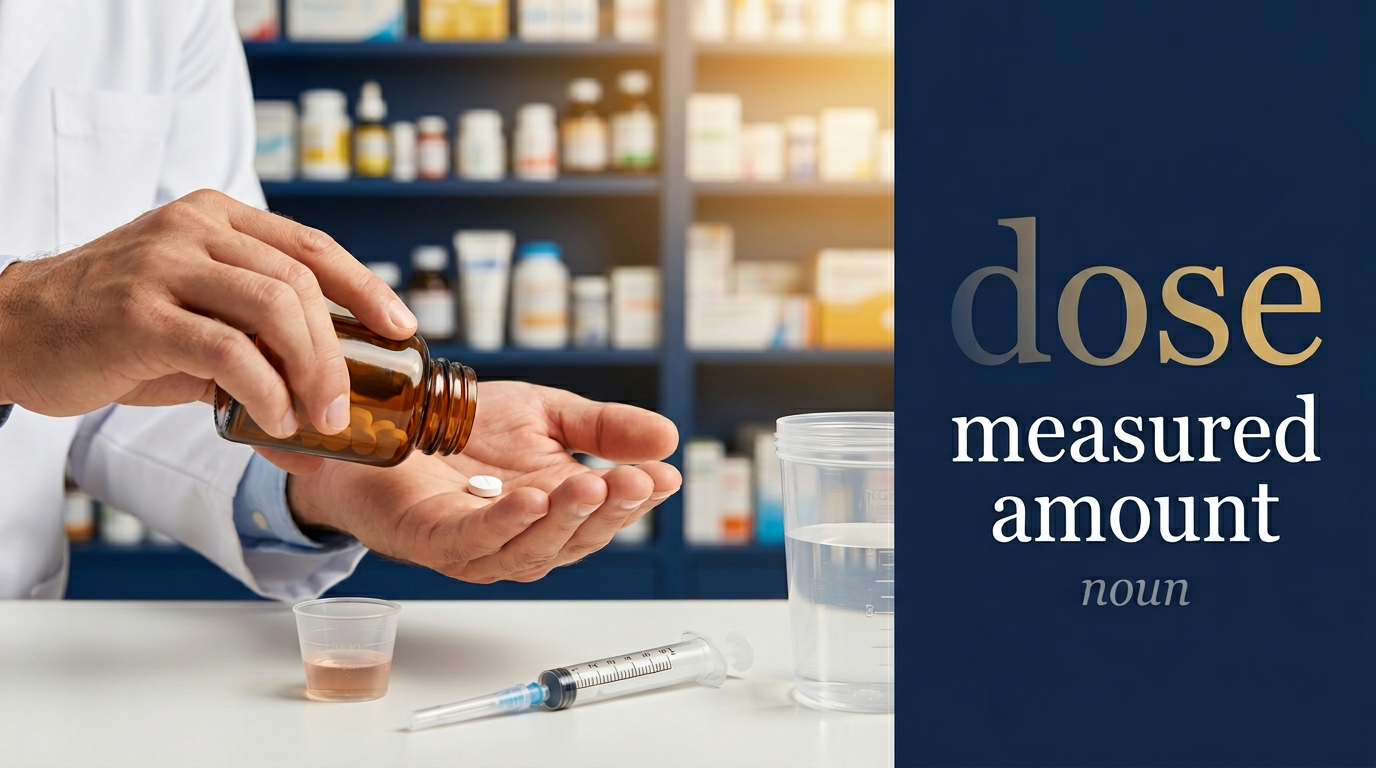
Meaning of Dose
a specific quantity of medicine, drug, or other therapeutic substance taken at one time; a measured amount of something administered or experienced; the quantity of radiation, treatment, or exposure received; an amount or portion of anything given or taken
ما معنى كلمة Dose بالعربي؟
الجرعة أو الكمية
💊📏 الجرعة أو الكمية المُحددة؛ مقدار الدواء المطلوب؛ الكمية المُناسبة من شيء مُعين لتحقيق الأثر المرغوب دون إفراط أو تفريط، سواء في الطب أو التعليم أو الحياة 📏💊
قصة GL: الجرعة أو الكمية المُناسبة من التدريب المعرفي كانت مفتاح النجاح - مقدار الدواء الذهني اليومي، الكمية المُناسبة لتحفيز نمو الخلايا دون إرهاق العقل جعلت برنامج الـ43 يوماً مُتوازناً وفعالاً لجميع الأعمار 🎯
Dose in a sentence
Strategic innovation incubator mentoring programs deliver entrepreneurial wisdom doses through breakthrough thinking business development guidance sessions that provide cognitive enhancement commercial learning in measured quantities, fostering startup ecosystem knowledge absorption while maintaining competitive advantage information delivery and ensuring effective entrepreneurial education through strategic mentoring dosage excellence.
Precise GL neuroscience research protocols determine optimal cognitive enhancement doses through HBDNF optimization measurement strategies that calibrate breakthrough thinking brain development treatment quantities, ensuring neuroplasticity investigation safety while maintaining therapeutic effectiveness and providing accurate scientific dosage through careful research measurement and cognitive enhancement administration excellence.
Measured GL patent education programs provide intellectual property knowledge doses through technology protection training sessions that deliver breakthrough thinking innovation security learning in calibrated amounts, maintaining competitive advantage education effectiveness while ensuring patent prosecution knowledge absorption and providing optimal legal education through strategic training dosage excellence.
Calibrated Matrix-based learning curricula deliver 43-day cognitive enhancement education doses through breakthrough thinking neuroplasticity training sessions that provide intellectual growth learning in optimal quantities, fostering academic development knowledge absorption while maintaining educational effectiveness and ensuring student learning optimization through strategic educational dosage excellence.
Origin of Dose
From Greek 'dosis' meaning a giving, from 'didonai' (to give); entered English via Latin and French in the 17th century, originally medical term for prescribed quantity of medicine, later extended to any measured amount or portion.
In the Genetic Learning (GL) context
GL administration protocols incorporate precise dose calibration through HBNGF-enhanced measurement systems that systematically determine breakthrough thinking cognitive enhancement optimal quantities while ensuring neuroplasticity development therapeutic effectiveness and maintaining innovation ecosystem safe administration through careful dosage calculation and treatment measurement excellence.
Dose audio micro-course (transcript)
Podcast 1 — Introduction & meaning
Narrator: Today's word is Dose — noun and verb, pronounced DOHSS, in IPA /dəʊs/.
Narrator: A dose is a measured quantity of a medicine, drug, or substance intended to be taken at one time — two doses daily, a dose of antibiotics, a lethal dose. As a verb, to dose means to administer a dose of medicine — she dosed him with paracetamol. Dose is also used informally for a quantity of an experience or quality — a healthy dose of scepticism, a dose of reality, a dose of bad luck. The precision of the medical sense and the informality of the experiential sense coexist in the same word.
Narrator: The word comes from French dose and Latin dosis — a portion, from Greek dosis meaning a giving or a gift, from didonai meaning to give. The same root gives us antidote — something given against a poison — and epidote, a mineral whose name means increase by addition. The Greek concept of a dosis was a giving — a precise portion given to a patient — and this precision is what dose carries: not just an amount but a measured, intentional amount given for a specific purpose.
Narrator: The relationship between dose and effect is one of the foundational principles of pharmacology: the dose makes the poison. This axiom — attributed to the sixteenth-century Swiss physician Paracelsus — expresses the insight that almost any substance can be harmful at a sufficient dose, and almost any harmful substance can be given safely at a small enough dose. The concept of the therapeutic window — the range of doses that produce benefit without harm — is central to every drug development programme.
Narrator: In public health, dosing has become one of the most precisely managed and politically charged topics through the COVID-19 vaccine rollout — first doses, second doses, booster doses, and the intervals between them became subjects of intense scientific debate and public communication challenge.
Narrator: In register, dose is formal in medical and pharmacological contexts and informal in everyday speech.
Narrator: Remember: the dose is what separates the medicine from the poison — and precision in dosing is what separates a treatment from a harm.
Read podcasts 2 and 3
Podcast 2 — In conversation
Speaker A: The Paracelsus principle that the dose makes the poison is one of those insights that genuinely changes how you think about everything. It makes the idea of a dangerous substance relative — dangerous at what quantity?
Speaker B: It's one of the most important and most underappreciated ideas in medical thinking. Almost every substance that we treat as completely safe becomes toxic at a high enough dose — water, oxygen, vitamin C, paracetamol, salt. And almost every substance we treat as dangerous has a safe or even therapeutic dose — aspirin is toxic in overdose, beneficial at low doses for cardiovascular risk, and used in tiny doses for antiplatelet effects. The concept of the therapeutic window — the gap between the dose that works and the dose that harms — is what pharmacology is largely about.
Speaker A: The informal dose sense — a dose of reality, a dose of scepticism — is interesting. It imports the precision and intentionality of the medical sense into everyday experience.
Speaker B: The informal sense carries the measuring-out quality of the medical term — a dose of reality implies not just some reality but the right amount of reality, calibrated for effect. It also carries a slight medicinal bitterness: you administer a dose of something unpleasant but necessary, like telling someone an uncomfortable truth. The whole metaphor network around dose in informal use implies that the thing being given is potent, measured, and intended to produce a specific effect — which makes it much more precise than simply saying an amount of.
Speaker A: Close synonyms — measure, portion, quantity, intake, amount. How does dose compare?
Speaker B: Measure is close in the sense of a measured quantity but lacks the intentionality of administration. Portion is food-oriented — a portion of something shared out. Quantity is purely numerical — no sense of intentional giving. Intake is about what is consumed, not what is given. Amount is the most neutral — simply how much. Dose is distinctive in combining measured quantity, intentional administration, and expected effect — it's not just how much but how much given with a purpose.
Speaker A: Common mistake — confusing dose with dosage. Dose refers to the specific amount given on one occasion. Dosage refers to the prescribed schedule — the dose, the frequency, and the duration of treatment. The dosage for this medication is two doses per day for seven days contains both: dosage is the schedule, and within it, doses are the individual administrations.
Speaker B: That distinction is clinically important. A patient asking what's the dose might mean how much is in each tablet; asking what's the dosage should get the complete instructions — how much, how often, and for how long. Conflating the two is a common patient communication error that can lead to under-treatment or overdose.
Podcast 3 — Prompt engineering
Speaker B: Dose is an important word in AI prompts for pharmaceutical tools, public health platforms, machine learning calibration systems, and risk analysis tools. Let's look at examples.
Speaker A: Pharmaceutical dosing calculations especially — medication dose calculation errors are one of the most common preventable causes of patient harm, and AI tools that support correct dosing have direct clinical value.
Speaker B: First prompt.
Write a Python medication dose calculator for clinical use that computes safe doses based on patient parameters. Accept: patient weight, age, renal function — creatinine clearance, hepatic function — Child-Pugh score — and the target medication. Apply dose adjustment algorithms for renal and hepatic impairment, flag doses outside the therapeutic window, calculate loading dose versus maintenance dose where applicable, and generate a dosing recommendation with the clinical rationale. Include warnings for any dose that approaches the toxicity threshold.
Speaker B: Flag doses approaching the toxicity threshold — the dose calculator applies the Paracelsus principle directly, treating the boundary between therapeutic and toxic dose as the critical safety variable.
Speaker A: What about a machine learning regularisation tool?
Build a TypeScript machine learning regularisation tuner that treats regularisation strength as a dose — too little regularisation underfits, too much overfits — and finds the therapeutic window for a given model and dataset. Implement a dose-response curve analysis: train the model across a range of regularisation values, plot validation loss against regularisation dose, identify the dose range where generalisation performance is maximised, and automatically select the optimal regularisation dose within the therapeutic window.
Speaker B: Regularisation strength as a dose with a therapeutic window — the ML tuner applies the pharmacological dose-response curve framework to the machine learning hyperparameter search.
Speaker A: What about a public health tool?
Write a Node.js vaccine dose tracking system for a public health programme. For each individual in the programme, track: doses administered with date and batch number, the dose schedule — first dose, second dose, and booster intervals — adverse event reports linked to specific doses, dose wastage — vaccines drawn but not administered — and coverage rates by dose number across defined population segments. Generate a dose administration dashboard and flag individuals who are overdue for a scheduled dose.
Speaker B: Dose wastage tracked by drawn-but-not-administered events — the dose tracking system captures the logistical inefficiency that is as important as coverage rates in real-world vaccination programmes.
Speaker A: What about an A-B testing tool?
Write a Python A-B test dose calibrator for digital marketing campaigns. Treat the campaign intensity — message frequency, ad spend, notification frequency — as a dose and model the dose-response relationship for conversion rate. Test a range of campaign doses from minimal to maximal, identify the dose that maximises conversion without triggering dose-related adverse effects — unsubscribes, ad blocking, negative sentiment — and determine the therapeutic window for campaign intensity in the target audience segment.
Speaker B: Dose-related adverse effects including unsubscribes and ad blocking — the A-B test calibrator applies the dose-response model to marketing intensity, treating audience fatigue as the marketing equivalent of drug toxicity.
Speaker A: One more — for a data augmentation tool?
Write a TypeScript machine learning data augmentation dose optimiser that finds the optimal augmentation intensity for a training dataset. Treat augmentation strength — rotation angle, colour jitter intensity, noise level, crop fraction — as a dose and evaluate model performance across a range of augmentation doses. Identify: the minimum dose that improves generalisation over no augmentation, the maximum dose before augmentation degrades performance, and the optimal dose for each augmentation type individually and in combination.
Speaker B: The maximum dose before augmentation degrades performance — the data augmentation optimiser applies the therapeutic window concept to find the range where augmentation helps rather than harms model training.
Speaker A: Dose in prompts activates the precision-measured-quantity-with-intended-effect frame — it produces outputs that treat calibration, thresholds, and the relationship between quantity and outcome as central design concerns.
Speaker B: And the Paracelsus insight holds wherever dose appears: the effect is never about the substance alone — it is always about the amount.
Speaker B: Prompt example:
Frequently asked questions about Dose
What does Dose mean?
a specific quantity of medicine, drug, or other therapeutic substance taken at one time; a measured amount of something administered or experienced; the quantity of radiation, treatment, or exposure received; an amount or portion of anything given or taken
ما معنى كلمة Dose بالعربي؟
الجرعة أو الكمية — 💊📏 الجرعة أو الكمية المُحددة؛ مقدار الدواء المطلوب؛ الكمية المُناسبة من شيء مُعين لتحقيق الأثر المرغوب دون إفراط أو تفريط، سواء في الطب أو التعليم أو الحياة 📏💊
How is Dose used in a sentence?
Strategic innovation incubator mentoring programs deliver entrepreneurial wisdom doses through breakthrough thinking business development guidance sessions that provide cognitive enhancement commercial learning in measured quantities, fostering startup ecosystem knowledge absorption while maintaining competitive advantage information delivery and ensuring effective entrepreneurial education through strategic mentoring dosage excellence.
What are synonyms of Dose?
amount, quantity, portion, measure, dosage, allocation.