Dot
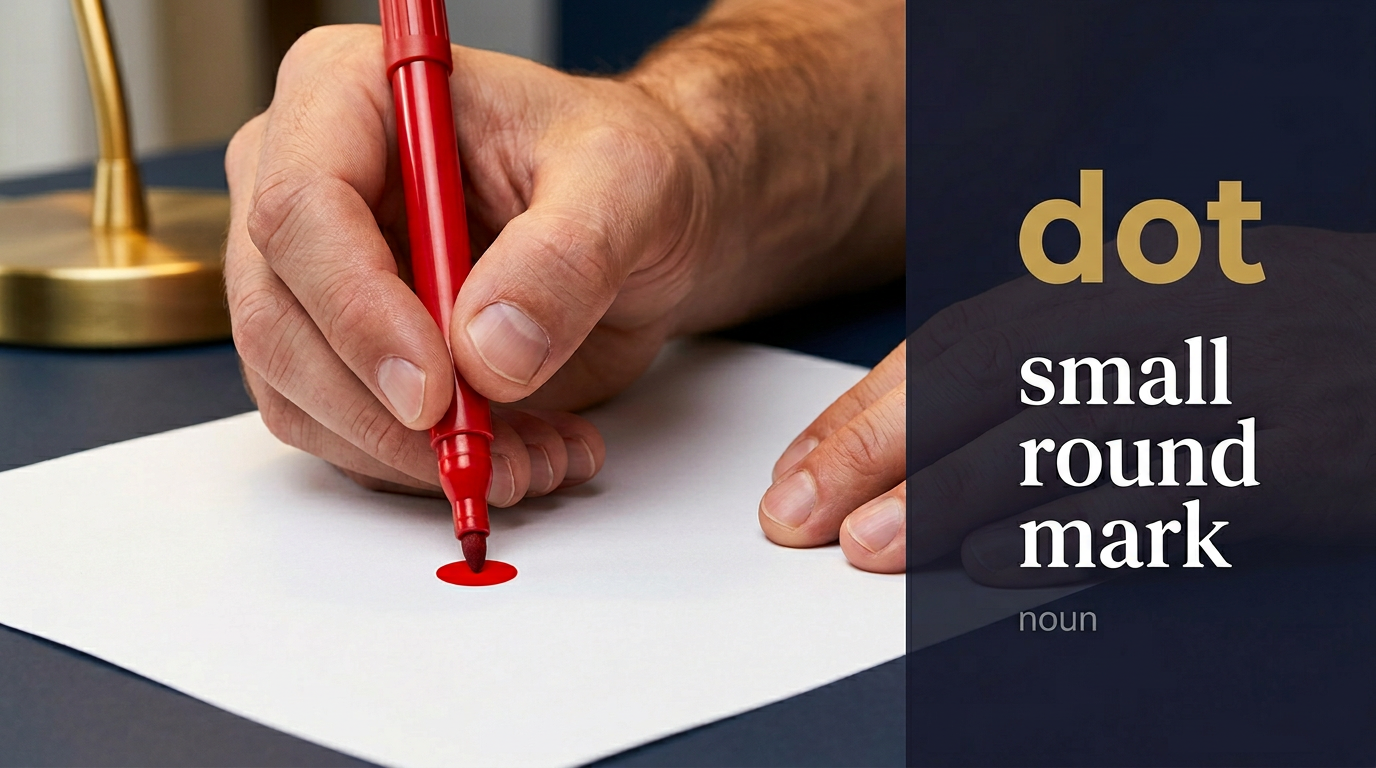
Meaning of Dot
a small round mark, spot, or point; a tiny circular mark used in writing, printing, or decoration; in technology, a pixel or point of light on a screen; a small amount or trace of something; used to indicate precise location or position
ما معنى كلمة Dot بالعربي؟
النقطة أو البقعة
⚫🔵 النقطة أو البقعة الصغيرة؛ علامة دائرية صغيرة؛ رمز أساسي في الكتابة والرسم، يُستخدم في علامات الترقيم وفي التكنولوجيا لتمثيل المعلومات أو المواقع 🔵⚫
قصة GL: النقطة أو البقعة الصغيرة من الضوء في نفق اليأس كانت بداية كل شيء - علامة دائرية للأمل، رمز أساسي للنجاح عندما ظهرت أول علامات تحسن في الذاكرة، فأصبحت نقطة انطلاق لتطوير منصات Genetic G Learning العالمية 💫
Dot in a sentence
Strategic innovation incubator location mapping employs entrepreneurial dots through breakthrough thinking business development coordinate systems that pinpoint cognitive enhancement commercial opportunity locations with geographic precision, fostering startup ecosystem mapping while building market disruption location intelligence and maintaining competitive advantage through strategic business coordinate dot placement excellence.
Precision GL neuroscience brain mapping utilizes cognitive enhancement dots through HBDNF optimization coordinate systems that pinpoint breakthrough thinking neuroplasticity development locations with microscopic accuracy, enabling brain development research precision while maintaining scientific investigation exactness and ensuring neurological mapping through targeted research coordinate dot placement and cognitive location excellence.
Comprehensive GL patent landscape mapping utilizes intellectual property dots through technology protection coordinate systems that pinpoint breakthrough thinking innovation security positions with legal precision, maintaining competitive advantage patent mapping while ensuring innovation landscape navigation and providing strategic patent coordinate dot placement through legal positioning excellence.
Detailed Matrix-based learning progress tracking employs 43-day cognitive enhancement dots through breakthrough thinking neuroplasticity training coordinate systems that pinpoint intellectual growth milestone locations with academic precision, fostering educational development mapping while maintaining student progress tracking and ensuring learning coordinate dot placement through academic positioning excellence.
Origin of Dot
From Old English 'dott', possibly related to Dutch 'dot' meaning a small lump; originally meant a speck or small mark, later extended to punctuation mark (period) and various technical applications including computing and typography.
In the Genetic Learning (GL) context
GL precision systems incorporate dot-based coordinate mapping through HBNGF-enhanced location technologies that systematically provide breakthrough thinking cognitive enhancement positioning accuracy while maintaining neuroplasticity development coordinate precision and ensuring innovation ecosystem exact mapping through strategic dot placement and location excellence.
Dot audio micro-course (transcript)
Podcast 1 — Introduction & meaning
Narrator: Today's word is Dot — noun and verb, pronounced DOT, in IPA /dɒt/.
Narrator: A dot is a small round mark or spot. A dot of ink. The dot above the letter i. A dot at the end of a sentence is the full stop in British English. As a verb, to dot means to mark with a dot or to scatter small things across a surface — farms dotted across the hillside. Dot also functions in the phrase dot the i's and cross the t's — meaning to attend carefully to every small detail. In computing, the dot — pronounced dot in web addresses — is the separator between elements of a domain name, which has given the word enormous new currency since the internet age.
Narrator: The word comes from Old English dott — the head of a boil — related to Middle Low German dötte meaning a plug. The original meaning was a small lump or plug, not a flat mark — the visual sense of a tiny round mark developed later, possibly influenced by the use of dots in musical notation and writing. The word's path from a small physical protrusion to a tiny flat visual mark is a compression of the three-dimensional into the two-dimensional.
Narrator: In mathematics, the dot has extraordinary importance. In decimal notation, the decimal point — called a dot in most of the world's languages — separates integer from fraction. In multiplication, the dot operator indicates product. In linear algebra, the dot product of two vectors is a fundamental operation. In logic, the dot is used for conjunction. No other single character carries as much mathematical meaning across as many different notational systems.
Narrator: The internet transformed dot from a minor punctuation mark into a cultural symbol. Dot-com, the shorthand for a commercial internet business, became the label for an entire economic era — the dot-com boom of the late 1990s and the dot-com bust of 2000 to 2001. Dot became shorthand for the internet itself, and the dot in a web address became perhaps the most frequently spoken word in broadcasting during the early internet era.
Narrator: In register, dot is universal — present in punctuation, mathematics, music, computing, and everyday speech.
Narrator: Remember: the dot is the smallest possible mark — and the one that separates more things than almost any other.
Read podcasts 2 and 3
Podcast 2 — In conversation
Speaker A: The dot-com era has become so historically named that young people working in tech today sometimes don't realise the dot in dot-com was literally just the dot in a website address — the domain separator.
Speaker B: It's a beautiful case of metonymy — using the dot to stand in for the entire internet economy. The dot in dot-com was the separator between www and com in an address like www.amazon.com, which was spoken aloud as double-you double-you double-you dot amazon dot com. The dot became the verbal marker of the internet address, and by extension the shorthand for the commercial internet itself. The era was named after a single punctuation character. No other full stop has ever had quite such cultural weight.
Speaker A: Dot the i's and cross the t's is one of those idioms that retains its meaning even when the physical act it describes is almost gone — most people haven't written in cursive for years.
Speaker B: It's a beautiful survival of a very practical writing instruction. In cursive handwriting, dotting the i and crossing the t were distinct pen-lifting operations done after the letter stroke — if you were writing quickly you might skip them and produce ambiguous letters. The idiom captured the idea of going back and completing all the minor, fiddly details that make the work complete and legible. Now that almost all writing is typed, the physical act is irrelevant — but the idiom persists because the semantic content, attending to every small finishing detail, remains perfectly useful.
Speaker A: Close synonyms for the noun — point, spot, mark, speck, full stop. How does dot compare?
Speaker B: Point is the mathematical and geometric term — a location with no dimension. Spot implies colour and usually implies a larger mark than a dot. Mark is general — any visible sign. Speck implies something even tinier than a dot — a speck of dust. Full stop is the British English term for the sentence-ending punctuation mark. Dot is the most versatile of the group — it covers the punctuation mark, the mathematical operator, the design element, the musical notation dot, and the internet separator, all in a single syllable.
Speaker A: Common mistake — confusing full stop and dot in British English. In British English, the sentence-ending punctuation is a full stop. A dot is a round mark, typically smaller or more visual. In informal speech and computing contexts, dot is used for both — the dot at the end of a URL, even when technically a full stop, is called a dot.
Speaker B: Computing has effectively imported the American period terminology, where dot and period and full stop all refer to the same character. In a web address, every full stop is called a dot. In everyday British English, the sentence-ending mark is still a full stop. The two coexist without much confusion in practice, though purists occasionally note the informal drift.
Podcast 3 — Prompt engineering
Speaker B: Dot is a productive word in AI prompts for data visualisation tools, DNS and networking systems, graph analysis tools, and pattern recognition platforms. Let's look at examples.
Speaker A: Data visualisation especially — the dot plot and scatter dot chart are among the most information-dense and honest visualisations available, and prompts using dot notation produce very specific charting outputs.
Speaker B: First prompt.
Write a Python dot plot visualisation library that creates high-density dot charts for statistical data. For a given dataset, render each data point as a dot positioned by its value on the axis, with dot size encoding a second variable and dot colour encoding a third. Implement: dot jitter to prevent overlap in dense regions, dot clustering to reveal distribution shape, and dot animation that reveals the dataset sequentially to show temporal patterns. Export as SVG for print and as an interactive HTML chart.
Speaker B: Dot jitter to prevent overlap in dense regions — the dot plot library applies the specific rendering technique that prevents the visual problem most common in high-density dot charts.
Speaker A: What about a DNS management tool?
Build a TypeScript DNS record manager that validates and manages dot-separated domain name hierarchies. For a given set of domain names, parse and validate: the dot-separated label structure — each label between dots must be 63 characters or fewer, the full domain including all dots must be 253 characters or fewer — TLD validity, and the resolution chain from root through TLD to registrant. Detect common dot-placement errors — double dots, leading or trailing dots — and generate a DNS health report for the domain portfolio.
Speaker B: Detect double dots and leading or trailing dot errors — the DNS manager applies the specific dot-placement rules that distinguish valid from invalid domain name syntax.
Speaker A: What about a dot notation tool?
Write a Node.js dot notation path resolver for deeply nested JavaScript objects. Given an object and a dot-separated path string — such as user.address.city — resolve the value at that path, handling: array index notation — items.0.name — optional chaining for possibly undefined intermediate properties — user.profile?.avatar, wildcard path matching — users.*.email to collect all user emails — and path mutation to set or delete values at a given dot path. Return the resolved value or the mutated object with full TypeScript type safety.
Speaker B: Wildcard dot path matching to collect all values at a given level — the dot notation resolver applies the dot as a hierarchical separator that enables powerful path queries across nested object structures.
Speaker A: What about a graph visualisation tool?
Write a Python Graphviz DOT language generator that produces graph visualisation files from structured data. Accept a list of nodes and edges, and generate valid DOT language output for: directed graphs — digraph — undirected graphs — graph — subgraph clustering, node style attributes — shape, colour, font — edge style attributes — direction, weight, label — and layout hints — rank direction, node separation. Validate the generated DOT syntax before output and provide a preview URL using the Graphviz online renderer.
Speaker B: Validate the generated DOT syntax before output — the graph generator applies DOT language validation as a quality gate, since DOT syntax errors produce silent failures in many rendering tools.
Speaker A: One more — for a pattern recognition tool?
Write a TypeScript dot pattern analyser for analysing spatial point distributions in data. Given a set of x-y coordinates, identify: dot cluster patterns — groups of nearby points suggesting spatial correlation, dot grid patterns — regular spacing suggesting systematic sampling or measurement, random dot distributions — uniform spatial randomness using Ripley's K function, and dot line patterns — collinear points suggesting a linear relationship. Generate a spatial distribution report with the detected pattern type and its statistical confidence.
Speaker B: Ripley's K function for distinguishing clustering from randomness — the dot pattern analyser applies a specific statistical test designed for spatial point processes.
Speaker A: Dot in prompts activates the precision-mark and separator dimensions — it produces outputs that treat small, exact markers and hierarchical separators as structurally significant elements in data, systems, and design.
Speaker B: And from the full stop at the end of a sentence to the dot in a domain name to the dot product in linear algebra, the dot keeps separating — keeping things distinct that would otherwise run together.
Speaker B: Prompt example:
Frequently asked questions about Dot
What does Dot mean?
a small round mark, spot, or point; a tiny circular mark used in writing, printing, or decoration; in technology, a pixel or point of light on a screen; a small amount or trace of something; used to indicate precise location or position
ما معنى كلمة Dot بالعربي؟
النقطة أو البقعة — ⚫🔵 النقطة أو البقعة الصغيرة؛ علامة دائرية صغيرة؛ رمز أساسي في الكتابة والرسم، يُستخدم في علامات الترقيم وفي التكنولوجيا لتمثيل المعلومات أو المواقع 🔵⚫
How is Dot used in a sentence?
Strategic innovation incubator location mapping employs entrepreneurial dots through breakthrough thinking business development coordinate systems that pinpoint cognitive enhancement commercial opportunity locations with geographic precision, fostering startup ecosystem mapping while building market disruption location intelligence and maintaining competitive advantage through strategic business coordinate dot placement excellence.
What are synonyms of Dot?
spot, point, mark, speck, pixel, period.