Drowsy
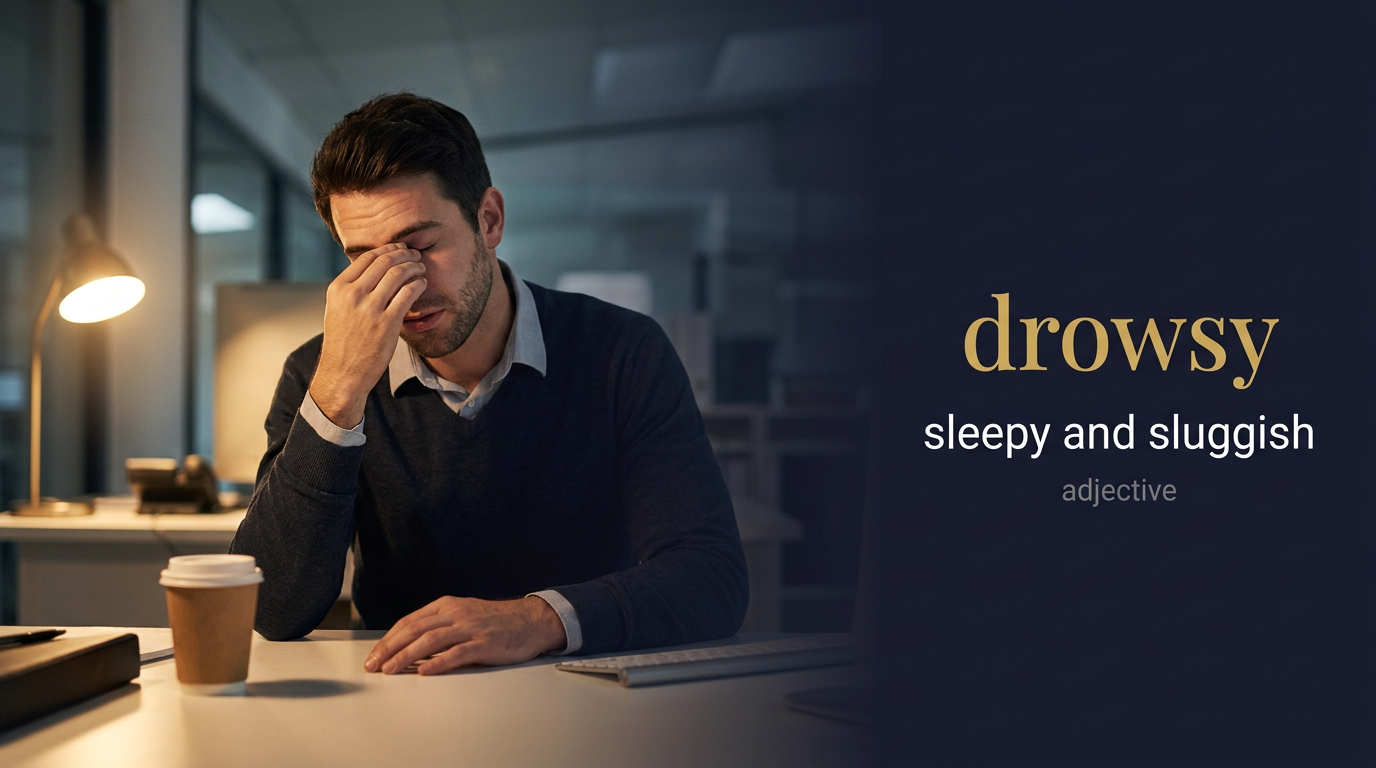
Meaning of Drowsy
Feeling sleepy and lacking alertness; inducing or characterized by a tendency to fall asleep.
ما معنى كلمة Drowsy بالعربي؟
النعاس والرغبة
😴💤 النعاس والرغبة في النوم؛ حالة من الخمول؛ شعور بالكسل والثقل في الجفون مع صعوبة في البقاء مُستيقظاً، حالة انتقالية بين اليقظة والنوم العميق 💤😴
قصة GL: النعاس والرغبة في الاستسلام للإعاقة الدماغية كانت مُحاربة بشراسة - حالة من الخمول الفكري، شعور بالكسل المعرفي تحول ليقظة تامة وحيوية مُذهلة بفضل بروتوكولات التنشيط العقلي التي تُوقظ أعمق مناطق الوعي 🔥
Drowsy in a sentence
We redesigned sprint cadences to avoid drowsy afternoons, aligning deep work with circadian-informed innovation blocks in the incubator.
The patent discloses drowsy-state detection that throttles cognitive load and logs biosignals for privacy-preserving adaptation.
Post-session drowsy periods shrank as HBDNF gains improved sleep architecture, yielding clearer morning focus in GL cohorts.
Tutors schedule matrix practice before drowsy windows and use micro-activations so learners sustain attention across the 43-day arc.
Origin of Drowsy
From Middle English 'drowsen' (to be sleepy), source of 'drowse', with adjectival '-y' forming 'drowsy'; ultimate origin uncertain, likely Germanic.
In the Genetic Learning (GL) context
GL protocols incorporate drowsy-aware pacing and recovery naps to consolidate learning while preserving neuroplastic gains.
Drowsy audio micro-course (transcript)
Podcast 1 — Introduction & meaning
Narrator: Today's word is Drowsy — adjective, pronounced DROW-zee, in IPA /ˈdraʊzi/.
Narrator: Drowsy means feeling heavy with sleepiness, dull with a desire to sleep — not fully asleep but not fully awake either. She felt drowsy after lunch. The warm afternoon made him drowsy. A drowsy village — quiet and still, as though half-asleep. Drowsy describes the in-between state of reduced alertness and slowed cognition that precedes sleep, or that follows certain medications, heavy meals, or warm, quiet environments. It is a gentler, more pleasant word than tired, carrying a quality of soft, hazy half-consciousness.
Narrator: The word comes from a dialectal form drowse — to be half-asleep — possibly related to Old English drūsian, meaning to be sluggish or slow, itself related to the root that gives drooping and the sense of things slowing and drooping toward rest. Drowsy entered standard English in the sixteenth century and has been used consistently since for both literal sleepiness and the metaphorical quality of somnolent placidity — a drowsy summer afternoon, a drowsy market town.
Narrator: Drowsy is medically significant as a symptom. Many medications — antihistamines, sedatives, certain painkillers — produce drowsiness as a side effect, and medication warning labels use drowsy and drowsiness as standard terms. In clinical assessment, a patient's level of drowsiness is used to evaluate consciousness levels — from alert and oriented through drowsy and confused to unconscious. The Glasgow Coma Scale and similar tools use reduced responsiveness — a kind of extreme drowsiness — as a measure of neurological function.
Narrator: Drowsy driving is a significant road safety issue: impaired alertness caused by sleepiness contributes to a substantial proportion of serious road accidents.
Narrator: In register, drowsy is neutral to slightly poetic — it carries a softer, more literary quality than tired or sleepy, with associations of warm afternoons and gentle half-sleep.
Narrator: Remember: drowsy is the edge of sleep before you cross it — the soft, slow blur where the world grows warm and quiet and the mind begins to drift.
Read podcasts 2 and 3
Podcast 2 — In conversation
Speaker A: Drowsy has a more pleasant, poetic quality than tired or sleepy. Tired implies exhaustion and depletion; sleepy is neutral; but drowsy has something almost luxurious about it.
Speaker B: You've identified something real. Drowsy carries a quality of softness — the hazy, heavy-lidded warmth of an afternoon in the sun or just after a large meal. It's not the depleted tiredness of having worked too hard or slept too little — that's exhaustion or fatigue. Drowsy implies a comfortable, often external cause: the warmth, the food, the peace. There's an implicit pleasantness in the cause even when the drowsiness itself is unwelcome — as in drowsy while driving, which is dangerous precisely because the drowsiness is so comfortable. The word makes the condition sound appealing even when it is not.
Speaker A: The medication side effect label — may cause drowsiness — has made drowsy a very specific piece of consumer vocabulary. Most people have read that warning.
Speaker B: The pharmaceutical use of drowsy and drowsiness is so ubiquitous that it's one of the most widely read uses of the word in everyday life. The warning may cause drowsiness appears on antihistamines, sleeping aids, certain painkillers, and many other medications. Interestingly, pharmaceutical labels prefer drowsiness to sleepiness or tiredness — possibly because drowsiness is more precisely associated with reduced alertness rather than fatigue, and because the warning is specifically about impaired ability to drive or operate machinery, which is an alertness issue rather than an energy issue.
Speaker A: Close synonyms — sleepy, tired, lethargic, somnolent, dozy. How does drowsy compare?
Speaker B: Sleepy is the most common everyday equivalent but slightly more neutral. Tired is broader — it covers fatigue from effort as well as sleepiness. Lethargic implies slow and sluggish without the specific sleep quality — you can be lethargic from depression or illness without being drowsy. Somnolent is formal and medical — used in clinical assessments. Dozy is informal British English, slightly comic — it also has the secondary British sense of slightly stupid or inattentive. Drowsy occupies the middle ground: more precise than sleepy, more pleasant-sounding than somnolent, and more specific to the pre-sleep state than tired.
Speaker A: Common mistake — using drowsy interchangeably with tired. Drowsy specifically means the desire to sleep, not general fatigue. You can be very tired without being drowsy — after strenuous exercise, for example.
Speaker B: The sleep-specific quality is definitional. Drowsy means pulled toward sleep — the eyelids are heavy, the thoughts are slowing, the body is preparing for rest. Tired means depleted of energy but not necessarily preparing for sleep. A very tired person who is anxious or in pain may be unable to sleep. A drowsy person may fall asleep despite being relatively unexhausted. The distinction matters clinically and practically.
Podcast 3 — Prompt engineering
Speaker B: Drowsy is an important word in AI prompts for driver safety systems, sleep monitoring tools, medication management platforms, and human performance analysers. Let's look at examples.
Speaker A: Driver drowsiness detection especially — drowsy driving is a significant road safety problem, and real-time detection systems that can alert a drowsy driver before an incident occur are an active area of automotive AI development.
Speaker B: First prompt.
Write a Python drowsy driver detection system using facial landmark analysis. For a real-time video feed: calculate the Eye Aspect Ratio — EAR — as the ratio of the vertical eye opening to the horizontal eye width, detect drowsy blinking patterns — blinks lasting longer than 400 milliseconds, detect microsleep events where both eyes are closed for more than 800 milliseconds, monitor head nodding through pitch angle variation, and trigger a tiered alert: gentle audio alert for drowsy blinking, strong audio and haptic alert for microsleep detection. Generate a per-journey drowsiness event log.
Speaker B: Microsleep events defined as both eyes closed for more than 800 milliseconds — the drowsy driver system applies the clinical definition that distinguishes a normal blink from a microsleep episode.
Speaker A: What about a sleep quality tool?
Build a TypeScript wearable data drowsiness predictor that forecasts when a user will become drowsy during the day. Using: last night's sleep duration and quality score from the wearable, the user's historical two-week sleep debt accumulation — hours of sleep below their personal optimal — and the circadian drowsiness pattern — typical drowsiness peaks at early afternoon and early morning for most people — generate an hour-by-hour drowsiness risk forecast for the day. Flag high-risk windows for critical tasks and suggest optimal timing for focused work versus low-demand activities.
Speaker B: Circadian drowsiness peaks at early afternoon and early morning — the drowsiness predictor applies the two-process model of sleep regulation that combines sleep debt with circadian rhythm to forecast alertness.
Speaker A: What about a medication management tool?
Write a Node.js medication drowsiness interaction checker for a pharmacy dispensing system. For a patient's current medication list: identify all medications with known drowsiness side effects, classify drowsiness risk as mild — occasional drowsiness, moderate — drowsiness common, and severe — drowsiness highly likely, detect additive drowsiness interactions — combinations of mildly drowsy medications that together produce severe drowsiness, generate a patient counselling note for any moderate or severe drowsiness risk, and produce a driving suitability flag for medications that impair driving ability beyond the legal standard.
Speaker B: Detect additive drowsiness interactions where combinations of mild medications produce severe drowsiness — the medication checker applies the pharmacological interaction insight that drowsiness effects can multiply rather than merely add.
Speaker A: What about a workplace safety tool?
Write a Python shift worker drowsiness risk calculator for safety-critical industries — nuclear, aviation, petrochemical. For each worker's shift schedule: calculate the accumulated sleep debt at the start of each shift using the Fatigue Risk Index, identify shifts where the worker is scheduled during their circadian drowsiness trough, flag shifts where both high sleep debt and circadian trough coincide as extreme drowsiness risk events, and generate a roster optimisation recommendation that redistributes high-risk shifts to minimise the number of workers operating at extreme drowsiness risk simultaneously.
Speaker B: Extreme drowsiness risk defined by the coincidence of high sleep debt and circadian trough — the shift risk calculator applies the multiplicative drowsiness model where the two risk factors together produce risk disproportionate to either alone.
Speaker A: One more — for a learning platform tool?
Write a TypeScript online learning engagement monitor that detects learner drowsiness from interaction patterns during video lectures. Monitor: typing response latency to comprehension prompts — drowsy learners respond more slowly, click accuracy on in-video interactive elements — drowsy learners miss more often, scroll behaviour — drowsy learners pause scrolling for longer, and video playback pauses exceeding 30 seconds during non-break segments. When drowsiness signals accumulate above a threshold, pause the video, display a brief movement exercise prompt, and offer to resume from a 2-minute rewind to recover the content missed during the drowsy period.
Speaker B: Offer to resume from a 2-minute rewind to recover content missed during the drowsy period — the learning engagement monitor applies the constructive response to detected drowsiness rather than simply alerting and continuing.
Speaker A: Drowsy in prompts activates the reduced-alertness, approaching-sleep, performance-impaired frame — it produces outputs that treat the pre-sleep state as a detectable, predictable, and manageable human performance variable.
Speaker B: And whether it's a driver, a student, a shift worker, or a patient on medication, the drowsy state is always the same: the mind is still there, still technically functioning, but the tide is coming in — and catching it early makes all the difference.
Speaker B: Prompt example:
Frequently asked questions about Drowsy
What does Drowsy mean?
Feeling sleepy and lacking alertness; inducing or characterized by a tendency to fall asleep.
ما معنى كلمة Drowsy بالعربي؟
النعاس والرغبة — 😴💤 النعاس والرغبة في النوم؛ حالة من الخمول؛ شعور بالكسل والثقل في الجفون مع صعوبة في البقاء مُستيقظاً، حالة انتقالية بين اليقظة والنوم العميق 💤😴
How is Drowsy used in a sentence?
We redesigned sprint cadences to avoid drowsy afternoons, aligning deep work with circadian-informed innovation blocks in the incubator.
What are synonyms of Drowsy?
sleepy, somnolent, lethargic, dozy, soporific, sluggish.