Duration
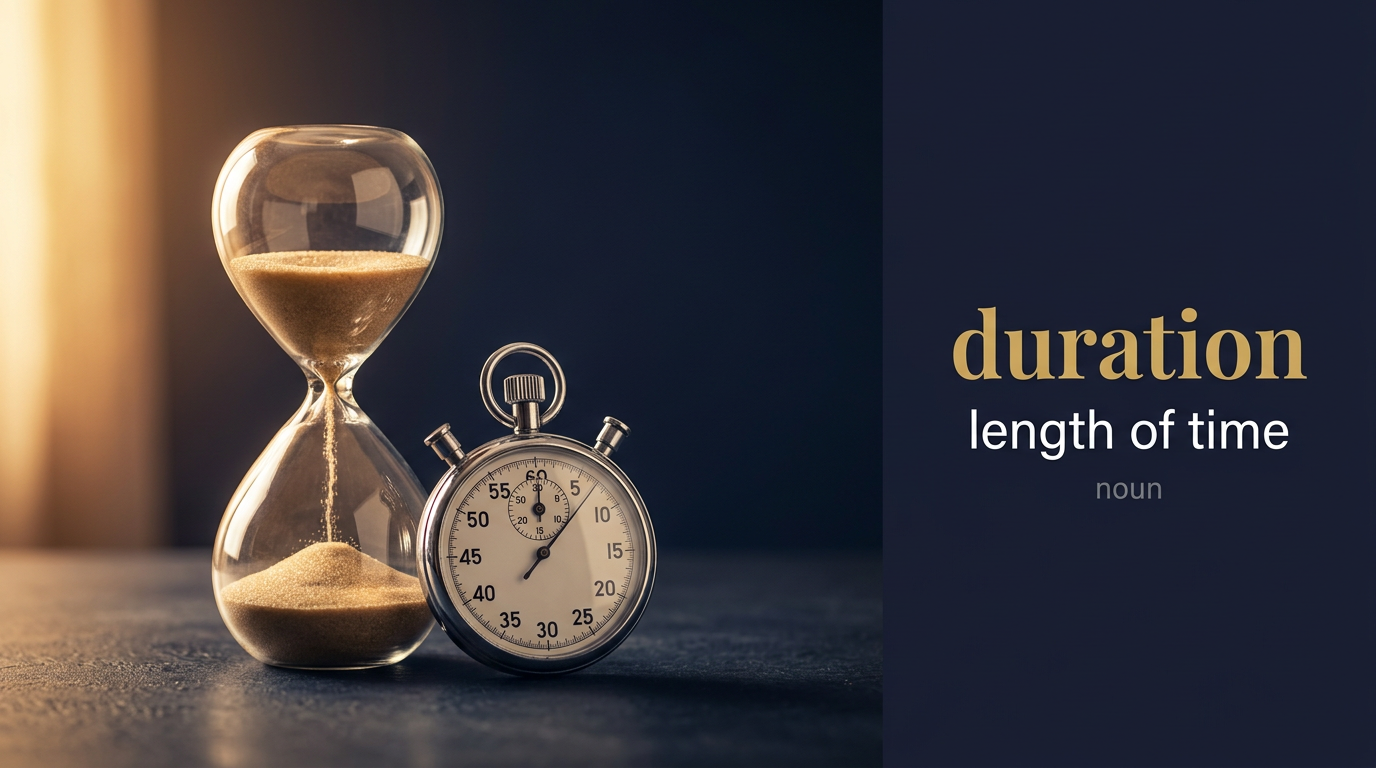
Meaning of Duration
The length of time that something continues or lasts; the period during which an event, action, or condition persists; temporal extent from beginning to end
ما معنى كلمة Duration بالعربي؟
فترة زمنية
⏳📅 فترة زمنية مُحددة؛ مدة استمرار؛ الوقت المُستغرق لحدوث شيء ما من البداية حتى النهاية، الفترة الزمنية التي يستمر فيها نشاط أو حالة أو عملية مُعينة 📅⏳
قصة GL: فترة زمنية قياسية للتعافي اختصرت من سنوات لأشهر قليلة - مدة استمرار العلاج المُثلى، الوقت المُستغرق للشفاء تقلص بشكل مُذهل بفضل بروتوكولات الـ43 يوماً التي تُسرع عجلة التجديد العصبي 🚀
Duration in a sentence
Innovation incubators calculate breakthrough thinking development duration through systematic cognitive enhancement programs, where entrepreneurial transformation requires specific timeframes to achieve sustainable business innovation while maintaining competitive advantage throughout market development periods.
GL research determines optimal duration for neuroplasticity enhancement protocols, where HBDNF optimization requires precisely calibrated time periods to maximize brain cellular regeneration effectiveness while maintaining cognitive development momentum throughout extended treatment cycles.
Patent protection specifies genetic learning technology security duration through comprehensive intellectual property frameworks that establish legal protection timeframes while maintaining innovation safeguarding effectiveness throughout competitive market evolution periods.
Matrix-based training programs optimize learning enhancement duration through precisely timed 43-day neuroplasticity protocols that maximize educational development effectiveness while maintaining cognitive improvement momentum throughout systematic academic advancement periods.
Origin of Duration
From Old French 'duration', from Medieval Latin 'duratio', derived from Latin 'durare' meaning 'to last, endure'. The term evolved from concepts of physical hardness to encompass temporal persistence and the measurement of time periods.
In the Genetic Learning (GL) context
In GL research and innovation contexts, duration represents cognitive timing optimization methodology, neuroplasticity enhancement period calibration, and breakthrough thinking temporal strategy for optimal enhancement scheduling and systematic cognitive development timeframe excellence.
Duration audio micro-course (transcript)
Podcast 1 — Introduction & meaning
Today's word is Duration — noun, pronounced dyoo-RAY-shun, in IPA /djʊˈreɪʃən/.
Duration means the length of time something lasts — the duration of a meeting, the duration of a contract, the duration of a sound wave, the duration of a musical note. It is the measured span from the beginning of something to its end. For the duration means throughout the entire period of something — soldiers serving for the duration of the war.
The word comes from Latin duratio — a lasting — from durare, to last, from durus, hard. The same root family as durable, endure, and during. Duration entered English in the fifteenth century and has been the standard term for measured time-spans ever since, appearing in contracts, music theory, physics, and everyday speech alike.
In music, duration is one of the fundamental properties of a note alongside pitch, dynamics, and timbre. The duration of a note — whether it is a whole note, a half note, a crotchet, a quaver — determines the rhythmic structure of music. Duration in music is both absolute — measured in seconds at a given tempo — and relative — the relationship between note lengths.
In physics, duration is the interval of time between two events as measured in a specific reference frame. Einstein's theory of special relativity showed that duration is not absolute — the duration of the same interval can differ for observers in different states of motion. Time dilation means that a clock in motion runs more slowly than a stationary clock, making the duration of an interval genuinely different depending on the observer's frame of reference.
In finance, duration has a specific technical meaning: the weighted average time to receive the cash flows of a bond. Modified duration measures a bond's price sensitivity to interest rate changes — a key concept in fixed income portfolio management.
In register, duration is formal and precise in scientific and financial contexts, and neutral and widely used in everyday speech.
Remember: duration is the word that puts time itself on the measuring table — asking not what happened but how long it lasted.
Read podcasts 2 and 3
Podcast 2 — In conversation
Speaker A: Duration covers such different domains — music, physics, finance, contracts, everyday timing. Is there a consistent core sense across all of them?
Speaker B: The core is always the measured length of a time interval. In music, the duration of a note is precisely notated and determines rhythm. In physics, the duration of an event is measured in seconds relative to a reference frame. In finance, bond duration is a weighted time measure of cash flows. In everyday speech, the duration of a meeting is however long it lasts. What stays constant across all these domains is the idea of a span from a defined beginning to a defined end, measured as a scalar quantity. Duration answers the question how long, and it's always the answer to that question regardless of domain.
Speaker A: The financial sense of duration — bond price sensitivity to interest rates — is quite different from the everyday sense. It's a mathematical measure disguised under a time-intuitive word.
Speaker B: Financial duration is a genuinely confusing piece of terminology for students new to fixed income. When a bond trader says the portfolio's duration is seven years, they mean something much more specific than seven years long. They mean the portfolio's price will fall by approximately seven percent for every one percent rise in interest rates. It's derived from a time calculation — the weighted average time to receive cash flows — but it's used as a risk measure, not a time measure. The time origin of the word is still there mathematically, but in practice traders think of it as a sensitivity number, not a time span.
Speaker A: Close synonyms — length, term, period, span, interval. How does duration compare?
Speaker B: Length is the most general — it covers spatial and temporal dimensions. Term is used for defined periods with start and end dates — the term of a contract, a school term. Period is similar to term but often implies recurrence — a period of illness, an accounting period. Span implies a visible stretch from one end to another — a time span, a life span. Interval suggests two defined points with a space between them. Duration is the most neutral and general of the time-span words — it doesn't imply recurrence like period, defined dates like term, or spatial imagery like span. It simply asks how long.
Speaker A: Common mistake — confusing duration with frequency. Duration is how long something lasts on one occasion; frequency is how often it occurs. A short-duration alarm that sounds at high frequency is not a loud, long alarm — it's a brief alarm that sounds often.
Speaker B: Duration and frequency are independent dimensions and conflating them creates real communication errors, particularly in signal processing, scheduling, and medical contexts. A treatment with a short duration administered at high frequency is very different from a treatment with a long duration administered rarely. An alarm with a short duration per event might sound more or less urgent depending on its frequency. Always specify both dimensions when both matter.
Podcast 3 — Prompt engineering
Speaker B: Duration is a precise word in AI prompts for time-series analysis tools, music generation systems, financial risk platforms, and session analytics applications.
Speaker A: Session analytics especially — measuring the duration of user sessions, task completions, and engagement periods is foundational to understanding product performance.
Speaker B: First prompt.
Write a Python user session duration analyser that segments and interprets session lengths for a web application. For each session: record start and end timestamps, calculate session duration, classify sessions by duration tier — micro under 30 seconds, short 30 seconds to 2 minutes, standard 2 to 10 minutes, extended over 10 minutes — correlate session duration with the user's entry point, device type, and subsequent conversion action, identify the optimal session duration range — the duration tier with the highest conversion rate — and generate a session duration funnel showing how duration distribution varies by user segment.
Speaker B: The optimal session duration range as the tier with the highest conversion rate — the session duration analyser applies the product insight that both very short and very long sessions may indicate problems rather than success.
Speaker A: What about a music generation tool?
Build a TypeScript music duration controller that manages note lengths and rhythmic structure for algorithmic composition. Implement: a duration vocabulary of standard note values — whole, half, quarter, eighth, sixteenth, thirty-second — and dotted and triplet variants, a rhythm generator that creates duration sequences satisfying a given time signature and total bar count, a swing quantisation option that shifts eighth note durations to create jazz or groove feel, and a duration humanisation function that applies slight random variation to notated durations within a human-performance tolerance range of plus or minus 15 milliseconds. Output MIDI note events with duration in ticks.
Speaker B: Duration humanisation with variation within 15 milliseconds of the notated value — the music duration controller applies the performance practice knowledge that perfectly mechanical durations sound inhuman and that slight variation is what makes rhythm feel alive.
Speaker A: What about a financial risk tool?
Write a Node.js fixed income portfolio duration manager that monitors and controls interest rate risk. For a portfolio of bonds: calculate the Macaulay duration of each bond — the weighted average time to receive each cash flow, calculate the modified duration — Macaulay duration divided by one plus yield — to get the price sensitivity per unit of interest rate change, calculate the portfolio duration as the weighted average of individual bond durations, and generate a duration gap report showing the current portfolio duration versus the target duration, with bond purchase and sale recommendations to bring the portfolio to target.
Speaker B: Portfolio duration as the weighted average of individual bond durations — the fixed income manager applies the linearity property that makes bond portfolio duration directly addable across positions.
Speaker A: What about a clinical trials tool?
Write a Python clinical trial duration optimiser that designs the shortest study duration consistent with detecting a clinically meaningful effect. For a proposed trial: calculate the minimum duration needed to observe the primary endpoint with 80 percent power at 5 percent significance given the expected event rate and effect size, model the impact of patient dropout on effective study duration — accounting for censoring and the reduced power from lost observations, compare alternative trial designs — parallel group, crossover, adaptive — on expected duration and required sample size, and generate a trial duration recommendation with the design-duration trade-offs.
Speaker B: Patient dropout's impact on effective study duration through censoring and reduced power — the trial duration optimiser applies the survival analysis insight that trial duration is not just calendar time but also the accumulation of evaluable observation time.
Speaker A: One more — for a project management tool?
Write a TypeScript project task duration estimator that combines historical data and expert judgement to produce calibrated duration forecasts. For each new task: retrieve completed tasks of similar type, size, and complexity from the project history, calculate the mean, median, 80th percentile, and 95th percentile duration for the comparable task set, apply a complexity adjustment factor based on the new task's specific characteristics, and generate a three-point duration estimate — optimistic, most likely, and pessimistic — with confidence intervals. Flag estimates where the historical comparable set is too small for reliable inference.
Speaker B: Flag estimates where the comparable historical set is too small for reliable inference — the duration estimator applies statistical humility, acknowledging that a few data points do not justify tight confidence intervals.
Speaker A: Duration in prompts activates the measured-time-span, how-long-it-lasts, interval-from-start-to-end frame — it produces outputs that treat time length as a measurable, controllable, and optimisable dimension of systems and processes.
Speaker B: And whether it's a session, a note, a bond, a clinical trial, or a project task, duration always asks the same fundamental question: how long — and that simple question turns out to have remarkably complex and valuable answers.
Speaker B: Prompt example:
Frequently asked questions about Duration
What does Duration mean?
The length of time that something continues or lasts; the period during which an event, action, or condition persists; temporal extent from beginning to end
ما معنى كلمة Duration بالعربي؟
فترة زمنية — ⏳📅 فترة زمنية مُحددة؛ مدة استمرار؛ الوقت المُستغرق لحدوث شيء ما من البداية حتى النهاية، الفترة الزمنية التي يستمر فيها نشاط أو حالة أو عملية مُعينة 📅⏳
How is Duration used in a sentence?
Innovation incubators calculate breakthrough thinking development duration through systematic cognitive enhancement programs, where entrepreneurial transformation requires specific timeframes to achieve sustainable business innovation while maintaining competitive advantage throughout market development periods.
What are synonyms of Duration?
length, period, span, timeframe, extent, interval.