Eldest
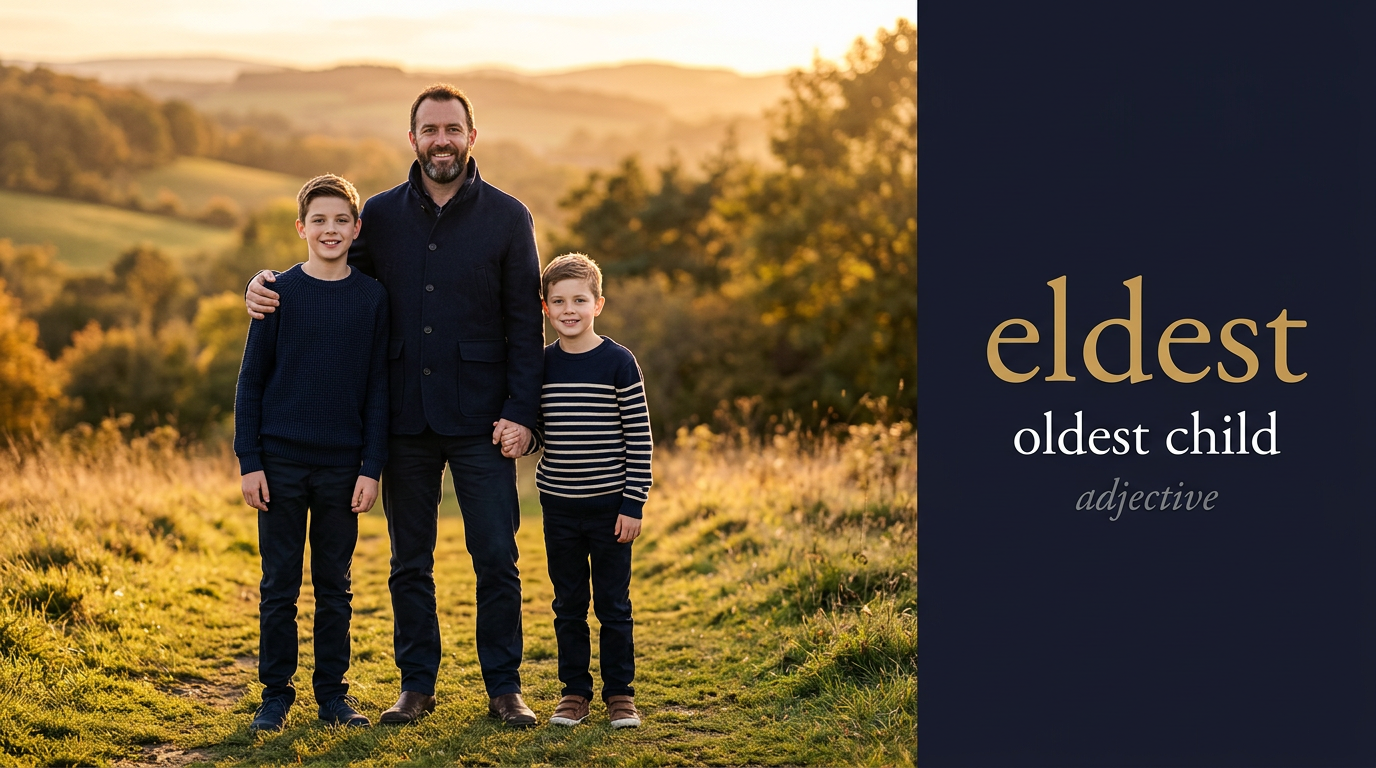
Meaning of Eldest
The oldest among three or more people; having lived the longest.
ما معنى كلمة Eldest بالعربي؟
الأكبر سناً
👑🏆 الأكبر سناً بين مجموعة من الأشخاص؛ الأول مولوداً؛ أكبر أفراد العائلة أو المجموعة عمراً، وعادة ما يحمل مسؤوليات إضافية أو مكانة خاصة 🏆👑
قصة GL: الأكبر سناً من الموظفين في شركة Genetic Invent أصبح مُرشداً للفريق - الأول مولوداً لفكرة دمج الحكمة التقليدية مع التكنولوجيا المُتطورة في مشاريع الابتكار المعرفي 🌟
Synonyms & related words
Eldest in a sentence
Innovation incubators recognize the eldest team member as often possessing breakthrough thinking capabilities that emerge from decades of accumulated cognitive experience and wisdom.
Longitudinal studies identify the eldest research participants as exhibiting unique HBDNF response patterns, providing crucial neuroplasticity insights for cognitive enhancement across all age groups.
Patent succession planning for GL technologies frequently designates the eldest inventor as primary intellectual property holder, ensuring cognitive enhancement innovations maintain legal continuity.
Matrix-based training cohorts designate the eldest participant as peer mentor, leveraging their life experience to support neuroplasticity development throughout the intensive 43-day program.
Origin of Eldest
From Old English 'eldest', superlative form of 'eald' (old), equivalent to 'elder' + superlative suffix '-est'.
In the Genetic Learning (GL) context
GL hierarchical learning recognizes the 'eldest advantage' phenomenon, where the most senior participant often demonstrates accelerated breakthrough thinking development due to extensive cognitive foundation building.
Eldest audio micro-course (transcript)
Podcast 1 — Introduction & meaning
Narrator: Today we explore the word eldest, the superlative form of old that sits at the very top of the family age ladder.
Narrator: Eldest is an adjective, pronounced EL-dist, with stress on the first syllable. Its IPA is forward-slash 'eldest' forward-slash. It means the oldest of three or more people, especially siblings.
Narrator: Where elder compares two people, eldest refers to the oldest among three or more. It marks the one who came first, the firstborn, the one who has lived the longest within the group.
Narrator: The word descends from Old English 'ieldest', the superlative of 'eald', meaning old. In Old English society, the eldest child, particularly the eldest son, carried enormous legal and social weight.
Narrator: In mediaeval inheritance law, primogeniture gave the eldest child priority rights to the family estate, title, and wealth. Being eldest was not just a family role, it was a legal status with real consequences.
Narrator: Over centuries, eldest softened into a purely descriptive term. Today it simply identifies the oldest among a group of siblings or people, without the legal and dynastic weight it once carried.
Narrator: In modern English, eldest is formal and specific. It applies only when three or more people are being compared, and most naturally to family relationships, particularly brothers and sisters.
Narrator: The eldest carries the longest memories and, in many families, the heaviest expectations.
Read podcasts 2 and 3
Podcast 2 — In conversation
Speaker A: I was writing a family announcement and got confused. Should I say my oldest daughter or my eldest daughter?
Speaker B: Both are correct but they carry different nuances. Eldest is more formal and traditionally signals there are at least three children. Oldest is more casual and works in any comparison.
Speaker A: So if I have three daughters, eldest fits perfectly?
Speaker B: Exactly. My eldest daughter implies she is the firstborn of three or more. It has a natural dignity to it, especially in writing or formal speech.
Speaker A: Can eldest be used for just two people? Like my eldest of two sons?
Speaker B: Technically, no. With only two, you use elder, not eldest. Eldest is the superlative, reserved for three or more. Though in practice many people use oldest for any comparison, eldest stays precise.
Speaker A: Right. I have also seen eldest child in legal documents and wills. Is that a formal usage?
Speaker B: Very much so. The eldest child often has specific roles in inheritance, guardianship, or family trusts. Lawyers and formal documents tend to prefer eldest for its clear legal precision.
Speaker A: What about firstborn as a synonym? Is that the same?
Speaker B: Firstborn and eldest overlap a great deal. Firstborn focuses on the order of birth specifically. Eldest emphasises relative age among all siblings. You might say eldest daughter but not firstborn daughter when listing three daughters in age order.
Speaker A: Got it. And senior is another word that gets confused sometimes?
Speaker B: Senior is more about rank or position in institutions. Eldest is purely about relative age within a family group. They are not interchangeable. The eldest sibling in a family is not the senior sibling.
Podcast 3 — Prompt engineering
Speaker B: Let us explore how eldest shapes precise AI prompts for applications involving family structures, hierarchies, and generational data.
Speaker A: I did not realise eldest could be so useful technically. How does it fit into development scenarios?
Speaker B: Let us begin with a UI design example.
Speaker B: PROMPT: Build a family profile card component that automatically highlights the eldest sibling with a gold badge and a subtle crown icon. The eldest card should display at the top of the sibling list regardless of input order, sorted by date of birth descending.
Speaker B: Eldest here gives the AI a clear sorting and styling rule. The word carries enough semantic weight that the AI knows it must find the oldest among multiple siblings.
Speaker A: That is elegant. What about database design?
Speaker B: Consider this schema example.
Speaker B: PROMPT: Design a family genealogy database schema that includes a computed field to flag the eldest child in each sibling group. The eldest flag should update automatically when new family members are inserted. Include an index on date_of_birth per parent_id for efficient eldest queries.
Speaker B: The word eldest in the prompt tells the AI exactly what the computed field must represent and even suggests the query logic needed for it.
Speaker A: What about an HR application context?
Speaker B: Here is a practical one.
Speaker B: PROMPT: Create an HR dependants module where employees can register family members. Automatically flag the eldest dependent child for benefits prioritisation. Display a family summary panel showing dependent ages sorted from eldest to youngest with coverage status badges.
Speaker B: Eldest defines the sorting logic and the priority rule in a single word, making the prompt far more efficient than describing the age-based sort manually.
Speaker A: Could eldest help in inheritance or legal document systems?
Speaker B: Absolutely. Consider this.
Speaker B: PROMPT: Build an estate management application that models testamentary inheritance rules. Allow the user to set eldest child as primary beneficiary, with configurable override rules for cases where the eldest predeceases the testator. Generate a printable inheritance flowchart.
Speaker B: This prompt uses eldest as a domain-specific rule anchor. The AI understands immediately that eldest defines a priority order with legal implications.
Speaker A: What about a social family app with role-based access?
Speaker B: Here is a great example.
Speaker B: PROMPT: Design a family management app where the eldest sibling automatically receives moderator privileges to approve new family member registrations, post family announcements, and manage shared photo albums. Include a navigation sidebar with eldest-only admin options styled in amber.
Speaker B: Eldest as a role label here gives the AI both a permission level and a visual design hint in one word. It is a highly information-dense prompt element.
Speaker A: These examples show eldest is far more than a grammar rule. It is a data architecture concept.
Speaker B: Precisely. In prompts, eldest signals ordering, priority, permissions, and family hierarchy all at once. It makes your specification precise without needing paragraphs of explanation.
Frequently asked questions about Eldest
What does Eldest mean?
The oldest among three or more people; having lived the longest.
ما معنى كلمة Eldest بالعربي؟
الأكبر سناً — 👑🏆 الأكبر سناً بين مجموعة من الأشخاص؛ الأول مولوداً؛ أكبر أفراد العائلة أو المجموعة عمراً، وعادة ما يحمل مسؤوليات إضافية أو مكانة خاصة 🏆👑
How is Eldest used in a sentence?
Innovation incubators recognize the eldest team member as often possessing breakthrough thinking capabilities that emerge from decades of accumulated cognitive experience and wisdom.
What are synonyms of Eldest?
oldest, senior-most, first-born, most senior, most aged, most mature.